
Xiaomi Distributes Another 200 Million Tokens, MiMo Ecosystem Expansion Enters a New Stage
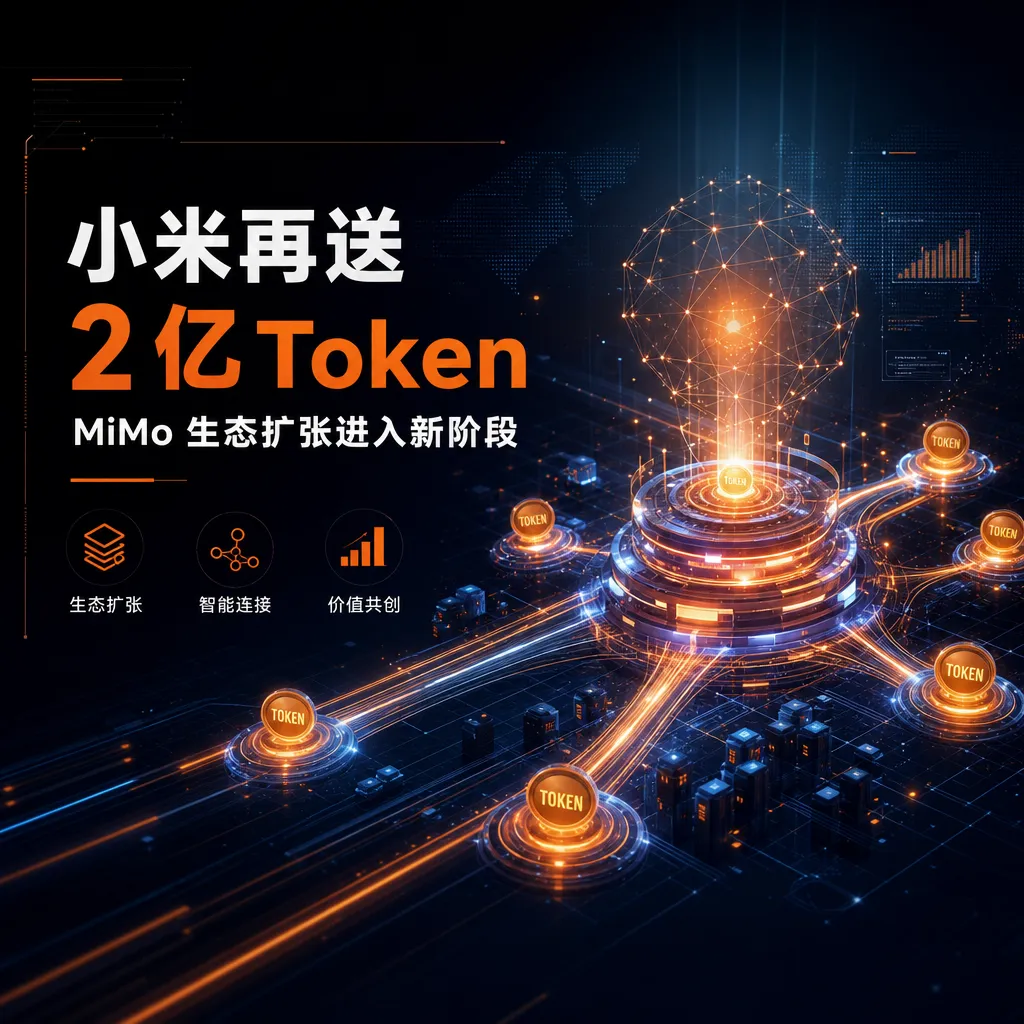
Following the trillion-token plan in April, Xiaomi MiMo has launched another giveaway of 200 million tokens. This time, instead of an application process, the tokens are distributed directly to community users, marking MiMo’s shift from “user acquisition” to “user activation.”
Xiaomi Distributes Another 200 Million Tokens, MiMo Ecosystem Expansion Enters a New Phase
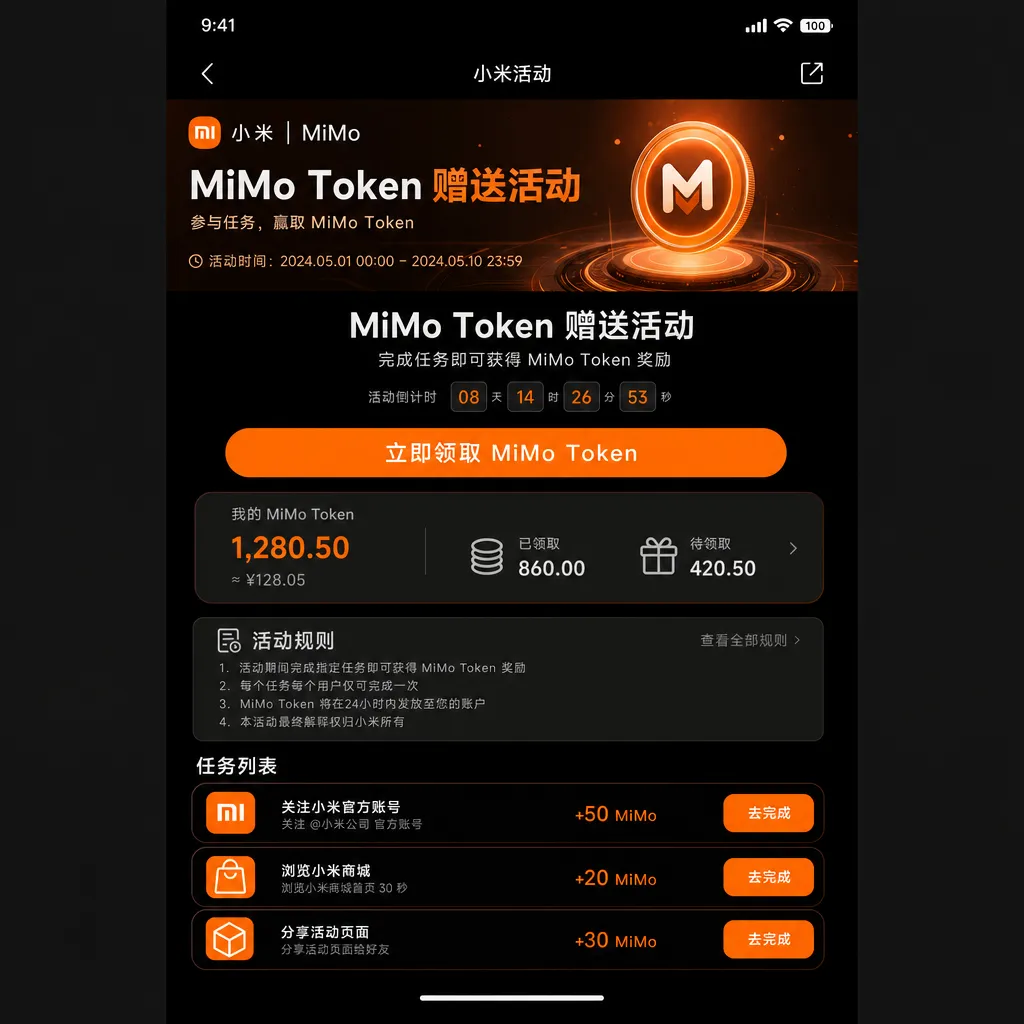
Xiaomi’s MiMo has started distributing tokens again. This time it’s 200 million — not the quadrillion-scale giveaway from April — but the approach is different: no more applications and reviews, now it’s distributed directly to community users.
Judging from posts on the Linux.do forum, this event feels more like a community “follow-the-trend” giveaway. The poster wrote, “Since other folks are handing out tokens, I’ll join in and send out Xiaomi’s 200 million tokens,” providing two claim links: token-plan-sgp.xiaomimimo.com/v1 and /anthropic. This direct distribution method is completely different from April’s application-based one, which required submitting project descriptions and supporting materials.
From a Quadrillion to 200 Million: A Signal of Strategic Shift
On April 28th, Xiaomi launched the “Creator Quadrillion Token Incentive Plan” alongside the open-source release of the MiMo-V2.5 model series. That campaign was massive: distributing token privileges equivalent to 100 quadrillion tokens over 30 days through an application process, evaluated based on AI tool usage, base model selection, project description, and submitted proofs. Approved users could receive a one-month Max Plan subscription worth up to 1.6 billion credits (¥659 in value).
The goal was clear: attract global AI developers and drive real-world adoption of the MiMo ecosystem. Xiaomi needed to prove that MiMo-V2.5-Pro’s “#1 open-source model globally” ranking on GDPVal-AA and ClawEval wasn’t just a benchmarking result, but a model developers would actually use.
The current 200-million-token campaign is two orders of magnitude smaller, but with nearly zero entry barriers. This suggests Xiaomi’s focus has shifted from user acquisition to user activation — after drawing in developers through the quadrillion-token program, the goal now is to get them actively engaged and build usage habits.
The Business Logic Behind the Token Plan
Token Plan is Xiaomi MiMo’s subscription service that integrates MiMo models directly into tools like Claude Code or Cursor. It’s a clever design: not just API quotas, but a product tied deeply into developers’ daily workflows.
Comparing other approaches: OpenAI and Anthropic primarily charge per API call, occasionally giving trial credits; similarly, Tongyi Qianwen and Ernie Bot use volume-based billing. Xiaomi’s Token Plan more closely resembles GitHub Copilot’s subscription model — developers don’t need to worry about each call’s cost, they can use MiMo freely during the active subscription period.
The April pricing update is also notable: Xiaomi removed the 1 Token = 4 Credits rule, and unified Credit rates across 256k and 1M context windows. This means users can leverage long-context capabilities without cost anxiety. Additionally, between 00:00–08:00 Beijing time, all model Credit consumption is discounted by 20% — aligning with working hours in Europe and America, and China’s late-night engineer hours.
Real Progress in the MiMo Ecosystem
From April until now, the MiMo ecosystem’s growth has been rapid.
Chip adaptation: On its open-source launch day, MiMo-V2.5-Pro completed integration with multiple chip vendors including T-Head (Alibaba), AWS, AMD, Baidu Kunlun, Enflame, Moore Threads, and TianShu AI. This wasn’t just “it runs,” but deep optimization — with Day-0 adaptation for both SGLang and vLLM inference frameworks, ensuring developers could deploy immediately at launch.
Agent ecosystem: Xiaomi introduced the “Agent Ecosystem Co-Build Program”, partnering with OpenCode, Hermes Agent, and KiloCode among others. The program offers time-limited free model access for global Agent framework teams. Since MiMo-V2.5-Pro focuses on reasoning, planning, and tool-use — closely tied to Agent and coding applications — this ecosystem plan makes sense.
Performance: Xiaomi claims that MiMo-V2.5-Pro outperforms DeepSeek-V4-Pro and Kimi K2.6 (both strong models, one open-source, one closed-source) on GDPVal-AA and ClawEval benchmarks. That claim should be viewed cautiously — it’s unlikely MiMo-V2.5-Pro leads universally across all dimensions. More plausibly, it has advantages in specific workloads (like Agent planning or code generation) but still lags in general-purpose performance.
The Commercialization Dilemma of Open-Source Models
Xiaomi’s large-scale token distributions are essentially efforts to solve the commercialization challenge of open-source models.
Open-source models offer transparency, controllability, and customization — but come with a big downside: why would users pay for your cloud service if they can run the model locally? Meta (Llama), Mistral, and Alibaba (Qwen) all face this issue — open-sourcing is the easy part, monetizing isn’t.
Xiaomi’s answer: lower usage friction through Token Plan, tie developers to workflows through the Agent ecosystem, and enable broad hardware deployment through chip compatibility. This combination bets on one idea — even if the model is open-source, most developers will still prefer cloud services since self-hosting costs (hardware, maintenance, optimization) are higher than subscription fees.
But that only works if Xiaomi’s cloud service is good enough and competitively priced. The strategy is to hook users with free tokens, let them experience MiMo’s capabilities, then eventually convert them to paying customers. It’s logical, but success depends on two factors:
-
Can MiMo’s models stay competitive?
MiMo-V2.5-Pro is strong now, but the AI field evolves fast. With DeepSeek, Qwen, and GLM advancing quickly, Xiaomi’s edge may not last long. -
Can the ecosystem truly take root?
Agent frameworks, dev tools, chip integrations — all crucial parts of an ecosystem. But ecosystems grow from long-term investment, not short-term subsidies. Xiaomi’s AI budget is impressive (Lei Jun announced ¥16 billion in AI R&D and capital investments by 2026), but spending big doesn’t guarantee an ecosystem.
How Does Xiaomi Compare to Others?
Here’s how Xiaomi’s approach stacks up:
OpenAI: Gives minimal free credits — users quickly need to pay. GPT-4’s strength ensures willingness to pay.
Anthropic: Similar strategy but more generous for researchers and educators. Claude 3.5 Sonnet excels in code generation and reasoning, overlapping MiMo-V2.5-Pro’s positioning.
DeepSeek: Competes on price — API rates an order of magnitude lower than OpenAI, with open-source models. DeepSeek-V3 and V4 already rival GPT-4, posing direct pressure on Xiaomi.
Alibaba (Tongyi Qianwen) and ByteDance (Doubao) also distribute tokens but on smaller scales. Alibaba leverages ecosystems like DingTalk and Taobao, ByteDance uses Douyin and Feishu.
Xiaomi’s strength lies in hardware — smartphones, IoT, and cars — natural grounds for AI integration. But in pure software, Xiaomi’s AI ecosystem is still thin. For MiMo to stand out, it must offer differentiation beyond giveaways.
Should Developers Try It?
From a developer’s perspective — is the 200M Token giveaway worth claiming?
Reasons to claim:
- It’s free — why not?
- MiMo-V2.5-Pro performs well in code generation and Agent tasks — a viable alternative to Cursor or Claude Code
- Token Plan integrates directly into coding tools for a GPT/Claude-like experience
- Xiaomi APIs are OpenAI-compatible, making integration easy
Points to note:
- 200 million tokens sound like a lot, but for teams they may deplete quickly
- MiMo’s ecosystem is still maturing — stability and reliability need observation
- Post-free-period pricing competitiveness is unknown
- Data privacy and security — Xiaomi claims data isn’t used for training, but read the privacy policy carefully
If you’re an individual developer using Cursor or Claude Code, MiMo is worth a test.
For teams or enterprises, start small — evaluate stability and performance before large-scale adoption.
Xiaomi’s AI Ambitions
Xiaomi is serious about AI investments. Since open-sourcing MiMo-V2-Flash in Dec 2023, releasing MiMo-V2 in March 2024, and MiMo-V2.5 and the Quadrillion Token Plan in April, their pace has been fast.
Lei Jun stated in March: “Our R&D and capital investments in AI this year alone will exceed ¥16 billion.” That’s among the largest domestic AI budgets. Xiaomi’s core AI strategy is “deep integration of AI with the physical world” — embedding AI into phones, IoT, and cars.
MiMo’s positioning is clear: not to compete head-on with GPT or Claude as a general-purpose model, but to specialize in Agent and Coding scenarios through deep optimization. That’s a smart move — the general large-model field is saturated. Still, even this domain (Copilot, Cursor, Replit) has tough competition, so Xiaomi’s breakthrough won’t be easy.
The key question: can Xiaomi turn MiMo into a truly competitive product, not just a usable alternative? That will take time to prove.
Final Thoughts
Xiaomi’s 200M Token giveaway isn’t huge, but it signals a shift — the MiMo ecosystem is moving from user acquisition to user activation. The quadrillion-token plan built the initial user base; now Xiaomi needs them to stay active.
Business-wise, the logic is sound: free tokens lower barriers, Token Plan binds usage, and the Agent ecosystem expands scenarios. But whether it succeeds depends on sustained model quality and genuine ecosystem growth.
Competition is fierce — DeepSeek, Qwen, and GLM evolve fast, with OpenAI and Anthropic adding features nonstop. To secure a foothold, Xiaomi must go beyond handouts — excelling in product experience, ecosystem integration, and real applications.
For developers, claiming free tokens and testing MiMo makes sense — but don’t put all your eggs in one basket. Keeping multiple tools ready is the right move in a rapidly evolving AI era.
References
- Linux.do community discussion – User shares Xiaomi’s 200M Token Giveaway
- Xiaomi MiMo official activity page – Token Plan claim portals (token-plan-sgp.xiaomimimo.com)
- 36Kr Report – Details on Xiaomi’s Quadrillion Token Plan
- Admin5 & Tencent News – Updates on MiMo-V2.5 open source and ecosystem progress


