
Sulphur 2 Open Source Release: Uncensored Video Generation Runs on 8GB VRAM
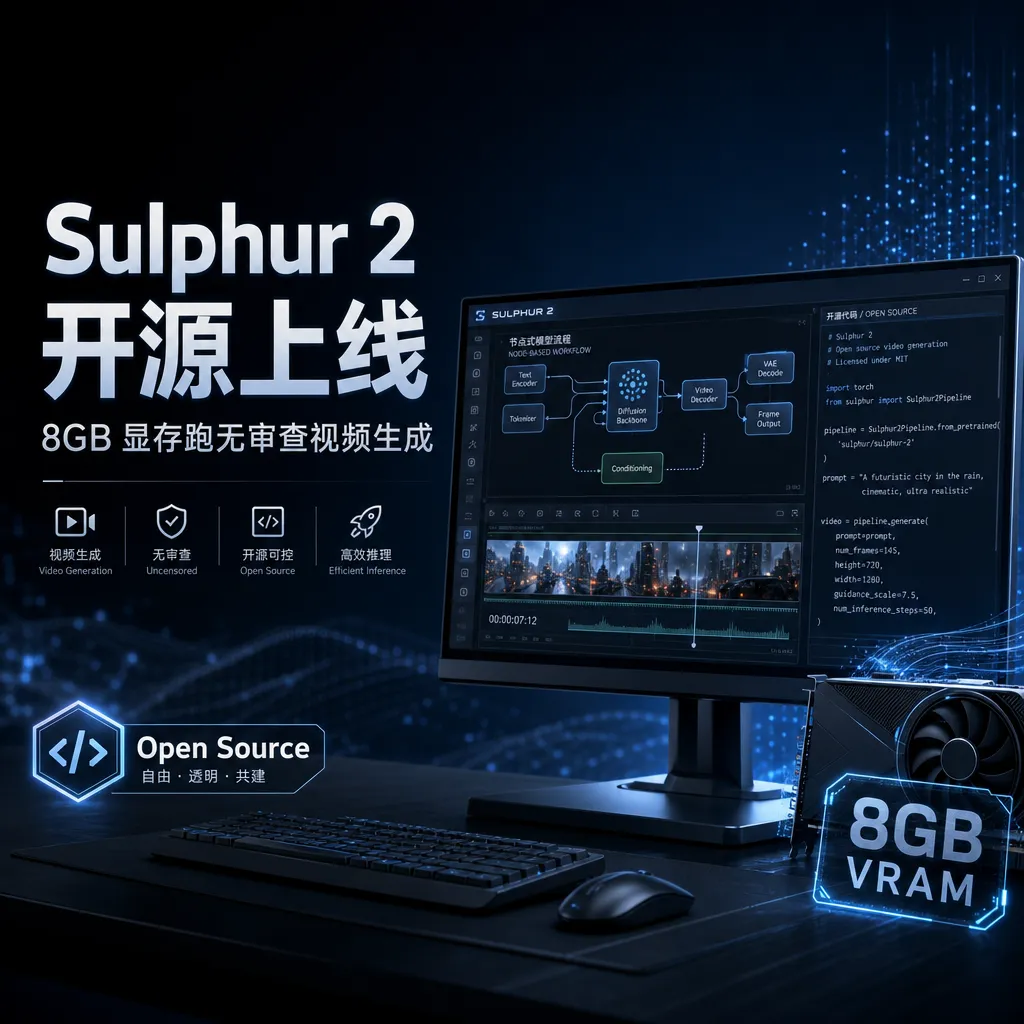
The open-source video generation model **Sulphur 2**, based on deep fine-tuning of **LTX 2.3**, is officially launched. It supports local deployment and can run with just **8GB of VRAM**. This *"uncensored"* model has drawn industry attention for both its technical capabilities and the breadth of its content.
Sulphur 2 Open Source Release: Video Generation Without Censorship on 8GB VRAM
A new controversial product has emerged in the open-source video generation space. In early May, the Sulphur 2 model, a heavily fine-tuned version based on the LTX 2.3 architecture, was officially released on Hugging Face. It highlights two main selling points: “no censorship” and local deployment. Unlike commercial services such as Runway and Pika, this model can run on consumer-grade GPUs, with the official claim that 8GB of VRAM is enough to start experimenting.
This isn’t the first open-source model to claim “no censorship,” but what sets Sulphur 2 apart is that it lowers the entry barrier to a level accessible to ordinary users. You don’t need to rent a cloud GPU or queue for API quotas—just a reasonably configured PC, and you can generate videos locally. This accessibility quickly made it a center of attention.
Technical Architecture: Standing on the Shoulders of LTX 2.3
Sulphur 2 is built upon Lightricks’ open-source LTX 2.3 model. The LTX series is an important player in the video generation field, based on a Diffusion Transformer architecture and supporting both text-to-video and image-to-video modes. LTX 2.3 features a native resolution of 768×512, a frame rate of 24fps, and a maximum duration of 5 seconds.
The Sulphur team made two major modifications on this foundation: first, deeply fine-tuning the content moderation mechanisms to significantly relax generation restrictions; and second, optimizing inference performance to run on lower-spec hardware. Technically, this is a classic “standing on the shoulders of giants” approach—using a mature open-source foundation while focusing on targeted optimization.
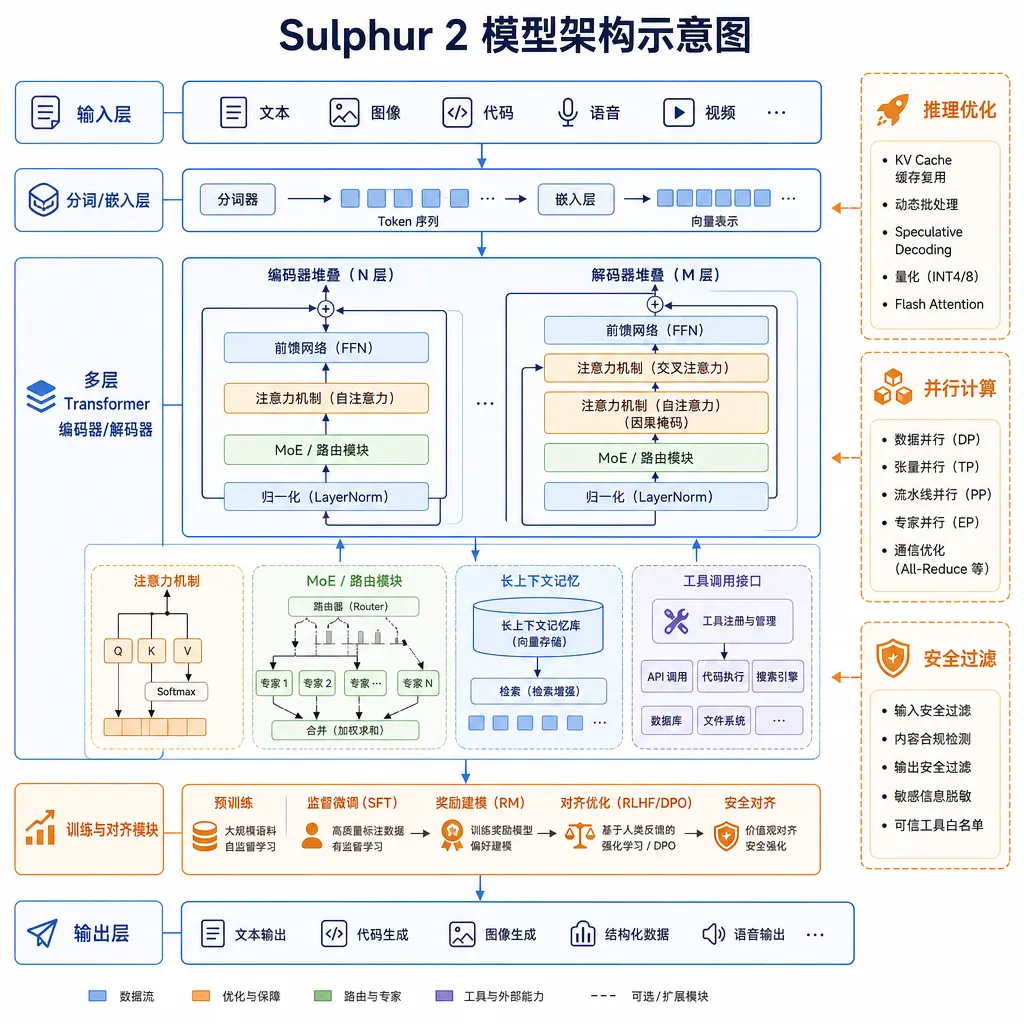
The community has also provided a GGUF quantized version (vantagewithai/LTX2.3-10Eros-GGUF), which further reduces VRAM usage. Quantization compresses the model size by lowering parameter precision, at the cost of some generation quality. But for users who just want a quick local experience, this is a reasonable trade-off.
Deployment Requirements: ComfyUI + 8GB VRAM
The officially recommended deployment setup is ComfyUI—a node-based AI workflow tool that’s already well established in the Stable Diffusion community. The steps are:
- Install the ComfyUI environment: Requires Python 3.10+ and an NVIDIA GPU with CUDA support
- Download model files: Get Sulphur 2’s weight files (about 15GB) from Hugging Face
- Load the workflow: In ComfyUI’s template library, choose “LTX-2.3: Image-to-Video,” and replace the default model with Sulphur 2
- Adjust parameters: Tune resolution, frame count, and batch size based on available VRAM
Benchmark data suggests that an 8GB GPU (such as RTX 3060) can generate videos at 512×512 resolution and around 3 seconds long, taking about 5–8 minutes per sample. With more VRAM (12GB+), you can increase resolution to 768×512 and render up to 5 seconds.
This hardware demand is notably friendly compared to other open-source video models. For example, CogVideoX officially recommends 24GB VRAM, and Wan2.2 requires at least 16GB. Sulphur 2’s optimizations make it accessible to a much broader audience.
Where Does “No Censorship” End?
The biggest controversy around Sulphur 2 lies in its “no censorship” claim. The official stance is to filter only “illegal content,” but that’s a vague statement—what exactly counts as illegal? Legal standards differ widely between countries and regions.
In practice, Sulphur 2 can indeed produce content that most commercial services would reject. The web is already flooded with demo videos, many of which require pixelation before being shared publicly. This level of freedom has sparked polarized debates within the technical community:
Supporters’ Viewpoint: The value of open-source models lies in their independence from corporate content policies. Creators should have the freedom to choose, rather than being bound by “paternalistic censorship.” Besides, much of the content rejected by commercial services isn’t illegal—it just doesn’t align with corporate branding.
Opponents’ Concern: Technological neutrality ≠ moral neutrality. A nearly unrestricted video generator can easily be abused to create misinformation, illegal materials, or rights-infringing content. The open-source community should take responsibility for social impacts, not just defer to “user discretion.”
There’s no simple resolution to this debate. But one thing is clear: Sulphur 2’s emergence makes the question of “who should handle content moderation” more pressing. When generation tools can run locally, traditional platform-level review mechanisms no longer apply.
Technical Capabilities: More Than “Adult Content”
Labeling Sulphur 2 merely as an “adult model” is inaccurate. From a technical standpoint, it has achieved meaningful progress in several aspects:
1. Motion Coherence
Early open-source video models (like ModelScope and Zeroscope) often suffered from jerky or incoherent motion. Sulphur 2 inherits LTX 2.3’s temporal modeling strength, resulting in smoother motion and camera dynamics. It still trails models like Sora and Veo but surpasses most open-source peers.
2. Facial Expression Detail
Facial expressions are a long-standing challenge in video generation. Sulphur 2 performs notably well, generating relatively natural micro-expression changes. This is crucial for emotionally expressive content like short films or ads.
3. Image-to-Video Consistency
Maintaining consistent characters and environments when animating static images is tough. Sulphur 2’s image-to-video mode performs decently here—it preserves core features of the input image while adding natural motion.
Of course, it has clear limitations. A maximum duration of 5 seconds is too short for narrative content. The resolution cap of 768×512 is modest by current standards. Moreover, generation stability needs improvement—the same prompt can yield highly variable results.
The Current State of Open-Source Video Generation
In the broader context, Sulphur 2 represents a key trend in open-source video models: the shift from “usable” to “practical.”
In 2023, open-source models were still in the “proof of concept” phase. Early ones like ModelScope and Zeroscope produced barely watchable videos, far from practical use. By 2024, models like CogVideoX and Wan2.2 raised the quality bar, but also increased hardware demands.
Sulphur 2’s value lies in balancing quality and accessibility. It keeps performance high enough while significantly lowering hardware requirements—a “cost-efficiency optimization” that may be more meaningful than chasing top-tier results.
In parallel, commercial services are advancing fast. Runway Gen-3, Pika 1.5, and Luma Dream Machine all deliver superior video quality compared to open-source models. But their downsides are high cost, strict moderation, and lack of transparency. For large-scale or sensitive-generation needs, open-source solutions still hold unique advantages.
Thoughts Beyond the Debate
The “no censorship” label easily triggers emotional discussions, but the deeper issue is technological democratization.
Video generation capabilities are spreading from tech giants to the wider public. This inevitably introduces risks of misuse but also opens new creative opportunities. Independent creators, small studios, and research institutions can now access tools once exclusive to big companies.
Sulphur 2’s existence poses a fundamental question: Should more people have the power to generate video content—even if it carries inherent risks? Opinions vary, but the question itself deserves serious thought.
From a technological perspective, open-source models are evolving rapidly. What Sulphur 2 achieves today required top-tier hardware just six months ago. In another half-year, maybe 4GB of VRAM will suffice. This trend will likely continue until video generation becomes as common as image generation.
At that point, the real question won’t be “whether to open source,” but “how to balance openness and safety.” Sulphur 2 is just one milestone in this process—but the questions it raises will accompany the field for a long time.
Practical Recommendations
If you want to try Sulphur 2, here are some important tips:
- Hardware Requirements: Minimum 8GB VRAM NVIDIA GPU, 16GB system memory, 50GB+ disk space
- Expectation Management: This isn’t Sora—quality and stability are limited. Treat it as an experimental tool, not a production system
- Legal Awareness: Even if the model itself is “uncensored,” your generated content must comply with local laws. Technical feasibility ≠ legal permissibility
- Community Support: ComfyUI has an active Chinese-speaking community; for issues, seek help on GitHub or related forums
For developers, both the code and weights of Sulphur 2 are open source, allowing for further fine-tuning and optimization. If you’re interested in video generation technology, this is an excellent starting point.
References
- Hugging Face - SulphurAI/Sulphur-2-base - Official Sulphur 2 model repository
- Hugging Face - vantagewithai/LTX2.3-10Eros-GGUF - GGUF quantized version
- Linux.do Community Discussion - User tests and deployment experiences


