
OpenAI invests $4 billion in enterprise deployment, aiming to compete with Palantir.

OpenAI has established a new company, **OpenAI Deployment Company**, with an initial investment exceeding **$4 billion**, acquiring **Tomoro** and gaining **150 engineers** to embed on-site deployment engineers within enterprises to facilitate the implementation of AI. This approach follows **Palantir’s** playbook and serves as a direct response to **Anthropic’s** push into the enterprise market.
OpenAI Invests $4 Billion in Enterprise Deployment, Ready to Compete with Palantir
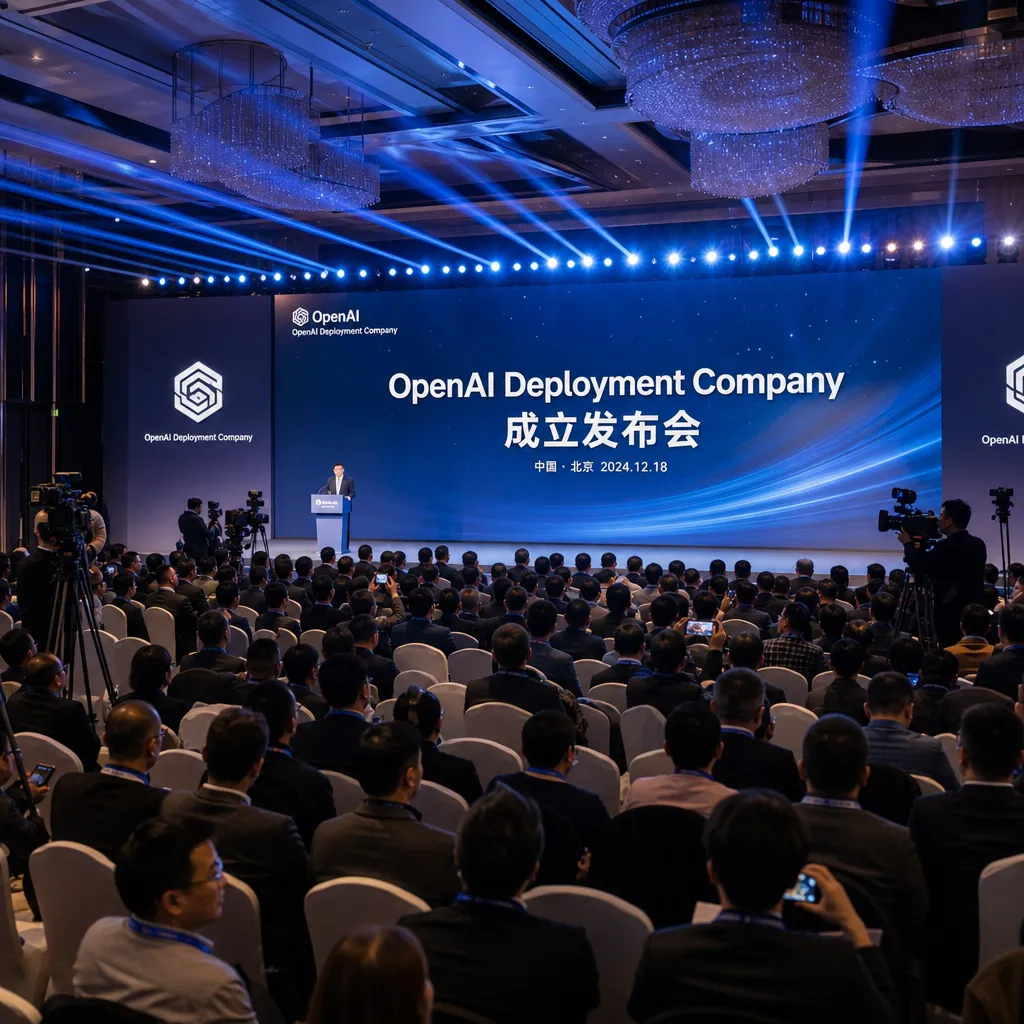
OpenAI has just announced the establishment of a new company with an initial investment exceeding $4 billion, dedicated to helping enterprises deploy AI systems. The new company, called OpenAI Deployment Company, will not merely sell model APIs—it plans to send engineers directly to client companies to provide hands-on guidance on how to use AI.
This approach isn’t new—Palantir adopted the same model over a decade ago. By embedding engineers within the Pentagon and intelligence agencies, Palantir carved out a niche in the enterprise software market. Now OpenAI is replicating that model—and moving fast: it has acquired AI consulting firm Tomoro, gaining 150 engineers and “implementation specialists” in one move.
Why Suddenly Focus on Enterprise Deployment?
On the surface, it’s because Anthropic is catching up quickly in the enterprise market. The Claude series has expanded rapidly among corporate clients this year. Although OpenAI’s ChatGPT Enterprise launched earlier, its actual deployment capabilities aren’t much ahead. Critically, the pain point for enterprise clients isn’t “is the model strong enough” but “how do we actually use AI effectively.”
OpenAI Chief Revenue Officer Denise Dresser put it plainly in an internal memo in April: “The biggest bottleneck for enterprises adopting AI isn’t the technology itself—it’s deployment.” Translated, that means selling APIs isn’t enough—you need people to help clients write code, redesign workflows, and train employees.
That assessment is spot-on. Most enterprises’ IT teams lack AI engineering skills and don’t know where to start. Give them a GPT-4 API key and they might not even grasp prompt engineering, let alone integrating models into existing systems, handling data privacy compliance, or optimizing inference costs.
The Palantir Model: Selling Engineers as a Product
What OpenAI is learning this time is precisely Palantir’s playbook. Palantir’s core products—Foundry and Gotham—are essentially data analytics platforms. But its true moat isn’t the software itself—it’s the Forward Deployed Engineers (FDEs).
These engineers don’t sit at headquarters writing code; they’re embedded onsite with clients, working closely with business teams. They understand specific client needs, build customized features, train client staff, and even participate in strategic decision-making. This approach allowed Palantir to win over customers like the Pentagon, CIA, and FDA—organizations demanding extremely high standards and generally reluctant to adopt new software.
OpenAI Deployment Company intends to do exactly the same. According to official statements, these engineers will “collaborate closely with enterprise teams to identify application areas where AI can deliver maximum value.” In practical terms: we won’t just give you a model—we’ll send people to your company, help you find where AI makes sense, and build the system for you.
The advantage of this model is extremely strong customer stickiness. Once engineers are deployed and systems go live, a client’s workflows become deeply tied to your tech stack. Switching providers becomes prohibitively costly. Palantir leveraged this dynamic to turn individual client contracts into multimillion—and even hundred-million—dollar deals.
Acquiring Tomoro: A Fast Track to Deployment Expertise
The acquisition of Tomoro is the missing puzzle piece. Founded in collaboration with OpenAI in 2023, Tomoro specializes in enterprise AI consulting and deployment. Its clients include major corporations such as Mattel, Red Bull, Tesco, and Virgin Atlantic.
While 150 engineers may not sound like much, these are experienced professionals. They understand how to work with IT departments, handle legacy system integration, and design AI solutions that meet industry-specific compliance requirements. These skills can’t be built overnight by hiring a few fresh grads—acquisition is the fastest way.
Tomoro’s client roster adds value too: Mattel is a toy giant, Red Bull a consumer goods brand, Tesco a retail chain, and Virgin Atlantic an airline—industries with vastly different AI use cases. The fact that Tomoro has served all of them suggests strong methodological versatility. By inheriting these case studies, OpenAI can quickly establish benchmark clients across verticals.
Capital Structure: OpenAI Holds Control, Private Equity Foots the Bill
OpenAI Deployment Company’s ownership structure is also intriguing. OpenAI holds a majority stake and controls operations, but the funding mainly comes from 19 institutional investors, led by TPG, alongside Bain Capital, Advent International, Brookfield, and other private equity firms.
Why are these private funds willing to invest? Because their portfolios include many companies that need AI transformation but don’t know how to proceed. OpenAI Deployment Company can directly serve these enterprises, allowing private equity firms to both improve operational efficiency across their portfolios and profit from deployment services—while benefiting from OpenAI ecosystem growth.
More importantly, OpenAI has promised investors a 17.5% annual guaranteed return with a five-year lock-up period. That’s highly attractive in today’s rate environment—and it’s guaranteed, meaning actual returns could be even higher. This structure ensures that even if deployment growth falls short of expectations, investors won’t lose money—the risk lies largely with OpenAI.
It’s a clever design. OpenAI exchanges capital for channels: private equity firms bring clients and industry relationships, OpenAI provides technology and deployment capability. Interests are aligned. And because it’s a joint venture, OpenAI doesn’t have to put the $4 billion liability on its own balance sheet—easing financial pressure considerably.
Anthropic Is Doing the Same Thing
OpenAI isn’t alone in spotting this opportunity. Anthropic is also in talks with Blackstone, Hellman & Friedman, Goldman Sachs, and others to form a similar consulting venture, seeking to raise $1.5 billion to help enterprises deploy Claude.
Anthropic’s enterprise performance has been strong. After releasing Claude 3.5 Sonnet, many developers noted that it outperforms GPT-4 in code generation, long-text comprehension, and multi-turn conversation tasks. Combined with Anthropic’s focus on safety and interpretability, it’s highly appealing to enterprise clients in heavily regulated sectors like finance, healthcare, and law.
Reuters reported last week that both the OpenAI and Anthropic joint ventures are negotiating acquisitions of multiple AI deployment service providers. This shows competition has expanded beyond models—now both firms are racing to build enterprise service capacity. Whoever can assemble teams faster and deliver flagship projects sooner will gain a decisive lead in the enterprise market.
Can This Model Work?
In theory, yes—but there are risks.
First, scalability. The Palantir model is inherently labor-intensive: each client requires customized service, meaning marginal costs don’t decline like SaaS. OpenAI now has 150 engineers—if each handles 2–3 clients, that’s only 300–450 enterprises. Serving more would require constant hiring, but top-tier AI engineers are scarce.
Second, client expectations. Enterprises paying premium prices for deployment expect immediate ROI. Yet AI project success rates are low—often because of workflow, organizational, or data-quality issues, not technical ones. If the first few pilot projects fail, reputation could quickly suffer.
Third, synergy with OpenAI’s core business. OpenAI is fundamentally a model company—its DNA is research, training, and inference optimization. Pivoting to enterprise services demands entirely different organizational capabilities and culture. Palantir succeeded because it was built for that from day one; whether OpenAI can adapt remains uncertain.
Nevertheless, strategically, this direction makes sense. The AI industry’s bottleneck today isn’t model capability—it’s deployment speed. If OpenAI builds strong deployment capacity, it can establish true enterprise-market defensibility. Models can be replicated; deep client relationships and domain know-how cannot.
What Does This Mean for Developers?
For developers using OpenAI APIs, short-term impact will be minimal. The Deployment Company focuses on large enterprise clients and won’t conflict with the existing API business. But long-term, OpenAI may allocate more resources toward enterprise services, potentially slowing API product updates or lowering their priority.
Pricing is another key point. Palantir’s contracts often run into tens of millions, and OpenAI’s deployment services are unlikely to be cheap. This means small and medium-sized businesses may not afford such full-service deployments and will continue to rely on APIs and self-built solutions. The market will further segment: large enterprises using end-to-end services, smaller firms and indie developers sticking to APIs—leading to diverging product forms and pricing strategies.
For AI startup founders, this is a message: technology alone isn’t enough—you need deployment capability. If your product demands heavy customization or system integration, you may also need to emulate Palantir and OpenAI by building onsite engineering teams. This raises the entry barrier but also increases value for companies capable of real-world implementation.
Final Thoughts
OpenAI’s latest move signals a major trend: the AI industry is shifting from “technology-driven” to “delivery-driven.” Model capability is already strong—the current bottleneck is applying AI effectively. Whoever solves that problem will win the enterprise market.
Palantir took over a decade to perfect this model; whether OpenAI can do it faster remains to be seen. Still, the direction is right, and the resource commitment is significant. The real question is execution—can they recruit enough top engineers, produce flagship case studies, and outperform Anthropic in this new race?
For developers in China or elsewhere using OpenAI models (for example via platforms like OpenAI Hub), it’s worth watching whether OpenAI Deployment Company eventually introduces lighter-weight services for SMEs. After all, with $4 billion invested, they’ll surely want to reach as many clients as possible.
References
- OpenAI invests $4 billion to establish a new company to help enterprises deploy AI — IT Home — Detailed coverage from IT Home on OpenAI’s new company launch


