
E2a Open Source: Equipping the AI Agent with an Email Transceiver

Mnexa AI open-source E2a project provides standardized email gateway capabilities for AI agents. Against the backdrop of the A2A protocol promoting agent interoperability, E2a fills the final gap in interaction between agents and traditional email systems.
E2a Open Source: Equipping AI Agents with Mail Transceivers
AI Agents are moving from the lab into production environments, but one question remains unsolved: how can an Agent send and receive emails like a human?
Mnexa AI’s recently open-sourced project, E2a, is designed exactly for that. It’s not yet another email client, but an email gateway purpose-built for AI Agents — allowing Agents to handle emails through a standardized interface instead of having to implement SMTP/IMAP from scratch each time.
Why Agents Need Email Capabilities
Email is still the backbone of enterprise collaboration. Customer inquiries, order confirmations, meeting invites, approval workflows — a huge amount of business communication still relies on email. If an Agent can’t connect to mail systems, it can’t participate in these real-world business processes.
Existing solutions are either too heavy (integrating a full mail server stack) or too fragmented (each Agent framework implementing its own protocol parser). E2a’s idea is to provide a middle layer: Agents simply call RESTful APIs while the gateway handles the protocol layer, authentication, and attachment parsing underneath.
Its positioning is clear — not a mail server replacement, but an adapter between Agents and email systems. Think of it as what Twilio is for SMS, or SendGrid is for marketing emails: E2a aims to be the email infrastructure for the Agent world.
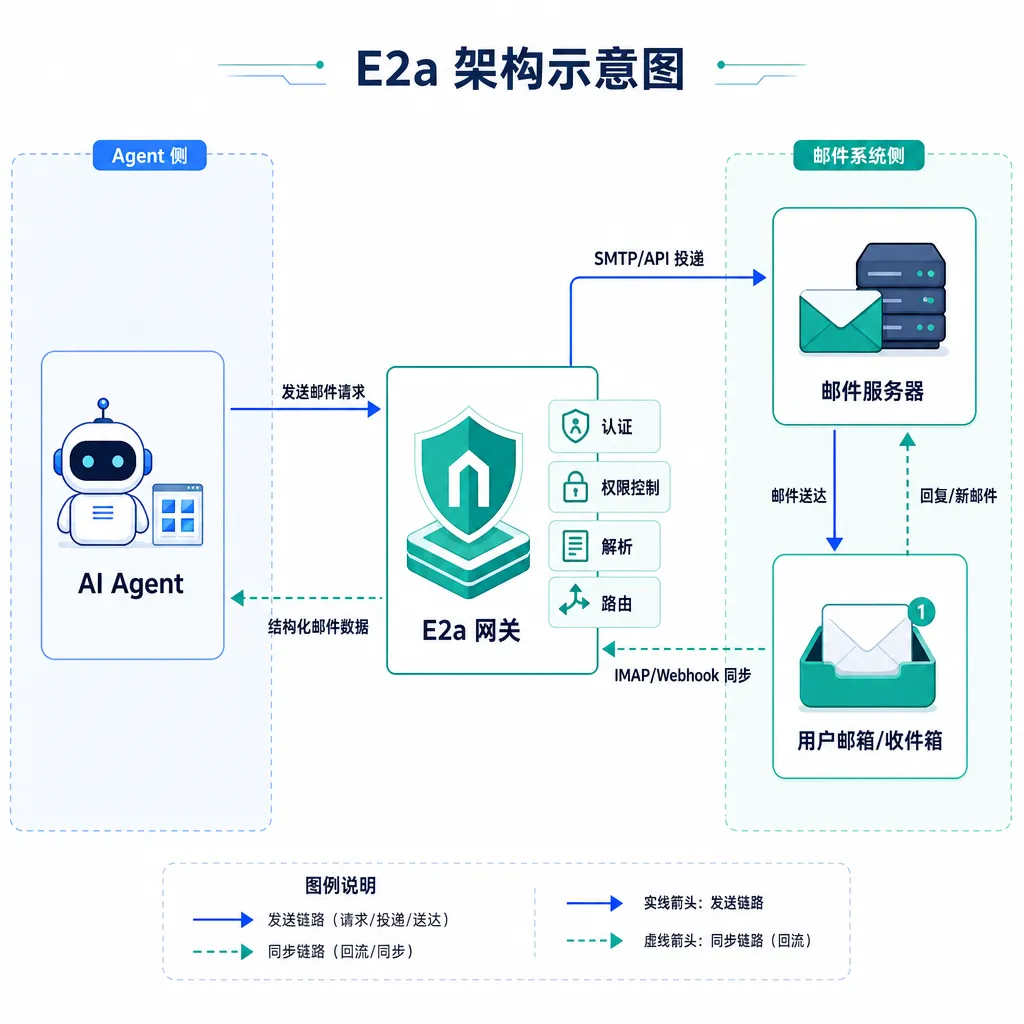
Technical Implementation: Simple but Not Simplistic
The heart of E2a is a lightweight gateway service written in Go, easy to deploy. The architecture is divided into three layers:
Protocol Layer
Handles the low-level details of SMTP (sending) and IMAP (receiving). It supports TLS encryption and OAuth2 authentication (Gmail, Outlook, etc.), compatible with major email providers. It includes robust fault-tolerance features — automatic retries, connection pooling, timeout controls — ensuring Agents don’t crash due to minor network fluctuations.
API Layer
Exposes RESTful endpoints so Agents can send and receive emails via HTTP requests. The API design is straightforward:
POST /send— send an emailGET /inbox— fetch inboxGET /message/:id— read specific messagePOST /reply/:id— reply to a messageDELETE /message/:id— delete a message
All requests and responses are in JSON; Agents don’t have to deal with MIME encoding or mail header parsing. Attachment handling is abstracted — supporting Base64 content or download links, letting Agents decide which to use per scenario.
Event Layer
This is the interesting part. E2a supports Webhook and Server-Sent Events (SSE), proactively pushing new mail notifications to Agents. This is key for real-time response scenarios — e.g., when a customer sends a complaint email, the Agent can act immediately instead of polling every few minutes.
Webhook mode fits stateless Agents that process events and exit. SSE mode fits long-lived connections, like a customer service Agent monitoring multiple mailboxes.
Real-World Use Cases: What Agents Can Do with Email
Customer Service Automation
The most direct use case. An Agent monitors a customer service inbox, identifies common issues (returns, logistics inquiries, account problems), and replies automatically or escalates. Context handling is key — when a customer sends a follow-up email, the Agent can link it to the prior conversation.
E2a’s GET /thread/:id endpoint returns the entire email thread, allowing the Agent to make context-aware decisions. This is far more reliable than simple keyword matching.
Workflow Automation
Many enterprise workflows are email-driven — vendors sending quotes, HR receiving resumes, accounting receiving invoices — all can be automated via Agents.
For example, in procurement: when a vendor sends a quotation email with an Excel attachment, the Agent parses and compares it against historical prices and inventory rules, and if it meets predefined criteria, auto-generates a purchase order and replies with confirmation. No manual steps required, but key checkpoints still CC the manager.
E2a’s attachment processing is particularly useful here — not just transferring files but also extracting metadata (file type, size, MD5 checksum), enabling Agents to decide next steps programmatically.
Multi-Agent Collaboration
A more complex scenario: suppose you have a sales Agent handling client communication, a legal Agent reviewing contracts, and a finance Agent issuing invoices. A customer requests a contract, sales handles and forwards to legal, legal approves and CCs finance to prepare the invoice.
If this coordination used an internal message queue, Agents would be locked into one system. But using email as the medium allows each Agent to be independently deployed and upgraded, as long as they adhere to the agreed email format. E2a acts as the standardized communication layer.
Relationship with the A2A Protocol
In April, Google open-sourced the A2A (Agent-to-Agent) protocol to enable cross-framework Agent discovery and collaboration. E2a and A2A aren’t competitors — they complement each other.
A2A handles direct Agent communication — capability discovery, task delegation, state sync. But many enterprise scenarios require Agents to interact with traditional systems that lack A2A support; email is such a common interface. E2a can act as an adapter within the A2A ecosystem, allowing A2A-compliant Agents to handle email tasks too.
For instance: an A2A-based customer service team could use E2a to connect to corporate mailboxes, offering email-based customer support externally while coordinating task sharing internally through A2A. Each protocol focuses on its own domain.
From an ecosystem perspective, A2A focuses on interoperability among Agents, while E2a focuses on integration with existing enterprise systems. The former represents the future; the latter the present. Since enterprises can’t replace every system overnight, tools like E2a offer a progressive migration path.
Open-Source Strategy and Community Feedback
E2a is released under the MIT license and hosted on GitHub. Mnexa AI, a startup focused on Agent infrastructure, open-sourced E2a to build a standard and attract an ecosystem.
From Hacker News discussions, developers are positive about this direction but raised practical concerns:
Security: Since the gateway needs mailbox credentials, how are they protected? E2a currently supports environment variables and encrypted configs, but lacks enterprise-grade KMS integration — which might be a barrier for large organizations.
Multi-Tenant Isolation: When multiple Agents share an E2a instance, how is data kept separate? Current design uses simple API-key-based auth, but lacks full tenant management — an issue for SaaS use cases.
Performance Bottlenecks: IMAP is inherently inefficient; syncing large mailboxes (tens of thousands of emails) can be slow. E2a uses incremental sync and local caching, but high-concurrency cases (e.g., call centers with tens of thousands of daily emails) still need optimization.
Email Format Compatibility: Real-world emails can be messy — non-standard formats, corrupted attachments, odd encodings. E2a’s parser handles most common cases but edge cases need time to refine.
Community contributors have already submitted PRs improving error handling and logging; others are discussing Microsoft Graph API support (a more modern email interface). The project is young, but the direction looks solid.
Comparison with Existing Solutions
Similar tools exist, but with different focuses:
Nylas, SendGrid: Mature email API platforms — feature-rich, but designed for conventional app development, not Agent scenarios. Their APIs focus on human readability, while Agents need structured data and event-driven design. They’re also commercial, with high self-hosting costs.
LangChain Email Tool: LangChain does provide an email utility, but it’s just a thin SMTP/IMAP wrapper, leaving Agents to handle protocol details. E2a, by contrast, is a ready-to-deploy gateway; Agents simply call the API.
DIY Solutions: Many teams implement email handling using libraries like smtplib and imaplib. The issue: reinventing the wheel for every project, often without production-level reliability. E2a abstracts these common functions, letting developers focus on business logic.
E2a’s strengths are focus and lightness — it doesn’t try to be a full email platform, only the parts Agents actually need. It’s easy to deploy and maintain — one Docker container is enough, ideal for small teams.
Future Roadmap
Based on the GitHub roadmap, Mnexa AI plans to add key features:
Intelligent Routing: Auto-distribute emails based on content — technical issues to support Agents, business inquiries to sales Agents, etc. This would involve NLP classification with built-in pretrained models.
Email Template Management: Agents often use email templates, but they shouldn’t be hardcoded. E2a plans to provide a template engine supporting variable substitution and conditional rendering so non-engineers can maintain templates easily.
Audit & Compliance: In enterprises, outbound Agent emails must be auditable. E2a will add logging, data masking, and approval workflows.
Multi-Protocol Support: Beyond SMTP/IMAP, E2a will integrate modern APIs like Microsoft Graph API and Gmail API for better performance and more features.
If achieved, E2a will evolve from a gateway into a complete Agent email solution — but it’s still early; the core is under active development.
Significance for the Agent Ecosystem
The emergence of projects like E2a signals a shift from “can run” to “can be used” in Agent development.
Earlier Agent projects were mostly demos showcasing what LLMs could do. Now, attention turns to production readiness: integration with existing systems, exception handling, security, and maintainability.
E2a’s choice of email as the entry point is smart. Email is the great common denominator of enterprise IT — nearly every system can interact via email. Once Agents master email integration, they can participate in many real workflows. Also, email protocols are standardized, unlike bespoke APIs in ERP or CRM.
From a higher-level view, Agent infrastructure is becoming layered:
- Bottom layer: LLM inference services (OpenAI, Anthropic, open models)
- Middle layer: Agent frameworks (LangChain, AutoGPT, Semantic Kernel)
- Top layer: Scenario-driven tools (E2a-like gateways, database connectors, API adapters)
E2a belongs to the top layer. It’s framework-agnostic, focusing on standardized email capabilities. Such layering benefits ecosystem health by avoiding duplication of infrastructure across frameworks.
Key Takeaways
If you work on AI Agent projects, E2a is worth watching — especially for:
Enterprise Automation: Departments like customer service, procurement, HR, and finance are still email-heavy; enabling Agents to connect expands automation potential enormously.
Multi-Agent Collaboration: Email’s asynchronous nature makes it ideal for loosely coupled Agent collaboration — more flexible than RPC calls, more universal than message queues.
Gradual AI Adoption: You don’t need to overhaul entire systems; start with email automation and expand progressively.
Of course, E2a is still early-stage, so production adoption requires caution. But its direction is right — and being open source means you can customize it to fit your needs. If email integration is your pain point, it’s worth trying or at least following its evolution.
Under the broader trend of A2A standardization for Agent interoperability, tools like E2a fill the critical gap between Agents and traditional systems. Agents must not only “talk” to other Agents but also participate in real business workflows. A mail gateway may look small — but could be the key step toward making Agents truly practical.
References
- E2a GitHub Repository — Source code and documentation
- Google Open-Sources A2A Protocol — Background on the A2A protocol


