
CodeRelay transfer officially in operation, donates 1% to the Han Hong Foundation on the 12th of each month.

The multi-model protocol unified gateway **CodeRelay**, built on the New API, officially launched on April 18, 2026. It focuses on cross-format protocol conversion and multi-channel account pool scheduling. The site announced that on the 12th of each month, 1% of the platform’s total spending will be donated to the Han Hong Foundation.
Another relay station goes online—but this one does something different on the 12th of every month
On April 18, CodeRelay Relay (coderelay.cn) officially entered operation. It’s not earth-shattering news—China’s AI API relay market has been crowded for the past two years, with DMXAPI, CRS, and various NewAPI forked sites flooding the space. But today (May 12), CodeRelay posted an announcement that got pinned on the linux.do forum: starting immediately, on the 12th of every month, CodeRelay will donate 1% of all users’ total spending to the Han Hong Love Charity Foundation, with the transfer note marked as “CodeRelay Relay” – on behalf of all site users.
May 12 marks the 18th anniversary of the Wenchuan earthquake. Choosing that date to start is clearly not random.
A relay site doing charity sounds like a publicity stunt. But if you look at the competitive landscape of this niche over the past six months, you’ll see that mere price wars have left little room—Opus 4.6 reverse proxy pricing has dropped to RMB 1.5 per million input tokens, and Sonnet 4.6 has channels pushing RMB 0.3. When prices approach cost limits, differentiation must come from elsewhere.
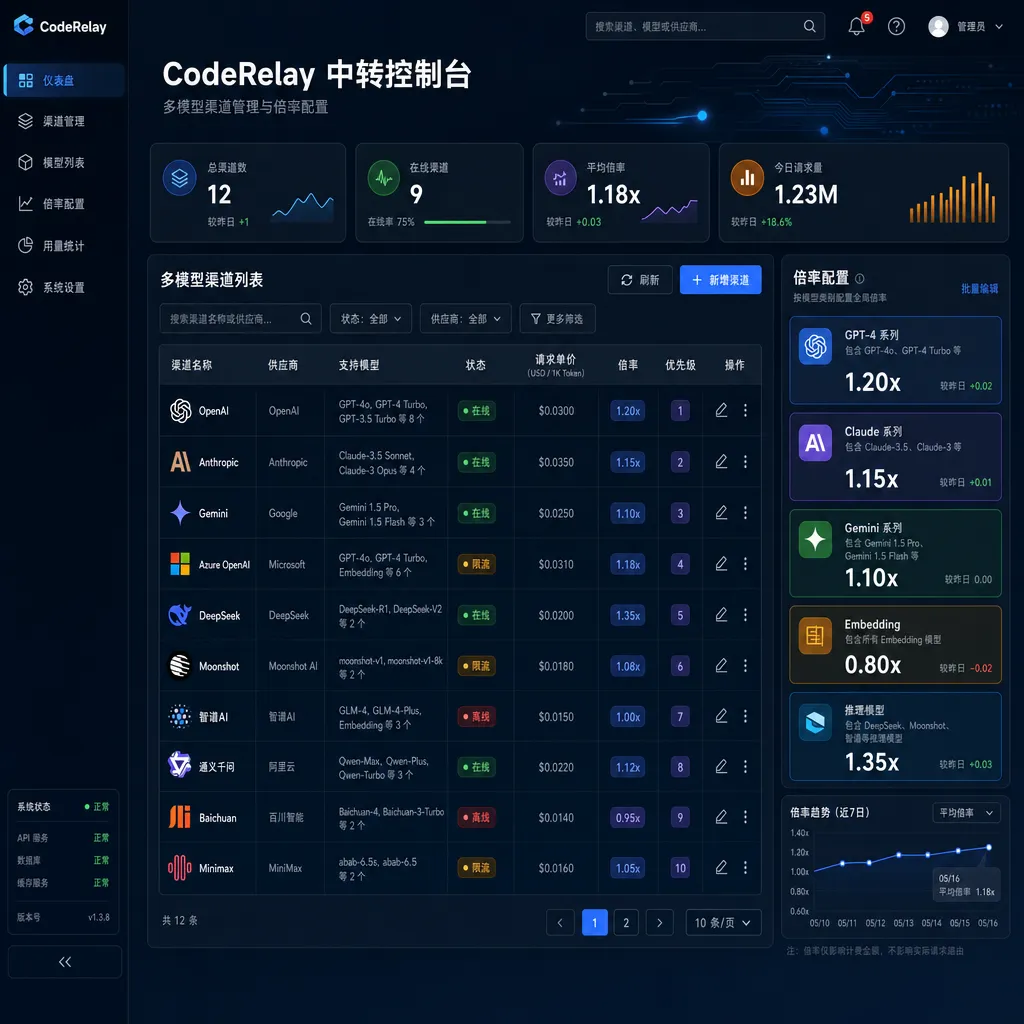
Technical Foundation: New API + Protocol Conversion Layer
Let’s get to the technical part. CodeRelay’s tech stack isn’t mysterious. At its core is the open-source New API gateway project, which has become a de facto standard in China’s relay industry—a lively fork of One API that supports channel grouping, rate-based billing, quota management, and a complete capability set.
Its core value lies in protocol unification. For developers, one of the biggest headaches is having an app that needs to integrate OpenAI’s /v1/chat/completions, Anthropic’s /v1/messages, and Google’s generateContent simultaneously—three request structures, three authentication mechanisms, three streaming response formats. What CodeRelay does is flatten all that at the gateway layer—you can use OpenAI-style requests to call Claude, Claude’s native format to call GPT, or Gemini’s protocol to run DeepSeek. This isn’t simple field mapping; details like tool calling, multimodal input, streaming increments, and thinking blocks all need correct two-way conversion. Anyone who’s tried this knows how much work it involves.
For tools like Claude Code, Codex CLI, and Cursor, which are natively bound to specific vendor protocols, such a gateway is a universal key—the tool thinks it’s talking to Anthropic, but behind the scenes it’s actually connected to any model in a domestic account pool.
Channel Structure: Layered Account Pools with Transparent Pricing
Take a look at CodeRelay’s publicly listed multiplier table—it reveals the typical tactics in today’s relay market:
- ClaudeCode-Max Channel: multiplier 1.5
- ClaudeCode-Anti-Gravity Reverse: multiplier 0.65
- ClaudeCode-Subsidized Channel: multiplier 0.5
- ClaudeCode-Budget Channel: multiplier 0.45
- ClaudeCode-Kiro Reverse: multiplier 0.4
- ClaudeCode-Wd Reverse: multiplier 0.4
- Codex Plus Pool: multiplier 0.15
- Codex Fast Pool: multiplier 0.3
This table basically puts the industry’s unwritten rules out in the open. The “Max Channel” uses Claude Max subscription accounts for API calls—quality closest to official but costliest. “Reverse” channels are those extracted from IDE plugins or wrapper tools—cheap but stability depends on luck. Subsidized and budget channels are usually covered by the site operator’s own funds or enterprise quotas. Codex’s 0.15 multiplier? At current GPT-5 pricing, that’s just a fraction of the official rate—perfect for bulk tasks at dirt-cheap cost.
A word of caution: reverse and pooled account solutions carry compliance and stability risks—account bans, throttling, and poor data quality are common. CodeRelay’s approach is to clearly group channels by quality and let users choose: use Max for production, reverse for experiments. That level of transparency is relatively rare among relay sites.
What Problem Does Protocol Unification Really Solve?
Let’s get specific. A typical multi-model application—say a code assistant—might face these actual needs:
- Use Claude Sonnet 4.6 as the main model for balanced latency and quality
- Upgrade to Opus 4.7 for complex refactoring tasks, but only when necessary to control cost
- Route simple Q&A to GPT-5.4 or DeepSeek-V3.2 to further cut cost
- Automatically fall back to backups when the main model is throttled
If each model connected directly to its official API, this routing logic would need to be built at the business level, involving three SDKs, three exception types, and three billing accounts. Even worse for domestic deployment—OpenAI and Anthropic both block direct access from China, forcing companies to either build overseas proxies or use relays. There’s no third option.
A unified gateway solves all that in one package: one base_url, one api_key, one OpenAI-style request format—just change the model field to target a different model. All billing, logs, and throttling are centralized at the gateway level. For independent developers and small teams, the operational efficiency gained is far more valuable than the few tokens saved.
Where Does Differentiation Go From Here?
Back to the opening question—after extreme price competition, what else can a relay site compete on?
Judging from CodeRelay and other recent entrants, there are several directions:
Enterprise integration capability.
CodeRelay explicitly mentions “intermediate relay for enterprise connection, adjustable rate”—clearly leaning toward the B2B side. Individual users care about price and stability; enterprise clients care about SLA, invoicing, dedicated channels, and negotiable rates—two entirely different businesses. Established players like DMXAPI have also secured their footing through enterprise compliance services.
Billing transparency.
“No hidden deductions” sounds trivial, but stealth markups and diluted channels are rampant in the relay scene. The GitHub repo zzsting88/relayAPI updates weekly with tested prices and quality ratings across major sites—most readers are developers burned by opaque billing. A site that posts its rate table on the homepage is at least serious in attitude.
Community and trust.
That brings us back to the charity pledge. Dedicating 1% of monthly spending to charity might not be huge, but it symbolically ties the operator and users together—you invoke an API, a fraction of that goes to good. This kind of small narrative resonates well with developer communities—often more memorable than any “limited-time discount.”
A Practical Assessment
CodeRelay is still a new site, gaining traction on linux.do, but seasoned forum users know the high mortality rate of this business—shutdowns, quality collapses, and abrupt price hikes are common cautionary tales. The basic principles remain: start with small trial deposits, don’t put all eggs in one basket, and keep fallback options with official or top relay providers for critical workloads.
For developers, having one more gateway that supports OpenAI/Claude/Gemini protocol conversion is never a bad thing, especially as tools like Claude Code and Codex proliferate—they’re hardwired to specific protocols and simply don’t run domestically without an intermediary layer. If you’re already using OpenAI Hub (openai-hub.com) or similar aggregator platforms, CodeRelay is basically an additional option—fully compatible with OpenAI format, near-zero switching cost, and reliable as mutual backup when needed.
As for that 1% on the 12th—how long it lasts, whether donation receipts are public, how the amounts are audited—all that takes time to verify. Mixing business and sentiment can backfire easily, but putting charity into operational rules right from launch at least shows the operator understands what this industry lacks—more than cheap tokens, a bit of dignity worth remembering.
References
- “CodeRelay Relay” wants not only strength but also compassion - linux.do: CodeRelay’s official announcement outlining its April 18 launch and monthly charity donation rule
- “CodeRelay” arrives in force! Claude Code, Codex relay - linux.do: CodeRelay’s debut post with complete channel multiplier table
- zzsting88/relayAPI - GitHub: Repository tracking Chinese AI API relay pricing and performance, regularly updated with real test data
- Wei-Shaw/claude-relay-service - GitHub: Open-source Claude Code relay solution (CRS) supporting multi-subscription unified access


