
TabPFN-3 Released: Training-Free Tabular Model Processes Millions of Rows on a Single GPU

TabPFN-3 released today: a single H100 can process millions of rows of tabular data, with inference speed improved by 10–1000×. The Thinking Mode outperforms all traditional methods by over 200 Elo on the TabArena leaderboard, achieving prediction without any training.
TabPFN-3 Released: Training-Free Tabular Model Handles Millions of Rows on a Single GPU
Today marks a major update in the field of tabular data processing. TabPFN-3 has officially been released — the third-generation product following TabPFN-2.5 (November last year) and TabPFNv2, which appeared in Nature in January. The core promise remains the same: no training, no parameter tuning, no hyperparameter search — just a single forward pass for instant results.
This upgrade focuses on scale and speed. A single H100 GPU can now process 1 million rows of data, a tenfold increase over the previous version. Inference speed has improved between 10× and 1000×, SHAP interpretability analysis is 120× faster thanks to KV caching, and the new Thinking Mode surpasses all non-TabPFN methods by over 200 Elo in TabArena benchmarks — including the AutoGluon 1.5 “extreme” model tuned for 4 hours. On large dataset slices, that gap expands to 420 Elo.
For developers working on tabular modeling, this means you can skip the entire training process — just feed data into the model and get predictions in seconds. This is especially useful for small-sample tasks, where traditional machine learning struggles with overfitting. TabPFN has been pre-trained on 130 million synthetic tabular datasets, enabling it to understand various table structures and distributions.
Technical Architecture: How Transformers Handle Tabular Data
The core idea of TabPFN is to transform tabular prediction into a sequence modeling problem. Instead of training one dedicated model per dataset, TabPFN takes the opposite approach: it pre-trains a general-purpose model on massive synthetic datasets and, during inference, concatenates the training and test samples into a single sequence input, allowing the model to perform in-context learning (ICL) for prediction.
This idea borrows from large language model paradigms. Just as GPT models can perform new tasks via few-shot prompting, TabPFN applies the same mechanism to tables. Specifically, the model input is [training sample 1, training sample 2, ..., test sample], and the output is the test sample’s prediction. The entire process requires no gradient updates—just one forward pass.
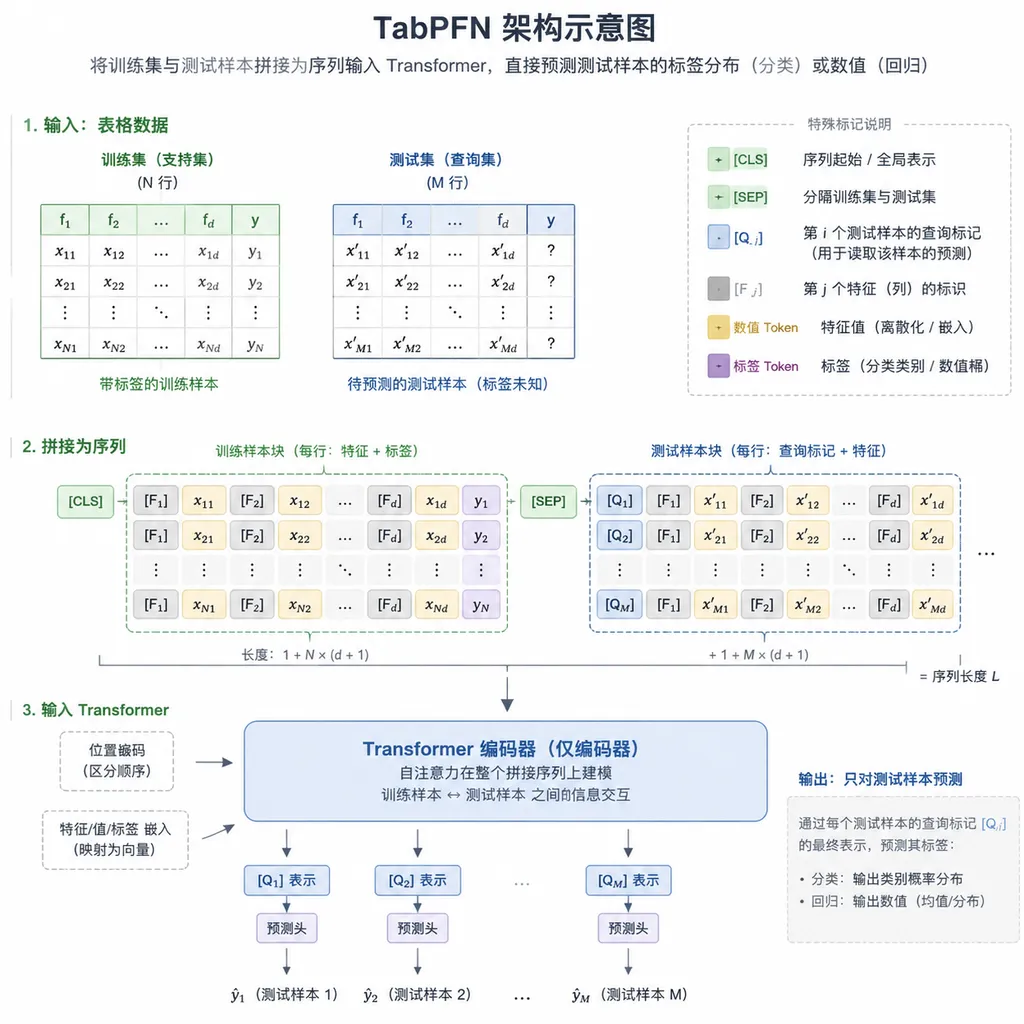
Advantages of this design:
- Zero training cost: No need to train separate models per dataset, eliminating preprocessing, feature engineering, model selection, and hyperparameter tuning
- Strong generalization: Having seen a wide variety of structures and distributions across 130M synthetic tables, TabPFN adapts far better to new datasets
- Fast inference: No training overhead—predictions in seconds
The limitation, however, was scalability. Early versions handled up to 10,000 rows and 500 features. TabPFN-3 raises that limit to 1 million rows, solving a major pain point.
The Three Key Upgrades in TabPFN-3
1. Scale: 1 Million Rows on a Single GPU
TabPFN-2.5 supported up to 100,000 rows; TabPFN-3 jumps to 1 million. This leap wasn’t mere model expansion—it was enabled by two technical optimizations:
KV Cache Optimization: Transformers require storing all key/value pairs for attention, and memory grows quadratically with sequence length. TabPFN-3 compresses the KV cache to about 8GB per million rows per estimator, allowing a single H100 (80GB VRAM) to handle full inference.
Row-Chunk Inference: Large datasets are split into chunks, attention computed separately, then merged. This greatly reduces memory usage while preserving accuracy.
Together, these make TabPFN-3 capable of handling medium-scale production data on one GPU. For reference, AutoGluon needs hours of training on datasets this size, whereas TabPFN-3 delivers results in minutes.
2. Speed: 10–1000× Faster Inference
Several factors drive TabPFN-3's speed gains:
- Base inference: 10× faster than TabPFN-2.5, mainly via KV caching and operator optimization
- SHAP interpretability: 120× faster due to cache reuse across multiple SHAP runs
- Batch prediction: Parallel handling of test samples yields up to 1000× speed improvement
This matters because TabPFN’s paradigm is “inference as training”—inference speed directly affects end-to-end latency. TabPFN-3 achieves second-level response times, enabling real-time predictions.
3. Thinking Mode: Inference-Time Computation Boosts Accuracy
Thinking Mode, the most intriguing new feature (API-only for now), performs extra computation during inference — a one-time “extra fitting” to improve accuracy.
It’s akin to the Chain-of-Thought prompting used in large language models, but applied to tabular data. The model analyzes training data distributions and adjusts its prediction strategy dynamically — no gradient updates, just more computation for higher precision.
Results? In TabArena benchmarks, Thinking Mode’s TabPFN-3 surpasses all non-TabPFN methods by over 200 Elo, including the fully tuned AutoGluon 1.5 extreme. On large dataset slices, that margin widens to 420 Elo.
TabArena includes real-world classification, regression, and time-series datasets from Kaggle, UCI, and others. A 200 Elo lead means TabPFN-3 wins about 75% of matchups—a statistically significant advantage.
Comparison with Traditional Methods: 93% Win Rate — What It Means
TabPFN-3 wins against traditional ML baselines 93% of the time, though the context matters:
Small-sample scenarios (≤1000 rows): TabPFN shines brightest. Traditional models easily overfit small data and require heavy feature engineering and regularization. TabPFN’s pre-training learns universal tabular patterns, enabling strong performance with few samples.
Mid-scale scenarios (1K–100K rows): TabPFN remains competitive, but the gap narrows. This is the comfort zone for classical methods like XGBoost or LightGBM, which can reach high accuracy with tuning. TabPFN’s edge: no tuning, instant use.
Large-scale scenarios (≥100K rows): TabPFN-3 expands to 1M rows, but traditional tuned models may still perform better here because TabPFN’s synthetic pretraining datasets are smaller. Its ultra-large-scale generalization remains under study.
Feature type also matters: TabPFN handles numerical and categorical features well but performs less effectively on high-dimensional sparse features (e.g., text embeddings, image features). Hybrid setups may be necessary for such cases.
When to Use TabPFN
Best-suited use cases for TabPFN-3:
1. Rapid Prototyping
Got new business data and want to test ML feasibility? Traditional workflows take days (cleaning, engineering, model tuning). TabPFN delivers a usable baseline in minutes, helping decide whether to invest further.
2. Small-Sample Prediction
Common in domains like healthcare, finance, or industry — datasets are tiny, labeling costly. Traditional methods struggle; TabPFN’s prior knowledge handles small data gracefully.
3. Multi-Task Modeling
If you manage dozens or hundreds of tabular datasets, training one model per dataset is expensive. TabPFN lets you reuse a single model across tasks, drastically reducing maintenance effort.
4. Real-Time Prediction
When data updates frequently, classical models require retraining; TabPFN simply re-infers, responding far faster.
Not ideal for:
- Ultra-large data (>1M rows): while supported, tuned traditional methods might yield higher accuracy
- Maximum-accuracy tasks (e.g., Kaggle competitions): traditional pipelines with tuning still win
- High-dimensional sparse features: deep learning may handle these better
Open Source Ecosystem & Commercialization
TabPFN’s earlier versions accumulated 3M+ downloads and 200+ application papers, gaining traction in academia and industry. TabPFN-3 continues this open-source tradition—both code and weights are public on GitHub, while Thinking Mode is API-only.
This strategy is smart: open-source core functionality to attract users and developers, but commercialize advanced features to sustain R&D—similar to Hugging Face or Replicate.
Technically, TabPFN represents a new paradigm: pretraining + in-context learning replacing training + inference. Proven in NLP, this paradigm is now expanding to tables, time series, and graphs. TabPFN’s time-series variant, TabPFN-TS, has already achieved promising results on the GIFT-Eval benchmark, with more domain-specific variants likely ahead.
Comparison with Large Language Models
You might ask: if LLMs can handle tables, why TabPFN?
Indeed, models like GPT-4 and Claude can process tabular data via prompts. However, they’re designed for general language understanding, not tabular prediction. The differences:
Accuracy: TabPFN far exceeds LLMs in tabular tasks—the former is pre-trained purely on tables and architecture-tuned for table structure; LLMs are mostly trained on text.
Cost: TabPFN runs locally on a single GPU; LLMs require paid API calls, making large-scale tabular inference expensive.
Explainability: TabPFN supports SHAP and other conventional ML interpretability tools; LLM decision processes remain opaque.
Latency: TabPFN infers in seconds; LLMs have multi-second to multi-ten-second API latency.
LLMs excel at unstructured data, language interaction, and complex reasoning; they complement, not replace, TabPFN.
Outlook
The release of TabPFN-3 signals a new stage in tabular modeling. Future directions worth attention:
Scaling up: Beyond 1M rows—toward 10M or 100M—necessitating more efficient attention and distributed inference.
Multimodal fusion: Tables often come with text, images, or time series; integrating TabPFN with other modalities is an exciting frontier.
Domain adaptation: General models may lag behind specialized ones. Expect domain-tuned TabPFN variants for finance, healthcare, e-commerce, etc.
Automation: TabPFN removes training and tuning, but preprocessing still requires manual effort. Full end-to-end AutoML remains the ultimate goal.
For developers, TabPFN-3 offers a powerful new tool. It won’t replace traditional ML, but in the right scenario, it can dramatically boost efficiency. Definitely worth a try.
References
- TabPFN-3 Reddit Discussion – Official announcement and community feedback
- TabPFN Tabular Foundation Model Explained – Zhihu – Technical principles and algorithm details
- Nature 2025: TabPFN Transformer — The New Weapon for Tabular Prediction – Zhihu – Nature paper overview on TabPFNv2


