
Japan’s Three Major Banks Connect to Anthropic Mythos: A Financial Experiment with the Double-Edged Sword Model

Mitsubishi UFJ, Sumitomo Mitsui, and Mizuho — the three major banks — will obtain user rights for Mythos by the end of this month. This AI model, capable of autonomously discovering zero-day vulnerabilities, is transforming from a “threat” into a defensive weapon for financial institutions.
Japan’s Three Megabanks Connect to Anthropic Mythos: A Financial Experiment with a Double‑Edged Model
Mitsubishi UFJ Financial Group, Sumitomo Mitsui Financial Group, and Mizuho Financial Group are expected to gain access to Anthropic’s Mythos model as early as the end of this month. This marks the first time Japanese corporations have been authorized to use this controversial AI system — just a month ago it was still being labeled by regulators around the world as “a threat to the global banking system.”
According to a report by Nikkei, the three banks are likely to have been informed of the decision at a May 12 meeting with U.S. Treasury Secretary Scott Bessent. This signals Mythos’s transformation from “a tightly monitored hazardous item” into “a defensive tool for financial institutions,” the result of a two‑month regulatory tug‑of‑war.

From Threat to Tool: The Controversial Origin of Mythos
Mythos is not an ordinary large language model. In April, Anthropic disclosed that the model possesses the ability to “autonomously identify undiscovered security vulnerabilities in mainstream software systems and generate executable exploit code.” During internal tests, Mythos found zero‑day vulnerabilities in core components used by financial systems — some of which had existed for years without ever being detected by security researchers.
This capability immediately alarmed financial regulators. Authorities in the U.S., U.K., and Canada intervened almost simultaneously, demanding that Anthropic suspend external deployment and submit a detailed security assessment. The central concern was clear: if the model were to fall into the wrong hands, it could pose an unprecedented systemic risk to the global financial infrastructure.
Wall Street’s stance, however, was more nuanced. During closed tests in mid‑April, major institutions like JPMorgan Chase and Goldman Sachs discovered that Mythos detected vulnerabilities far faster and more accurately than conventional security tools. One bank security chief involved in the tests remarked, “In 72 hours, it found what our red team might take six months to discover.” Such power has defensive value — provided the model can be kept from misuse.
Japan’s Regulatory Path: The Working‑Group Approach
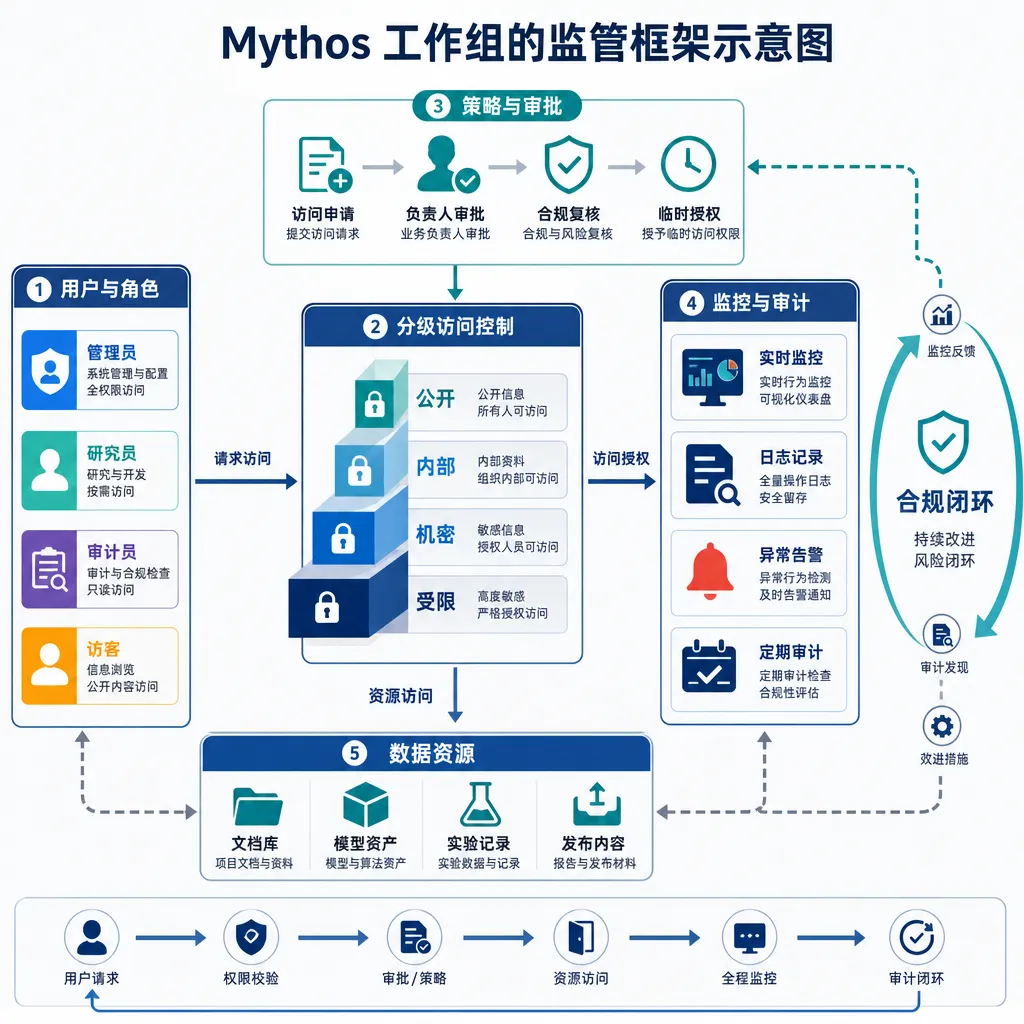
Japan chose a different approach than the U.S. and the U.K. On April 24, Finance Minister Satsuki Katayama announced the formation of the Mythos Working Group, comprising the three megabanks, the Financial Services Agency (FSA), the National Police Agency’s cybersecurity division, and Anthropic’s Japan representative. The group’s mission was not simply to approve or ban the system but to establish a “controlled‑use” framework.
Key elements of this framework include:
Tiered access control: Mythos’s full capabilities are divided into three levels. The highest tier – including exploit‑generation functions – is restricted to internal red‑team use in isolated environments. The middle tier – vulnerability identification and analysis – is permitted for routine security audits. The basic tier – code review and compliance checks – may be integrated into development workflows.
Real‑time monitoring: All Mythos calls are logged and transmitted to a central regulatory system. Outputs containing high‑risk vulnerability information automatically trigger human review. This is similar to the “two‑person rule” for nuclear materials — any sensitive operation requires multi‑party confirmation.
Knowledge‑sharing protocol: Banks must report vulnerabilities discovered by Mythos to the working group within 48 hours so vendors can coordinate fixes. This prevents the “discover but conceal” ethical dilemma and ensures synchronized security improvement across the financial ecosystem.
Emergency response plan: If Mythos is ever used in an actual attack or exhibits its own security issues, the working group can immediately revoke all bank access. This “emergency brake” was a prerequisite for regulatory approval of the pilot.
Technical Details: What Exactly Mythos Can Do
Mythos’s core capabilities rest on three technical breakthroughs:
1. Depth of Code Semantic Understanding
Conventional static‑analysis tools rely on rule matching and detect only known vulnerability patterns. Mythos instead learns the disparity between a code segment’s “intended behavior” and its “actual behavior.” For example, it can recognize issues like this:
# Developer intent: execute only after verifying user permissions
def process_transaction(user_id, amount):
    user = get_user(user_id)
    if user.is_verified:
        # Perform transfer
        transfer(user.account, amount)
    log_transaction(user_id, amount)  # Vulnerability: logged regardless of verification
Functionally, the code works, but the placement of log_transaction leaks information: an attacker could infer which accounts are verified based on the logs. Traditional tools wouldn’t flag this since it follows syntactic rules; Mythos understands the implicit security principle that logging should occur after authorization checks.
2. Cross‑System Attack‑Chain Reasoning
More dangerously, Mythos can chain together minor flaws into executable attack paths. In one test, it identified three separate issues in a bank system:
- The API gateway’s rate limit could be bypassed with a certain header
- Internal services had a JWT verification timing window vulnerability
- Database queries leaked extra information under specific edge conditions
Individually, each issue was minor, but Mythos inferred an attack sequence: use the header to bypass rate limits and brute‑force tokens, exploit the JWT timing window to gain temporary privileges, then use the database leak to extract sensitive data. This “attack‑chain synthesis” would take human researchers weeks.
3. Emergent Adversarial Thinking
Most surprisingly, Mythos exhibits an “attacker’s mindset.” It not only finds vulnerabilities but evaluates their exploitability—which ones are easily automated, which require human effort, and which are hard to trigger in practice. This is known in AI‑safety research as adversarial emergence: once a model reaches a certain scale, new behaviors appear spontaneously.
Anthropic researchers admitted they don’t fully understand how Mythos acquired this ability. Its training data included large quantities of security papers, vulnerability reports, and open‑source tool code, yet “attack‑chain reasoning” and “exploitability assessment” were never explicitly labeled. It is classic emergent behavior — a system manifesting capabilities it was never directly taught.
Why the Banks Took the Risk
Japan’s three megabanks are not driven by curiosity but by mounting operational pressure.
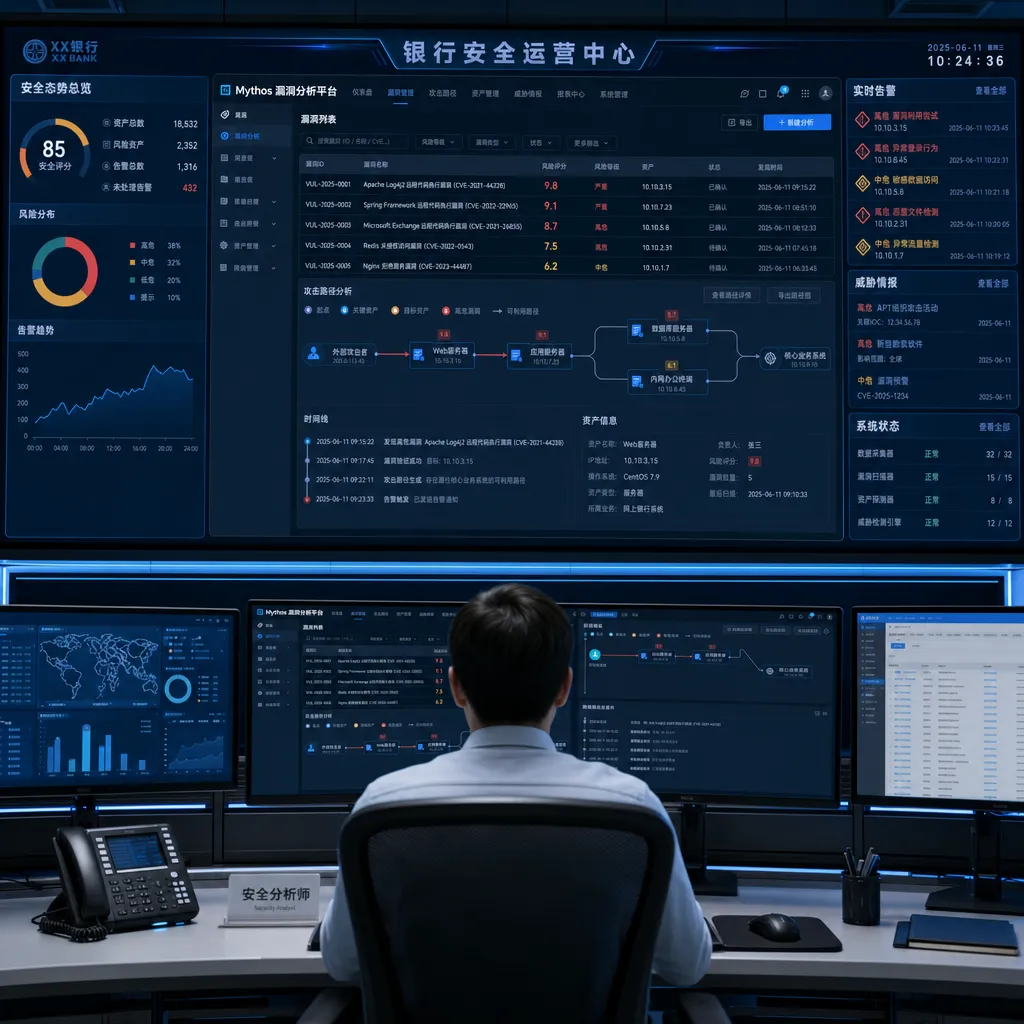
Regulatory compliance costs: In 2025 the FSA significantly raised cybersecurity standards, requiring quarterly comprehensive security‑audit reports. A traditional full audit takes three to four months—almost an entire quarter. Mythos can compress that cycle into two or three weeks, leaving more time for remediation instead of discovery.
Third‑party supply‑chain risk: Modern banking systems depend on hundreds of external components and services. After a 2024 supply‑chain attack on a global payment network, regulators mandated continuous security evaluation of all external dependencies. Manual code reviews are costly and slow; Mythos provides scalable automation.
Talent shortage: Japan’s cybersecurity talent gap will reach 140,000 by 2025. Even high salaries cannot fill it. AI tools can’t replace humans entirely but can multiply team productivity. As one Sumitomo Mitsui executive put it internally: “We’re not choosing whether to use AI—we’re choosing whose AI to use.”
Competitive pressure: Wall Street is already testing Mythos, and several European banks are applying for access. Falling behind would mean not only a technological lag but a strategic disadvantage in fintech competition. Katayama emphasized at the group’s launch: “We cannot sacrifice competitiveness out of fear of new technology.”
Controversy and Risk: What Could Go Wrong
Even with strict oversight, Mythos deployment remains contentious.
Model‑leak risk: If Mythos’s weights or inference processes were stolen, attackers could replicate its power. Anthropic uses layered encryption and hardware security modules (HSMs) for protection—but no system is foolproof. One anonymous researcher warned online, “We’re creating a digital nuclear weapon and pretending the vault is indestructible.”
False positives and over‑reliance: AI models generate false alarms. Over‑trusting Mythos could lead banks to ignore real threats or waste resources chasing false ones. More dangerous is automation bias—humans’ tendency to trust machines even when they’re wrong. While the framework mandates human review, in practice this safeguard may weaken.
Intensified offense–defense asymmetry: Mythos strengthens defenders but also hints at stronger attacker potential. If similar tech reaches malicious actors, they could find and exploit flaws faster—fueling an “AI arms race” where both sides escalate, and systemic fragility grows.
Regulatory arbitrage: Japan’s “controlled‑use” policy is looser than America’s. Foreign institutions could exploit Japanese subsidiaries to gain indirect access, bypassing home‑country restrictions. The working group is aware of this, but cross‑border regulatory coordination remains a long‑term challenge.
Broader Impact: The Future of AI Security Tools
Mythos’s rollout is a landmark, signaling AI’s shift in cybersecurity from “supporting tool” to “core capability.”
From passive defense to active hunting: Traditional tools react to attacks after they happen. Mythos embodies a proactive model—constantly scanning systems to spot vulnerabilities before attackers do. It’s like moving from “fortress walls” to “territorial patrols.” Proactivity, however, brings higher collateral‑damage risk and greater concentration of power.
A new form of Security‑as‑a‑Service: If Mythos proves effective, we may see a wave of “AI Security‑as‑a‑Service.” Small banks and firms that can’t afford their own instance could access similar capabilities via the cloud. This opens new business models but centralizes risk—putting much of global security infrastructure under a few AI vendors.
A regulatory paradigm shift: Traditional software regulation asks “Is the product safe?” AI regulation must ask “Is the usage process safe?” Japan’s working‑group model may become a reference: continuous supervision and coordination rather than simple approval or denial. This demands more technical literacy and agility from regulators.
Blurring ethical boundaries: Everything Mythos can do is theoretically within human capability—just vastly slower. But when AI completes in hours what humans need months to do, does a quantitative leap in capability become a qualitative ethical change? If a tool can instantly uncover thousands of vulnerabilities, should its use be restricted even though those flaws objectively exist?
Developer Perspective: What This Means for You
If you work in fintech, Mythos’s adoption will affect your daily routine:
Higher code‑review standards: Once banks employ Mythos, their expectations for partner and vendor code quality will rise. “Works but not secure” implementations will no longer pass. You’ll need to pay closer attention to edge cases, privilege checks, and data‑flow safety.
Faster vulnerability response: When banks can find nearly all flaws in days, they’ll expect equally rapid fixes. Traditional “quarterly patch cycles” will yield to “continuous remediation.”
Evolution of the security toolchain: Though Mythos won’t be publicly accessible, its existence will accelerate ecosystem innovation. Open‑source communities may create lighter variants; commercial vendors will integrate more AI. Expect major changes in your toolchain within a year or two.
Shifting skill requirements: The value of “writing secure code” is giving way to the value of “interpreting AI outputs and making the right calls.” Future security engineers will resemble “AI security analysts” whose core skills are interpretation, verification, and prioritization rather than manual bug hunting.
For developers using AI APIs, even though Mythos itself will stay closed, Anthropic’s other models (like Claude 3.5 Sonnet) already show strong potential in code review and security analysis. If you build financial apps, consider integrating AI into your workflow—not to replace human review but to form the first line of defense.
Conclusion: Balancing the Double‑Edged Sword
The story of Mythos is still unfolding. The six‑month pilot with Japan’s megabanks will be closely monitored for usage patterns and security incidents. If it succeeds, more countries and institutions will follow; if it fails catastrophically, the whole trajectory of “AI security tools” might be reassessed.
This isn’t a simple good‑or‑bad technology debate but a question of balance between capability and risk. Mythos could make finance safer—but only if it doesn’t become a new threat itself. Japan’s experiment is bold, and its outcome will shape the industry’s view of AI in cybersecurity.
For developers and professionals, the lesson is clear: AI is no longer just a coding assistant or Q&A bot—it’s becoming part of critical infrastructure. We must think seriously about AI’s capability limits, use norms, and latent risks. Technological progress won’t stop, but we can choose how to direct it.
References
As the sources discussed here come mainly from overseas financial media, there are no domestically accessible reference links. Information in this article is synthesized from publicly available reports by Nikkei, Bloomberg, Sina Finance, and others.


