
Running a 20B large model on a smartphone becomes reality: Phison and MediaTek break the memory wall
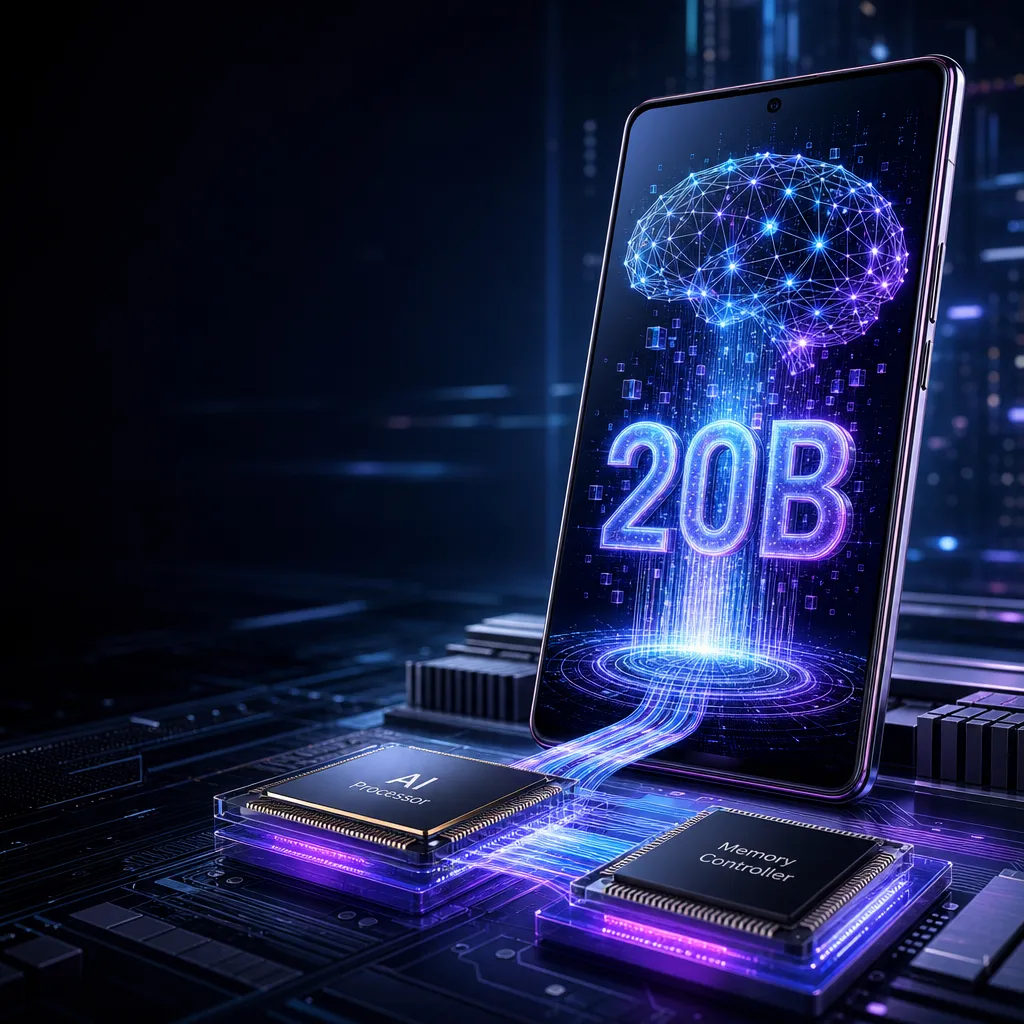
Phison Electronics and MediaTek have achieved on-device operation of a 20B large language model on the Dimensity 9500 platform, requiring only 12GB of memory. Through aiDAPTIV Hybrid UFS technology, MoE model weights are dynamically offloaded to the storage layer — a key step in transforming edge AI from a toy into a tool.
Running a 20B Model on a Smartphone Becomes Reality: Phison + MediaTek Break Through the Memory Wall
Phison Electronics and MediaTek today showcased the world’s first solution for running a 20-billion-parameter large language model natively on a smartphone at the MediaTek Dimensity Developers Conference (MDDC 2026). This wasn’t a PowerPoint demo—it was a live demonstration on the Dimensity 9500 chip.
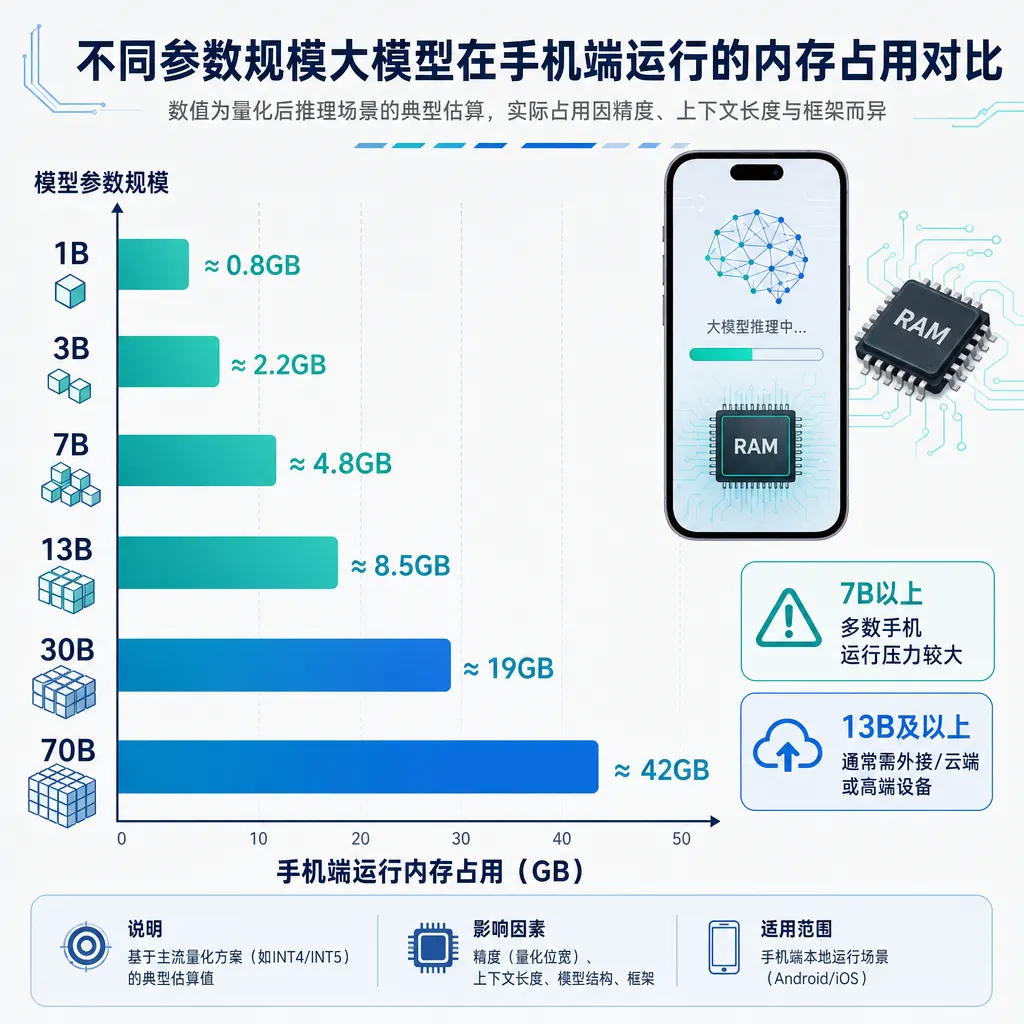
The key breakthrough: running a 20B model on just 12GB of DRAM. Ordinarily, a 20B model’s FP16 weights require about 40GB of VRAM—even with INT4 quantization, it would still need 10GB+. Phison’s solution reduces that requirement to fit within a smartphone’s 12GB of memory.
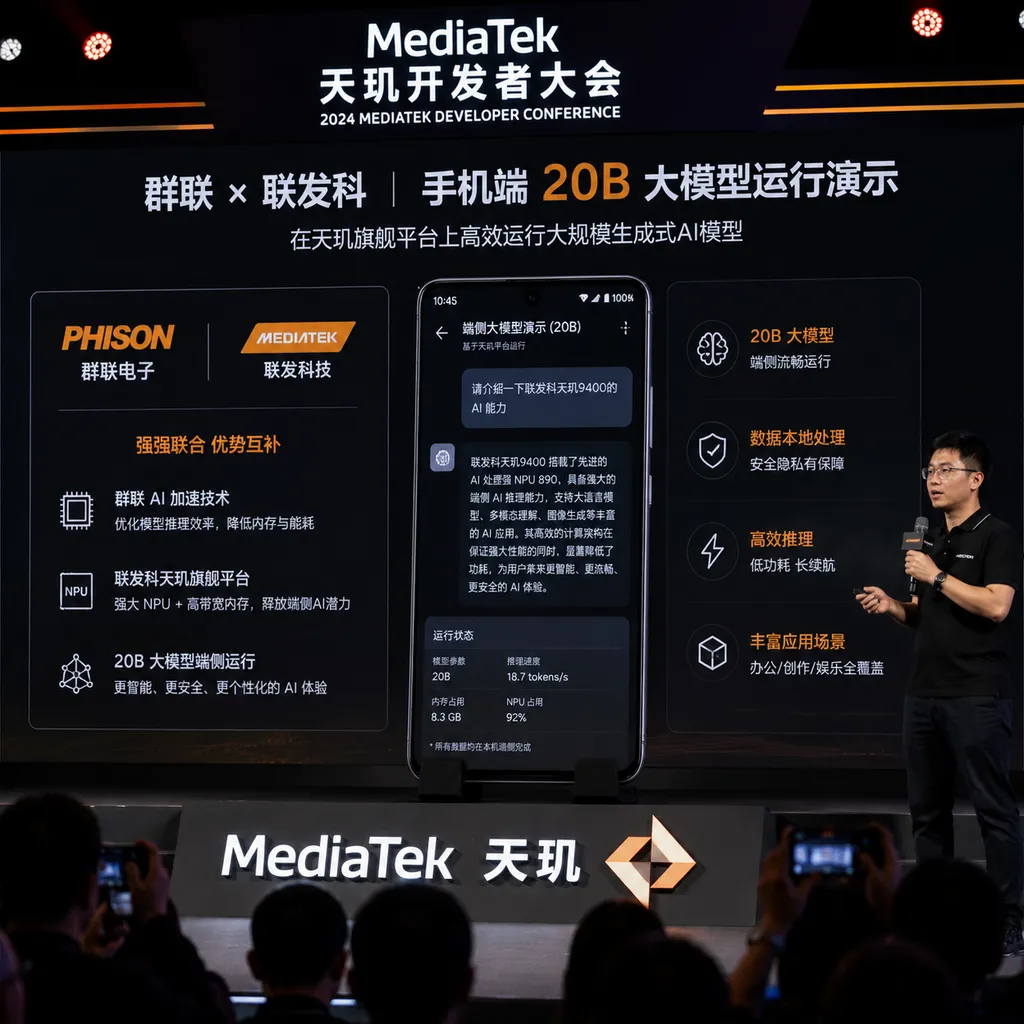
Core Technology: Hiding the Model in Flash Storage
The core of this breakthrough is Phison’s aiDAPTIV Hybrid UFS technology. In short, it dynamically offloads parts of a Mixture of Experts (MoE) model into UFS storage, loading only the expert modules needed at a given moment instead of putting the entire model into RAM.
The MoE architecture was designed for exactly such scenarios. A 20B MoE model might include dozens of expert modules, but only a few are activated per inference. Traditionally, all experts are loaded into memory. Phison’s approach keeps inactive experts in UFS storage and swaps them in as needed.
This sounds similar to virtual memory, but the technical challenges are on a completely different level. UFS read latency is measured in nanoseconds, while DRAM operates in picoseconds—three orders of magnitude faster. Guaranteeing inference speed while swapping weight data in and out requires deep optimization in scheduling algorithms, prefetching strategies, and storage controller design.
As a storage controller developer, Phison already has deep expertise in this area. Its patented hardware-level weight scheduling system avoids simplistic software-based swapping. MediaTek’s Dimensity 9500 provides the NPU compute power and memory bandwidth necessary to make this approach feasible.
Why 20B, and Not 7B or 70B?
The 20B parameter scale wasn’t chosen at random.
A 7B model is too small and limited in capability. Models like Llama 3.1 8B or Qwen2.5 7B can run on smartphones, but their performance in complex reasoning, multi-turn dialogue, and code generation is mediocre. They’re better suited for demos than production tools.
A 70B model is simply too large. Even with Phison’s storage virtualization, an INT4-quantized 70B model would require about 35GB of weights. Add KV cache and intermediate activations, and the memory and compute requirements would exceed any phone’s capacity.
20B hits the “sweet spot.” Models like DeepSeek-V3 and Qwen2.5-32B show that MoE models in the 20–30B range can approach GPT-4 levels of capability for many tasks. Running a 20B model locally means on-device AI can tackle genuinely productive tasks—beyond voice assistants and photo enhancement.
What Is the Real-World Experience Like?
The on-site demo didn’t reveal inference speed—a crucial metric. If first-token latency exceeds five seconds or generation speed dips below 10 tokens/s, user experience will suffer.
From a technical standpoint, the bottleneck is UFS read speed. UFS 4.0 reads sequentially at up to 4GB/s, but random reads are much slower. If several gigabytes of weights must be swapped from UFS per query, latency will spike. Phison likely optimized prefetching and caching to predict which expert modules will be needed next, minimizing runtime overhead.
Another issue is power consumption. Frequent UFS read/write operations draw power, and sustained large-model inference can cause heat and throttling. The Dimensity 9500’s NPU efficiency will be critical. MediaTek is known for aggressive power optimization, but real-world results will depend on production hardware.
The True Value of On-Device Large Models
Running large models on smartphones isn’t about showmanship—it addresses key weaknesses of cloud-based AI:
Privacy. Sensitive data never leaves the device, which is critical for enterprises and privacy-sensitive contexts.
Latency. Cloud models incur hundreds of milliseconds of network delay, while local models respond in milliseconds—vital for real-time applications like conversational assistants or live translation.
Cost. Cloud models charge per token. Heavy users can spend hundreds of dollars monthly. Local models are a one-time cost—use as much as you want.
Offline use. Whether on a plane, subway, or in remote areas, on-device AI still works. This may sound niche, but it’s essential in many scenarios.
However, on-device models have limits: restricted capability ceilings, no real-time knowledge updates, and limited multimodal processing. Phison and MediaTek’s solution raises the ceiling from 7B to 20B, closing—but not eliminating—the gap with cloud models.
The more practical future lies in hybrid deployment: handle routine tasks locally, escalate complex ones to the cloud. A 20B local model could cover 80% of daily use, leaving the remaining 20% to the cloud—balancing experience, cost, and privacy.
Ripple Effects Across the Industry
Phison and MediaTek’s collaboration will likely trigger several chain reactions:
A new battlefield for storage vendors. Smartphone storage is no longer about capacity—it’s about AI performance. If Phison’s aiDAPTIV technology becomes standard, other storage-controller companies (like Silicon Motion and Memblaze) will have to catch up. The UFS 5.0 spec might even include AI-optimized features.
Pressure on chipmakers. With MediaTek leading the charge, Qualcomm and Apple will speed up. Qualcomm’s Snapdragon 8 Gen 4 emphasizes on-device AI; rumors suggest Apple’s A19 will significantly boost NPU power. On-device large-model support will become a flagship feature.
Differentiation for smartphone brands. Xiaomi, OPPO, and Vivo are all developing their own on-device AI models—but currently limited to 7B due to hardware constraints. If Phison’s technology is licensed broadly, more brands could run 20B models, equalizing hardware competition and shifting focus to model tuning and real-world applications.
Opportunities for open-source models. Cloud models are dominated by closed giants; on-device AI is the natural home of open-source models. Llama, Qwen, and DeepSeek can be optimized for mobile deployment without API costs or data privacy concerns. Phison’s solution lowers the deployment threshold, accelerating adoption.
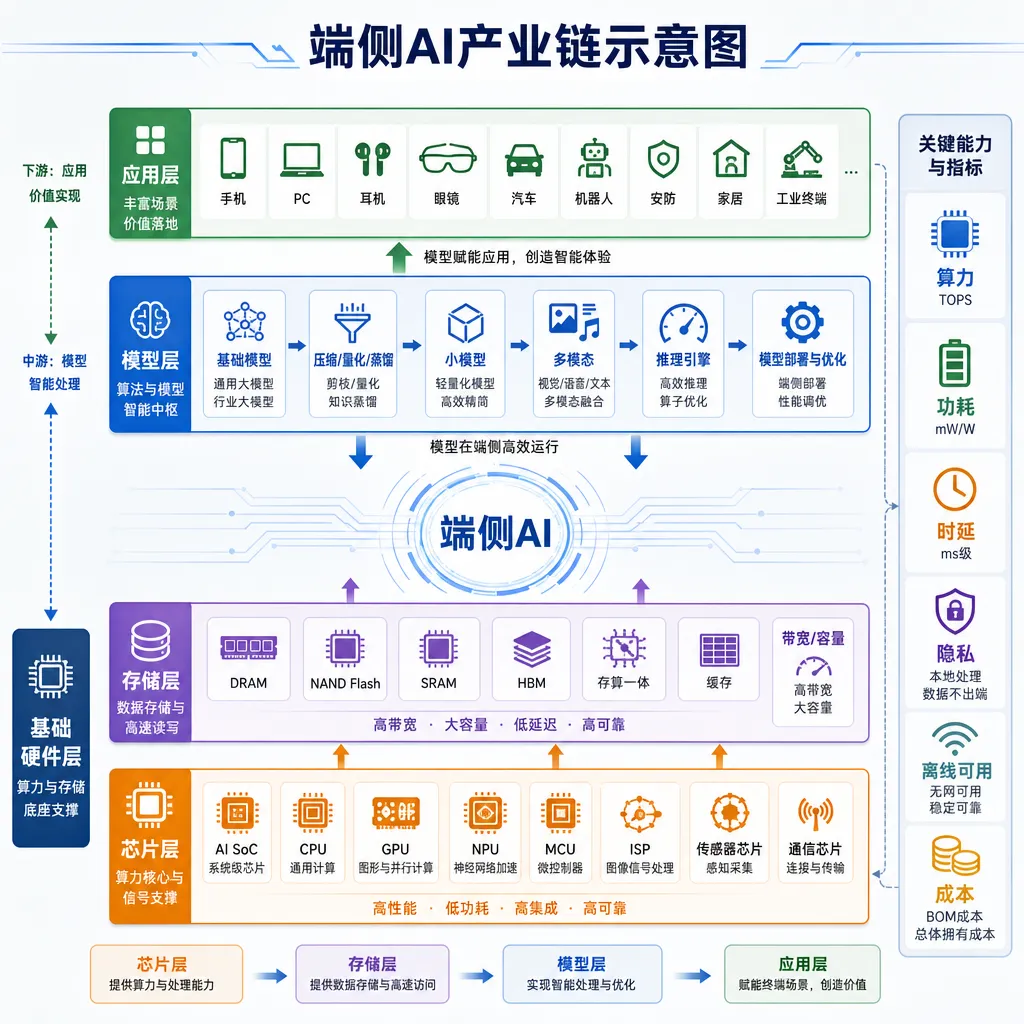
Other Technical Approaches
Phison’s solution isn’t the only path. The industry is exploring alternatives:
Model compression. Techniques like pruning, distillation, and quantization shrink large models—e.g., distilling a 70B model into a 20B one that retains 90% capability with only 30% of parameters. The tradeoff: potential performance loss and huge training costs.
Specialized hardware. Custom AI accelerators (Apple’s Neural Engine, Google’s TPU) boost inference efficiency but are expensive and slow to develop—viable only for top-tier companies.
Mixed precision. Use high precision (FP16) for critical layers, low precision (INT4/INT2) for others. The challenge lies in automatically identifying critical layers without degrading accuracy.
Distributed inference. Split model workloads across multiple devices—e.g., phone + watch + earbuds forming a distributed AI cluster. A fascinating idea, but communication latency and synchronization remain major hurdles.
Phison’s approach—trading storage for memory—is a practical engineering optimization on existing hardware. It’s fast to commercialize without waiting for new chips or retraining models. Long-term progress, however, still depends on stronger compute and improved model architectures.
Can Developers Access It?
Phison and MediaTek haven’t announced plans to open this technology to developers. If it remains an internal solution for chip and device manufacturers, developers won’t access it soon.
That said, the industry trend is toward increasing openness in on-device AI infrastructure. Apple’s Core ML, Google’s MediaPipe, and Qualcomm’s AI Engine all aim to lower development barriers. If MediaTek wants leadership in this market, it will eventually need to offer toolchains and SDKs.
For developers, the practical question is: What scenarios justify a 20B on-device model?
Personal assistants. Managing calendars, emails, and notes—privacy-sensitive and latency-critical. A 20B model can handle complex, multi-turn tasks.
Content creation. Writing assistance, code completion, image caption generation—tasks needing deeper language understanding. 7B is barely enough; 20B offers clear improvements.
Real-time translation. High latency kills the experience in cloud-based translation. A 20B model can deliver high-quality multilingual inference in real time.
Offline knowledge bases. Embedding enterprise knowledge, technical documentation, or legal texts for offline Q&A use cases.
These all share key traits: strong privacy, low latency, offline capability, and moderate but nontrivial model power requirements—the perfect fit for a 20B on-device model.
Will Cloud Models Be Replaced?
No. On-device and cloud models will coexist and complement each other.
Cloud models excel in:
- Scale. GPT-4 and Claude 3.5 have hundreds of billions of parameters, far surpassing 20B models.
- Real-time updates. They can refresh knowledge instantly, whereas on-device models require downloading tens of GBs.
- Multimodality. Cloud models handle image, video, and audio processing—tasks beyond on-device compute.
- Connectivity. Cloud models can search, call APIs, and pull current information; local models rely only on stored data.
On-device models shine in areas the cloud can’t: privacy, low latency, offline functionality. The future will be device–cloud synergy.
For developers, the choice depends on the use case:
- Internal enterprise tools, privacy-sensitive apps, or offline-first products → on-device.
- Knowledge-heavy, multimodal, or real-time web-connected features → cloud.
Platforms like OpenAI Hub will remain valuable—even as local AI spreads—by offering unified APIs for seamless model switching.
When Will It Be Available?
Neither Phison nor MediaTek have released a commercial timeline. Following typical chip cycles, the Dimensity 9500 is expected to enter mass production in late 2026, with devices launching in early 2027.
However, early phones may not expose full 20B model functionality. Manufacturers will need time for system integration, application adaptation, and UX optimization. The first 2027 flagships may include built-in 20B-model-powered AI features (like assistants or translation) but keep them closed to third-party developers.
A truly open ecosystem could emerge by late 2027 or 2028, with mature toolkits, model libraries, and stores—allowing developers to invoke on-device 20B models as easily as today’s cloud APIs.
Until then, developers can prototype with current 7B models and prepare for the shift. Once 20B models become mainstream, it will just be a matter of swapping model files—no major code changes required.
Final Thoughts
The Phison–MediaTek demo isn’t just a flashy tech showcase—it proves that large on-device models can be practical productivity tools.
Moving from 7B to 20B marks not just a quantitative leap, but a qualitative one. 7B models handle basic Q&A and text generation; 20B models perform complex reasoning, code synthesis, and multi-turn dialogue—bridging the gap between demos and truly useful AI.
Of course, 20B still trails cloud behemoths like GPT-4 or Claude 3.5. But progress is exponential: today’s 20B local model is roughly where GPT-3.5 was three years ago. In a couple of years, it could rival today’s GPT-4.
When that happens, the AI landscape will change forever. Cloud AI will no longer monopolize cutting-edge capability—on-device AI will become standard. Developers will need to rethink architectures: which functions run locally, which in the cloud, and how the two collaborate.
That future isn’t far away. The Phison–MediaTek demo is a clear signal of what’s to come.
References
- World’s First: Phison Electronics and MediaTek Run a 20B LLM Locally on Dimensity 9500 Platform - IT Home – IT Home’s coverage of MediaTek’s MDDC
- Bedtime Tech News Roundup 2026513 - Linux.do – Daily tech news summary


