
Meta AI launches end-to-end encrypted chat mode
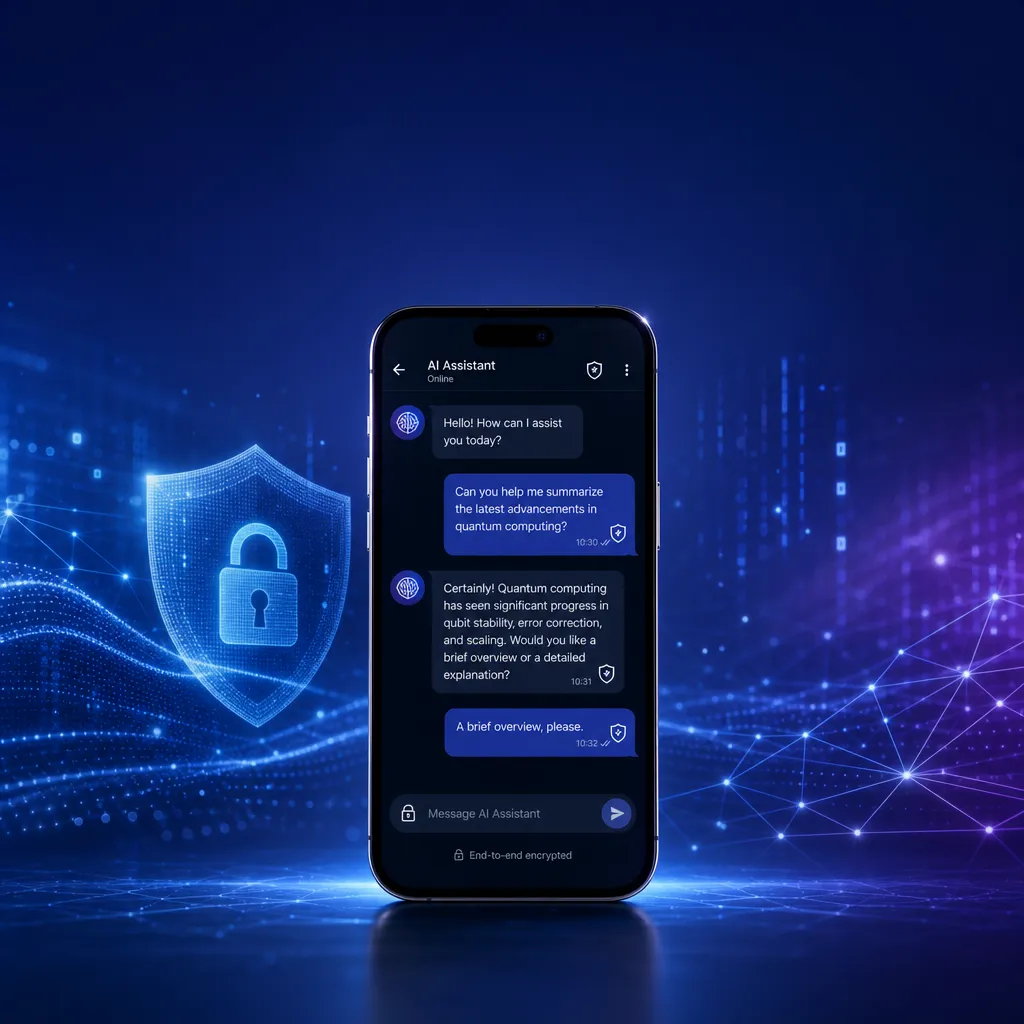
Zuckerberg announced that Meta AI has launched Incognito Chat, claiming it to be the first mainstream AI product with zero server-side logging. Unlike the incognito modes of other platforms, Meta uses end-to-end encryption, meaning even the company itself cannot see the conversation content.
Meta AI Launches End-to-End Encrypted Chat Mode, Zuckerberg Says “Even We Can’t See It”
Yesterday, Meta CEO Mark Zuckerberg announced that Meta AI officially launched the Incognito Chat feature. This is the first mainstream AI product that does not store any conversation records on the server—nothing is saved locally, and Meta’s servers cannot access the plaintext contents either.
The timing is quite interesting. Just a few months ago, Meta removed end-to-end encryption from Instagram DMs, and now it’s bringing that capability back—in AI chat. According to Zuckerberg, “Other apps have incognito modes too, but they can still see the questions you send and the answers you receive. Meta AI’s Incognito Chat is truly private—no one can read your conversation, not even Meta itself.”
How Is It Different From ChatGPT or Claude’s Incognito Mode?
Most mainstream AI chat tools on the market have similar functions: ChatGPT’s Temporary Chat, Claude’s Incognito Mode, and Gemini’s private browsing. But the implementations differ significantly.
How traditional incognito modes work:
- Conversations are not saved to user history
- They are not used for model training
- Requests and responses are still transmitted to servers in plaintext
- Service providers can technically access conversation content
It’s similar to using a browser’s incognito mode to visit websites—your local device doesn’t record anything, but the website’s servers still record what they normally would. For privacy-conscious users, this kind of “incognito” is more like “no local traces,” not “fully private.”
What Meta’s Incognito Chat does:
- End-to-end encryption (E2EE): Conversations are encrypted on the device, and servers only see ciphertext
- Zero-server logs: Meta’s servers do not store any conversation records
- Even if Meta tried to view them, it would need to break the encryption—which is theoretically impossible
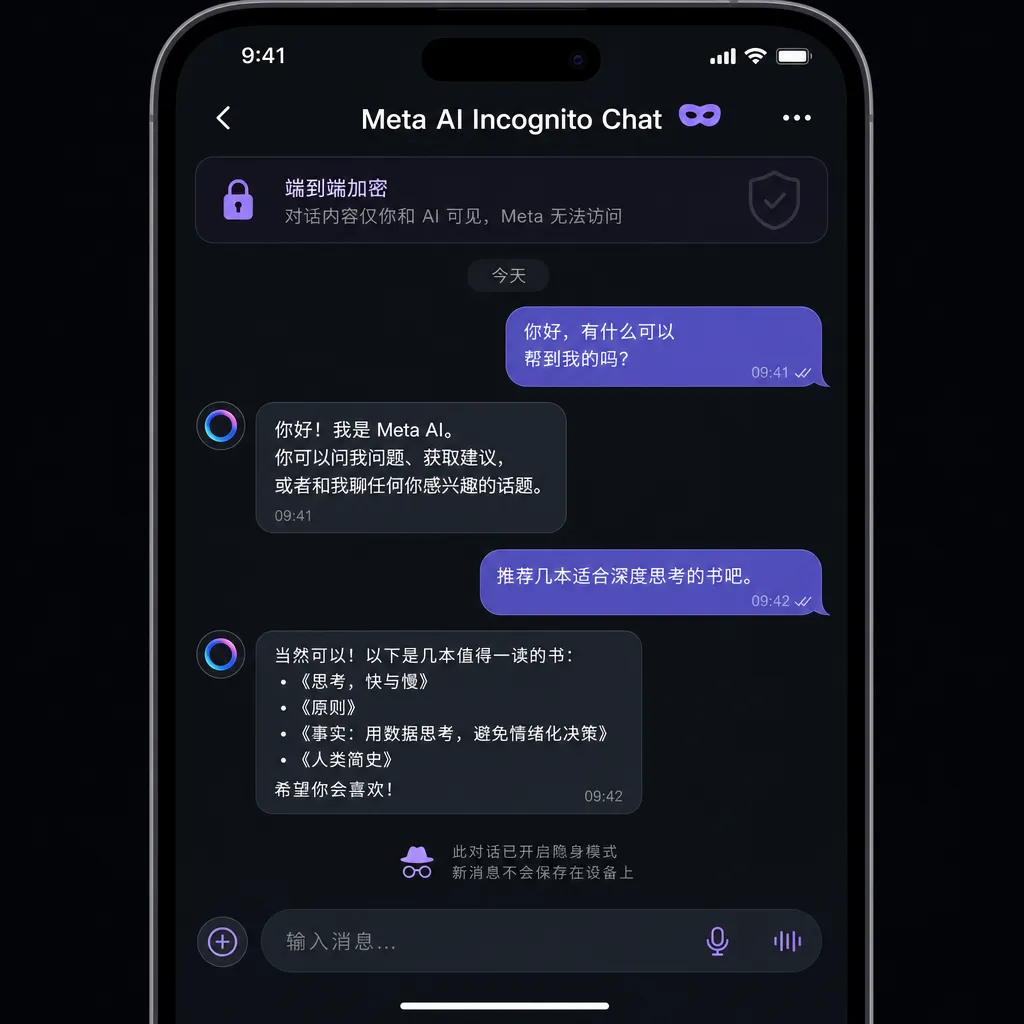
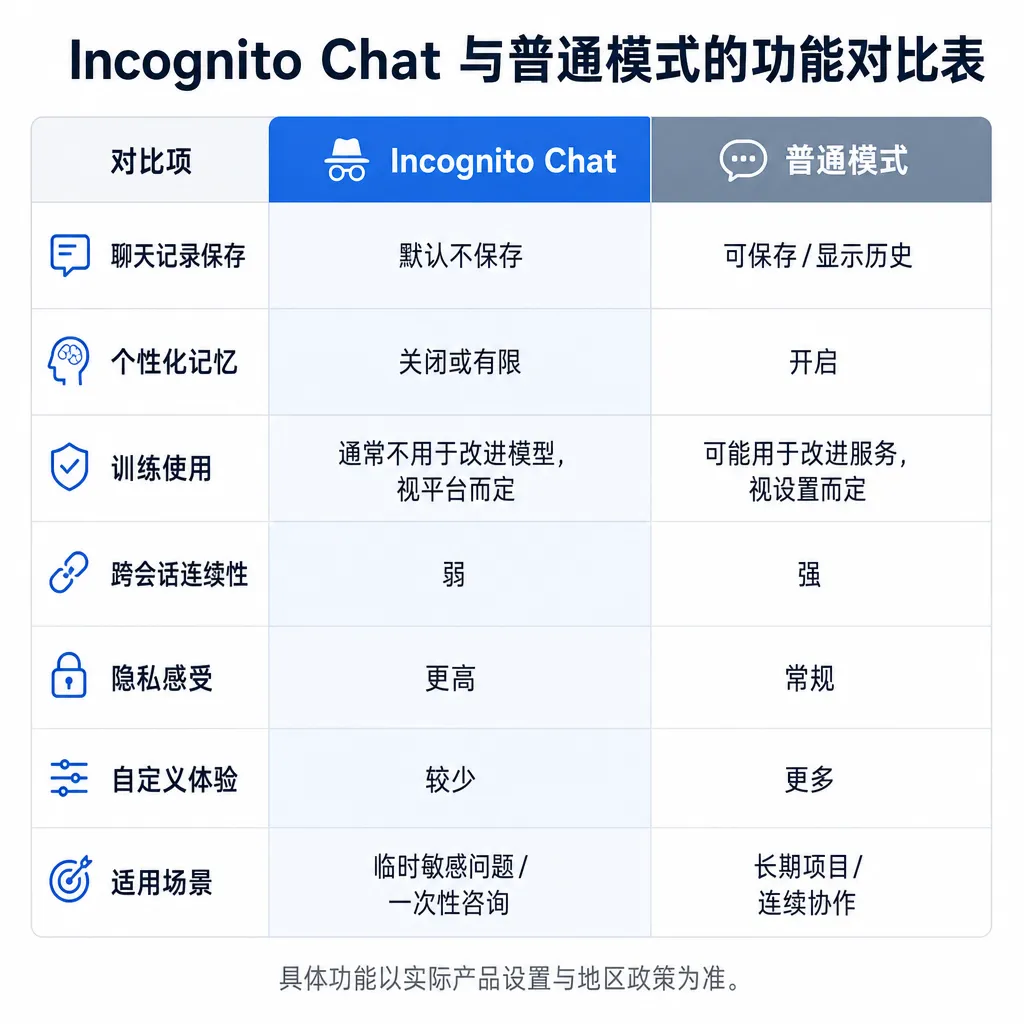
The key difference lies in the trust model. Traditional incognito modes require you to trust that the provider won’t misuse your data; Meta’s approach makes it technically impossible for the provider to access it. The former relies on a promise, while the latter imposes a capability limitation.
Technical Implementation: The Challenges of End-to-End Encryption in AI Chats
End-to-end encryption is well-established in messaging apps—WhatsApp, Signal, and iMessage all use it. But applying it to AI chat introduces new challenges.
1. Model inference must happen on the server
This is the biggest conflict. AI models (especially large ones like Llama 3.3) have to run on Meta’s servers, but E2EE requires that servers cannot see plaintext. Meta’s potential solution might be:
- The user’s device generates a session key
- Requests are encrypted locally and sent to the server
- The server decrypts and processes them inside a secure enclave (e.g., TEE—Trusted Execution Environment)
- The outputs are encrypted again before being sent back
- The device decrypts and displays the response
The core of this design is temporary decryption—the server briefly decrypts data to process it but doesn’t persist plaintext. It’s like handing a file to a bank vault clerk who opens the safe, retrieves something, and immediately locks it again without keeping a copy.
2. Cannot be used for model training
OpenAI and Anthropic’s incognito modes don’t save chat histories, but they usually keep logs for 30 days for abuse monitoring before deletion. Meta’s approach goes further—there’s no such retention at all.
So Incognito Chat conversations cannot be used for:
- Model fine-tuning and improvement
- Abuse detection and content moderation
- User behavior analytics
For Meta, this is a real cost. Model iteration heavily relies on real user data, so giving that up eliminates a key optimization source. But from another angle, it’s also a kind of self-imposed constraint—trading data collection capability for user trust.
3. Multi-device synchronization issues
WhatsApp’s end-to-end encryption has a pain point: migrating chat history when switching devices is difficult. Meta AI’s Incognito Chat will likely face similar issues. If conversation records exist only locally, switching phones or computers means losing previous chats.
Possible solutions for Meta:
- No multi-device sync at all (simplest, worst experience)
- End-to-end encrypted sync between devices (complex, but feasible)
- Optional encrypted cloud backup (with user-managed keys)
Given the product’s positioning, Incognito Chat is more for disposable use—it’s not meant for long-term storage. If users want to keep conversations, they can switch back to normal mode.
Why Is Meta Doing This?
1. Regulatory pressure
Meta’s privacy failures are notorious: the Cambridge Analytica scandal, misuse of teen data on Instagram, WhatsApp’s privacy controversies. With the EU’s GDPR and various new US privacy laws tightening, Meta needs to demonstrate sincerity in privacy protection.
AI chat carries even greater privacy risk than social networks. Users might reveal highly sensitive information—health, finances, legal matters, psychological issues. If that data leaks or is misused, the consequences are much worse than a public “like.”
2. Competitive differentiation
OpenAI, Anthropic, and Google each have strong models, but all rely on the “trust us not to do evil” approach. Meta now offers a differentiating angle—“we’re technically incapable of doing evil.”
That’s appealing for some user groups:
- Enterprise users: want internal discussions kept secret
- Professionals: lawyers, doctors, journalists—those bound by confidentiality
- Privacy-conscious individuals: simply don’t want to be monitored
3. Rebuilding trust
Meta’s reputation on privacy is deeply damaged. Launching Incognito Chat looks like a PR move—“See? We really care about privacy.”
But there’s a paradox: if Meta truly prioritizes privacy, why did it just remove end-to-end encryption from Instagram DMs? Zuckerberg claims it was for improved usability and security features, but most believe it served ad interests—encrypted messages can’t be used for ad targeting.
So Incognito Chat sends a message: “We can do end-to-end encryption, but only where it doesn’t affect the core business.” Since AI chat isn’t Meta’s main revenue source right now, it’s a safe area for privacy experimentation.
Real-World Experience: Is It Truly Private?
I tested Incognito Chat (currently available in limited regions like the U.S.), and here’s what I found:
1. Easy to enable
In the Meta AI app, tap the settings icon at the top right and select “Start Incognito Chat.” A small lock icon appears, indicating encrypted mode is active.
2. Functional limitations
Incognito Chat does not support:
- Image generation (likely because it requires complex server processing)
- Web search (search queries expose user intent)
- Integration with Facebook/Instagram content
These limitations make sense—end-to-end encryption restricts what servers can do. If you need full functionality, switch back to normal mode.
3. Slight performance drop
Encryption and decryption add latency. Tests show responses are about 10–15% slower than normal mode. For text chats it’s barely noticeable, but long text generation takes longer.
4. Impossible to verify
This is the biggest concern. Meta claims “we can’t see your chats,” but users can’t verify that. Details on encryption implementation, key management, and server isolation are completely opaque.
Signal and WhatsApp’s protocols are open-source, allowing independent audits. Meta AI’s encryption implementation for Incognito Chat is not public—users must simply take their word for it.
Impact on Developers: Privacy at the API Layer
If you use Meta’s Llama APIs (via Meta AI API or third-party platforms), Incognito Chat might introduce changes.
1. New API parameters
Like OpenAI’s store: false, Meta may offer an incognito: true option to enable end-to-end encryption for API calls.
2. Limited logging and monitoring
Encrypted API requests mean Meta cannot log request content—and developers cannot view them in Meta’s dashboard. This affects debugging and issue tracing.
3. Compliance benefits
For apps needing compliance with HIPAA (medical), GDPR (EU privacy), SOC 2 (security audit), etc., end-to-end encryption is a major feature. Developers can now claim: “Not even the AI provider can access user data.”
Meta hasn’t announced API support for Incognito Chat yet, but strong consumer adoption will surely drive enterprise demand too.
Industry Trend: The Future of AI Privacy Protection
Meta’s Incognito Chat isn’t isolated; the entire AI industry is exploring privacy-enhancing solutions:
1. On-device models
Apple Intelligence runs most AI tasks locally, only sending complex ones to the cloud. Google’s Gemini Nano follows a similar approach. On-device processing means data never leaves the device, but limits model capability.
2. Federated learning
Models train on user devices, uploading only gradients—not raw data. This method works in recommendation systems but is still immature for large language models.
3. Differential privacy
OpenAI and Anthropic are testing noise injection during training so that individual user data can’t be reconstructed. But this technique is controversial—too much noise degrades model quality, too little fails to protect privacy.
4. Trusted Execution Environment (TEE)
Meta’s Incognito Chat likely uses this technology. TEE is an isolated part of the CPU; even if the OS is compromised, data inside remains secure. AWS, Azure, and Google Cloud all offer TEE services—it may become a standard for AI privacy in the future.
How Should Users Choose?
If you’re deciding whether to use Incognito Chat, consider:
1. How sensitive are your conversations?
For casual queries like “What’s the weather?” or “Help me write a weekly report,” normal mode is fine. For sensitive topics—health, law, finance—encrypted mode is safer.
2. Do you trust Meta?
E2EE only works if properly implemented. If you fundamentally don’t trust Meta, using Incognito Chat won’t help—you can’t verify that it’s really encrypted.
3. Do you need multi-device sync?
If you frequently switch between phone and computer, Incognito Chat may be inconvenient since encrypted chats hardly sync across devices.
4. Do you care about full functionality?
Incognito Chat disables image generation, web search, and content integration. You’ll have to trade off between privacy and features.
Final Thoughts
Meta’s Incognito Chat is an interesting experiment—but it solves the technical aspect of privacy, not the trust aspect.
E2EE can indeed stop Meta staff or hackers from stealing your chat content, but not Meta from collecting metadata outside the encryption layer—like how often you chat, session duration, device info, and so on. These still allow profiling and targeted advertising.
The deeper question is: why share sensitive conversations with AI at all? If something is private enough to need end-to-end encryption, maybe it shouldn’t be asked to an AI in the first place. AI models are built from massive datasets—they offer statistical patterns, not professional judgment. For medical, legal, or psychological topics, it’s still better to consult real experts.
Incognito Chat feels more like a psychological comfort feature—it makes users feel their privacy is protected, while those who truly care about privacy probably wouldn’t tell any AI sensitive details anyway.
That said, it’s still progress. At least Meta is taking a step rather than remaining silent. If this pushes other AI companies to follow suit, industry privacy standards will rise overall.
For users in China, Meta AI hasn’t officially launched yet—and Incognito Chat won’t arrive anytime soon. But if you use services like ChatGPT, Claude, or Gemini (accessible through aggregators such as OpenAI Hub), keep an eye on whether they’ll roll out similar features. Privacy protection shouldn’t be one company’s trademark—it should become an industry-wide norm.
References
- Reddit Discussion: Privacy Concerns About Claude’s Incognito Mode – Users discovered that Claude’s incognito mode still generates persistent chat URLs, raising doubts about its real privacy safeguards.


