
Anthropic has set up a separate quota pool for the Claude Agent SDK.
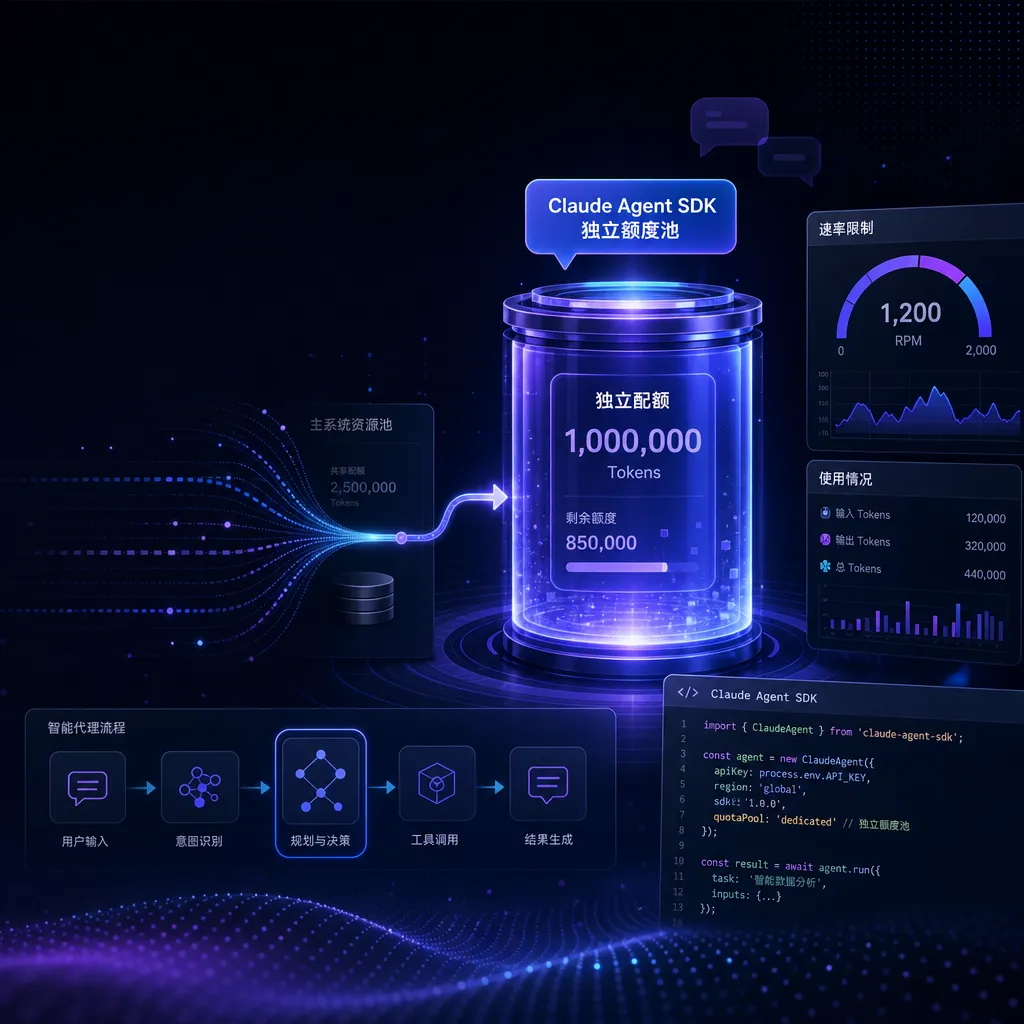
Starting June 15, the Claude Agent SDK will no longer count against subscription usage limits. Pro/Max/Team/Enterprise users can apply separately for monthly credits for automation development. API billing and subscriptions are now completely separated.
Anthropic Opens a Separate Credit Pool for the Claude Agent SDK
Anthropic has just confirmed a developer-friendly change: starting June 15, 2026, usage of the Claude Agent SDK will no longer count toward your Claude subscription limits. Pro, Max, Team, and Enterprise users can apply for separate monthly credits specifically for running automated tasks and developing Agents.
This adjustment addresses a long-standing pain point — previously, using Claude for coding on the web, collaborating via Claude Cowork, and running automation scripts through the SDK all drew from the same quota pool. Now that the SDK has its own independent budget, you can confidently run Agent tasks in the background without worrying about exhausting your interactive usage quota.
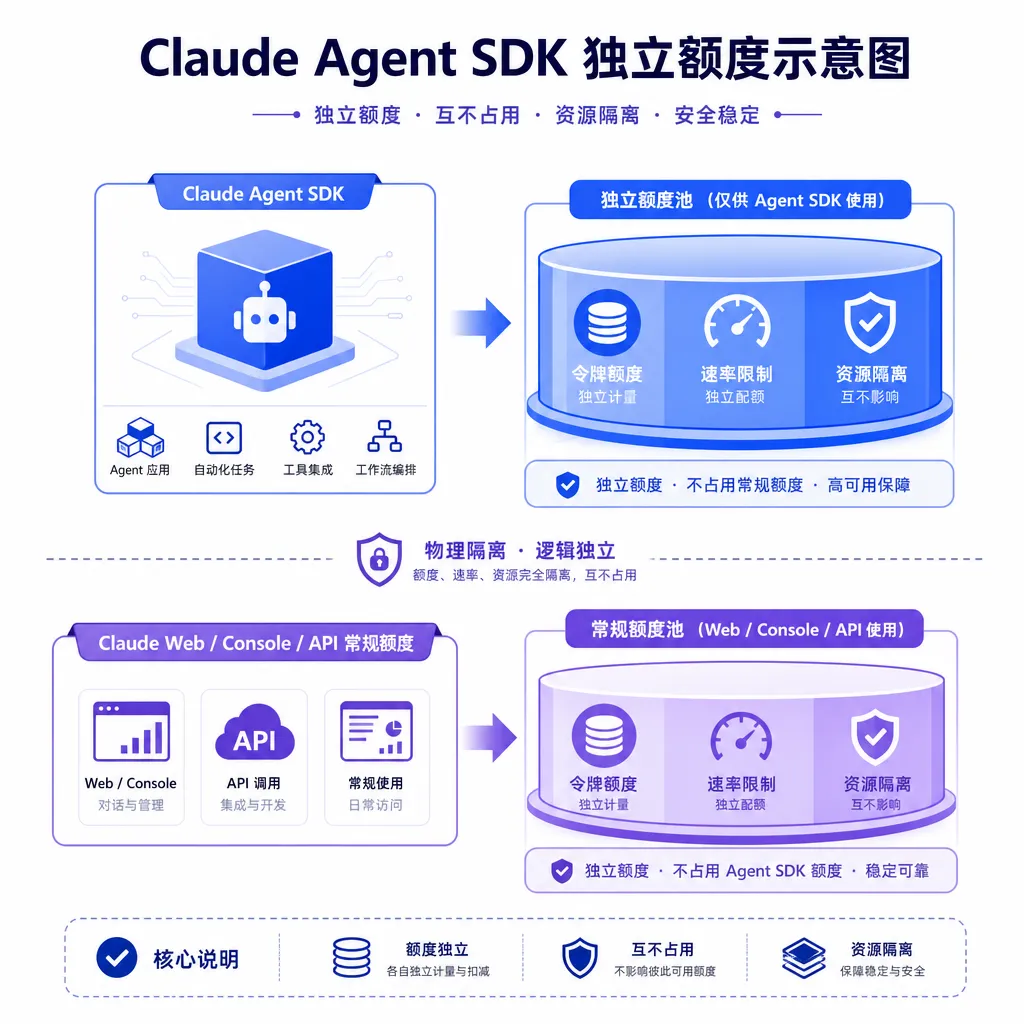
Subscriptions and API Are Finally Completely Separated
This change represents an important refinement in Anthropic’s billing model. Many users still find the relationship between Claude’s subscription and API confusing — simply put, they have never been the same thing.
Claude’s Pro / Max / Team / Enterprise subscriptions are designed to enhance the web, desktop, and mobile chat experience. You’re paying for higher usage limits, faster response speeds, and priority access to new features. But those subscriptions have never included usage credits for the Claude Console API.
If you want to call Claude via API, you must separately top up usage credits in Claude Console. It’s a prepaid model — pay as you go — and it has nothing to do with whether you have a subscription. After the March 2026 update to the documentation, Anthropic made this explicit: once you create a Console organization, you must add usage credits before you can use the API.
Now with the Agent SDK having its own credit pool, Anthropic has effectively created a third line of usage. Your subscription quota is still for interactive Claude use, API credits remain pay-as-you-go, and SDK credits are a monthly refreshed subscriber-only benefit, separate from the other two budgets.
How to Obtain and Use Agent SDK Credits
Anthropic’s announcement is still fairly brief, but the key rules are clear:
Eligibility
Pro, Max, Team, and Enterprise plan users. Free users are not eligible, in line with Anthropic’s usual approach — free users can experience the product, but automation and bulk calls require payment.
How to claim
A separate application is required. Anthropic hasn’t said whether this will be granted automatically or require review. Given the phrasing “eligible users can apply,” it’s likely not enabled by default — you may need to submit an application via the Console or contact support.
Credit amount
No official numbers yet. Considering Pro costs $20/month, Max $40, Team is per seat, and Enterprise is custom, credit levels will likely differ. Based on the existing subscription limits, Pro users may get just enough for lightweight automation, while Max and Team users get more, and Enterprise clients may negotiate custom amounts.
Refresh cycle
Follows the billing cycle. Monthly subscribers will have credits refreshed each month; annual subscribers likely get monthly distribution. Unused credits won’t roll over — a standard “use it or lose it” policy.
Usage restrictions
Restricted to Claude Agent SDK only — cannot offset API calls, web usage, or be transferred to others. This makes sense: Anthropic wants to encourage SDK-based automation and Agent app development, not turn credits into general-purpose coupons.
Why Now
Agent development began gaining traction in the second half of 2025. OpenAI’s Swarm, Anthropic’s Computer Use, and Google’s Gemini Agent Builder are all competing in this field. But developers quickly found that Agent calls differ dramatically in frequency and cost compared to traditional API calls.
A simple Agent task might require multiple rounds of dialogue, tool invocations, and context management — consuming dozens or even hundreds of API requests per task. Using a subscription plan could rapidly exhaust limits; using API credits could be much costlier than expected.
By separating the Agent SDK, Anthropic is effectively lowering the trial-and-error cost for developers. You can use the included credits to run experiments, test Agent logic, and fine-tune prompts without worrying about burning through your production API budget or exceeding quotas.
It also benefits Anthropic. Agent development is long-cycle work — developers need time to explore, iterate, and identify valuable use cases. If they had to pay per call from the start, many would give up before making progress. Offering free subscriber credits helps build the ecosystem — once developers create valuable Agent apps, they’ll naturally switch to paid API for production traffic.
How It Compares to Other Platforms
OpenAI currently has no similar mechanism. ChatGPT Plus or Team subscribers still need separate API credits — subscriptions and API are completely distinct.
Google’s Gemini takes a hybrid approach. Gemini Advanced subscribers can use Gemini API in AI Studio for free, but with RPM (requests per minute) limits. It’s meant for API feature exploration, not production-grade deployment. For serious Agent development, you must use Vertex AI or Google Cloud’s paid channels.
Anthropic’s model sits in between. Unlike OpenAI, subscriptions and API aren’t fully disconnected; unlike Google, it doesn’t give full API access to subscribers. Instead, Anthropic creates a dedicated credit pool for the Agent SDK, maintaining the boundary while offering a low-cost sandbox for developers.
From a developer experience standpoint, this is clever. The pain point in Agent development isn’t “I need infinite API calls,” but “I need a safe environment to test and iterate.” Anthropic’s credits might be modest, but sufficient to verify Agent logic, tune prompts, and test toolchains. When moving to production, you’ll naturally switch to paid API — and by then, you’ll understand your costs and returns.
Other Ways to Get Free Credits
If you’re still looking for Claude API free credits, as of 2026 Anthropic largely stopped providing default trial credits for new users. The documentation clearly states that Claude API and Workbench use a prepaid usage credits model — you must purchase credits before use.
However, several paths remain:
Official Anthropic Programs
- AI for Science: Academic researchers can apply for Anthropic’s research support program, potentially receiving free API credits.
- Anthropic Startups: Early-stage startups can apply for the startup program, which typically provides some credit allowance.
These are direct Anthropic grants with higher application thresholds but usually generous credit amounts.
Cloud platform credits
- AWS Activate / Bedrock: Startup members of AWS Activate receive credits applicable to Claude calls via Bedrock.
- Google Cloud / Vertex AI: Likewise, Google Cloud credits (e.g., via Google for Startups) can cover Claude costs on Vertex AI.
These essentially let you use cloud provider credits to indirectly offset Claude usage — not direct Anthropic funding. But if you already use AWS or GCP, they can substantially reduce costs.
Note that pricing and model freshness differ: Claude editions on Bedrock or Vertex AI may lag new releases by weeks or months. For the latest Claude Opus or Haiku, you’ll need the official Anthropic API.
Third-party aggregation platforms
In China and elsewhere, some API aggregator services (e.g., OpenAI Hub) allow multi-vendor model access, including Claude. These platforms often provide new-user bonuses or top-up promotions — useful as an interim option. Just be sure to verify reliability and compliance before committing.
What to Do After June 15
If you’re a Claude subscriber using or planning to use the Agent SDK, consider the following:
Apply for credits early
Anthropic only said “eligible users can apply,” without detailing the approval process or timeframe. If you need SDK access, check for the application interface in Console before June 15, or contact support for clarity.
Evaluate current Agent costs
If you’re already using the SDK, review past usage and estimate monthly credit requirements before applying. If the included credits seem insufficient, plan to upgrade or top up API credits.
Separate dev and production environments
Use subscription credits for development and testing — not production traffic. If your Agent app is live, run it on paid API and reserve subscription credits for R&D. This helps control costs and maintain stability.
Track credit refresh logic
If credits refresh monthly and don’t roll over, plan your usage accordingly — start experiments early in the month, and if credits remain near month-end, use them for batch tasks or stress tests so nothing goes to waste.
Monitor policy updates
This is Anthropic’s first major billing experiment, and more refinements are likely — adjusting credit amounts, introducing purchasable credit options, or expanding supported use cases. Keep an eye on official announcements and documentation.
What This Means for the Agent Ecosystem
Anthropic’s adjustment sends a clear message: they’re serious about building the Agent ecosystem and willing to invest in it.
Agent development differs fundamentally from traditional API usage. API calls are predictable — one input, one output. Agents, however, autonomously decide how many calls to make, which tools to use, and how to manage context. That uncertainty makes developers cautious — afraid of runaway costs.
By offering separate Agent SDK credits to subscribers, Anthropic is effectively saying: “We understand Agent development’s unique nature and will absorb part of your trial cost to let you explore freely.” It’s a strong positive signal for the broader ecosystem.
From a bigger perspective, this also reflects evolution in AI business models. The classic “per token” billing model, though simple, is too rigid for newer scenarios like Agents, multimodal processing, and long contexts.
Anthropic is testing scenario-based pricing:
- interactive usage via subscription,
- API usage via prepaid credits,
- Agent development via monthly points.
Each use case has its own cost structure and value expectations — matched by distinct billing logic. If this works, it could become an industry standard.
Of course, it’s early to judge. Anthropic hasn’t announced credit limits or the application workflow yet. If credits are too few or eligibility too restricted, the impact may be limited. But the direction is right — reducing developer trial costs and encouraging exploration of Agent potential.
For developers, this is an opportunity worth attention. If you’ve wanted to build Agents but hesitated over cost, now might be the time to subscribe to Claude and use the included credits as a test bed. If you’re already working on Agents, consider migrating part of your dev process to the Claude SDK to benefit from the independent credit pool.
The Agent race has just begun — whoever offers the best developer experience, lowest trial cost, and most flexible billing will attract the strongest developers and applications. Anthropic’s move shows they’re genuinely thinking about that problem.
References
- Anthropic Claude subscriptions now include automation credits - Linux.do — Community discussion on the new independent credit policy for Claude Agent SDK
- Claude API Free Credits Guide - Cursor IDE Blog — Detailed guide to free Claude API credit options and 2026 policy changes


