
LangChain Releases SmithDB: A Distributed Database Designed for Agent Observability

At the Interrupt 2026 conference, LangChain launched SmithDB, a distributed database built with Rust, specifically designed to address issues of oversized agent tracking data and slow queries. The P50 latency dropped to 92 ms, with performance improvements of up to 12×.
LangChain Releases SmithDB: A Distributed Database Designed for Agent Observability
At the first day of the Interrupt 2026 conference, LangChain announced SmithDB—a distributed database built specifically for agent observability. This isn’t yet another wrapper around a general-purpose database, but infrastructure designed from the ground up for agent-tracing scenarios.
Why a Specialized Database?
The problem is simple: agent trace data is enormous, and traditional databases can’t handle it.
A typical agent execution may involve dozens of tool calls, multiple reasoning rounds, and extensive context switching. Each step generates structured data, unstructured text, and possibly multimodal content (images, audio). These data are not only large in volume but also intricately related—you need to track the entire call chain, understand input-output at each step, and pinpoint performance bottlenecks or error nodes.
Using general databases like Postgres or MongoDB to store agent traces exposes several critical flaws:
- Slow queries: Loading a full trace tree can take seconds because it requires recursive queries and massive JSON concatenation.
- Even slower full-text search: Searching through vast unstructured text overwhelms traditional full-text indexing.
- Inefficient multimodal storage: Storing blobs like images and audio in relational databases wastes space and disables performance.
- Poor scalability: As agent usage grows, your database quickly becomes a bottleneck.
LangChain previously used such conventional solutions, and LangSmith users complained mostly about slow trace loading and searching. SmithDB was born to solve these problems.
SmithDB’s Technology Choices
SmithDB’s tech stack showcases a relentless pursuit of performance and scalability.
Rust + Apache DataFusion + Vortex
The core is written in Rust, a standard choice for performance-critical infrastructure. Rust’s zero-cost abstractions and memory safety allow SmithDB to achieve high performance without memory leaks or concurrency issues.
Apache DataFusion is a query engine written in Rust, specialized for high-performance analytical databases. It provides SQL optimization, vectorized execution, and parallel processing. Using DataFusion instead of building a query engine from scratch lets LangChain quickly deliver a production-grade database while benefiting from ongoing Apache community improvements.
Vortex is a columnar storage format optimized for analytical workloads. Agent trace queries fit columnar access patterns perfectly: scanning a few fields (like execution times or error messages across all traces) rather than reading all fields of a single record. Columnar storage drastically reduces I/O and accelerates queries.
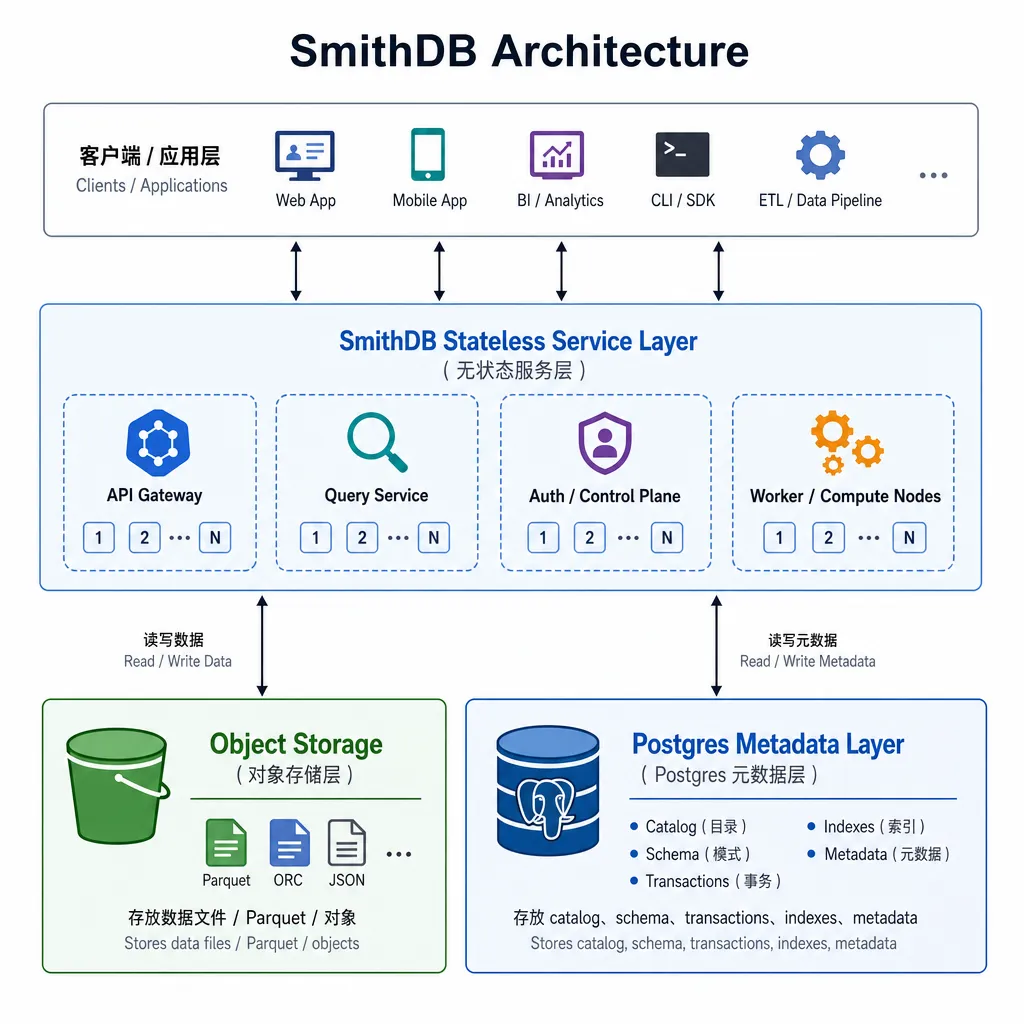
Layered Architecture: Object Storage + Metadata + Stateless Services
SmithDB’s architecture is elegantly designed:
- Object Storage Layer: Real trace data—including multimodal content—is stored in object storage systems like S3, GCS, or MinIO. Object storage is inexpensive, reliable, and infinitely scalable—ideal for massive unstructured data.
- Postgres Metadata Layer: Stores only lightweight metadata such as trace IDs, timestamps, and indexing info. Postgres handles small data gracefully and adds transactional guarantees.
- Stateless Service Layer: The query service itself is stateless and horizontally scalable. Need more query capacity? Just add machines—no complex sharding or master-slave setup required.
This design enables elastic scalability and cost optimization. By decoupling storage and computation, each can scale independently. And since the service layer is stateless, deployment on container orchestration platforms like Kubernetes is straightforward, with built-in auto-scaling.
For self-hosted enterprise use, the architecture is equally friendly—you only need an object storage (such as open-source MinIO) and a Postgres instance to deploy.
Performance Data: 12x Speedup Is Real
LangChain’s reported metrics are convincing:
- Trace tree loading P50 latency: 92ms — half of queries return the full call chain in under 100 ms, fast enough for interactive debugging.
- Full-text search latency: 400ms — searching specific text across huge trace stores feels nearly real-time.
- Up to 12x performance boost compared to LangSmith previously
This 12x improvement stems from several factors:
- Columnar + Vectorized Query Execution: reduces I/O and leverages CPU SIMD instructions.
- Specialized Index Structures: optimized for trace query patterns (time range, Agent ID, error type) outperform generic B-tree indices.
- Separated Storage of Large Blobs: keeps query paths lean and fast.
- Rust’s Zero-Cost Abstraction: far less runtime overhead than Python- or Java-based solutions.
For LangSmith users, it means a smoother debugging experience—quickly finding problematic traces, searching errors, and analyzing behavioral patterns without long query delays.
Context Hub: The Central Repository for Agent Memory
In addition to SmithDB, LangChain also announced Context Hub—a centralized system for managing agent context.
What Is Agent Context?
For an agent to act intelligently, it must remember lots of things:
- AGENTS.md file: documents describing the agent’s capabilities, usage, and constraints
- Skills: reusable learned abilities like “how to parse a PDF” or “how to call a given API”
- Policies: rules agents must follow, e.g., “don’t leak user privacy,” “ask user when uncertain”
- Memory: accumulated information during interactions, including:
- Episodic Memory: detailed history—“what the user asked last time”
- Semantic Memory: abstract knowledge—“the user prefers Python over JavaScript”
- Procedural Memory: task execution knowledge—“the standard procedure for this problem”
These pieces of context are scattered—some in code, config files, vector databases, or relational databases. Managing them is messy, version control even more so.
The Value of Context Hub
Context Hub provides a unified interface to manage all such context. More importantly, LangChain is partnering with MongoDB, Pinecone, Elastic, and Redis to define an open standard.
This standard specifies:
- Data models for different memory types (episodic, semantic, procedural)
- Version control mechanisms for memory
- APIs for memory retrieval and updates
If widely adopted, it would enable:
- Migration between backends: using Pinecone today, switch to Elastic tomorrow—no code rewrite
- Hybrid storage: episodic memory in Redis (fast read/write), semantic memory in Pinecone (vector search), procedural memory in MongoDB (flexible document store)
- Version control and rollback: like managing source code, you can revert memory to previous states after issues
This is critical for enterprise-grade agent applications. You don’t want memory to be a black box, nor locked to one vendor’s solution.
What It Means for Agent Developers
SmithDB and Context Hub mark the transition of agent applications from experimental prototypes to production systems.
Observability Becomes Mission-Critical
For demo agents, restarting upon error may suffice. But once agents handle real workloads, observability becomes critical:
- Debugging: why did the agent make this decision? Which step failed?
- Performance optimization: which tool call is slowest? Can it be parallelized?
- Cost management: how many LLM calls? What’s the spend?
- Compliance auditing: what data did the agent access? Did it violate any rules?
SmithDB’s high-performance trace storage and query capabilities make these solvable—you can monitor behavior in real time, quickly locate issues, and optimize continuously.
Standardized Memory Management
Agent memory management has long been a chaotic field—each framework implements its own approach, with no unified best practice.
Context Hub and its forthcoming open standard could change that. If major storage providers support it, agent developers will no longer struggle with questions like “which backend to use for memory” or “how to model memory data.”
It’s reminiscent of how OpenAI’s API format became a de facto standard, allowing LLM providers to be interchangeable. Memory standardization will make agent development and deployment simpler and more reliable.
Self-Hosting Possibilities
SmithDB’s architecture anticipates self-hosting. Enterprises with strict data privacy requirements (finance, healthcare, government) need to run agent observability stacks entirely within their own infrastructure—a prerequisite for adopting agent technology.
LangChain offers not a cloud-only black box but an open architecture that can be fully self-deployed, reducing adoption barriers for enterprises.
Competitive Landscape: LangChain’s Moat
Competition among agent frameworks is fierce. Beyond LangChain, you have LlamaIndex, Semantic Kernel, AutoGPT, CrewAI, and more. So, what sets LangChain apart?
Ecosystem Completeness
LangChain isn’t just a framework—it’s an ecosystem:
- LangChain Framework: agent-building toolkit
- LangSmith: observability and evaluation platform
- LangGraph: workflow orchestration for complex agents
- LangServe: deployment and service layer for agents
Now, with SmithDB and Context Hub, LangChain covers the entire lifecycle from development, testing, and deployment to operations. This end-to-end capability is extremely difficult to replicate.
Enterprise-Grade Features
SmithDB’s performance tuning, self-hosting support, and push for open standards show LangChain’s commitment to the enterprise market.
Many frameworks target research or personal projects, lacking reliability, scalability, and security for production. LangChain’s investment in these capabilities makes it enterprise-ready.
Open vs. Closed
LangChain’s approach is open: the framework is open source, SmithDB can be self-hosted, and Context Hub promotes open standards—contrasting with certain vendors’ closed ecosystems.
Openness reduces vendor lock-in and attracts developers and enterprises. The challenge is commercialization—LangChain’s answer: monetize via hosted services (LangSmith Cloud) and enterprise support, not restrictions.
Technical Details Worth Noting
DataFusion Query Optimization
Apache DataFusion provides powerful query optimizations such as:
- Predicate Pushdown: pushes filters down to data sources, minimizing data scanned
- Projection Pushdown: reads only necessary columns instead of whole rows
- Parallel Execution: automatically splits queries into concurrent subtasks
These are especially valuable for trace queries—e.g., finding “all traces with execution time > 5s within the past hour.” DataFusion would:
- Filter by time range (predicate pushdown)
- Read only timestamp and execution-time columns (projection pushdown)
- Parallel-scan data partitions
Result: minimal data processed and lightning-fast queries.
Vortex Compression and Encoding
As a columnar format, Vortex employs multiple compression and encoding techniques:
- Dictionary Encoding: replaces repetitive values (like Agent ID or tool names) with integer indexes
- Run-Length Encoding: stores repeating values as value + repetition count
- Bit Packing: stores small-range integers using fewer bits
These drastically reduce space while boosting query performance by minimizing read size.
Object Storage Tiering
Object storage is cheap, but higher latency than local disks. SmithDB likely adopts tiered storage:
- Hot data: recent traces stay in high-performance tiers (e.g., S3 Standard)
- Warm data: older traces move to lower-cost tiers (e.g., S3 Infrequent Access)
- Cold data: archived traces go to ultra-cheap tiers (e.g., S3 Glacier)
This maintains fast access for current data while keeping costs low.
Future Outlook
Real-Time Analytics
Currently, SmithDB is mainly for post-execution analysis—checking traces after agents finish. In future, expect real-time analytics:
- Live monitoring: see agent state and performance as it runs
- Alerting: trigger notifications upon anomalies (e.g., long execution, high error rate)
- Active intervention: pause or correct misbehaving agents immediately
This will require streaming data processing, possibly integrating engines like Apache Flink or Kafka Streams.
AI-Powered Analysis
With rich trace data, AI can enable smarter insights:
- Anomaly detection: automatically find abnormal agent behaviors
- Performance optimization tips: recommend improvements (e.g., “parallelize these tool calls”)
- Root-cause analysis: locate fundamental reasons behind agent errors
These AI-driven functions could reduce agent operations workload dramatically.
Cross-Agent Collaborative Analytics
Today traces focus on single agent runs. Future use cases may involve multi-agent collaboration analysis:
- Agent call relationships: A invokes B, which calls C, etc.
- Collaborative performance: identify bottlenecks across the entire chain
- Pattern mining: discover most effective agent partnerships
SmithDB’s distributed design forms a solid foundation for such analysis.
Conclusion
SmithDB’s release marks a new stage in agent infrastructure—from “just runs” to “runs well, with observability and control”—a necessary step toward maturity in agent technology.
LangChain’s efforts in observability and memory management reflect deep enterprise insight. This isn’t tech showmanship—it directly addresses real pain points.
For developers, now is a great time. Infrastructure is maturing, barriers are falling, and the market is far from saturated. Those who leverage tools like SmithDB early may gain a serious edge.
Of course, tools are just enablers. Success ultimately depends on understanding the business context, user needs, and technical constraints. SmithDB can show you what your agent does—but deciding what it should do is still up to you.
References
- LangChain Interrupt 2026 announcements - Reddit - Official announcement from day 1 of LangChain Interrupt 2026, including details on SmithDB and Context Hub
- LangChain GitHub - Source repository for the LangChain open-source framework


