
OpenAI Opens the Gates for Open Source Developers: Six Months of Pro + $25,000 in API Credits

OpenAI launches the **Codex for OSS** program, offering open-source maintainers a 6-month ChatGPT Pro subscription and up to \$25,000 in API credits. The application threshold is low — core contributors, active maintainers, and even documentation translators have a chance to apply.
OpenAI Opens the Gates to Open Source Developers: 6-Month Pro + $25,000 in API Credits
OpenAI just threw a big gift pack to the open-source community. In mid-May, they officially opened the application channel for the Codex for Open Source program. The core offer is straightforward: eligible open-source maintainers receive a 6-month ChatGPT Pro subscription plus up to $25,000 in API credits. This isn’t a trial—it’s a real, substantial investment.
The target group for this program is open-source maintainers—the folks quietly fixing bugs, reviewing PRs, and managing releases on GitHub. OpenAI’s logic is simple: the open-source ecosystem is the foundation of the software industry, and maintainers are its structural reinforcement. But these people often lack tools and resources. Codex for OSS aims to put OpenAI’s programming toolchain directly in their hands, making their work easier and more efficient.
The Threshold Is Lower Than You Think
Many people’s first reaction to the news was: “Is my project eligible?” In fact, OpenAI has kept the bar unusually low this time—unlike previous programs that required a certain number of stars or downloads.
Eligibility is mainly based on three factors:
- You are a core maintainer: the primary person in charge of reviewing PRs, triaging issues, and managing releases
- You are an active contributor: not necessarily the owner, but consistently making meaningful code contributions and maintenance
- You play a key role in the ecosystem: this category is quite open—documentation translators, community operators, and tutorial writers all count, as long as you can clearly explain your contributions and the project’s importance in the application form
The project itself doesn’t face harsh requirements, either. OpenAI will consider factors like GitHub stars, monthly downloads, and ecosystem influence—but none are strict thresholds. A widely depended-upon foundational library with few stars can still qualify; conversely, a highly starred project with little real-world use might not.
What You’ll Get
Selected maintainers will receive three things:
1. 6-Month ChatGPT Pro Subscription
This is the most direct benefit. ChatGPT Pro includes access to Codex—OpenAI’s programming assistant. You can use it to:
- Write and refactor code: generate boilerplate, refactor legacy modules, or add unit tests
- Review PRs: have Codex perform a preliminary logic check to catch potential issues
- Triage issues: quickly understand bug reports and generate reproduction steps or fix suggestions
- Generate documentation: automatically produce API docs or examples from code comments
The Pro subscription also grants access to o1 and o1-pro reasoning models, helpful for complex architecture design or algorithm optimization.
2. Conditional Access to Codex Security
Some participants will get access to Codex Security, OpenAI’s code security auditing tool. It automatically scans for vulnerabilities, dependency risks, and sensitive information leaks. For foundational libraries relied upon by many projects, this is invaluable—a single vulnerability could affect thousands of downstream projects.
3. API Credit Funding
This is the most flexible benefit. OpenAI provides API credits based on project needs, up to $25,000. These can be used for:
- Automated PR reviews: integrate Codex into CI/CD to check code quality and style automatically
- Release automation: generate changelogs, update documentation, and verify version compatibility
- Issue auto-categorization: use GPT-4 to analyze issues and auto-tag or prioritize them
- Community support: build GPT-powered FAQ bots to reduce repetitive support load
The API credits focus more on engineering and automation than personal productivity. If you already have a mature CI/CD setup, this funding can significantly boost your maintenance efficiency.
Application Process and Key Points
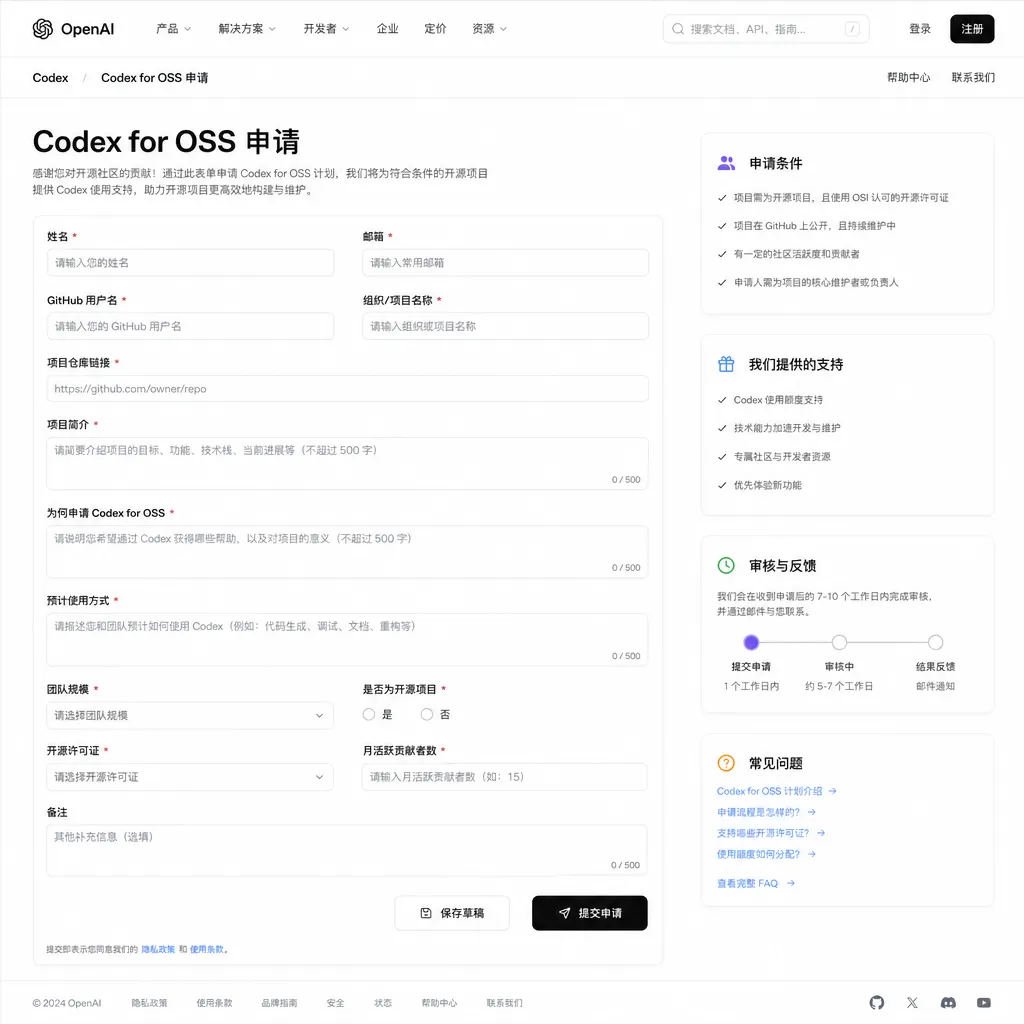
Apply at the OpenAI website: https://openai.com/zh-Hans-CN/form/codex-for-oss/
The form is straightforward. You’ll need to provide:
- Project’s GitHub link
- Your role and contributions
- Proof of project impact (stars, downloads, dependencies, etc.)
- How you plan to use the resources
- Organization ID (if applicable)
The most critical section is “Why your project qualifies.” OpenAI will assess how well you justify your project’s importance and your contributions. If your project isn’t a high-profile one, be sure to explain:
- What real-world problem it solves
- How many projects or users depend on it
- What core maintenance work you handle
- Exactly how you’ll use the resources if approved
After submission, OpenAI will review your application within a few weeks. If accepted, you’ll receive an email notification and can start using your Pro subscription and API credits.
Note: submitting an application means you agree to the program’s terms. These resources are meant specifically for open-source project maintenance, not for commercial or personal use.
The Real Value
From a financial perspective, a 6-month Pro subscription is worth about $120 (at $20 per month), and up to $25,000 in API credits brings the total to around $25,120—a substantial amount for an individual maintainer or small team.
But the real value lies in the tools themselves. Open-source maintainers’ time is expensive—especially those maintaining projects in their spare time. The tasks Codex can handle—code reviews, documentation, issue triage—are the most time-consuming yet least technically challenging. Automating or semi-automating these tasks allows maintainers to focus on architecture and feature development.
API credits are particularly valuable for scaling. An active open-source project may get dozens of PRs and hundreds of issues daily. Manual handling easily becomes a bottleneck. With API-powered automation, response times and maintenance quality can see a substantial boost.
Comparison with Other Companies
This isn’t the first AI tool program aimed at open-source developers. GitHub Copilot has long been free for open-source maintainers, and Anthropic’s Claude offers similar support. OpenAI’s initiative differs in that:
- More comprehensive resource package: not just tool access, but also large API credits—covering individual to engineering-scale use
- Lower barrier to entry: project size isn’t a requirement; even documentation contributors or community managers are eligible
- Stronger time focus: six months is enough to complete a feature iteration or refactor a medium-sized project
There are also limits: once the six months end, you must either pay or reapply if the program continues. API credits don’t automatically renew after exhaustion. That means maintainers should use this window to set up their automation pipelines—so that even after free resources expire, their workflows remain functional.
The Long-Term Issue in Open Source
This initiative highlights a longstanding problem: maintainer sustainability.
Many widely used projects are maintained by just one or two people, often in their spare time. When these projects develop security issues or stop maintenance, the effects ripple across ecosystems. The 2021 Log4j vulnerability is a textbook example—a logging library relied upon by countless Java projects, maintained by only a handful of volunteers.
OpenAI’s Codex for OSS essentially reduces maintenance costs through tooling—it’s a short-term fix. The real solution lies in rethinking how the industry funds open source: not just providing money or tools, but establishing sustainable support mechanisms so maintainers can treat open-source work as a viable career, not just a side hobby.
Still, from a practical standpoint, this program offers genuine help. If you maintain an open-source project—big or small—it’s worth applying. The worst case is rejection; the best case is access to a toolkit that significantly boosts your productivity.
Application Tips
If you plan to apply, here are a few suggestions:
- Quantify your contributions: use data—e.g., “Reviewed 500+ PRs in the past year” or “My library is used by 10,000+ projects.”
- Clearly explain use cases: be specific—e.g., “Use Codex for preliminary PR reviews” or “Build automated issue classification with the API.”
- Emphasize project impact: highlight if your project is a key ecosystem dependency or solves a pain point in a niche field.
- Prepare project metrics: GitHub stars, forks, monthly downloads, dependent projects—organize this data beforehand.
If you’re not a core maintainer but contribute significantly, explain your role clearly. For example, as a documentation translator, emphasize “Maintained the Chinese docs covering XXk developers,” or as a community manager, “Moderate the Discord community with XX monthly active users and resolved XX tech questions.”
Final Thoughts
This move from OpenAI is a goodwill gesture toward the open-source community. While six months isn’t long and $25,000 in credits may not cover large projects, it sends a clear message: big tech is starting to take open-source maintainers’ tooling needs seriously.
If you’re an open-source maintainer, you can apply now. If you’re an open-source project user, share this with maintainers—they might not know about it yet.
A healthy open-source ecosystem requires collective maintenance: tool vendors provide resources, enterprises offer funding, and individual developers contribute code and time. That’s how the cycle keeps spinning. Codex for OSS may be a small step in this cycle, but at least it’s one in the right direction.
References
- OpenAI Official Application Page — Official entry and full details for the Codex for Open Source program
- Linux.do Community Discussion — Developers’ real application experiences and discussions about the program


