
Ali Qoder 1.0: The Agent team takes over the entire development process

Alibaba released Qoder 1.0 today, upgrading it from an AI IDE to an autonomous agent development platform. Developers only need to define their requirements—the Agent team will autonomously handle execution, verification, and delivery—introducing, for the first time, a team-level knowledge sharing mechanism.
Alibaba Qoder 1.0: Agent Teams Take Over the Entire Development Process
Alibaba today released Qoder 1.0, officially upgrading it from an AI IDE to an autonomous development workbench for intelligent agents. The core logic of this upgrade is: developers only need to focus on defining the requirements, while the Agent team autonomously handles execution, verification, and delivery. It currently supports Windows, macOS, and Linux, allowing over 5 million users worldwide to download and use it directly.
This is not a simple piling up of features. Qoder 1.0 has been fundamentally restructured at the system level, upgrading the traditional chat interface into a structured Task Runtime and merging scattered contextual inputs into a unified, runtime-driven Knowledge Engineering system. As Alibaba puts it, the model provides intelligence, the Harness determines whether that intelligence can turn into usable delivery.
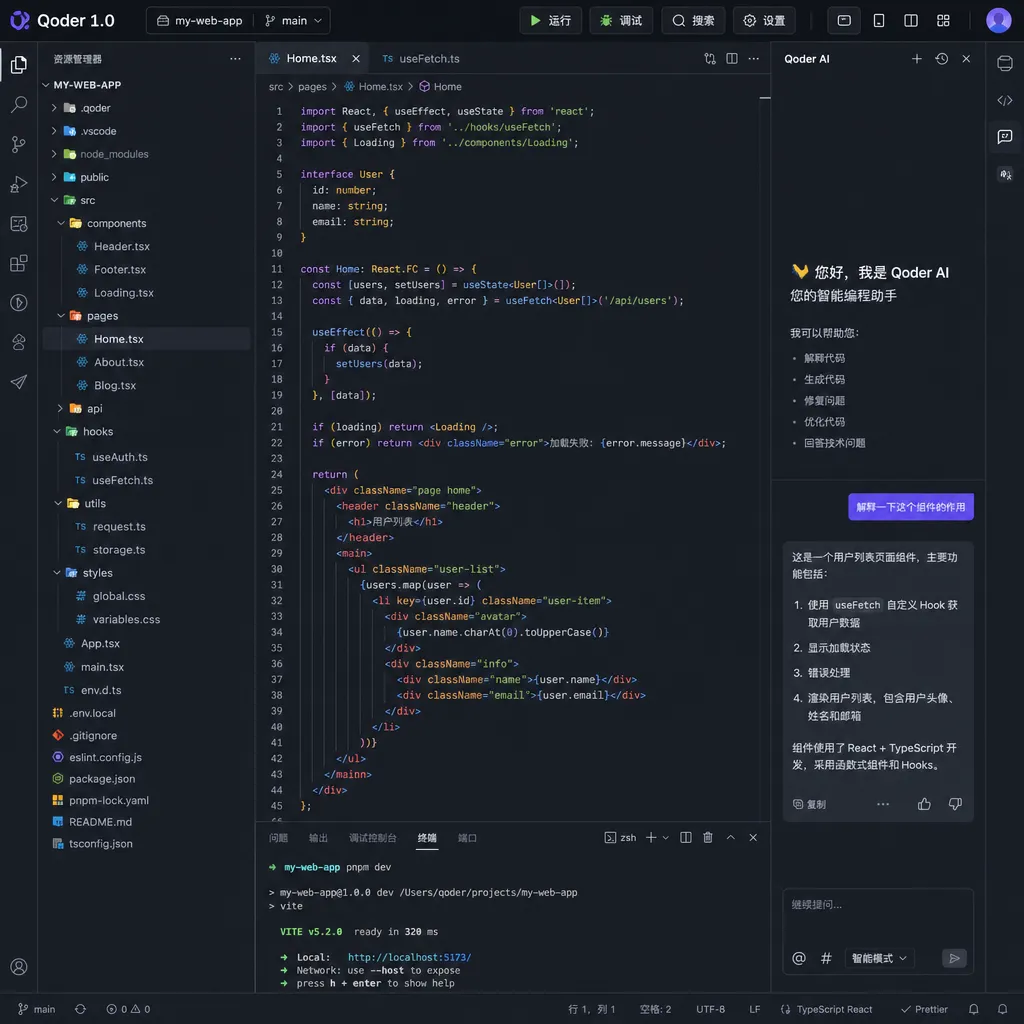
Quest Window: From Mode to Independent Workbench
The most visible change in Qoder 1.0 is that Quest has been upgraded from a mode within the IDE to an independent window. This window integrates task management, status tracking, artifact review, and knowledge invocation — becoming a development workbench tailored for an Agent-first workflow.
Once the developer defines a goal, execution, verification, and delivery are all carried out by Agents within the workbench. Engineering information such as file structures, code changes, terminal outputs, and browser previews can be expanded on demand, allowing developers to explore project details without leaving the current task context. This design eliminates the cognitive burden caused by frequent window switching.
More importantly, Qoder 1.0 expands parallelism to cross-project, cross-repository dimensions. Developers can run different Agent tasks in multiple workspaces simultaneously and track all ongoing tasks in real time through a unified panel. Each Quest task has independent status labels (Running / Awaiting Confirmation / Completed), with progress clearly visible. Once a task is complete, the system automatically generates a Summary delivery list, including progress updates, documentation, and code changes for quick review.
This design targets Cursor’s Composer mode, but Qoder offers more refined management of parallel tasks and status tracking. Cursor’s Composer behaves more like single-thread dialogue-based coding, while Qoder’s Quest Window serves as a multi-threaded task orchestration hub.
Team-Level Knowledge Engine: The World’s First Knowledge-Sharing Mechanism
The most notable upgrade in Qoder 1.0 is the team-level Knowledge Engine — the world’s first implementation of a knowledge-sharing mechanism in an AI programming tool.
Previously, Qoder’s memory, Repo Wiki, and Knowledge Cards were separate. Version 1.0 unifies them into a single Knowledge Engine:
- Memory System: Records user expression habits, technical preferences, team standards, and historical decisions
- Repo Wiki: Automatically builds architectural knowledge, module relationships, and coding standards from repositories
- Knowledge Cards: Extracts technical stack knowledge and best practices
Unified management allows Agents to continuously invoke relevant knowledge during task execution. According to Alibaba’s test data, after deploying the Knowledge Engine, code retention increased by 11%, token consumption decreased by 40%, and dialogue rounds dropped by 33%.
Those numbers are quite convincing. A higher code retention rate means Agents generate code more in line with project standards, reducing developer edits. Lower token usage and fewer dialogue rounds show that the engine reduces redundant communication.
Even more crucially, the Knowledge Engine enables team collaboration. Based on repositories, each member can contribute and refine knowledge, while Agents continuously optimize it. All knowledge is stored in the cloud, enabling unified enterprise maintenance and audit tracking. Individual experience thus transforms into organizational growth capability.
This design addresses a key pain point of AI coding tools: helping Agents understand team context. Tools like Cursor and GitHub Copilot mainly rely on codebase context, but implicit team knowledge (such as design rationale or lessons learned) often escapes Agents. Qoder’s Knowledge Engine makes implicit knowledge explicit and structured through memory and collaboration mechanisms.
Experts Team: From Single Agent to Multi-Agent Collaboration
Qoder’s previously introduced Experts Team mode is now formally integrated into the Quest Window in version 1.0. Developers can freely choose between single-Agent mode or the Experts Team mode within Quest.
The expert team consists of five roles — Planning, Research, Coding, Review, and Testing — collaborating in a pipeline-style workflow. This mirrors real software team division, with each expert responsible for a specific phase, avoiding capability bottlenecks of single Agents in complex tasks.
Version 1.0 adds custom expert capabilities. Developers can create exclusive Agent teams with domain knowledge, task skills, and external tool interfaces tailored to their business needs. This flexibility is particularly valuable for enterprise users. Different industries and teams have varying standards and tech stacks, so a generic Agent rarely fits all scenarios. Custom experts transform Qoder from a tool into a platform.
Multi-Agent collaboration is the next battleground for AI development tools. OpenAI’s Swarm and Anthropic’s Claude Projects explore similar directions. Qoder’s Experts Team is ahead in productization — integrating multi-Agent collaboration directly into the workbench rather than offering it as a separate experimental feature.
Agent Harness Overhaul: The Leap from Intelligence to Delivery
Behind Qoder 1.0’s product upgrade lies a systematic overhaul of the underlying Agent Harness. As Alibaba clearly describes: the model provides intelligence, the Harness determines whether that intelligence becomes usable delivery.
Qoder 1.0 improves the Harness layer along two paths:
- Upgrade traditional chat to a structured Task Runtime — meaning Agents no longer just interact through unstructured conversation but follow a lifecycle (definition, execution, verification, delivery) in structured management. The runtime tracks states, manages artifacts, and supports rollback, making the Agent’s work observable and controllable.
- Merge scattered contextual input into runtime Knowledge Engineering — this powers the Knowledge Engine. It’s not simple RAG (retrieval-augmented generation) but dynamic, stage-specific knowledge injection into runtime, ensuring Agents always operate with correct context.
The core logic of these upgrades is clear: the bottleneck of AI coding tools isn’t model capability, but engineering capability. Models like GPT-4, Claude 3.5 Sonnet, and Gemini 1.5 Pro already generate strong code, but consistent, reliable delivery in real development scenarios is the real challenge.
Qoder’s Harness overhaul aligns with backend architectures of tools like Devin and Cursor. Devin’s advantage lies in end-to-end automation but with slow productization. Cursor is strong in lightweight integration and rapid iteration, yet weaker in complex orchestration and knowledge management. Qoder aims to balance both — combining Devin’s automation with Cursor’s speed.
Differentiation from Competitors
The AI coding-tool market is already crowded — GitHub Copilot, Cursor, Windsurf, Cline, Continue, and more each have distinguishing strengths. Qoder 1.0 stands out in three areas:
1. Team-Level Knowledge Sharing Mechanism
This is Qoder’s most unique capability. While other tools focus on individual developer experience, Qoder was designed for team collaboration. Its Knowledge Engine makes implicit organizational knowledge explicit and structured — far more valuable for enterprises than individuals.
2. Multi-Workspace Parallel Task Management
Cursor’s Composer is single-threaded; Windsurf’s Cascade mostly focuses on single tasks. Qoder’s Quest Window supports cross-project and cross-repo parallel task management — crucial for developers managing multiple projects concurrently.
3. Custom Expert Teams
Multi-Agent collaboration isn’t new, but Qoder made it practical. Developers can customize Agent teams with domain knowledge and tool interfaces. This flexibility elevates Qoder from a tool to a platform.
Of course, Qoder has weaknesses. Compared to Cursor’s lightweight integration and quick responsiveness, Qoder’s learning curve is steeper. Concepts like Quest Window, Knowledge Engine, and Expert Teams take time to understand and adapt to. For developers seeking simple code completion, Qoder may feel too complex.
Product Matrix and User Scale
Qoder is a global intelligent-agent programming platform, offering Qoder IDE, Qoder CLI, Qoder JetBrains Plugin, Qoder Mobile, QoderWork, and QoderWake. Since its launch in August 2025, Qoder has served over 5 million users worldwide.
That user scale places it among the top-tier AI coding tools. GitHub Copilot exceeds 10 million users, Cursor is around 1 million. Reaching 5 million in under a year shows rapid growth.
Its product lineup is also comprehensive. Qoder IDE is the core; Qoder CLI covers command-line scenarios; the JetBrains plugin supports IntelliJ IDEA and PyCharm; mobile tools cover fragmented use cases; QoderWork and QoderWake serve teams and enterprises.
This full-stack approach ensures Qoder covers all developer scenarios, though the long product line risks spreading resources thin. Judging from version 1.0’s upgrade focus, Alibaba is prioritizing the IDE and Quest Window — the right strategy.
Real Value for Developers
The real value of Qoder 1.0 depends on use cases:
Individual Developers: For plain code completion or conversational coding, Cursor or GitHub Copilot may suit better. Qoder shines in complex tasks and multi-project setups — features most solo developers won’t fully use.
Team Developers: For teamwork and shared knowledge, Qoder’s Knowledge Engine and collaboration mechanisms are extremely valuable. Teams with defined coding standards and tech stacks will especially benefit, reducing communication costs.
Enterprise Users: If you need customized Agent teams, unified knowledge management, auditing, and compliance — Qoder is currently the most complete solution. Custom expert capabilities and cloud-based knowledge storage make it an enterprise-grade platform.
Pricing-wise, Qoder is free for individual users, with business inquiries required for enterprise plans. This mirrors Cursor and Copilot’s strategy: build user base via free tiers, monetize through enterprise editions.
Technical Implementation Challenges
Qoder 1.0 faces several technical challenges:
1. Knowledge Engine Accuracy
Extracting structural, modular, and standard knowledge from repositories involves complex code analysis, dependency resolution, and pattern recognition. Inaccurate results could mislead Agents. An 11% improvement in code retention signals progress but leaves room for refinement.
2. Multi-Agent Collaboration Stability
The difficulty lies in task decomposition and result integration. Poor decomposition or conflicting Agent outputs can harm final quality. Qoder’s pipeline-style Expert Team is conservative but stable.
3. Parallel Task Resource Management
Running multiple Workspace tasks simultaneously demands high system resources. Each Agent task requires independent context, environment, and state tracking. Balancing large-scale parallelism with performance is an engineering challenge.
4. Knowledge Sharing Privacy and Security
Team-level sharing means centralized cloud storage. For enterprises, this raises sensitive issues — repositories may contain trade secrets or client data. Qoder must provide strong privacy and access control safeguards.
Industry Trend: From AI IDE to Agent Workbench
Qoder 1.0’s upgrade aligns with an industry-wide shift — from AI IDEs to Agent Workbenches.
Early AI tools (GitHub Copilot, Tabnine) mainly provided code completion, essentially enhanced IDE plugins. Second-generation tools (Cursor, Windsurf) introduced conversational programming, letting developers describe needs in natural language. Third-generation tools (Devin, Qoder 1.0) aim for full Agent-managed development cycles — developers define requirements and acceptance criteria, Agents handle the rest.
The underlying trend: AI’s role is shifting from assistant to executor, while developers shift from coders to requirement and quality managers.
However, this movement brings challenges. The more autonomous the Agent, the less control developers retain. When an Agent errs, developers invest extra time understanding what went wrong and why. Hence Qoder 1.0’s emphasis on runtime observability and controllability.
Trust is another issue — how much can developers delegate? For critical logic, security-sensitive, or performance-driven code, many still prefer manual work. Qoder’s dual-mode design — switching between solo Agent and Expert Team — seeks balance between autonomy and human oversight.
Conclusion
Qoder 1.0 represents a systematic upgrade, not just new features. Transitioning from AI IDE to Agent Workbench, from individual tool to team platform, from single Agent to multi-Agent collaboration — Qoder has made major shifts in both product and architecture.
The Team-Level Knowledge Engine is Qoder’s most distinctive and valuable innovation, tackling a core AI coding bottleneck: helping Agents understand team context. For enterprises, this is far more meaningful than mere code completion or conversational coding.
Multi-Workspace parallel management and customizable expert teams highlight Qoder’s support for complex scenarios. These may be unnecessary for individuals but essential for teams and enterprises.
Qoder 1.0’s biggest weaknesses are its learning curve and complexity. Compared to Cursor’s lightweight integration, Qoder demands more time to understand. But if your team needs customizable Agents, knowledge sharing, and multi-project management, Qoder currently offers the most complete solution.
The competition among AI coding tools has just begun. Qoder 1.0’s release shows Alibaba’s serious commitment to this space. The next key indicators will be the accuracy of its Knowledge Engine, stability of multi-Agent collaboration, and enterprise adoption rate. If these continue to improve, Qoder could secure a strong foothold in the enterprise market.
Reference
- Alibaba’s AI Coding Tool Qoder 1.0 Released — Official IT Home report with detailed product introduction


