
AWS has integrated the Claude Platform into its own account system.
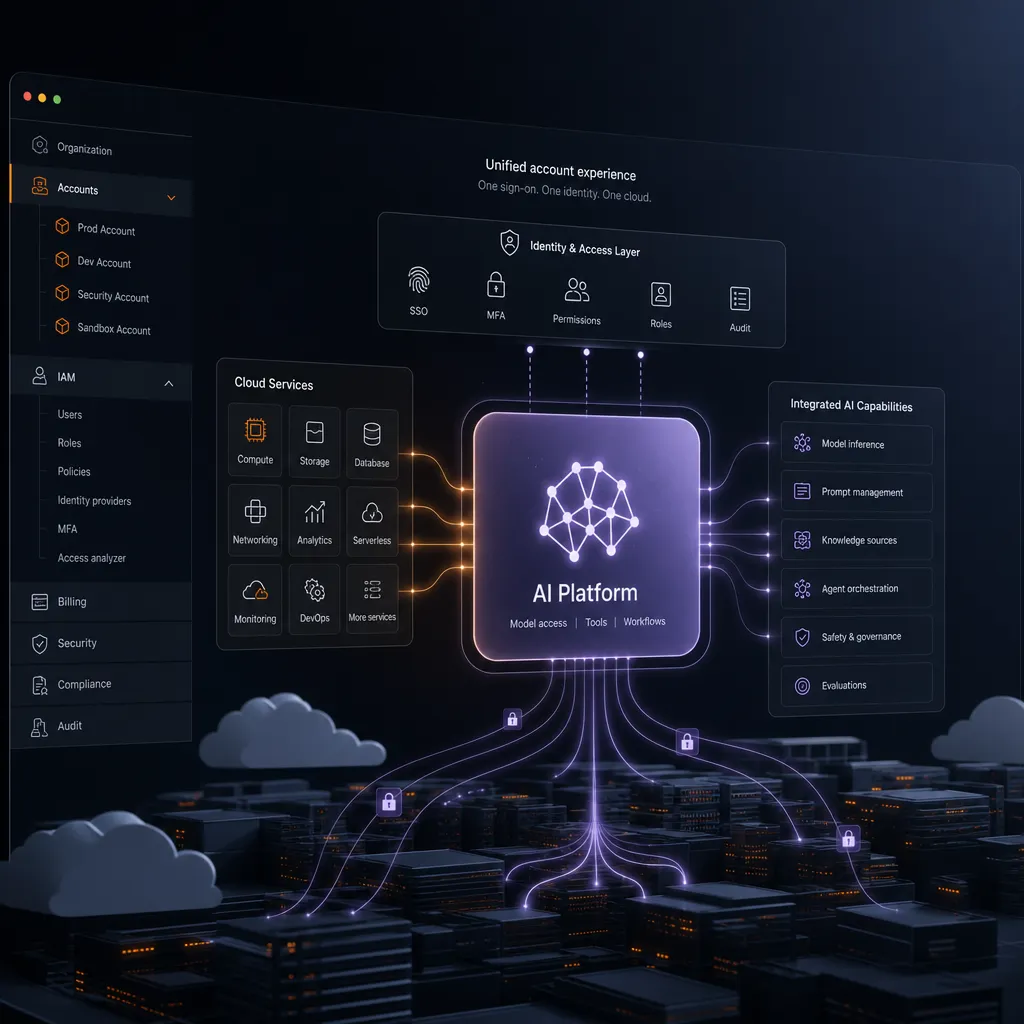
AWS becomes the first cloud provider to natively host the Anthropic Claude Platform, allowing developers to invoke it directly with their existing AWS accounts, running in parallel with Bedrock. Behind this is an extension of the two parties’ $13 billion investment and $100 billion compute power commitment.
This time, AWS didn’t stuff Claude back into Bedrock again, but did the reverse — it directly connected Anthropic’s native Claude Platform to the AWS account system.
On May 13, AWS announced the general availability (GA) of Claude Platform on AWS, making it the world’s first hyperscale cloud provider to directly host Anthropic’s native Claude Platform. Developers no longer need to register an Anthropic account, link a credit card, or reconcile invoices; by logging in with their existing AWS account, they can access the full Claude Platform capabilities. Billing is merged into the main AWS bill and can be offset against enterprise EDP (Enterprise Discount Program) commitments.
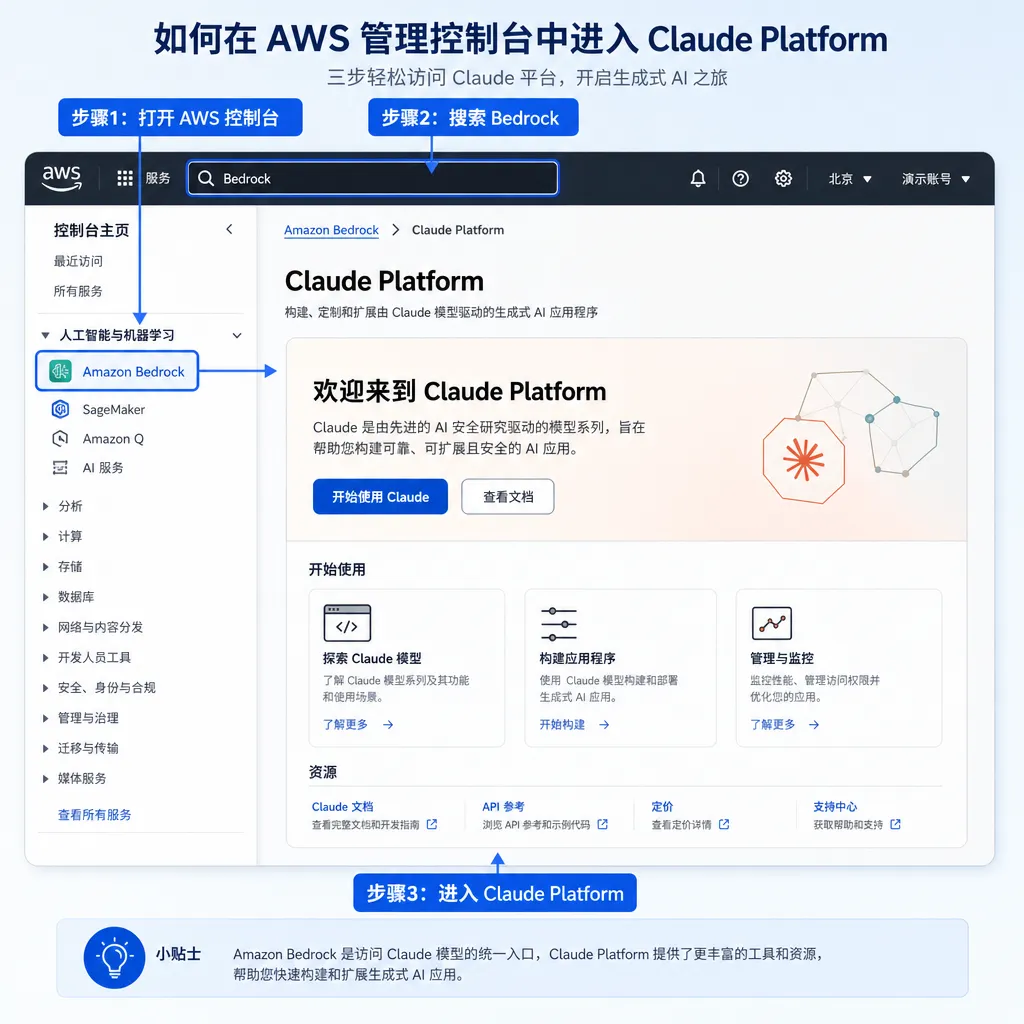
This is not the same thing as Bedrock
Many people’s first reaction is — isn’t Claude already on Bedrock? What’s new this time?
The key lies in the word “native.” The Claude on Bedrock is AWS’s managed version: the model is deployed within AWS’s secure boundary, AWS is the data processor, it uses AWS API protocols, and benefits from AWS’s full compliance infrastructure — regional data residency, VPC, KMS, etc. The tradeoff is that when Anthropic releases new features (like tool use, new beta options, or Skills), Bedrock typically lags behind by several weeks or longer.
Claude Platform on AWS takes a different path:
- Anthropic operates the platform itself — model inference runs on Anthropic’s infrastructure, with data processed outside AWS’s boundary
- New features roll out simultaneously with native Claude API updates — whatever Anthropic releases today, developers on AWS can use today
- AWS only handles the entry point, providing identity management (IAM), unified billing, and CloudTrail audit logs
Put simply, AWS acts more as a “reseller + identity gateway” rather than a “hosting provider.” This differs sharply from Microsoft’s Azure OpenAI Service model — Azure runs OpenAI models within its own infrastructure, keeping customer data inside Azure’s boundary. AWS, on the other hand, explicitly recognizes Anthropic’s platform independence and merely links accounts and billing.
It’s a subtle stance. AWS isn’t forcing Anthropic into its tech stack but instead offers a “dual-track” choice: for compliance and data residency, use Bedrock; for the native experience and the latest features, use Claude Platform on AWS.
Who will use it — and who won’t
From the product positioning perspective, this new channel is clearly aimed at two types of customers:
1. Teams already deeply using Anthropic’s native API.
They care about original features like Claude Code, Computer Use, Skills, and Agent SDK, and don’t want to rewrite calls just to use Bedrock. Until now, they either paid directly for the Anthropic API and wrestled with financial reconciliation, or settled for Bedrock and sacrificed new features. Now AWS offers a third option: keep the native experience, but merge billing into the enterprise AWS account — resolving finance and procurement in one go.
2. Enterprises planning large-scale agent deployments.
One of Claude Platform’s core capabilities is managed agents, supporting code execution, Skills, advisor policies, and a full toolchain with multiple beta features — clearly targeting scalable agent deployment scenarios. These workloads care much more about getting the latest agent capabilities than about data residency — customers want performance and features more than boundary control.
Conversely, financial, healthcare, government, and European enterprises constrained by GDPR, HIPAA, and data sovereignty regulations will likely stay with Bedrock. Claude Platform on AWS explicitly states that “user data is processed outside AWS’s secure boundary” — which basically rules it out for strict compliance scenarios.
Billing, IAM, and CloudTrail
For developers, the most tangible improvements are:
- Unified billing: Anthropic API spending counts toward the AWS EDP discount calculation and is no longer a separate SaaS expense
- Unified IAM access control: Use existing IAM policies to manage who can call Claude, which models, and how many tokens
- CloudTrail auditing: All API calls have audit logs — previously, this had to be built manually with Anthropic’s native API
- Simplified procurement process: Enterprises no longer need separate contracts, legal reviews, and procurement flows with Anthropic — AWS Marketplace processes can be reused directly
These may look like mere “operational details,” but for large enterprises, integrating a new vendor’s contracts, billing, auditing, and IAM often takes months. This time, AWS effectively handled all of it for Anthropic in one go.
The compute behind that $13 billion investment
This partnership isn’t an isolated event. Reviewing the timeline:
- On April 20, AWS and Anthropic expanded their collaboration; Amazon’s total investment in Anthropic rose to $13 billion, with another $20 billion tied to commercial milestones
- Anthropic committed to spend over $100 billion on AWS technologies over the next decade
- The procurement scope includes Trainium2 through Trainium4 chips, plus tens of millions of Graviton cores
- Project Rainier has deployed nearly one million Trainium2 chips, dedicated to Claude’s training and inference
- Locked compute capacity reaches 5 gigawatts
This is a classic “chips for usage” deal: AWS secures Anthropic’s long-term compute orders with its Trainium chips, while Anthropic gains stable, non-Nvidia-dependent compute capacity. The launch of Claude Platform on AWS is essentially the product-level fulfillment of that deal — since Claude’s training already runs on AWS, connecting its API system to AWS accounts is a natural next step.
It’s worth noting the execution risk of the Trainium roadmap itself. Trainium3 is still scaling up; Trainium4 specs aren’t public; and delivering the 5 GW capacity depends on AWS’s ability to execute its in-house chip roadmap on time. Any delays there would also postpone the $100 billion commitment.
The AWS–Azure OpenAI model showdown
This launch highlights a fascinating contrast between AWS-Anthropic and Microsoft-OpenAI models:
| Dimension | Azure OpenAI Service | Claude Platform on AWS | |------------|---------------------|------------------------| | Hosting provider | Microsoft | Anthropic | | Data boundary | Inside Azure | Outside AWS | | Feature updates | Lagged | Synchronized | | Compliance strength | Strong | Weak | | Platform independence | OpenAI yields some | Anthropic fully retains |
Microsoft’s approach is to “bring OpenAI in-house” — customers buy Azure’s compliance and stability, while OpenAI sacrifices some autonomy. AWS does the opposite — it recognizes Anthropic’s independence and positions itself as an “account gateway,” letting customers choose between the compliant Bedrock version and the native Claude Platform on AWS.
Which model is better remains to be seen. Azure OpenAI suits enterprise IT teams but frustrates cutting-edge developers; AWS’s approach is the reverse. From an ecosystem perspective, AWS gives Anthropic more autonomy, making it likelier to remain an independent AI lab rather than a cloud-vendor subsidiary.
Unanswered questions
The official AWS announcement still leaves several ambiguities:
- Pricing details: It’s unclear whether pricing matches Anthropic’s native API or includes AWS-exclusive discounts
- Network routing: The path and latency from AWS regions to Anthropic’s inference clusters aren’t disclosed
- Supported models: Three models are confirmed, but exactly which ones — including whether Claude Sonnet and Haiku are included — remains to be seen
- Availability zones: “Most AWS commercial regions” — meaning some regions and all GovClouds are currently excluded
These will only become clear after several weeks of actual usage.
What it means for developers
If you already run workloads on AWS and want Claude’s latest features, this is a direct benefit — no need for a separate Anthropic account, and no waiting for Bedrock updates.
If your goal is “one key to call all major models,” aggregation platforms like OpenAI Hub are still the lighter choice — they offer domestic connections, OpenAI-compatible formats, and unified SDKs supporting Claude, GPT, Gemini, DeepSeek, and more, avoiding multi-account, multi-SDK, and multi-billing overhead. Claude Platform on AWS solves enterprise-level procurement and identity governance; aggregator platforms solve developer experience and multi-model flexibility — the two target different use cases.
More importantly, this launch marks a new collaboration paradigm: hyperscale cloud providers no longer need to “absorb” AI labs — they can simply handle accounts and billing. If this model proves successful, we might soon see Google Cloud connect with xAI and Oracle with Mistral. The competition in AI infrastructure is shifting — from “who hosts the models” to “who controls the account system.”
References
- linux.do – AWS becomes the cloud provider hosting Anthropic’s native Claude Platform: original discussion, including release highlights
- Reddit r/ClaudeAI – Claude Platform on AWS GA discussion: developers’ first-hand reactions to the launch
- Reddit r/ClaudeAI – The Claude Platform on AWS is now generally available: follow-up discussion covering differences from Bedrock and synchronization policy


