
ChatGPT connects to bank accounts, OpenAI bets on financial AI

OpenAI connects ChatGPT directly to bank accounts through Plaid, allowing users to manage their finances using natural language. This isn’t a simple chatbot upgrade, but a key step in AI’s evolution from content generation to financial decision-making.
ChatGPT Connects to Bank Accounts: OpenAI Bets on Financial AI
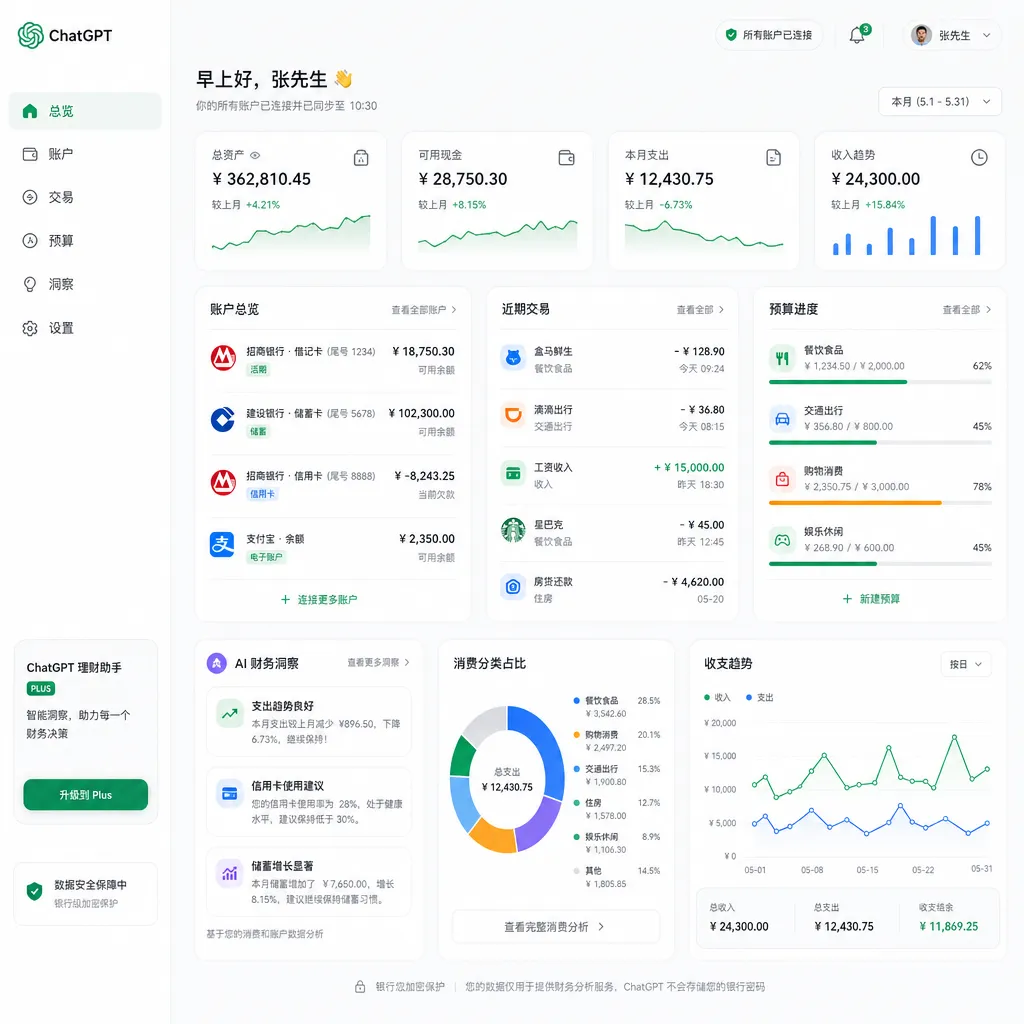
Yesterday (May 15), OpenAI announced that ChatGPT will support direct bank account connections. Users can authorize ChatGPT to access their financial data via Plaid. This means you can directly ask ChatGPT questions like “How much did I spend on takeout this month?” or “Help me find subscriptions I can cancel,” and it will give you answers based on real billing data instead of generic financial advice.
This isn’t OpenAI’s first attempt to move into vertical scenarios, but this time is different. Financial data is among users’ most sensitive information, and OpenAI’s decision to launch this feature now suggests they believe ChatGPT is reliable enough to handle real money matters.
Technical Implementation: Plaid as the Bridge, ChatGPT as the Brain
OpenAI chose Plaid as its technology partner. Plaid is North America’s largest financial data aggregation platform, connecting over 12,000 financial institutions, including major ones like Chase, Capital One, Schwab, and Fidelity. Once authorized, Plaid reads account data in a read-only mode and sends it to ChatGPT for analysis.
The entire process works like this:
- The user selects “Connect bank account” in ChatGPT
- Redirects to Plaid’s authorization page and selects the bank to connect
- Enters bank credentials (or logs in via OAuth) to complete authorization
- Plaid retrieves account data, including balances, transaction history, subscriptions, investment portfolios, etc.
- ChatGPT uses this data to generate personalized financial analysis and advice
From a technical architecture viewpoint, this is a typical “data aggregation + LLM analysis” setup. Plaid handles the messy integration work (since every bank’s API differs, and some don’t even have one), while ChatGPT transforms structured financial data into insights humans can understand.
The advantage of this design is that OpenAI doesn’t need to connect directly to banks or store user credentials. All sensitive operations occur within Plaid’s sandbox, and OpenAI only receives sanitized transaction data. However, the downside is clear: users must trust both OpenAI and Plaid. If either company encounters issues, data could be exposed.
Functional Scope: From Budget Analysis to Investment Advice
OpenAI mentioned in its announcement that more than 200 million users already ask ChatGPT financial-related questions every month—from budgeting to savings tips. Previously, those conversations were hypothetical; ChatGPT didn’t know users’ real finances and could only offer general advice.
With bank connections, ChatGPT can now:
- Spending analysis: Automatically categorize transactions and highlight areas where you overspend
- Subscription management: Identify recurring charges and flag forgotten subscriptions
- Cash flow forecasting: Predict next month’s income and expenses based on historical data
- Investment tracking: If you connect brokerage accounts, ChatGPT can show your holdings and returns
- Bill reminders: Notify you before credit card due dates to avoid late payments
These features might sound like Mint or YNAB clones, but ChatGPT's strength lies in interaction. You don't need to learn complex interfaces or set up budgets manually—just ask naturally: “How much did I spend dining last month?” “Find ways to cut my expenses,” or “How’s my portfolio performing this year?” ChatGPT gives direct answers, not spreadsheets to comb through.
OpenAI has also set boundaries: ChatGPT won’t execute transactions. It can suggest, for example, “You could move this money to a high-yield savings account,” but it won’t perform the transfer. That’s a wise decision—once money movement is involved, regulation and liability get complicated.
Competitive Landscape: A New Battlefield for Financial AI
Finance has long been a major field for AI applications, but previous players were mainly traditional institutions and fintech companies. With OpenAI entering, the battleground shifts to individual users’ personal finance routines.
Current financial AI products generally fall into three categories:
- Bank-built AI assistants: e.g., Bank of America’s Erica, Capital One’s Eno—limited to balance checks, transactions, reminders, with basic intelligence
- Standalone finance apps: e.g., Mint, YNAB, Personal Capital—more comprehensive but require proactive use and high learning effort
- Robo-advisors: e.g., Betterment, Wealthfront—focused on investing, with higher entry thresholds
ChatGPT’s positioning lies between the first and second. It’s not as limited as bank AIs, nor as complex as full-fledged financial apps. Its main advantage is “zero learning cost”—you already use ChatGPT; now it just adds an option to link your bank.
However, ChatGPT has notable shortcomings. It’s not a dedicated financial tool—it lacks budget engines, goal-based savings, and portfolio optimization algorithms. It’s more like a “chatbot that can read your bills” than a full financial management system.
Real competition may come from other AI model developers. If Google, Anthropic, or Microsoft introduce similar features, which one will users choose? It may depend on accuracy, data security, and ecosystem completeness. OpenAI currently has a first-mover advantage, but how long that lasts remains to be seen.
Security and Privacy: The Biggest Risk Factor
Allowing AI to access bank accounts raises not technical but trust concerns.
OpenAI emphasized several points in its announcement:
- Uses Plaid’s secure connections without storing user credentials
- Data encrypted during transmission
- Users can revoke authorization anytime
- Financial data not used for model training
But users cannot verify these promises. Plaid has previously faced lawsuits over data security, settling for $58 million. OpenAI’s record also isn’t spotless—it leaked user chat histories last year due to a Redis misconfiguration.
A larger risk lies in AI’s unpredictability. ChatGPT is a probabilistic model—its output isn’t guaranteed accurate. If it misinterprets financial data and offers bad advice, leading users to wrong decisions, who’s responsible? OpenAI’s terms of service disclaim liability, but does that hold legally?
Another issue is data misuse. Even if OpenAI doesn’t use financial data to train models, it could leverage it for advertising, profiling, or recommendations. Users might not notice when authorizing, realizing only too late.
Regulators remain uncertain. The U.S. CFPB (Consumer Financial Protection Bureau) advocates “open banking” for innovation but also tightens oversight on data aggregators. If OpenAI’s product encounters issues, will regulators intervene? Require a financial license? These are open questions.
Business Logic: From Tool to Platform
Why is OpenAI building this? On the surface, to improve user experience and make ChatGPT more useful—but the deeper reason lies in monetization.
ChatGPT’s current revenue comes mainly from subscriptions (Plus/Team/Enterprise) and API usage fees. Both are capped—subscriptions depend on user growth and willingness to pay; API fees depend on developer adoption and usage frequency. To break the ceiling, OpenAI needs new monetization paths.
Finance is an obvious direction. The global personal finance market exceeds $1 trillion, and users are more willing to pay. If ChatGPT becomes a “financial assistant,” OpenAI can claim a share.
Possible approaches:
- Subscription upgrade: Launch “ChatGPT Finance” plan with advanced analysis features, priced around $30–50 per month
- Commission sharing: Earn cuts from financial product, insurance, or credit card purchases made through ChatGPT’s recommendations
- Data monetization: Sell anonymized financial trends to institutions or research firms, despite promises not to use data for model training
- Advertising: Insert product recommendations in ChatGPT responses, similar to Google’s ad model
All these have precedents, but whether they’ll work for ChatGPT remains to be tested. The main challenge is user acceptance—if users feel ChatGPT becomes a “sales agent,” they might leave. OpenAI must balance commercialization and user experience carefully.
Industry Impact: AI Moves from Content to Decision
Connecting ChatGPT to bank accounts marks a shift in AI applications—from “content generation” to “decision support.” Previous AI tools helped with writing, drawing, or coding—creative work where errors are tolerable. Financial decisions differ; mistakes can cost real money.
This attempt effectively sets an example for the industry. If successful, other model providers will follow, making financial AI the next hotspot. If it fails, caution will rise toward “AI + finance.”
Technically, the implementation isn’t difficult—Plaid’s API is mature, and ChatGPT’s analytical strength sufficient. The true challenges are product design and risk control: building user trust, preventing erroneous advice, and ensuring regulatory compliance. These matter more than tech.
For developers, this function suggests a new approach—integrating LLMs with domain-specific data to create genuinely useful tools. Finance is just the start; opportunities exist in healthcare, education, and law. The key is finding areas with strong user pain points, rich data, and manageable regulation.
In Conclusion
ChatGPT’s bank account integration is a bold vertical move by OpenAI. Its success depends not only on tech and product design but also on trust and regulation.
From a user perspective, it’s genuinely useful. If you’re not good with money, ChatGPT can clarify your finances and highlight saving opportunities. But if you already use professional tools, it may add limited value.
From an industry perspective, it marks AI’s transition from “toy” to “tool.” AI is no longer just for chatting, writing, or drawing—it’s now entering real-world decision-making. That’s a positive direction, but it demands greater responsibility.
OpenAI’s move is worth watching, but not overinterpreting. It’s not the ultimate form of AI—just another experiment. The real test lies ahead: Will users adopt it? Will regulators intervene? Will competitors follow? Answers will emerge in the coming months.
References
- OpenAI is connecting ChatGPT to bank accounts via Plaid – Original report detailing the technical integration
- OpenAI now wants ChatGPT to access your bank accounts - The Verge – The Verge’s analysis on security and privacy concerns
- OpenAI launches ChatGPT for personal finance - TechCrunch – TechCrunch coverage highlighting features and UI


