
OpenAI quietly acquired Weights.gg: a spiky voice enhancement
Earlier this year, OpenAI quietly acquired the voice cloning platform Weights.gg, bringing in a team of about six people along with all of its IP. The startup, once controversial for hosting numerous unauthorized celebrity voice models, has now become a piece of OpenAI’s voice technology puzzle.
OpenAI Puts a “Gray Zone Voice” Company in Its Pocket
A New York Times report this week uncovered a deal OpenAI made earlier this year that didn’t get much publicity: the voice‑cloning platform Weights.gg was quietly acquired, including all its intellectual property and a core team of about six people. The amount was not disclosed, but according to PitchBook data, the company had only raised about $4 million in total, backed by Freestyle Capital, Kleiner Perkins, and Original Capital. For OpenAI’s current scale, a deal like this is practically pocket change.
Weights.gg shut down its service back in March. At the time, outsiders thought it was just another small startup burning out. In hindsight, that was a standard step in the acquisition process—clean up, migrate, integrate.
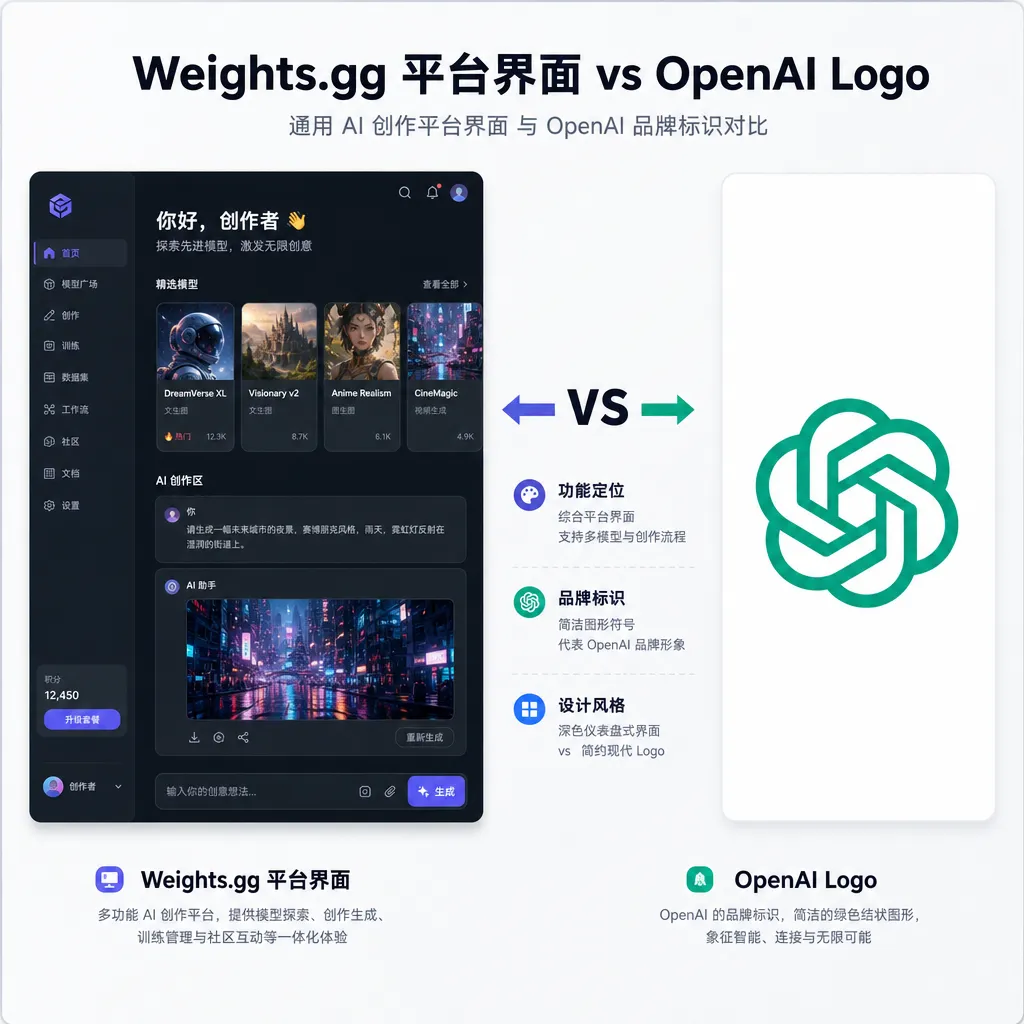
What This Company Did—and Why It Was “Controversial”
If you’ve been in the AI music scene over the past two years, you’ve probably heard of Weights.gg. Its flagship product, Replay, was a free app capable of three main things:
- AI‑powered voice covers (changing the singer’s voice to someone else)
- Text‑to‑speech (TTS)
- A community voice‑model library based on RVC (Retrieval‑based Voice Conversion) technology
RVC was an open‑source voice‑conversion scheme that blew up in 2023. It was extremely easy to use—you could train a passable voice model with just a few minutes of audio. What Weights.gg essentially did was turn that tech stack into a productized and community‑driven platform: users uploaded voice models, others used them, and the platform either took a cut or monetized through traffic.
The problem lay in what users were uploading.
The Weights.gg library was full of unauthorized celebrity voice clones—Taylor Swift, Kanye West, members of Blackpink, even Warner‑owned characters like Bugs Bunny and Daffy Duck. There were also numerous U.S. political figures’ voices available for direct use. Any legal department looking at this product would get instant headaches. Within the AI industry, it was seen as a synonym for “gray zone”—technically interesting, legally exposed.
So OpenAI’s move looked like this: a company currently being sued by The New York Times over copyright issues quietly bought another company that had shut down because of copyright problems. That combination is quite intriguing.
What OpenAI Wants Isn’t the Model Library—It’s Those Six People and Their Engineering Know‑How
You can’t judge this acquisition just by the product’s surface. The model library full of infringing voices is something OpenAI clearly can’t use; keeping it would only create legal landmines and will most likely be deleted entirely.
The real value is twofold:
First, the team’s hands‑on experience.
RVC is open‑source, but achieving Weights.gg’s “instant generation and in‑browser playback” experience requires a lot of engineering finesse: model quantization, inference acceleration, stable voice‑feature extraction, and latency control across devices. You don’t learn that from papers—you learn it from handling millions of real user requests and seeing what breaks.
Second, the product intuition shaped by user behavior data.
What kind of voice conversion wins users over? What kinds of failures turn them away? Which use‑cases are frequent (covers, dubbing, memes) and which are fake demands? That product insight is completely different from tweaking metrics in a lab.
OpenAI already has a strong foundation in voice work. Voice Engine has been underway since late 2022, with a small preview held in March 2024—it can generate natural speech remarkably similar to the original speaker’s voice from just 15 seconds of audio. Technically it combines diffusion models with Transformers for direct end‑to‑end synthesis.
But Voice Engine still isn’t publicly available. OpenAI says it’s “concerned about misuse, especially during an election year,” and currently provides very limited access to a few partners.
That creates a paradox: OpenAI has the most powerful voice‑cloning technology but doesn’t dare release it; Weights.gg released similar tech freely and was burned by compliance issues. In a sense, OpenAI is hiring the people who have “pushed the boundaries”—those who know how users really behave, what pitfalls exist, and how a viable product should look. Their job now is to help OpenAI make Voice Engine profitable without causing public backlash.
Timing Matters: Voice API Just Opened, CarPlay Integration Added
To grasp the real meaning of this acquisition, you have to look at OpenAI’s recent moves over the past two months.
Early this month, OpenAI officially opened its voice‑technology API to third‑party developers. This allows integration into apps for real‑time translation and command control scenarios—turning OpenAI’s voice capability from a “ChatGPT toy” into full‑blown infrastructure.
Soon after, ChatGPT was integrated with Apple CarPlay. Talking with ChatGPT in the car requires far stricter standards for latency, noise suppression, and multi‑turn context than on mobile. The in‑vehicle environment is one of the most demanding and profitable arenas for voice interaction.
Backtrack further: in early 2026, OpenAI shut down the video‑generation app Sora, which had also fallen into copyright trouble after numerous celebrity and institutional complaints. The closure of Sora, together with the Weights.gg acquisition, clearly reveals OpenAI’s current logic:
- Double down where revenue is steady (voice APIs, enterprise integrations, automotive use)
- Cut losses where copyright risk and monetization are unclear (Sora)
- Fill gaps—but take only talent and tech, not liability‑laden assets (Weights.gg’s controversial model library will be discarded)
That’s what a mature company does—it’s no longer in its “chasing‑whatever’s‑hot” phase.
Why “Real‑Time Voice Generation” Is the Next Battleground
The voice‑AI race has moved past “can you synthesize realistic speech.” Companies like ElevenLabs, Play.ht, ByteDance’s Doubao, and Alibaba’s Cosy Voice already do that well. The real differentiator now is real‑time performance.
To be truly real‑time, several hard metrics must be met:
- TTFB (First‑Byte Latency) under 300 ms; otherwise dialogue feels choppy
- Streaming output, generating and playing audio simultaneously, not after full synthesis
- Interruptibility, so output stops instantly when the user speaks
- Voice consistency, so the timbre doesn’t drift over long conversations
OpenAI demonstrated end‑to‑end real‑time voice in GPT‑4o, but merging that with “arbitrary target voice” capability—combining Voice Engine’s cloning and GPT‑4o’s live‑conversation power—still poses engineering challenges. The Weights.gg team’s hands‑on experience with real‑time RVC conversion perfectly fills that gap.
Think of it this way: within the next year or two, voice‑model products will likely center around the trio of custom voice + real‑time dialogue + cross‑language translation. A developer could integrate a single API to enable any authorized voice to converse live with users and translate automatically. Once that works, it could reshape interaction layers across customer service, education, automotive systems, and wearables.
A Background You Can’t Ignore: The Lawsuit Continues
While The New York Times exposed this acquisition, it’s still suing OpenAI and Microsoft over alleged training use of NYT news articles—both companies deny the allegations.
In this context, OpenAI acquiring a platform known for “unauthorized celebrity voice models” is a delicate PR move. One interpretation: OpenAI is absorbing the gray market, turning a potential risk into a controlled asset. Another: it’s proof that “AI giants launder infringement data through acquisitions.” Both narratives have merit—it depends which camp you’re in.
One thing is almost certain: the Weights.gg voice model library will not be ported directly into OpenAI’s products. Given OpenAI’s typical risk‑management style, those models will likely be deleted or archived, leaving only the tech stack and the team.
What This Means for Developers
In the short term, this acquisition won’t directly affect developers currently using OpenAI’s voice APIs—the products will remain the same for now.
But a few areas are worth watching early:
- Voice‑cloning APIs may go public this year. Voice Engine has been stuck in internal testing; with Weights.gg’s productization know‑how, it’s more likely to open up. Pricing could involve both “training by voice” and “billing by synthesis duration.”
- Compliance and authorization will tighten. Expect watermarking, source verification, and consent chains—meaning access will be more restricted than ElevenLabs’ early “upload‑and‑go” approach. This benefits enterprise users but may frustrate individuals.
- Real‑time dialogue APIs will expand. Look for a “voice‑parameter” option added to the Realtime API—combining Weights.gg’s cloning skills and GPT‑4o’s live audio is the natural evolution.
If you’re using aggregator platforms like OpenAI Hub to connect multiple models, keep an eye on the voice section—OpenAI Hub has been tracking OpenAI’s Realtime and TTS APIs, so once the new voice‑features roll out, migration costs should be minimal.
Final Thoughts
OpenAI’s product rhythm this year increasingly resembles that of a company focused on making money, not just changing the world. Shutting down Sora, acquiring Weights.gg, releasing voice APIs, and integrating ChatGPT into CarPlay—all together paint a clear commercialization curve.
Voice is one of the most straightforward and lucrative directions within that curve. The small‑scale Weights.gg deal may look casual, but it’s actually a key puzzle piece for OpenAI’s voice strategy. As for that once‑notorious model library full of Taylor Swift and Bugs Bunny clones—it will likely vanish quietly into history during the integration.
Sources
- OpenAI quietly acquires voice‑cloning platform Weights.gg, integrating AI voice tech while tackling copyright issues – IThome: NYT‑revealed acquisition details, Weights.gg’s business and funding background, and OpenAI’s recent voice initiatives
- OpenAI launches voice‑cloning tool Voice Engine, creating realistic speech from just 15 seconds of audio – Zhihu: Voice Engine’s architecture and its diffusion + Transformer implementation


