
Shanghai Telecom launches a Token plan, marking the carrier’s official entry into the AI API market

Shanghai Telecom today took the lead in launching a Token-based pricing plan, where 1 yuan corresponds to 250,000 credit points, supporting payment through phone bills and connecting to more than 30 mainstream large models. This marks the formal transition of the three major carriers from data traffic operations to Token operations, in an effort to break free from the “dumb pipe” dilemma in the AI era.
Shanghai Telecom launches Token plan, officially entering the AI API market
Shanghai Telecom announced today (May 16) the launch of its Token computing service, becoming the first operator in Shanghai to release a Token-based pricing plan. This is not a simple business experiment—it signals a collective transformation among China’s three major operators. As the mobile traffic dividend reaches its peak, they are now betting on the new currency of the AI era: Tokens.
Pricing directly benchmarked against cloud providers
Shanghai Telecom’s Token pricing is highly aggressive: 1 yuan equals 250,000 quota points. Taking Moonshot’s Kimi K2.5 model as an example, this equates to calls using 250,000 input Tokens. Users can purchase as needed, with discounts for bulk, and—most importantly—payment can be made through their mobile phone bill, an advantage unique to telecom operators.
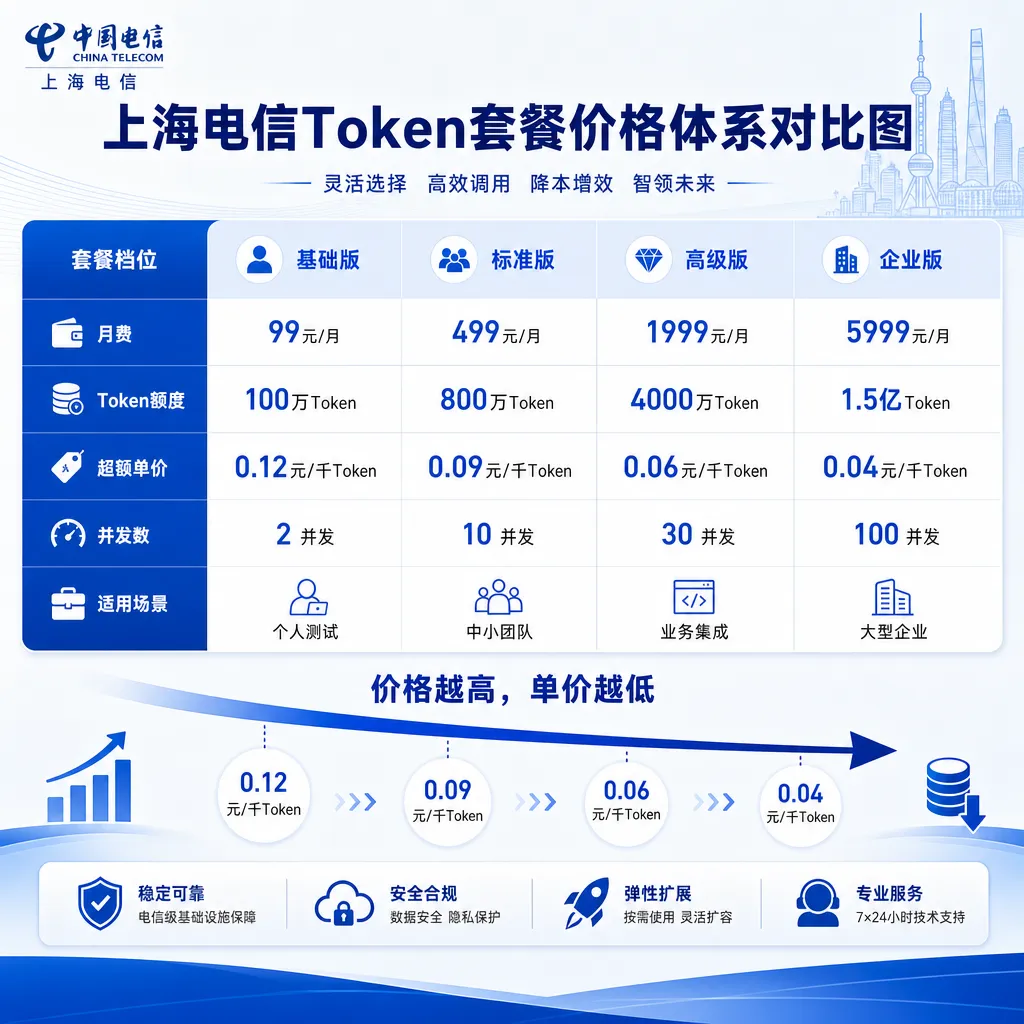
Even more appealing is the free quota. Shanghai Telecom mobile users can claim 25 million quota points for free for a one-month trial. A 10-yuan purchase gets 2.5 million points, enough for programs to automatically summarize around 100 e-books of 100,000 words each. Starting in June, users of Telecom’s “Better Home” integrated package will have Token membership benefits included—one price, all included.
This pricing strategy isn’t arbitrary. According to industry data, current operator Token plans are generally priced around 18% lower than leading cloud service providers’ API call rates. Shanghai Telecom’s 199 yuan/month family plan integrates 10-gigabit broadband with 3 million Token points, essentially packaging AI capabilities into traditional communication services.
Over 30 models with standard API interfaces
Shanghai Telecom isn’t just selling Tokens; it’s building an API aggregation platform. After purchasing Token points, users can use standard APIs to access more than 30 mainstream large models, including text and multimodal types. This means developers can call models from GPT, Claude, Kimi, Wenxin Yiyan, and others—all through one account and one interface.
This idea mirrors third-party API aggregation platforms like OpenAI Hub, but telecom operators have two unique advantages:
- Mature billing system: Paying through a phone bill is nearly frictionless for individual users, and business customers can use existing enterprise billing systems.
- Network infrastructure: Operators control backbone network resources and can theoretically offer more stable API experiences, especially for domestic access to overseas models.
However, problems are evident: operators don’t produce models—they’re intermediaries. They must negotiate with model providers, integrate APIs, and manage revenue sharing. Whether the system works depends on how favorable upstream pricing is and whether developer experience is good enough.
Collective anxiety among the three major carriers
Shanghai Telecom is not alone. In their 2026 annual reports, all three major operators stated intentions to strengthen Token operations, officially ushering telecom into the “Token era.” Subsequently, operators across China launched their own Token plans, revealing industry-wide anxiety over the traditional “pipe provider” dilemma.
For the past decade, operators have increasingly become “road builders”—selling cheaper and cheaper traffic while value-added services are taken by internet companies. Massive 5G investments have been difficult to monetize. Now, with the AI explosion and over 140 trillion daily API calls, operators see new opportunity—if mobile traffic was the infrastructure of the mobile internet era, Tokens are the infrastructure of the AI era.
Yet the path is tough. Operators lag in native model capability—they don’t have top-level proprietary models or robust AI application ecosystems. Current Token plans are essentially channel businesses: buying Tokens wholesale from model vendors and reselling them at a margin. Whether this model is sustainable depends on three questions:
- How long can they sustain a price war? Operators are grabbing market share through low pricing, but upstream vendors won’t offer discounts forever. When prices rise, margins will shrink.
- Will developers buy in? Developers care more about API stability, documentation quality, and SDK usability than just price. Operators lag far behind professional API platforms in these areas.
- Regulatory and compliance risk: As intermediaries, operators must take some responsibility for API output. If users generate prohibited content, who’s liable? It’s a gray area.
Competing with OpenAI Hub and others
Shanghai Telecom’s Token plan directly challenges third-party API aggregation platforms like OpenAI Hub, API2D, and SiliconFlow, which began aggregating models in 2023 and have since built sizable developer bases.
By comparison, operators have these advantages:
- Large user base: Shanghai Telecom serves tens of millions of mobile subscribers, who can easily be converted into Token users.
- Easy payment: Paying via phone bill is nearly frictionless—no need for a credit card or manual recharge.
- Compliance background: As state-owned enterprises, operators have inherent advantages in data security and compliance, appealing more to enterprise clients.
But disadvantages are equally clear:
- Weak technical foundation: Operators’ IT systems prioritize stability over agility; iteration is slow. Third-party platforms can quickly launch new models and features, while telecoms struggle to keep up.
- Lack of developer ecosystem: OpenAI Hub and similar platforms have vibrant communities, comprehensive documentation, and robust SDKs; operators start from zero.
- Limited pricing flexibility: Operator pricing must go through approval processes, making strategy adjustments slow compared to startups.
More critically, operators face a fundamental contradiction: they want to be platforms without alienating model providers. If they merely resell APIs, why wouldn’t model vendors sell directly? If they mark up prices too much, why wouldn’t developers go straight to the source? Striking this balance is tricky.
“Traffic anxiety” in the AI era
The logic behind operators’ transformation—from traffic to Tokens—is clear: in the mobile internet era, they sold network connectivity; in the AI era, they aim to sell compute connectivity. But the two are fundamentally different.
Traffic is standardized; users care only about speed and cost, not source. Tokens aren’t—models differ vastly in capability. GPT-4o Tokens are not equivalent to Llama 3.3 Tokens. Buying Tokens is effectively buying model capability, not abstract “compute.”
That means operators must do two things:
- Help users choose models: Offer model comparisons, scenario recommendations, and performance evaluations so users know which model fits their tasks.
- Optimize call experience: Handle load balancing, fault tolerance, and cost efficiency so users don’t feel the underlying complexity.
Both require strong AI technical capabilities—precisely where operators are weakest. If they merely wrap APIs into bundled plans, users will soon realize it’s easier to go directly to model providers.
Who will be the biggest winner?
Shanghai Telecom’s Token plan signals an important milestone for the AI API market: telecom giants have officially entered. But it’s still too early to tell who will come out on top.
Model providers may be the biggest beneficiaries. Operator participation means new distribution channels reaching more consumer users. With strong local marketing and enterprise connections, telecoms can open the SME market for model vendors.
Third-party API platforms will face pressure but not extinction. Operators primarily target price-sensitive and beginner users, while technical developers value professionalism. Platforms like OpenAI Hub can survive by deepening technical and ecosystem advantages.
Operators themselves may or may not escape the “pipe business” trap. If they treat Tokens merely as the new version of traffic packages, they’ll fall into endless price wars. Only by building developer ecosystems, enterprise services, and industry-specific AI solutions can true transformation happen.
From a broader perspective, operators entering Token operations is a battle for control over AI-era infrastructure. Cloud vendors hold computing power, model vendors hold intelligence, and operators hold networks and users. Their interplay has just begun—the final landscape will likely be coexistence, not replacement.
Shanghai Telecom’s Token plan looks more like a probing attack. Its success depends on whether operators truly understand developer needs, rather than applying old traffic-management thinking to Tokens. The struggle over AI infrastructure will be far more intricate than that of the traffic era.
References
- Shanghai Telecom releases Token plan: 1 yuan equals 250,000 points, supports mobile billing - IT Home – Official announcement from Shanghai Telecom
- The three major telecom operators may become the biggest intermediaries! - Linux.do – Industry discussion on operators’ Token operations


