
Ant Open-Source Trillion-Parameter Thinking Model Ring-2.6-1T: Adjustable Reasoning Intensity

Ant Bailin officially open-sourced its trillion-parameter flagship reasoning model Ring-2.6-1T yesterday, introducing the Reasoning Effort mechanism. It offers two levels of reasoning intensity — high and xhigh — allowing developers to freely balance effectiveness, speed, and cost.
Ant Group Open-Sources Trillion-Level Reasoning Model Ring-2.6-1T: Turning “How Deep to Think” into an Adjustable Knob
On May 15, Ant Group’s Bailing Large Model team (inclusionAI) officially launched Ring-2.6-1T on Hugging Face and ModelScope. This is a trillion-parameter reasoning model. After offering a limited free trial on OpenRouter starting May 9, it officially open-sourced its weights yesterday—a one-week turnaround.
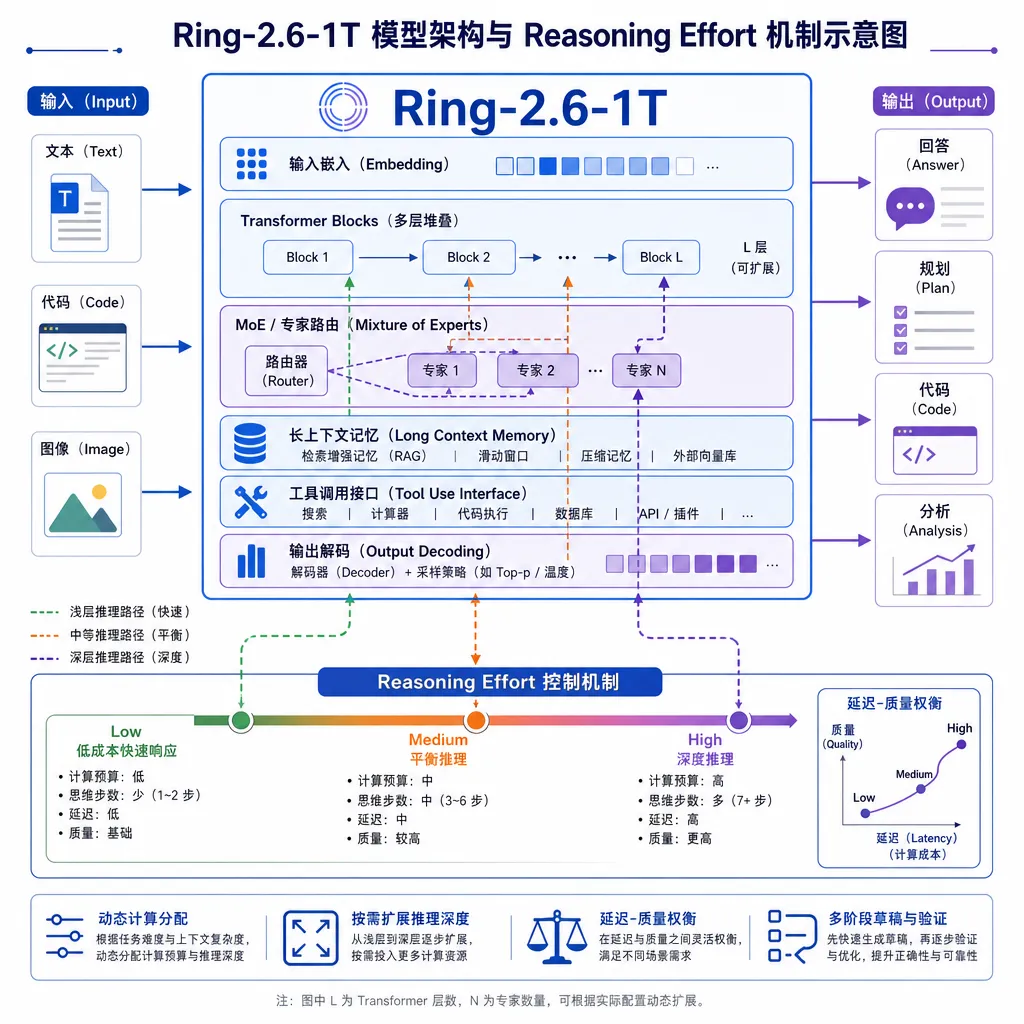
More noteworthy than the scale of parameters is its design philosophy: Ring-2.6-1T turns “how deeply the model should think” into an adjustable knob, providing high and xhigh levels of reasoning intensity that developers can choose based on task difficulty. This is more than simply flipping a “reasoning” switch—it reflects a redefined understanding of “thinking cost” in real production settings.
Not a New Model, But a New Approach
Over the past year, reasoning models have become standard for leading vendors. OpenAI’s o series, Anthropic’s extended thinking, Google Gemini Thinking, and DeepSeek-R1 all follow the idea of letting models “think for a bit” before answering. But there’s a common pain point in this paradigm: thinking has a cost.
A complex reasoning process can generate thousands of reasoning tokens—corresponding to real costs in latency and expense. The problem is worse in agent workflows, where a task may invoke the model dozens of times, each time requiring deep reasoning, making the entire workflow sluggish. Developers often face a false choice between high cost and high latency or abandoning reasoning models altogether—a dilemma that shouldn’t exist.
Ring-2.6-1T’s solution is to parameterize reasoning intensity. The official positioning is clear:
- high level: Designed for high-frequency agent workflows, featuring low token cost and faster multi-step execution. Suitable for multi-turn interaction, tool collaboration, and task decomposition—this is the “production-grade default.”
- xhigh level: Designed for mathematically intensive tasks, scientific analysis, complex logic, and multi-path searching, allowing more extensive reasoning space.
This tiered approach aligns with OpenAI’s reasoning_effort parameter (low/medium/high), but Ring-2.6-1T defines tiers more concretely—“high” isn’t “medium reasoning” but an optimized low-overhead mode for agent workflows. It’s an interesting product decision: in real-world development, most calls don’t need maximum reasoning—they need stable, inexpensive multi-step execution.
Benchmarks: xhigh Joins the Top Tier, high Shines in Agent Scenarios
Design alone doesn’t suffice—we need data. Ant disclosed evaluations covering both real task execution and complex reasoning.
xhigh level (complex reasoning):
| Benchmark | Score | Notes | |---|---|---| | ARC-AGI-V2 | 77.78 | Abstract reasoning | | AIME 26 | 95.83 | Math Olympiad level | | GPQA Diamond | 88.27 | Graduate-level scientific QA |
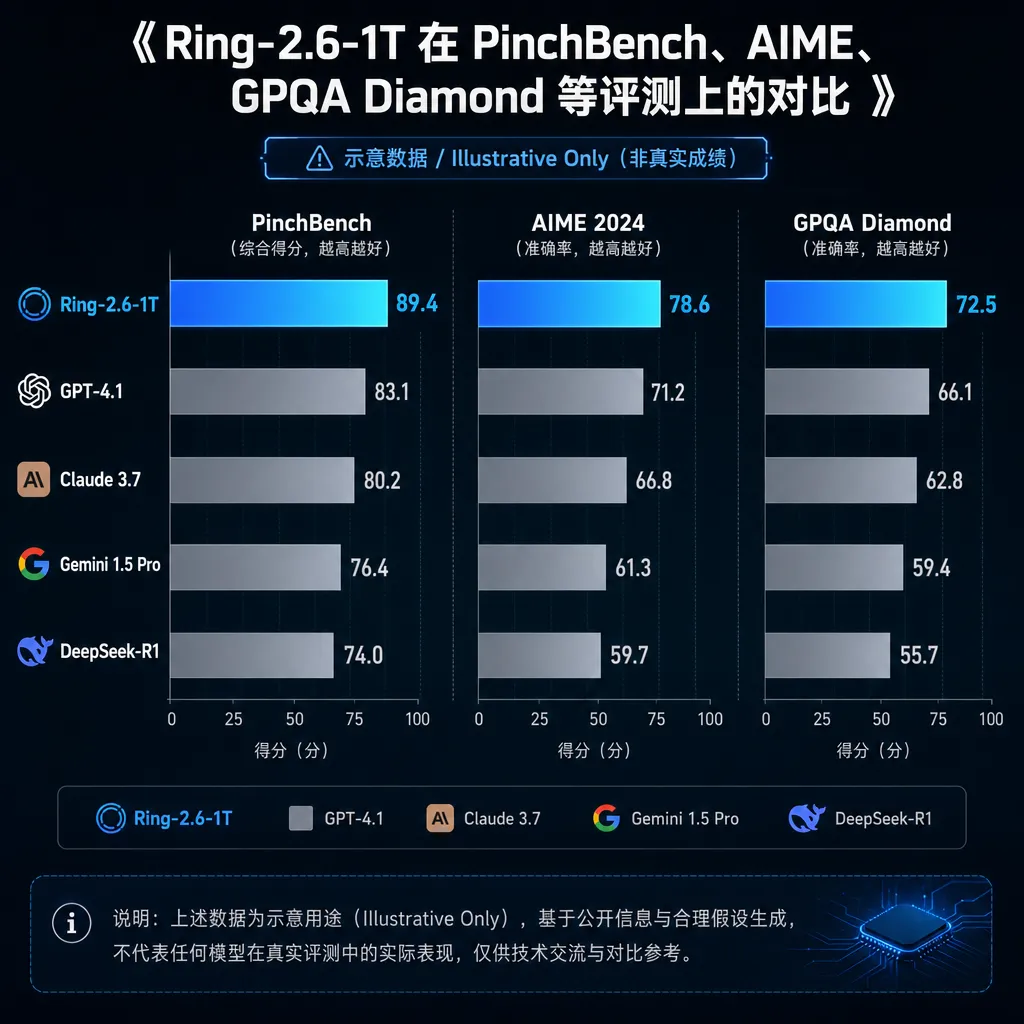
With 96 on AIME 26 and 88 on GPQA Diamond, Ring-2.6-1T stands shoulder to shoulder with GPT-5, Claude Opus 4.7, and Gemini 3.1 Pro. Its 77.78 on ARC-AGI-V2 is also strong—this benchmark is designed to expose weaknesses in models’ abstract reasoning.
high level (Agent and real task execution):
| Benchmark | Score | Comparison | |---|---|---| | PinchBench | 87.60 | Higher than GPT-5.4 xHigh, Gemini-3.1-Pro high, Claude-Opus-4.7 xhigh | | ClawEval | 63.82 | Complex business process evaluation | | Tau2-Bench Telecom | 95.32 | Tool collaboration and multi-turn interaction |
Notice PinchBench: Ring-2.6-1T’s high level outperformed competing models’ xhigh tiers. The 95.32 on Tau2-Bench Telecom is also impressive—this benchmark simulates telecom customer-service scenarios involving multi-step tool use, testing instruction following, state retention, and tool-use stability.
These results suggest that in agent scenarios—where deep thinking isn’t needed but reliable execution is—Ring-2.6-1T’s high setting reduces costs without sacrificing capability. This is its most commercially valuable aspect.
Trillion Parameters in Practice: MoE as the Implicit Foundation
Although the official release didn’t focus on architecture, “trillion-level” in today’s context basically implies MoE (Mixture of Experts). Prior Ring versions followed the MoE approach—1T total parameters with sparse activation means the effective parameters during inference are far fewer, forming the engineering basis for “low token cost + fast multi-step execution” at the high level.
For comparison: DeepSeek-V3/R1 has 671B total and 37B activated; Kimi K2 has 1T total; Qwen3-Max is in the trillion range as well. Ring-2.6-1T joins this scale but differentiates itself via the Reasoning Effort product abstraction—decoupling model capability from engineering cost and handing both to developers.
For enterprise deployment, running a trillion-parameter model isn’t trivial. Single-machine setups can’t handle it; multi-GPU or distributed inference is required. But open-sourcing isn’t just about “running it yourself”—it allows researchers to dissect, distill, align, and fine-tune for domains. Releasing weights on both Hugging Face and ModelScope enables global developer access.
How to Use: OpenRouter First, Then Open-Source
Ant’s release pacing was deliberate: a one-week free trial launched on OpenRouter on May 9, letting developers try it first; then on May 15, open-sourcing the weights for community deployment, fine-tuning, and secondary development. This order is smarter than simply dumping weights—it validates the high/xhigh difference in real traffic before full release.
Developers calling the API can already select tiers via the reasoning_effort parameter on OpenRouter. For open-source setups, inference frameworks like vLLM and SGLang have solid MoE support—the main engineering challenge is configuring multi-machine tensor parallelism.
Notably, aggregator platforms like OpenAI Hub are starting to integrate domestic open-source models—for developers who don’t want to manage hundred-GPU clusters yet want unified API access for comparing GPT, Claude, Gemini, and Ring-2.6-1T, this is a convenient path.
What This Open-Source Release Means Now
By mid-2026, the pace of domestic large-model open-sourcing has clearly accelerated. From DeepSeek to Qwen3 to Ant’s Ring-2.6-1T, trillion-level, reasoning-capable, deployable open-source models are no longer rare. But each brand differentiates itself: DeepSeek focuses on extreme cost performance, Qwen on multimodal full-stack capabilities, and Ring emphasizes the engineering semantics of "adjustable reasoning strength."
This reflects the industry’s evolving stance toward reasoning models. A year ago, everyone competed on “how long/deep the reasoning chain could go”; now they compete on “whether thinking can be pay-as-you-go.” Ant turning this into a visible API parameter and model tier is a pragmatic decision.
Points worth noting:
- high level surpasses competitors’ xhigh on PinchBench — if verified in third-party tests, Ring-2.6-1T’s cost-performance in agent workflows will stand out.
- xhigh scores 77.78 on ARC-AGI-V2 — this shows its complex reasoning abilities go beyond canned test patterns to handle real abstraction.
- Dual track of open-source + OpenRouter — Ant clearly aims for both “developer community influence” and “commercial deployment reach,” a strategy reminiscent of Mistral’s early playbook.
A Concrete Takeaway
If you’re building an agent-style product and need a stable multi-step execution model, Ring-2.6-1T’s high tier deserves serious testing—especially given its Tau2-Bench Telecom 95.32 score, signaling strong reliability in real-world tool use. If you’re focused on scientific research, math, or complex code generation, the xhigh tier merits inclusion in GPT-5 and Claude Opus 4.7 A/B comparisons.
That said, if you’re only running a chatbot, a trillion-parameter model is likely overkill—and Ant knows this, hence positioning high as the “production default,” bringing large-model capabilities into everyday use rather than reserving them for specialized benchmarks.
With weights now open-sourced, it’s up to the community to see what comes next.
References
- ITHome: Ant Group’s Bailing Open-Sources Trillion-Level Reasoning Model Ring-2.6-1T, Supporting Two Reasoning Intensities—high and xhigh — official release and announcement
- Hugging Face: inclusionAI/Ring-2.6-1T — model weights and card info


