
OpenAI Gives Plus to Everyone in Malta: An AI Experiment with 500,000 People

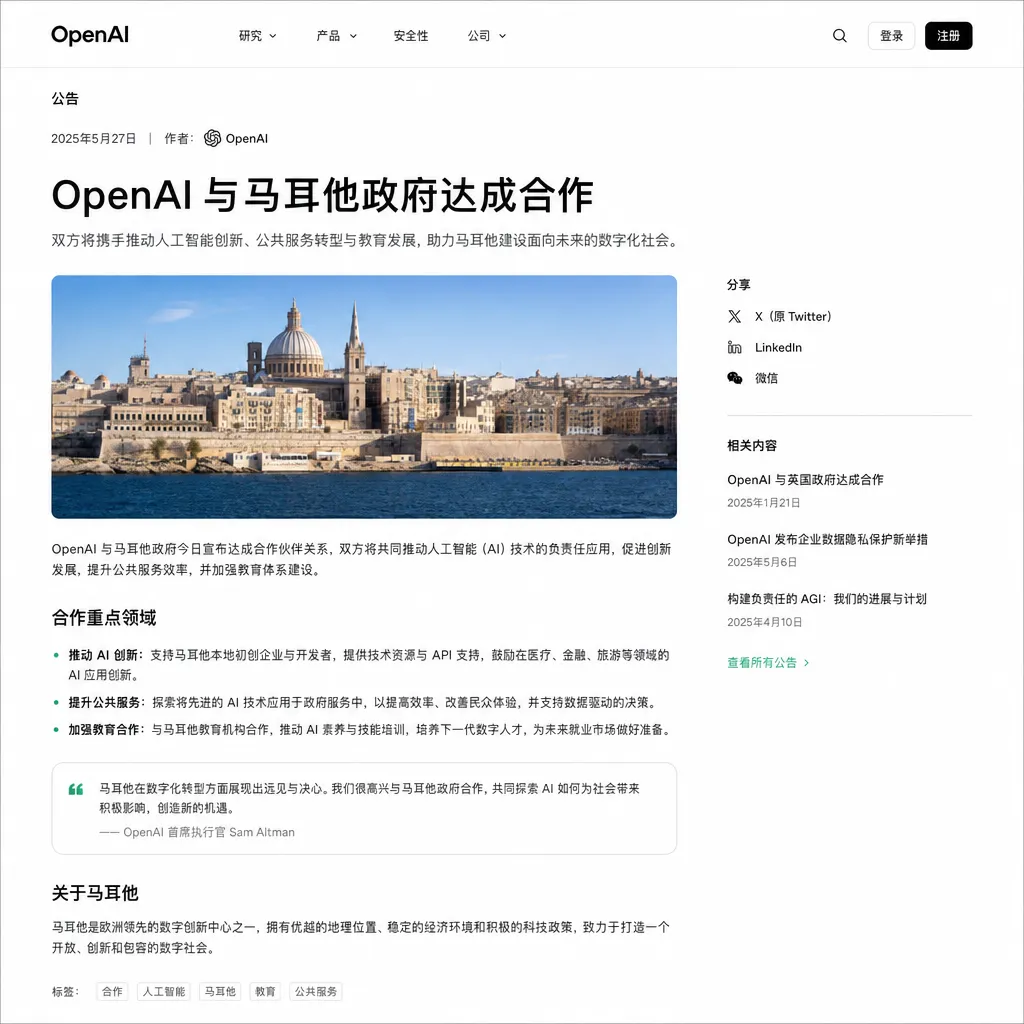
OpenAI has reached a cooperation agreement with the Government of Malta to provide all citizens with one year of free ChatGPT Plus service. This marks the first time OpenAI has established a nationwide coverage agreement with a sovereign state and follows the large-scale free initiative introduced for U.S. veterans.
OpenAI Gives Everyone in Malta Plus: A 500,000-Person AI Experiment
OpenAI has just done something unprecedented: it signed an agreement with the Maltese government to give every citizen of this Mediterranean country one year of ChatGPT Plus for free.
This is not an education discount or a corporate bulk deal—it’s genuine full national coverage. Malta’s total population is just over 500,000, so OpenAI’s move amounts to handing out subscriptions worth over $10 million. The project launches in May, and Maltese citizens can activate it with identity verification.
This Isn’t OpenAI’s First Free Strategy
Last year, the ChatGPT Go plan (a lower-priced subscription) in the Indian market sparked a wave of “becoming Indian to grab the deal.” This year, OpenAI offered US veterans a free one-year Plus subscription. The Malta initiative takes the free range directly to the national level.
From a business logic perspective, this looks more like a carefully designed market experiment:
- Data acquisition: Real usage data from 500,000 users across different ages, professions, and education backgrounds—more valuable than any A/B test
- Policy and PR: Partnering with a sovereign nation gives OpenAI stronger influence in the EU regulatory landscape
- Ecosystem lock-in: After one year of free access, user migration costs will be high, and paid renewal rates will likely be strong
Malta was not chosen at random. The country has a manageable population size, a high level of English proficiency (it’s an official language), leading digitalization within the EU, and a government receptive to new technologies. More importantly, Malta is an EU member state—this partnership can help OpenAI gain compliance experience for the European market.
The Freebie Hunters Are on Their Way
As soon as the news broke, Chinese developer communities lit up. On the Linux.do forum, related posts skyrocketed to the trending list within hours, with some joking that “Malta is about to gain hundreds of thousands more OpenAI users.”
The technical routes are already being studied:
- Identity verification bypass: Malta uses the EU’s unified eID system, theoretically requiring local ID documents—but the actual verification strength remains unclear
- IP location requirements: Whether Maltese IPs are needed, whether continuous monitoring occurs, and whether VPNs can pass—these are variables
- Payment binding: Even if verification succeeds, it’s still uncertain whether Maltese-issued payment methods will be required later
Compared with the previous US veterans program, some people reportedly succeeded with old veteran info plus automated verification bots. If Malta’s verification is lax, similar scenes will likely replay.
However, there’s a reality check: the whole country has only half a million people. If tens of thousands of “fake Maltese” accounts flood in, OpenAI will certainly notice. Either it’s already prepared (e.g., limiting simultaneous devices or strengthening behavioral detection) or it’s tacitly allowing some “spillover”—after all, traffic and data are valuable resources for an AI company.
What This Means for Other Countries
If the Malta model works, OpenAI could replicate it in more small economies. Nordic countries, the Baltic states, Singapore, and the UAE are all potential targets. These places share several features:
- Population around the million range—manageable costs
- Strong government digitalization capabilities—able to roll out national projects quickly
- Openness toward AI—willing to serve as policy testbeds
- Affluent economies—ensuring strong paid conversion after the free period ends
From OpenAI’s view, this is part of a bigger game: exchanging free services for government endorsement, endorsement for regulatory leniency, and leniency for market access. Especially with the EU AI Act now officially in effect, partnering with an EU government is far more powerful than any press statement.
But this model has an obvious ceiling. Major markets (China, India, the US itself) cannot be covered this way—the cost and political complexity are unrealistic. What OpenAI can do is create showcase cases in smaller countries, then leverage those cases as bargaining chips when negotiating with larger governments.
What Developers Should Care About
For developers, several points are noteworthy:
The reference for API call costs is shifting. If OpenAI can hand out Plus subscriptions at scale for free, that suggests GPT-4-level models have marginal costs low enough to support it. This could affect API pricing strategy—either more aggressive price cuts are coming, or more varied subscription tiers will be introduced.
The value of user behavior data is being redefined. A year of real usage data from 500,000 users could be worth far more for model training, product iteration, and market strategy than $10 million in subscription revenue. That explains why OpenAI can justify this seemingly “loss-making” deal.
Competition for national AI infrastructure has begun. Essentially, Malta is treating ChatGPT as part of its national digital infrastructure. More countries may soon strike similar deals—or even buy localized deployment solutions directly.
If you’re developing AI applications, it’s worth asking: when your target users already have free GPT-4 access, what extra value can your product offer? More vertical scenario adaptation, stronger data privacy protection, or a lower usage threshold?
Is This Freebie Worth Grabbing?
Technical feasibility doesn’t mean it’s worth doing. If Malta’s verification system is indeed lenient, it will likely get exploited within weeks—then OpenAI will tighten policy, leaving chaos behind.
A more practical issue: even if you do activate an account, it could be suspended anytime for abnormal activity. OpenAI’s risk control isn’t weak—it monitors IP drift, usage time, conversation patterns, API call behavior, and more. Running production operations on an account that could vanish any moment is simply not worth the risk.
If you truly need stable GPT-4 access, just subscribe directly or use API aggregation services (such as OpenAI Hub, which supports direct domestic access and API compatibility). A $240/year Plus subscription isn’t unaffordable for most developers.
Of course, if you just want to study verification mechanics or test risk control, that’s another matter. But don’t treat freebie exploitation as a long-term strategy.
Final Thoughts
OpenAI’s move may look like a welfare program for Maltese citizens, but it’s actually a national-scale AI penetration experiment—covering data, policy, market, and ecosystem, all at once.
Half a million Maltese people getting free GPT-4 sounds great, but the cost behind “free”—data sovereignty, technological dependence, market monopoly—may only become apparent years later.
For developers, the focus shouldn’t be on how to grab the free deal, but rather on what this trend means for the entire AI industry. As OpenAI starts using national partnerships to drive market infiltration, how will the other players (Anthropic, Google, Chinese model companies) respond?
The rules of the game are changing—choose your side early.
References
- Linux.do community discussion: OpenAI and the Maltese government partnership – Real-time discussions and technical analysis from the developer community
- Linux.do community discussion: Methods to get Malta’s free ChatGPT Plus – Technical exploration on how to obtain the free subscription


