
NVIDIA open-sources 2.6B world model, generates 1-minute 720p video in 29 seconds on RTX 5090
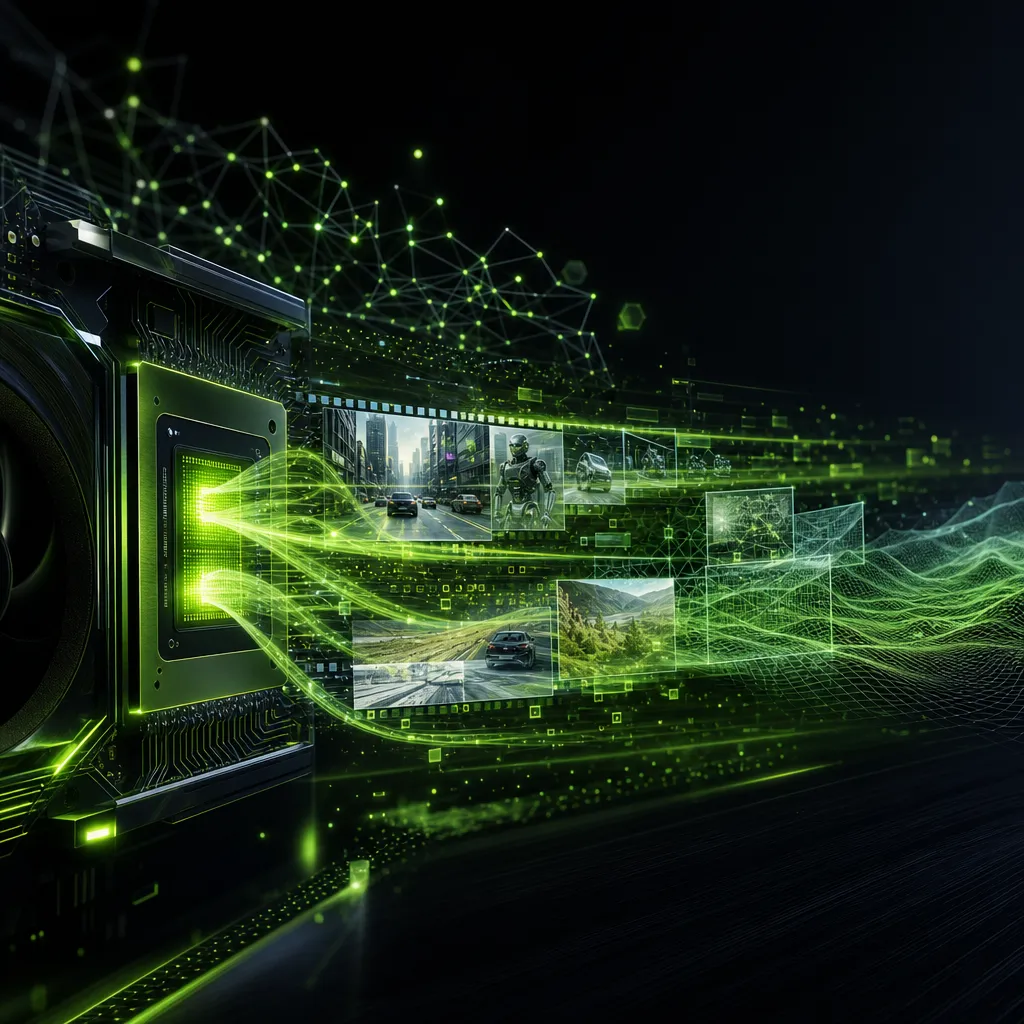
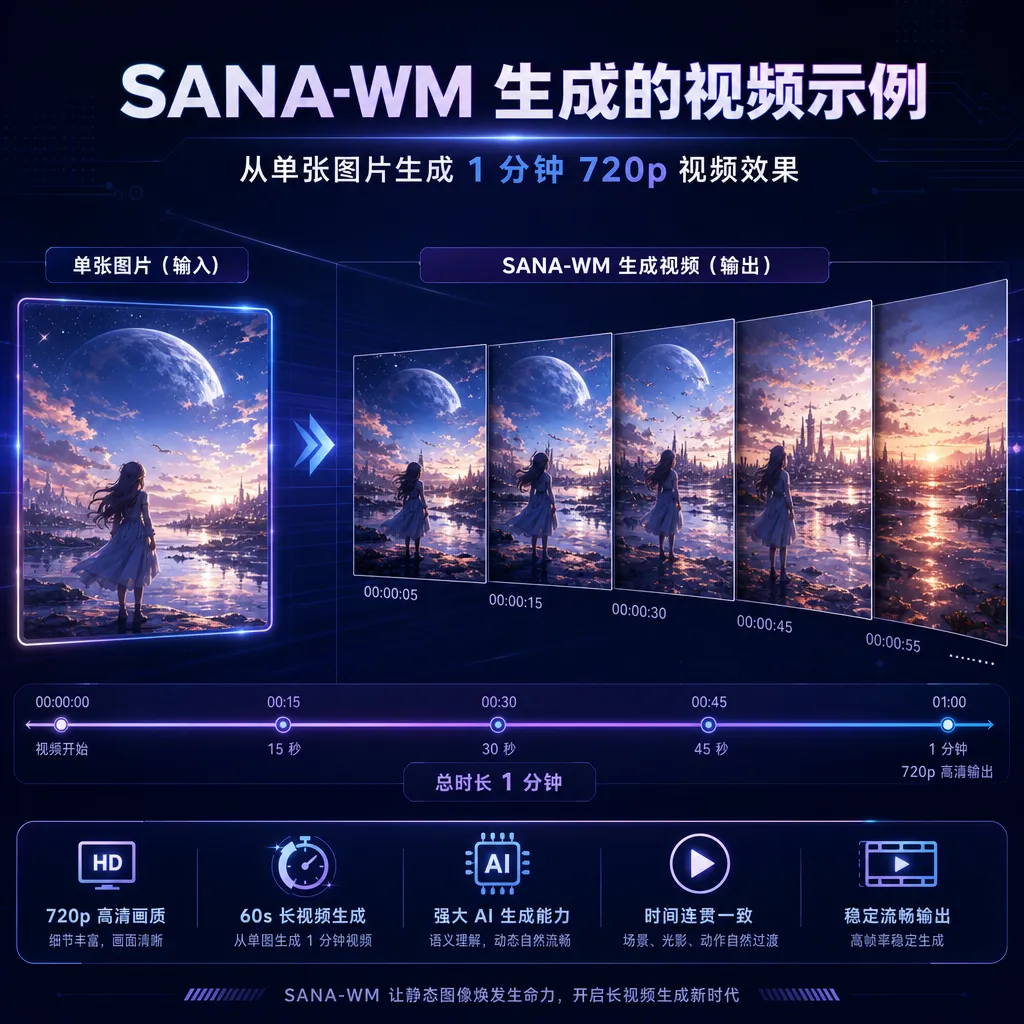
NVIDIA NVLabs has released SANA-WM, a 2.6-billion-parameter open-source world model that can generate a one-minute 720p video from a single image. Its training cost is only 1% of MovieGen’s and it can be deployed on a consumer-grade RTX 5090.
NVIDIA Open-Sources 2.6B World Model, Generates 1-Minute 720p Video in 29 Seconds on RTX 5090
NVIDIA NVLabs has just released SANA-WM (SANA World Model), an open-source world model with 2.6 billion parameters, designed to generate minute-long 720p videos. Its biggest highlight is efficiency: on an RTX 5090, with FP4 precision inference, it generates a 5-second 720p video in just 29 seconds, making it 2.4× faster than previous versions. Even more impressive, its training cost is only 1% of Meta’s MovieGen.
This isn’t NVIDIA’s first foray into video generation. The SANA series previously included image generation models—this time, SANA-WM and SANA-Video extend into video generation. Unlike many market models with tens of billions of parameters requiring datacenter-grade compute, SANA-WM was explicitly designed to “run on consumer hardware.”
Technical Architecture: Block Linear Attention at Its Core
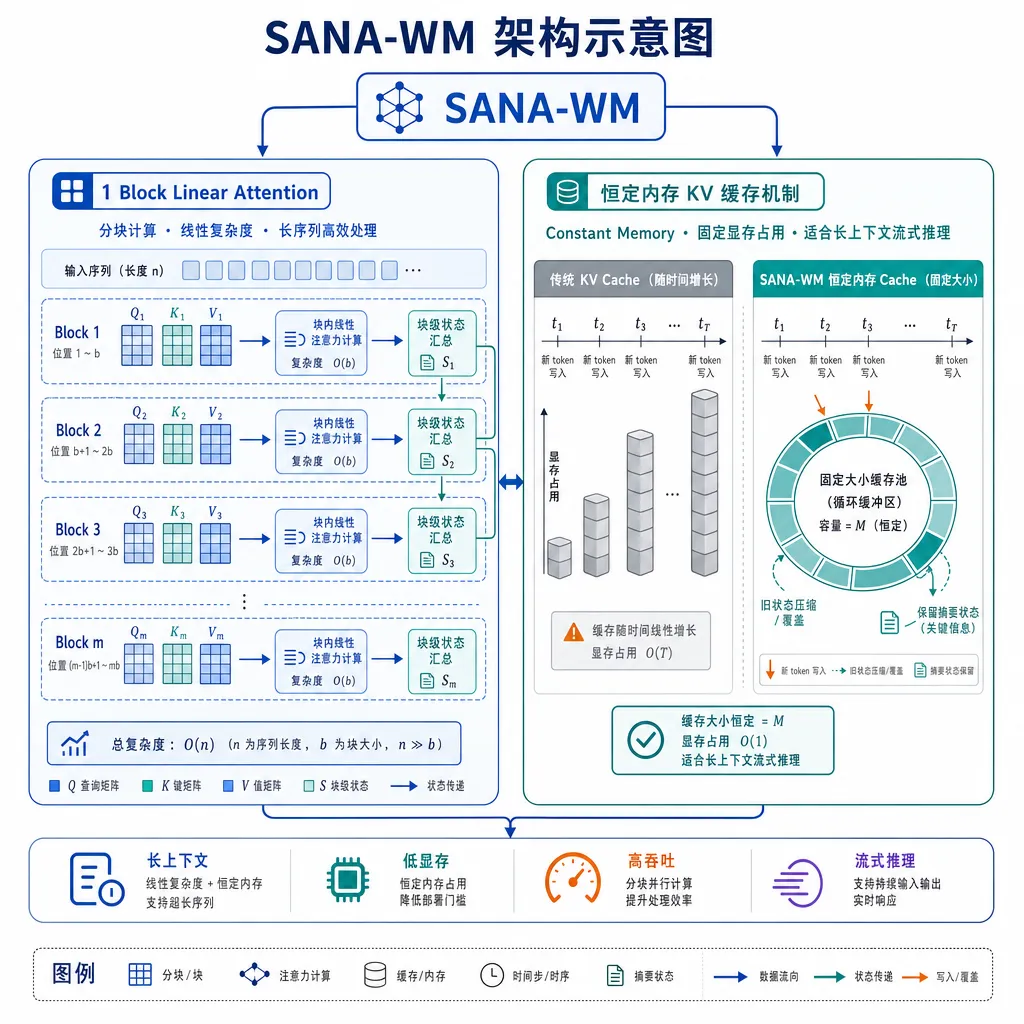
SANA-WM is built on the Block Linear Diffusion Transformer architecture—this is the key to its high efficiency. Traditional Transformers face quadratic complexity, O(n²), in their attention mechanism when processing long sequences, making video generation memory-intensive. SANA-WM employs Linear Attention, reducing complexity to O(n), and processes long videos in block-wise fashion.
Specifically, it introduces a constant-memory KV cache mechanism. Traditional autoregressive generation stores all historical frame key-value pairs, causing memory usage to grow linearly. SANA-WM compresses historical information into a fixed-size state vector using the accumulative property of linear attention—so memory use remains constant regardless of video length. This enables minute-long video generation within limited GPU memory.
Training Cost: 12 Days with 64 H100s, 1% of MovieGen
NVIDIA directly compared training costs in its paper. The SANA-Video series (including SANA-WM) was trained with 64 H100 GPUs for 12 days, consuming roughly 18,432 GPU-hours. In contrast, Meta’s MovieGen used thousands of GPUs for several months—estimated at well over 1 million GPU-hours. Thus, SANA’s training cost is indeed about 1% of MovieGen’s.
The cost difference isn’t just about hardware but also engineering optimization. The SANA team focused on data filtering and training strategy, using aggressive selection that retained only high-quality, high-resolution video samples. They also dynamically adjusted resolution and frame rate during training, preventing compute waste on low-quality data.
This “small model + efficient training” path stands in stark contrast to large closed-source models like OpenAI Sora and Runway Gen-3, which pursue “performance at any cost.” SANA aims for “good enough under limited resources”—a much more practical route for developers and small teams.
Performance: Benchmarking Against Wan 2.1 and SkyReel-V2
NVIDIA compared SANA-Video with two similarly sized open models: Wan 2.1-1.3B and SkyReel-V2-1.3B. Both have around 1.3B parameters—half of SANA-WM’s—but are significantly slower.
In tests generating 5-second 720p clips, SANA-Video needed 71 seconds on an H100 (FP16) but only 29 seconds on an RTX 5090 using FP4. By comparison, Wan 2.1 and SkyReel-V2 needed 400–500 seconds on the same hardware, making SANA roughly 16× faster.
In terms of quality, SANA-WM’s text alignment and temporal consistency are comparable, though its fine detail fidelity is slightly weaker—a common limitation in smaller models. Given its speed advantage, this trade-off is quite reasonable.
More importantly, SANA-WM supports multi-input control: image + text + camera trajectory. You can feed it an initial image, descriptive text, and a 6-DoF camera motion path—it will produce a matching video. This level of control is rare among text-only models.
Deployment: Ready to Run on RTX 5090
Consumer hardware deployment is a major selling point. NVIDIA tested SANA-WM on the RTX 5090, using NVFP4 precision (4-bit float)—a new low-precision format in the Blackwell architecture optimized for generative AI.
With 32GB GDDR7 memory and 1.8 TB/s bandwidth, the RTX 5090 uses around 24GB of VRAM to generate 5s 720p videos, leaving headroom. Longer videos can be generated in segments (5–10s) and then concatenated.
This makes SANA-WM highly accessible to individual developers. The RTX 5090 costs around $2000, not cheap but far less than renting cloud H100 instances. Local deployment also eliminates API call costs, ideal for high-volume generation tasks.
FP4 precision does cause slight quality loss—minor blur and color shift compared to FP16—but most cases are visually indistinguishable. For top-tier quality, FP16 or BF16 on higher-end GPUs is needed.
Open Source: Code and Weights Released
NVIDIA has open-sourced both the code and model weights on GitHub at NVlabs/Sana. The repo includes SANA-WM, prior SANA image models, and SANA-Video variants.
It provides end-to-end training and inference pipelines, including data preprocessing, training, and acceleration. Inference supports multiple precisions (FP32/FP16/BF16/FP4) and multi-GPU parallel generation, with well-documented guides.
Weights are hosted on Hugging Face, with versions including:
- SANA-WM-2.6B – Full version, 2.6B params, 1-minute 720p video generation
- SANA-Video-1.6B – Lightweight version, 1.6B params, 30-second 720p video generation
- SANA-Video-0.6B – Ultra-light version, 0.6B params, 10-second 480p video generation
Architecturally they are similar—differing mainly in depth and hidden dimensions—so users can pick based on hardware capability.
Data and Training Details: High-Quality Data Is Key
According to the paper, SANA used data from public video sets such as WebVid and Panda-70M, totaling around 10 million clips—but after strict filtering, only 2 million high-quality samples (20%) were used.
Filtering criteria:
- Resolution ≥ 720p, frame rate ≥ 24fps
- Duration between 5–60 seconds
- Moderate motion, avoiding static or shaky footage
- High-quality text captions (manual, not machine-generated)
This “less but better” strategy is common in small-model training—better to learn high-quality data than waste compute on noisy samples.
Two training stages:
- Pretraining: 256×256 resolution for 10 days, learning baseline video generation
- Fine-tuning: 720p resolution for 2 days, improving detail and fidelity
This low-to-high resolution curriculum drastically reduces computational cost.
Limitations: Not Ready to Challenge Sora Head-On
While SANA-WM is highly efficient, it still lags behind OpenAI Sora and Runway Gen-3.
- Quality: Sora renders crisp 1080p+ videos with superior realism. SANA-WM struggles beyond 720p, with blur and artifacts at 1080p.
- Length: Sora maintains coherence across 1-minute videos; SANA-WM may drift or lose logic past 30 seconds.
- Controllability: Sora excels at complex prompts with physics and causality. SANA-WM’s language understanding is weaker, prone to misinterpreting complex scenes.
But these trade-offs are expected—Sora likely has tens or hundreds of billions of parameters and hundreds of times higher training costs. SANA’s aim is not to be the best, but the most efficient open-source video model.
Applications: Ideal for Prototyping and Low-Cost Production
SANA-WM’s efficiency makes it useful in scenarios such as:
Game Development — generating cinematic clips, environment previews, or motion references for rapid iteration.
Advertising & Marketing — product showcases or short social videos, where quick turnaround matters more than perfection.
Education & Training — demonstration or simulation videos, prioritizing clarity over cinematic realism.
Prototype Validation — quickly testing scripts or storyboards before committing to large-scale production.
For high-end, long, or complex cinematic use, SANA-WM isn’t sufficient yet—but for most mid- to low-end needs, it’s more than capable.
Comparison with Other Open-Source Models
Current open-source video generation landscape:
- ModelScope (Alibaba): Unknown parameter count; good quality but slow, with weaker documentation and community.
- Zeroscope: SD-based with ~1B params; slower than SANA but better for artistic styles.
- AnimateDiff: Small (300–500M) focused on animation aesthetics; very fast but limited in scope.
- CogVideoX (Zhipu): ~5B parameters, near-commercial quality but very expensive to train and use.
SANA-WM strikes a balance between speed and quality—not the fastest (AnimateDiff is), nor the best-looking (CogVideoX is), but the best overall trade-off.
Future Directions: Longer, Sharper, More Controllable
NVIDIA listed several improvement goals:
- Longer videos: Extend beyond 1 to 5+ minutes, improving memory handling and temporal coherence.
- Higher resolutions: Move from 720p to 1080p or even 4K, requiring larger models and more data.
- Stronger control: Accept multiple keyframes, motion paths, and style reference images.
- Multimodal fusion: Incorporate synchronized audio for film/game production.
- Real-time generation: Reduce generation time from 29s per 5s clip towards real-time output.
These are challenging goals—but given SANA’s engineering track record, achievable.
Industry Impact: Lowering Barriers to Entry
The release of SANA-WM impacts the video generation field in several ways:
1. Lowers Technical Barriers: Before, you had to either pay for closed APIs (expensive) or train your own giant model (even more expensive). Now you can run an open small model locally—empowering indie developers.
2. Drives Hardware Adoption: Showing that consumer GPUs can handle video generation will fuel demand for high-end cards and further hardware optimization.
3. Accelerates Applications: Efficiency reduces cost, enabling wider real-world use. Expect more video generation products and services.
4. Pressures Closed-Source Models: As open models catch up, closed systems must either cut prices or further differentiate on quality.
Open models still face challenges—lack of commercial support, weaker documentation, and fragmented communities—but overall, SANA-WM is a positive force for the industry.
Conclusion
SANA-WM is a pragmatic project—aiming not for “the world’s best,” but for “good enough and efficient.”
With 2.6B parameters, 12-day training, and consumer-grade deployment, it showcases NVIDIA’s deep engineering optimization.
For developers, SANA-WM provides a realistic video generation solution—no datacenter-scale compute, no costly APIs, just a single GPU to get started. While it can’t yet rival Sora, it’s good enough for most practical tasks.
More importantly, SANA-WM proves that “small model + efficient training” is viable.
In an era of escalating model-scale arms races, such pragmatic approaches may well prove the most sustainable—after all, not everyone needs a cannon to kill a mosquito.
References
- SANA-WM Official Project Page – NVIDIA NVLabs official introduction and technical details
- NVlabs/Sana GitHub Repository – Open-source code and weights for SANA series models


