
Gemini 3.2 Flash Lite Live appears on Google Cloud, teased two days before I/O.
Two days before Google I/O 2026, **Gemini 3.2 Flash Lite Live** has quietly appeared in the Google Cloud backend. The name itself carries a lot of information: 3.2 generation, Flash Lite scale, Live real-time multimodal—putting these three labels together, it’s clear what Google intends to do.
Gemini 3.2 Flash Lite Live Appears on Google Cloud — Google Spills the Beans on the Eve of I/O
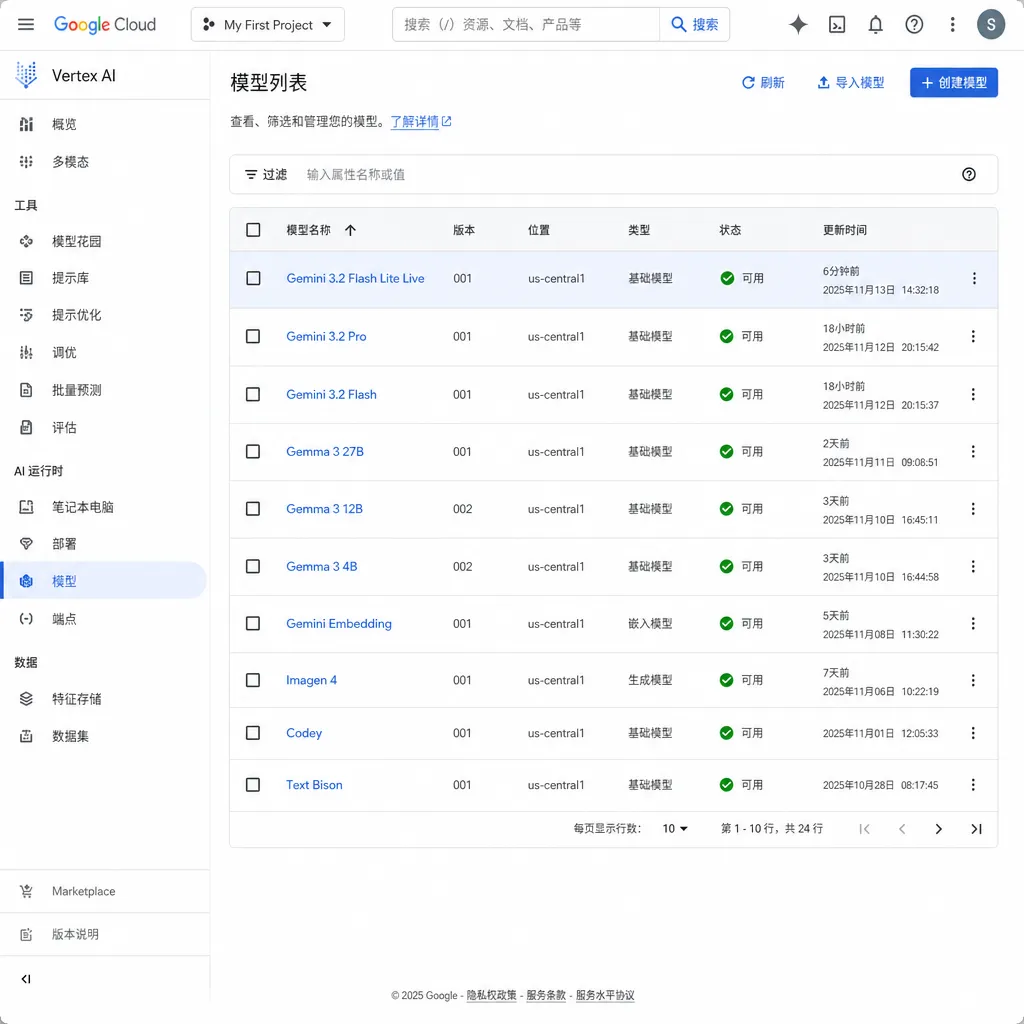
With less than 48 hours until Google I/O 2026 kicks off, Google has once again “spoiled its own surprise.” On May 17, a user posted a screenshot on the developer community linux.do showing a new model entry — Gemini 3.2 Flash Lite Live — already listed in the Google Cloud backend model directory. The entry was quietly taken down soon after, but screenshots have already circulated across X and Reddit.
This isn’t an isolated incident. Earlier in May, the iOS version of the Gemini App leaked a model selector displaying “Gemini 3.2 Flash.” AI Studio briefly listed related entries as well. Add to that the mysterious high-scoring model on LM Arena, and it’s pretty much confirmed that Google has been conducting limited gray-scale testing of its models ahead of I/O 2026.
The Name Says It All
Before we debate whether it’s “3.2 or 3.5,” just look at the suffix in “Gemini 3.2 Flash Lite Live” — it already tells you Google’s product strategy in full detail:
- 3.2: The generation number. Gemini 3 Pro / 3 Flash launched between late last year and early this year, and a 3.1 Pro was spotted on iOS. 3.2 is a natural incremental update, not a full architectural overhaul.
- Flash Lite: Size classification. “Lite” sits under “Flash,” corresponding to models like GPT-5 nano or Claude Haiku — emphasizing ultra-low latency, ultra-low cost, and high-QPS lightweight workloads.
- Live: The key word. In Google’s product lexicon, “Live” almost exclusively refers to real-time, bidirectional, multimodal streaming interfaces — essentially the Gemini Live API suite that supports audio in/out, real-time video frame understanding, and sub-second latency.
Combine the three: a cheap, lightweight Gemini 3.2 variant optimized for real-time multimodal interactions. This isn’t meant for summarizing long documents, but for embedding into AR glasses, customer service bots, in-car assistants, and real-time translation earbuds.
The Gap Google Is Filling
Take a look at the real-time multimodal market right now: OpenAI has its Realtime API + GPT-4o/GPT-5 Realtime; Google has Gemini Live; but no one has truly captured the “cheap and scalable” sweet spot yet. GPT-5 Realtime still costs about $32 per million audio input tokens — painfully expensive for customer service-scale deployments.
Gemini 3.2 Flash Lite Live is positioned precisely here. Based on Gemini 2.5 Flash Lite’s pricing ($0.10 / 1M input, $0.40 / 1M output), even if 3.2 costs slightly more, it’ll likely still undercut GPT-5 mini Realtime by at least half. For scenarios like voice agents, live translation, video surveillance, and voice outbound calling, price per token directly determines scalability.
Google’s product playbook these past two years has been clear — “Pro” for benchmarks, “Flash” for broad adoption, “Lite” for capturing API call share. When 3 Flash launched, Google said it would “replace 2.5 Flash as the default model in the Gemini App,” inheriting all free global user traffic. Now, 3.2 Flash Lite Live steps up to capture developer demand for models that are both “real-time and affordable.”
Why 3.2 and Not 3.5
Some users on linux.do have asked how Google’s versioning works. My take: 3.5 won’t show up anytime soon.
The reason is simple — Gemini 3 Pro launched late last year, and Gemini 3 Flash only rolled out fully in Q1. It typically takes Google two to three quarters to move from a finished model to a fully deployed family lineup. Version 3.2 makes more sense timing-wise — it represents post-training optimization and capability trimming on top of the 3-series base models, not a fresh pretraining effort.
That also explains the proliferation of 3.2 Flash, 3.2 Flash Lite, and 3.2 Flash Lite Live. They share one backbone, distilled into versions of different sizes, then fine-tuned with RLHF and latency optimizations for streaming scenarios. DeepMind has had this production line down since the Gemini 2 era.
GPT-5.5 is rumored to drop in June; releasing the 3.2 series two weeks before I/O clearly shows Google’s intent to dominate the news cycle.
What Developers Should Care About
If you’re already using the Gemini API, here are some practical tips:
- Don’t hardcode 3 Flash. After the May 19 keynote, the 3.2 series will likely open for preview quickly, and the default model will switch. Any code pinned to a specific model name should either be configurable or prepared for an update within the week.
- Expect SDK changes to the Live interface. Gemini Live currently uses WebSocket + a custom protocol. If 3.2 Flash Lite Live pushes for lower latency, the end-to-end protocol could change. When reading the release notes, pay extra attention to
BidiGenerateContent. - Watch context window sizes. That high-performing model on LM Arena handled roughly 800K tokens with minimal degradation — suggesting 3.2 may bring long-context support down to the Flash Lite tier. Great news for RAG use cases.
On OpenAI Hub, integration with the 3.2 series is already in progress. 3 Flash is callable today using the OpenAI-compatible API format, and once 3.2 Flash Lite Live opens for preview, it’ll go live there as well. For developers who don’t want to deal with Vertex AI’s authentication and region restrictions, being able to switch between GPT-5, Claude, and Gemini with one key is a real convenience — especially for benchmarking.
Example base call (replace model name once 3.2 Flash Lite Live is fully released):
from openai import OpenAI

client = OpenAI(
    api_key="your-openai-hub-key",
    base_url="https://api.openai-hub.net/v1"
)

resp = client.chat.completions.create(
    model="gemini-3-flash",  # Replace with gemini-3.2-flash-lite-live
    messages=[
        {"role": "system", "content": "You are a real-time voice assistant."},
        {"role": "user", "content": "Explain in one sentence the difference between Gemini Live and Realtime API."}
    ],
    temperature=0.3,
)
print(resp.choices[0].message.content)
As of now, the real-time streaming (Live) interfaces across providers still lack a unified OpenAI-compatible standard. When 3.2 Flash Lite Live officially launches, it’s expected to offer both the native Gemini Live protocol and an OpenAI Realtime-compatible one.
One More Variable: Tiered Pricing
Since the 2.5 generation, Google has differentiated pricing based on output tokens — even within the Flash family, long-output use cases cost more than short-output ones. The advantage is clear: it separates “long-context short-answer” RAG/search-style customers from “short-context long-generation” content creators for differentiated billing.
If 3.2 Flash Lite Live continues this structure, it actually benefits real‑time audio scenarios — voice responses are naturally short, with low output token use, meaning the effective per-minute cost could be even lower than the per-token rate implies.
See You on May 19
Google I/O 2026 will be held May 19–20 at the Shoreline Amphitheater in Mountain View, California. Based on Google’s rhythm in recent years, the opening keynote will almost certainly unveil:
- The full Gemini 3.2 lineup (Pro / Flash / Flash Lite / Flash Lite Live)
- Updated pricing
- New AI Studio and Antigravity integrations
- At least one on-device Gemini Nano update for Android
Whether 3.2 can outperform GPT‑5 mini in benchmarks, or undercut OpenAI Realtime’s costs in Live scenarios — we’ll know in 48 hours.
References
- linux.do: New model Gemini 3.2 Flash Lite Live spotted on Google Cloud Platform — First leak from the Chinese developer community, with backend screenshots


