
China Telecom launches Token plans starting at 9.9 yuan, marking the operator’s official entry into AI computing power retail.
China Telecom launched a trial commercial Token plan today, starting at 9.9 RMB/month for individual users and 39.9 RMB/month for enterprise users, with mobile bill payment supported. This marks the first time a domestic carrier has packaged AI computing power into a standardized pricing product, signaling a shift in large model usage from enterprise procurement to mass consumption.
China Telecom Launches Token Plans: Starting at 9.9 RMB, the Carrier Officially Enters AI Compute Retail
Today (May 17), China Telecom officially launched its trial commercial Token Plan, starting at 9.9 RMB/month for personal users and 39.9 RMB/month for business users. This marks the first time a domestic telecom operator has packaged large-model API calls as standardized billing products. Users can now purchase Token credits just like data plans and pay directly via their phone bill.
The significance of this move isn’t about how cheap it is, but that the carrier is transforming AI compute from a To-B enterprise procurement model into a To-C standardized commodity. Previously, developers needed to register accounts on various platforms, bind cards, top up balances, and handle different APIs. Now, if you’re a China Telecom user, you can simply open the app, buy Tokens, and settle payments using your mobile number and phone bill. The lowered entry barrier is akin to switching from on-demand cloud server billing to monthly subscription plans.
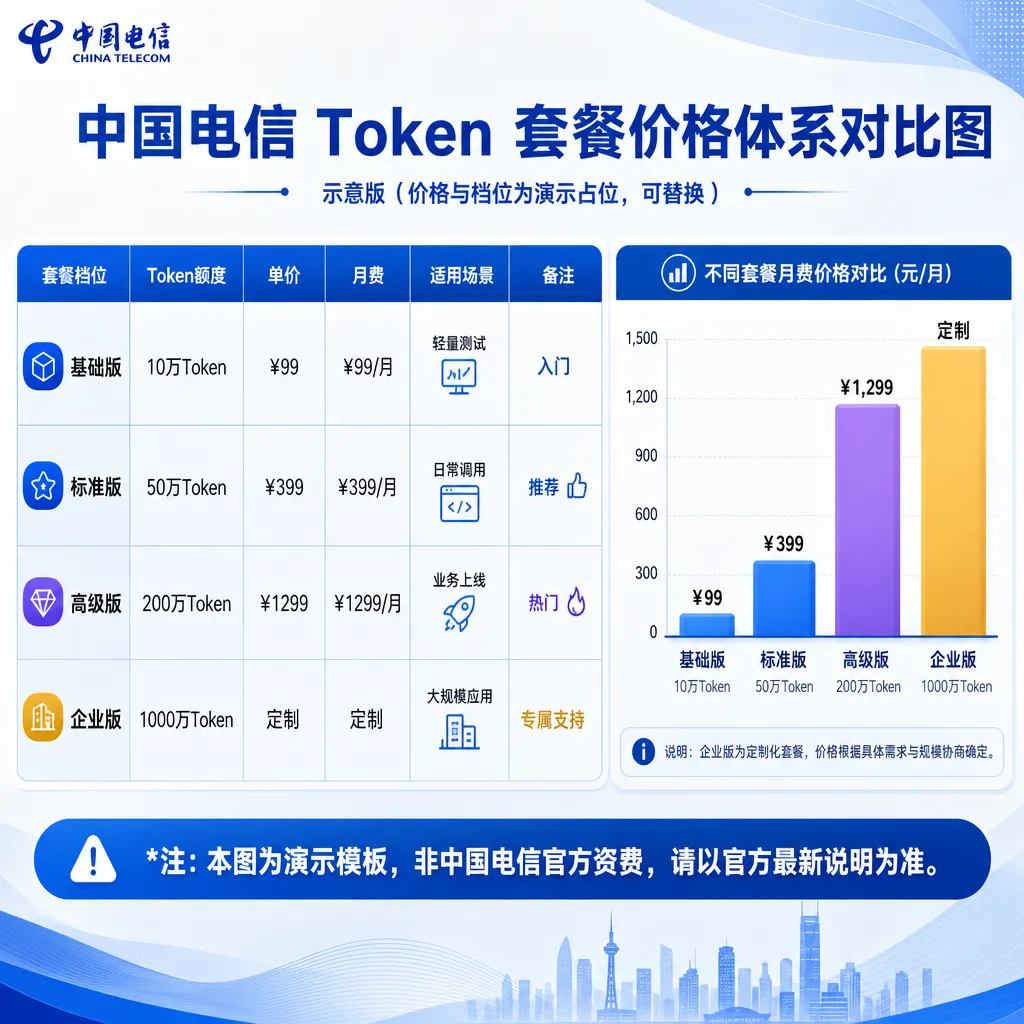
Two Pricing Systems: Separate Plans for Individuals and Businesses
China Telecom launched two independent Token Plan systems, clearly differentiated for personal and enterprise user groups.
Personal and Family Plans have three tiers:
- Lite Plan: 9.9 RMB/month for 10 million Tokens
- Enjoy Plan: 29.9 RMB/month for 40 million Tokens
- Premium Plan: 49.9 RMB/month for 80 million Tokens
Included models are China Telecom’s own Starfield Model and DeepSeek V3.2, aimed at light scenarios such as office tasks, studying, creative writing, and copywriting. According to official data, 10 RMB allows the model to automatically summarize about 100 e-books of 100,000 words each—based on the Shanghai Telecom conversion standard of 250,000 Token points per 1 RMB.
Developer and SME Plans also have three tiers:
- Basic Plan: 39.9 RMB/month for 15 million Tokens
- Professional Plan: 159.9 RMB/month for 70 million Tokens
- Flagship Plan: 299.9 RMB/month for 150 million Tokens
This set connects to Starfield and GLM-5 models, integrating both proprietary and third-party compute resources, optimized for heavy scenarios such as AI programming, code debugging, agent development, and high-compute tasks. The company emphasizes a “low-latency Token service”, crucial for real-time interactive applications.
The two systems follow different pricing logics. The personal plan is scenario-based with a higher per-unit price but smaller total volume; the enterprise plan is compute-based with a lower per-unit price but higher volume. It mirrors the telecom approach to selling data—individuals buy 30GB plans, while enterprises use 500GB unlimited data packages.
Carrier Advantages: Phone Bill Payments + Standard APIs + Cloud Integration
China Telecom’s solution stands out in three main aspects.
1. Payment Method:
Users can subscribe via the Tianyi Cloud website or China Telecom App, with costs billed directly to their phone bill. This is highly convenient—no separate top-ups, no card binding, no corporate purchasing workflows. When Shanghai Telecom piloted it on May 16, it became the first carrier in Shanghai to support AI model payments via phone bills.
2. Standard API Interface:
China Telecom has integrated over 30 mainstream large model APIs. After purchasing Tokens, users can call text or multimodal models through a unified standard API, integrating them into their own software, scripts, or automation flows. This means developers no longer need to write different integration code for different models—one API key handles all switching.
3. Unified Cloud + Intelligence Delivery:
For users without local hardware (e.g., Mac Mini), they can directly purchase a Tianyi AI Cloud PC preloaded with agents such as TeleClaw, OpenClaw, and Hermes—ready to use out of the box. This design cleverly bundles compute power, models, and applications into a single package, lowering technical barriers while promoting cloud PC hardware.
Combining these three points, China Telecom is essentially replicating the broadband business model: infrastructure (compute) + standardized services (API) + terminal devices (cloud PCs) + unified billing (phone charges). This approach is more appealing to individuals and SMEs than the traditional cloud pay-as-you-go model.
The Token Factory: A New Battlefield for Carriers
Behind this move lies the telecom industry’s collective bet on the emerging “Token Factory” model.
A Token Factory essentially standardizes large-model API calls into commoditized compute products, generating profit through large-scale procurement and distribution. In the context of the AI agent boom, brokers view this as the fastest-growing and most commercially tangible short-term model for large-model vendors.
Carriers have natural advantages here.
First, user base: China Telecom, China Mobile, and China Unicom together cover nearly all mobile users and enterprises domestically—an entry channel unmatched by cloud providers.
Second, payment system: phone bill payment is the most mature micro-payment method, easier than credit cards or corporate transfers.
Third, compute resources: carriers own extensive IDC facilities and compute reserves, allowing for rapid expansion through self-building and procurement.
At the summit, China Telecom also released the Starfield TokenHub Platform 1.0, touted as “filling the gap in integrated token operation services in China.” The platform provides multi-model aggregation, intelligent routing, and in-house agent integration—essentially the middle layer for AI compute management.
From a business logic standpoint, carriers building Token Factories resembles their earlier shift from simply selling bandwidth to selling data bundles, specific-use data, and zero-rated data cards. Now “data” becomes “Tokens,” and “bandwidth” becomes “compute.” For carriers, this shift is inevitable—traditional telecom growth has peaked, and they must seek new revenue sources.
What This Means for Developers and Regular Users
For developers, the greatest value lies in reduced integration cost and management complexity.
Previously, calling multiple large models required registering on platforms like OpenAI, Anthropic, Zhipu, and Moonshot, managing separate accounts, API keys, and billing systems. Now, one China Telecom Token Plan lets you access 30+ models through a single interface, with unified billing via your phone plan—no more managing multiple balances or invoices.
This is especially friendly to small teams and indie developers. A team building an AI app might use GLM for text generation, DeepSeek for code completion, and a multimodal model for image understanding. Before, they had to fund and manage each separately. Now, it’s just one monthly plan, no large prepaid costs.
For regular users, the impact is more psychological.
9.9 RMB/month for 10 million Tokens sounds cheap, but most users won’t use nearly that much. According to DeepSeek V3 pricing (0.4 RMB per million tokens input), 10 million tokens would cost about 4 RMB elsewhere. So, the Telecom plan isn’t necessarily cheaper—it might even cost more—but the subscription format lowers decision friction.
Just like how Netflix replaced pay-per-view with subscriptions, users no longer ask “how much will this call cost?” but rather “I’ve already subscribed, might as well use it more.” This mindset boosts engagement and retention.
Another potential effect is accelerating AI adoption. Once model access becomes as easy as buying data, more non-technical users will start exploring AI tools. For example, a content creator who found API registration and top-ups too troublesome can now buy a Token plan in the app and use built-in TeleClaw agents for auto-writing.
Can the Model Work?
The key uncertainty lies in cost control on the supply side.
Token Factories are essentially resellers—buying compute wholesale from model providers and retailing to users. Profitability depends on whether the margin between wholesale and retail can cover operating costs.
Currently, China’s API pricing is already extremely competitive:
DeepSeek V3 input: 0.4 RMB/million tokens; GLM-4: 5 RMB/million; Kimi: 0.1 RMB/million.
In China Telecom’s personal plan (9.9 RMB/10 million tokens), the unit price is about 1 RMB/million tokens—leaving little profit margin.
The carrier’s strength lies in scale and in-house compute. If they can cut wholesale costs via large-scale procurement or deploy self-built compute resources, the model could work. Otherwise, reselling third-party APIs yields very slim margins.
Another risk is underutilization. Ten million tokens equals roughly 5 million characters of text input—far more than most users need. If the average user only consumes 10%, Telecom must bear significant unused capacity, unlike data plans where unused data simply expires. Here, unspent tokens mean unmonetized compute.
Strategically, however, short-term profits may not be Telecom’s goal. The aim is to capture the AI consumer gateway. Once users get used to paying for AI via phone bills, the carrier can upsell value-added services—cloud PCs, agent subscriptions, enterprise AI packages. The logic mirrors free data card promotions: attract users first, monetize the ecosystem later.
Industry Impact: Will Other Carriers Follow?
If China Telecom’s pilot proves successful, China Mobile and China Unicom will almost certainly follow suit quickly.
When Shanghai Telecom launched on May 16, analysts predicted that “if the model works, China Mobile and Unicom will replicate it almost identically,” and that makes sense—telecom competition is always tit-for-tat, especially in emerging service areas where no one wants to fall behind.
If all three carriers roll out similar plans, the AI compute market landscape will shift. Traditional cloud vendors (Alibaba Cloud, Tencent Cloud, Huawei Cloud) will retain To-B advantages, but in the To-C and SME markets, carriers—with billing and user base advantages—could seize share.
For model providers, this is a double-edged sword. On one hand, carrier channels bring broader reach and higher call volumes; on the other, as intermediaries, carriers will squeeze margins and push prices down further.
Long term, this signals the commoditization of AI compute. When Tokens become standardized like data, users will prioritize price and quality over brand or model type. This benefits top-tier model providers (who can charge a premium) but challenges mid- and low-tier players—if performance is similar, users will pick the cheapest.
Final Thoughts
China Telecom’s Token Plan launch signals the shift of AI compute from enterprise procurement to consumer subscription—as pivotal as smartphones evolving from business tools to everyday products.
From a business model perspective, the Token Factory mirrors telecom’s proven success: standardized products + monthly subscriptions + unified billing. This approach has worked for decades in telecom, and it’s theoretically applicable to AI.
From a user experience angle, phone bill payment + standardized APIs + cloud integration indeed lowers barriers. Developers save on management complexity; users face less decision friction.
But whether this model truly works depends on three key factors:
- Can supply-side costs be controlled?
- Will actual usage meet expectations?
- Can carriers monetize further within the AI ecosystem?
For now, carriers have taken the first step. The rest depends on how the market responds.
References
-
China Telecom Launches Trial Commercial Token Plan, Starting at 9.9 RMB/month – ITHome
Official release details, pricing information, usage scenarios, and purchase methods. -
China Telecom Token Plan Discussion – Linux.do Community
Developer community discussions and feedback regarding the Token Plan.


