
Zhihu Opens Official API: AI Can Directly Access Search and Q&A

Zhihu has officially launched a developer API platform, offering interfaces for search, Q&A, trending lists, and more, along with support for the MCP and Skill protocols, enabling AI models to directly access Zhihu’s content capabilities.
Zhihu Opens Official API: AI Can Directly Access Search and Q&A
Zhihu quietly launched its developer platform (developer.zhihu.com) yesterday, officially opening its public API. This is not a simple case of data access—Zhihu is directly targeting the AI Agent ecosystem. In addition to standard REST APIs, Zhihu is also providing MCP (Model Context Protocol) and Skill protocol wrappers, enabling large models to use Zhihu’s search and Q&A capabilities as easily as calling any other tool.
For developers, this means your AI application can now directly let the model search Zhihu, check trending lists, or obtain direct-answer results without crawling data or manually wiring up complex APIs. For Zhihu, this move transforms its content capabilities into infrastructure for the AI era—once all AI assistants can access Zhihu, the logic of traffic entry changes.
What Capabilities Are Opened
Zhihu’s open APIs now cover four core scenarios:
Web Search API: Covers not only Zhihu’s internal content but its web-wide search capabilities. Results include structured data such as title, summary, and source links, suitable for information aggregation and knowledge retrieval.
Zhihu Q&A Search API: Specifically serves Zhihu’s internal Q&A content. Compared to web search, this returns Zhihu’s unique question–answer structure, including question descriptions, top-voted answers, and responder information. For apps that need high-quality Chinese Q&A data, this is more precise than general web search.
Direct Answer API: This is Zhihu’s native dialogue-model capability, similar to its web “Direct Answer” feature. You ask a question, and it returns a synthesized answer instead of a list of links. This is particularly useful for AI agents—when a user asks “How to learn Python,” the agent can call this API to get a structured learning path instead of having the user browse multiple posts.
Trending List API: Retrieves Zhihu’s trending topics in real time. This is a ready-to-use data source for apps focused on news aggregation, sentiment monitoring, or content recommendation.
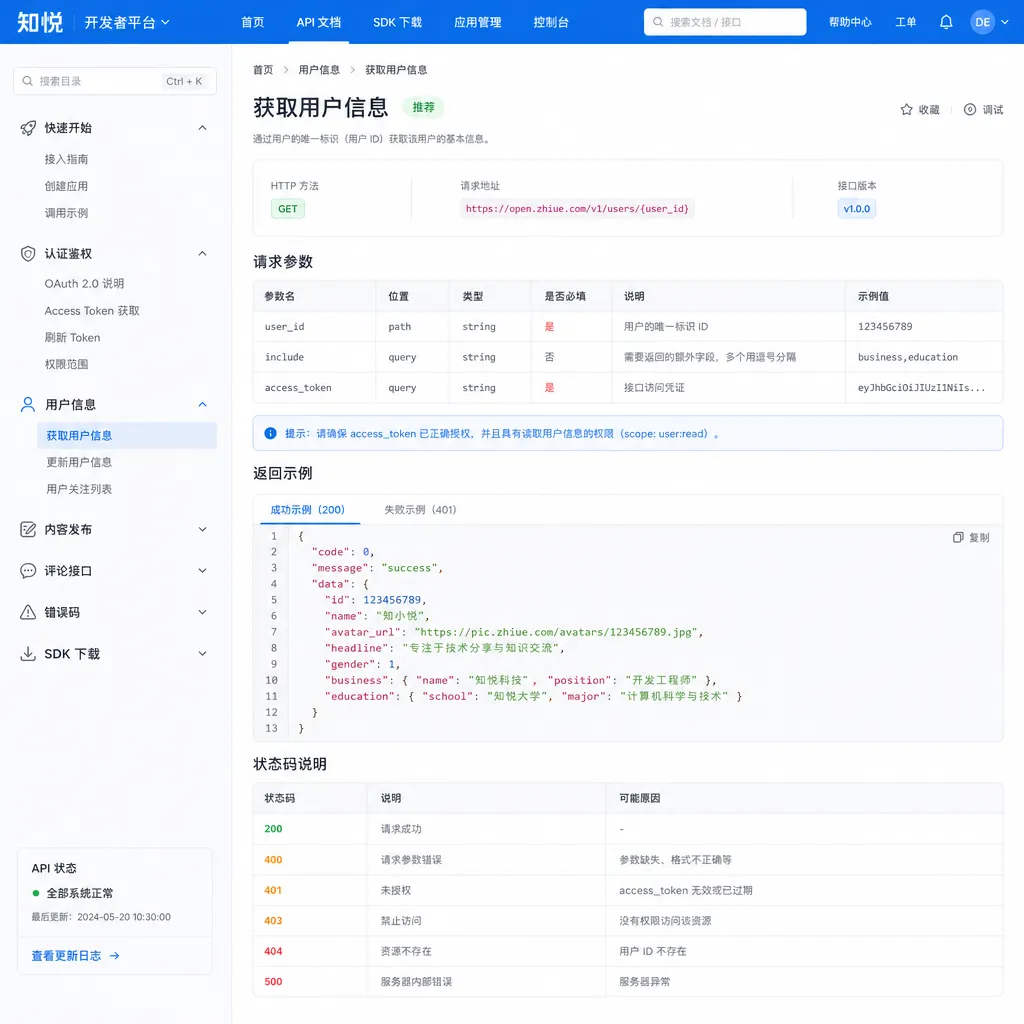
From the interface design perspective, Zhihu has been cautious this time—it does not expose user data or writing capabilities (like posting answers or liking/commenting), offering only read and search access. This protects user privacy and avoids abuse. For most AI applications, read access is sufficient—AI agents need knowledge retrieval and information acquisition, not to post content on behalf of users.
Usage Limits: Free but With Thresholds
Current limits for the Zhihu API are:
- 1,000 calls per developer account per day
- 60 requests per endpoint per minute
- Up to 20 results per request
This should suffice for individual developers or small-scale apps but not for commercial-scale products. Community discussions suggest Zhihu may later offer paid plans—API as a Service (APIaaS) is already a mature business model, used by OpenAI and Anthropic alike.
Interestingly, Zhihu does not enforce a strict approval process. Once you register as a developer, you can instantly start calling APIs without submitting app reviews or usage justifications. Such openness is rare among Chinese content platforms, most of which require corporate verification or manual review. Zhihu might be aiming to quickly build its developer ecosystem—since the AI Agent field is still nascent, whoever builds the ecosystem first gains an early advantage.
MCP and Skill: Protocols for AI Agents
Zhihu didn’t just open REST APIs—it also provided MCP and Skill protocol wrappers. For developers unfamiliar with AI Agent development, here’s a brief explanation:
MCP (Model Context Protocol), led by Anthropic, is an open-source protocol designed to standardize how AI models call external tools. Think of it as an “API gateway for AI”—developers wrap their services as MCP servers, and AI models can call these services through a unified protocol, regardless of whether they are REST APIs, GraphQL, or something else.
Skill, proposed by ByteDance’s Doubao team, follows a similar idea but emphasizes the concept of “skills.” A Skill is not just an API endpoint, but a full capability unit including input/output definitions, error handling, and access control. Compared with MCP’s “protocol-first” approach, Skill is more “product-first”—it encourages developers to wrap services as ready-to-use capability modules.
Zhihu supporting both protocols means it’s not taking sides in the AI Agent ecosystem. MCP is backed by Anthropic (developer of Claude), while Skill is backed by ByteDance (developer of Doubao)—both major players in China’s AI market. Zhihu’s “support both” strategy lets developers choose freely: Claude developers can use MCP, Doubao developers can use Skill, and others can directly call REST APIs.
Technically, both MCP and Skill are standardized descriptive layers atop REST APIs. For instance, the Zhihu Search API:
Using REST:
GET /api/v1/search?q=如何学习Python&limit=10
Using MCP:
{
  "method": "tools/call",
  "params": {
    "name": "zhihu_search",
    "arguments": {
      "query": "如何学习Python",
      "limit": 10
    }
  }
}
Skill calls work similarly, with slight protocol differences. For AI models, MCP and Skill have the advantage that the model knows the tool’s capability boundaries—what can search, what can compute—so it can autonomously pick the right tool based on the user’s intent. REST APIs, by contrast, require developers to hardcode that logic.
What It Means for the AI Ecosystem
Seen in a broader context, Zhihu opening its APIs marks a strategic transformation—content platforms repositioning themselves in the AI era.
For the past decade, content platforms’ core asset was the traffic gateway. Users seeking information had to open the Zhihu app or site; recommendation algorithms distributed content and monetized via ads. AI Agents disrupt that flow—users no longer need to visit Zhihu directly. They simply ask “How to learn Python,” and the AI assistant fetches data via Zhihu’s API, synthesizes an answer, and returns it—users might never even realize it came from Zhihu.
This shift devalues the traffic gateway and increases the value of the content itself. Zhihu’s response is to open APIs and become infrastructure for the AI ecosystem. Rather than battling web scrapers (and legal disputes), Zhihu provides official data access, maintaining some control and monetization potential.
For developers, Zhihu’s API means access to high-quality Chinese knowledge data. Compared with generic search engines, Zhihu’s question–answer format is more understandable by AI; compared with Baidu Zhidao or other Q&A sites, Zhihu offers higher quality and less noise. If you’re building a Chinese AI assistant, the Zhihu API is an excellent knowledge augmentation tool—when users ask professional questions, AI can first query Zhihu and then generate more accurate answers based on those responses.
Skeptics worry this could “commoditize” Zhihu—if every AI agent can access it, why would users open Zhihu at all? There’s no single answer. Zhihu could monetize by API usage volume, offsetting traffic loss, or it might embed brand metadata or referral links in API responses to drive users back to its app. Either way, the essence is this: content platforms must redefine their roles in the AI age.
Competitor Comparison: Who’s Betting on the AI Ecosystem
Zhihu isn’t the first content platform to expose APIs to AI, but it’s one of the most aggressive.
Wikipedia has long offered open APIs but positions itself as a public knowledge repository, not commercialized. AI models can freely access it, but Wikipedia doesn’t profit from API calls.
Stack Overflow also offers APIs, but primarily to enterprise clients—with tight quotas for individuals. It’s conservative about AI training data, having even sued companies scraping its data.
Reddit drastically limited its APIs last year and raised prices, killing many third-party clients. Its logic: Our data has value, AI companies must pay. But this sparked backlash, driving many users and developers away.
In contrast, Zhihu follows a “open first, monetize later” strategy—free for personal developers but reserving room for subscription tiers. The upside is rapid ecosystem growth; the risk is potential user loss if future pricing climbs steeply.
Other Chinese platforms haven’t followed suit yet. WeChat Official Accounts, Xiaohongshu, Bilibili—all have APIs, but mainly for enterprise clients, with heavy review and high fees. Zhihu’s open API move captures early AI integration advantage—once developers grow used to it, even if competitors join later, Zhihu will already have a moat.
How Developers Can Use It
To try Zhihu’s API:
- Visit developer.zhihu.com and register a developer account
- Create an app and get an API key
- Use the documentation to make API calls
Zhihu provides detailed docs and example code for popular languages like Python, JavaScript, and Go. If you’re using an AI framework supporting MCP or Skill (e.g., LangChain, Dify), you can directly import Zhihu’s MCP Server or Skill configuration without writing custom logic.
A typical use case: you’re building a technical Q&A assistant. A user asks “How to use Python decorators.” The assistant calls the Zhihu Q&A Search API, retrieves top-voted answers, uses them as context, generates a summarized reply, and appends Zhihu source links at the end for further reading.
This “Retrieval-Augmented Generation” (RAG) approach dominates current AI applications. Zhihu’s API provides a high-quality retrieval source—compared to letting AI browse random sites (with low-quality content), calling Zhihu directly greatly improves answer quality.
Potential Issues: Copyright and Abuse
Opening APIs inevitably raises issues.
Copyright: Zhihu’s content is user-generated. Allowing third-party apps to call it—does that infringe on creator rights? Legally, it depends on Zhihu’s user agreement—if users granted Zhihu distribution rights upon posting, API access is covered. Ethically, though, creators might not realize their work is being used by AI, inviting controversy.
Abuse: Even with usage limits, APIs can be exploited for bulk scraping, training competing models, or generating spam. Zhihu must balance openness with control—making APIs usable but resistant to misuse.
Content Quality: AI’s answers depend on Zhihu’s underlying content quality. If a topic has poor responses, the AI output will suffer too. Worse, AI could amplify biases or errors—e.g., a highly upvoted but incorrect answer could be treated as authoritative.
There’s no perfect fix for these challenges—only iterative improvement. Zhihu may add features like content provenance, quality scoring, or dispute flags to help AIs assess reliability better.
The Future: Will API Subscriptions Become a Business Model?
Community discussions speculate Zhihu may launch API subscription packages—a plausible direction, following OpenAI, Anthropic, and Google’s paid API models.
Possible pricing tiers:
- Free: 1,000 calls/day — for individuals or small projects
- Basic: ¥99/month, 10,000 calls/day — for small businesses
- Pro: ¥999/month, 100,000 calls/day — with dedicated support
- Enterprise: custom pricing, unlimited calls, SLA guarantees
If Zhihu adds such plans, it will evolve from content platform to “Knowledge-as-a-Service” provider. This shift offers opportunity—API subscriptions promise more stable, scalable revenue than ads or memberships. The catch: Zhihu must maintain superior content quality and an irreplaceable AI ecosystem position.
In the long run, Zhihu’s API opening could set off a trend. If it succeeds, other platforms (Xiaohongshu, Bilibili, Weibo, etc.) may follow. Then AI application development will no longer rely on data scraping but on official APIs from multiple sources aggregated together—better for developers (no bans or legal risks) and for platforms (a new revenue slice).
This will also shift competition among platforms—from “who has more traffic” to “whose APIs are better.” Zhihu now holds the early lead, but maintaining it will depend on continued product evolution and ecosystem growth.
References
- Zhihu Official API (Search, Q&A, Trending), MCP, SKILL Launch - Linux.do – Community discussion on Zhihu API rollout and limits
- AI Agent Beginner’s Guide (III): Tools — From Function Calling to MCP and Skills - Zhihu Column – Technical explanation of MCP and Skill
- From Zero: Understanding Model APIs — Tools + MCP + Skills - Zhihu Column – A walkthrough of model tooling fundamentals
- In Plain Terms: Skills Are Apps for AI - Zhihu Column – A layman’s intro to the Skill protocol design
- MCP vs. Skills? The Agent Protocol Battle Depends on Execution Environments - Zhihu Column – Comparing MCP and Skill implementations
- MCP vs. Skills: What Does Your AI Agent Really Need? - Zhihu Column – Developer perspective on choosing between protocols


