
HuggingFace Launches Its First Agent Leaderboard

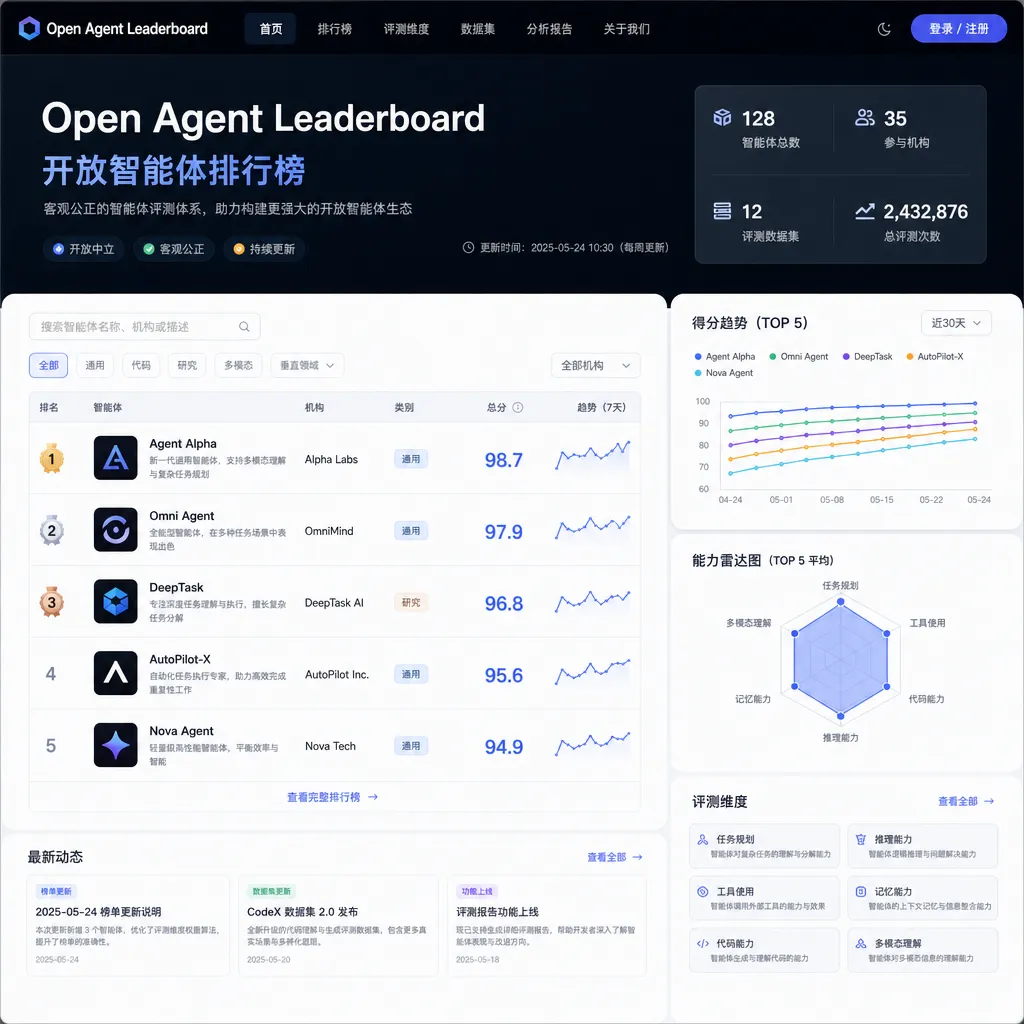
HuggingFace and IBM Research jointly launched the **Open Agent Leaderboard**, establishing for the first time a public benchmark for agent performance. It covers multiple dimensions such as mathematical reasoning and multimodality, and currently includes agent implementations of major open‑source and closed‑source models.
HuggingFace Launches Its First Agent Leaderboard, Marking the Start of the Standardized Era of Agent Evaluation
HuggingFace, in collaboration with IBM Research, has released the Open Agent Leaderboard, the industry’s first public benchmark focused specifically on evaluating agent performance. Unlike the earlier Open LLM Leaderboard, which centered on single-turn conversation ability, this new leaderboard emphasizes multi-step reasoning, tool usage, and task planning capabilities of agents.
The significance of this event lies in finally establishing a relatively unified reference system for agent evaluation. Over the past year, everyone has been building agents—but with vastly different benchmarks: some measure math accuracy, others API call success rate, and some focus on multi-turn coherence—making cross-comparison nearly impossible. Now, HuggingFace has integrated these dimensions into one leaderboard, at least giving developers a sense of where their agents stand in the industry.
What It Evaluates: Beyond Answers, Focusing on the Reasoning Chain
The Open Agent Leaderboard currently focuses on math reasoning tasks—a smart entry point. Math problems have clear correctness criteria, traceable reasoning processes, and place high demands on an agent’s core abilities such as multi-step planning and intermediate result verification.
The leaderboard includes several mainstream agent implementations:
- Chain-of-Thought (CoT): Basic reasoning chain prompts, prompting the model to write down its reasoning step by step.
- Self-Consistency CoT (SC-CoT): Samples multiple reasoning paths and selects the most consistent answer, improving accuracy through majority voting.
- ReAct: Alternates between reasoning and acting, allowing the model to call external tools to verify intermediate results.
- Reflexion: Agents with reflection mechanisms that learn from mistakes and adjust their strategies accordingly.
These methods represent major design trends for agents. CoT is lightweight and adds minimal reasoning cost; SC-CoT trades higher computation for accuracy and stability; ReAct and Reflexion require stronger self-monitoring ability, demanding more from the underlying LLM.
According to published results, closed-source models still lead in complex reasoning tasks, but open-source models are catching up. Especially when paired with engineering techniques like SC-CoT, some open-source models with around 70B parameters are approaching early GPT-4 performance levels. This suggests that agent capability doesn’t depend solely on model size—the design of the reasoning framework is equally critical.
How Evaluation Works: Standardized, Reproducible Environment
One major strength of this HuggingFace initiative is that all evaluations run in a unified environment with open-source code and publicly available datasets. This eliminates the “each-vendor-tells-its-own-story” problem—previously, models would claim SOTA (state-of-the-art) results that often vanished when tested with different datasets or prompt templates.
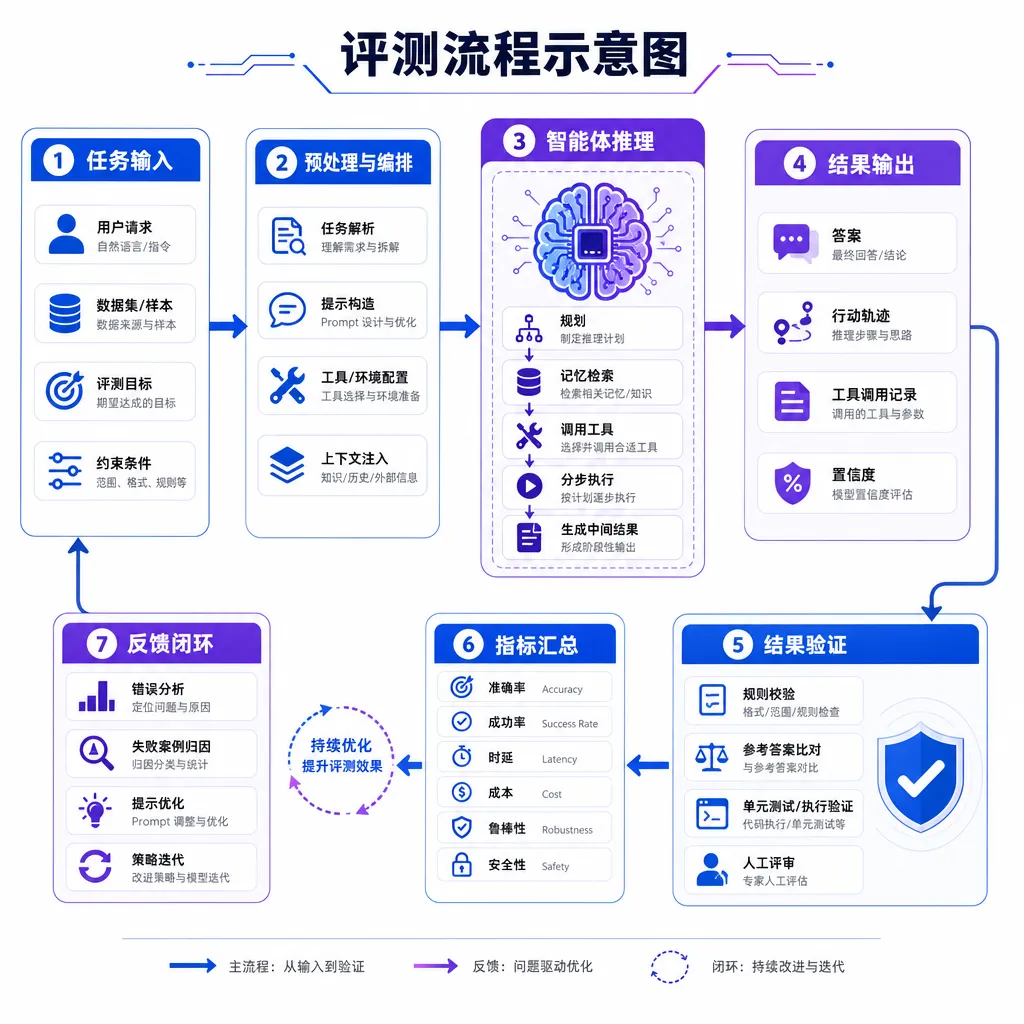
Datasets used include GSM8K, MATH, and other classic math reasoning benchmarks, as well as some multimodal tasks. Metrics go beyond final answer accuracy, recording reasoning steps, tool call counts, and error recovery capabilities. These process-level metrics matter greatly in real-world use—an agent that gets the right answer in 50 reasoning steps might be less practical than one that gets it wrong in only 5.
Crucially, the leaderboard offers standardized evaluation scripts. Developers can directly submit their agent implementations to get scores—no need to set up environments manually. This dramatically lowers participation barriers and allows leaderboard updates to keep pace with model iteration cycles.
Why Now
The timing is solid. Since the second half of 2024, agents have evolved from lab concepts into real-world products. OpenAI’s GPTs, Anthropic’s Claude Projects, and Google’s Gemini Extensions are all moving toward giving models autonomy to plan tasks and use tools. The open-source community is keeping up too—frameworks like LangChain, AutoGPT, and MetaGPT have made agent development accessible to ordinary developers.
The issue, however, is that while everyone’s building agents, no one agrees on what qualifies as a good agent. Some value fewer reasoning steps, others higher accuracy, others lower cost. The Open Agent Leaderboard essentially sets a baseline for a field that’s been growing chaotically.
From a business perspective, the leaderboard benefits both model providers and application developers. Model companies can use it to prove their models’ suitability as agent backbones, while application developers can use it for model selection—no need for extensive tests; the leaderboard reveals which models perform best for specific tasks.
Current Limitations
That said, the leaderboard is still in its early stage, with several obvious shortcomings:
Limited task coverage. It currently focuses on math reasoning, with multimodal tasks only experimental. Real-world agents face far broader task types—code generation, data analysis, multi-turn dialogue, long document comprehension—each with unique evaluation challenges. Excelling at math doesn’t guarantee coding ability.
No cost dimension. The leaderboard measures performance but not cost. In production, an agent that needs 10 API calls to complete a task costs five times as much as one that only needs two. For high-frequency scenarios, that difference can be fatal.
Insufficient reflection of tool-use ability. Current evaluations mostly test reasoning capability, but not the core skill of “when and how to use tools.” In real scenarios, agents contend with dozens or hundreds of available tools—deciding which to use, how to combine them, and how to handle errors are tough challenges.
Deployment factors for open-source models are ignored. The open-source models on the leaderboard are tested in idealized environments, but real-world deployments face issues like quantization, inference optimization, and concurrency control that can significantly affect performance. A model ranking third on the board might underperform one ranked fifth in production.
Practical Impact for Developers
If you’re building an agent-related product, this leaderboard is worth paying attention to—but don’t chase it blindly.
Match your model to your task type. If your agent mostly handles math or logical reasoning, the leaderboard is very informative. But for tasks like customer service, content generation, or data analysis, its guidance is limited.
Focus on reasoning frameworks, not just models. The same model can achieve vastly different scores with different agent frameworks, underscoring that framework design is as important as model choice. For open-source models, investing effort in prompt optimization and reasoning strategy often yields better results than switching to a larger model.
Balance cost and performance. Top-ranked methods often rely on multiple samplings or multi-step validation, which increases inference cost. If your application is latency-sensitive or high-traffic, you’ll need to balance accuracy with cost.
Treat the leaderboard as a starting point, not an endpoint. It shows performance in general scenarios, but every application has unique requirements. The best approach is to shortlist candidates from the leaderboard, then run targeted tests on your own datasets.
The Next Step for Agent Evaluation
The Open Agent Leaderboard is just the beginning. For agent benchmarks to truly mature, several issues must be addressed:
Standardizing multimodal tasks. Increasingly, agents handle images, audio, and video, yet evaluation standards remain vague. What does it mean to “understand an image”? Describing its content, or reasoning about it? Definitions will heavily affect outcomes.
Evaluating long-term tasks. Real-world agents often perform tasks over hours or days, handling anomalies, adjusting plans, and interacting with humans. Current short, one-off benchmarks fail to capture these long-term capabilities.
Safety and controllability. The more autonomy agents have, the higher the risk of misbehavior. Evaluation frameworks must incorporate safety measures—assessing whether an agent executes unsafe actions, leaks sensitive data, or succumbs to adversarial prompts. These are critical in production.
Human-AI collaboration. Practical agents aren’t fully autonomous—they should request human confirmation at key points, interpret ambiguous human commands, and quickly adapt based on feedback. While hard to measure automatically, this ability is vital for real-world usability.
HuggingFace has taken the first step, but agent evaluation still has a long road ahead. Fortunately, with a shared leaderboard, the industry at least has a common foundation for discussion. What happens next depends on how different players respond—and whether the leaderboard itself rapidly evolves with community feedback.
Looking broadly, the Open Agent Leaderboard signifies that agent development is shifting from an “alchemy” phase to an engineering phase. With standardized evaluation comes standardized optimization, enabling broader developer participation. That’s great news for the AI ecosystem at large.
For developers in China, if you want to quickly connect to various large models to test your agent implementation, you might consider an aggregator platform like OpenAI Hub—one API key gives access to mainstream models such as GPT, Claude, Gemini, DeepSeek, and more. It avoids the hassle of integrating multiple APIs separately and can be accessed directly from within China without network issues.
References
- The Open Agent Leaderboard - Hugging Face Blog – Official HuggingFace blog introduction
- Open Agent Leaderboard - Hugging Face Space – Real-time leaderboard page
- Open Agent Leaderboard: Open-Source Agent Benchmark - Zhihu – Chinese community interpretation
- Recent Updates to the Open LLM Leaderboard - CNBlogs – Background on HuggingFace’s prior LLM leaderboard


