
Agora-1 Release: The world model begins to learn multi-agent handling
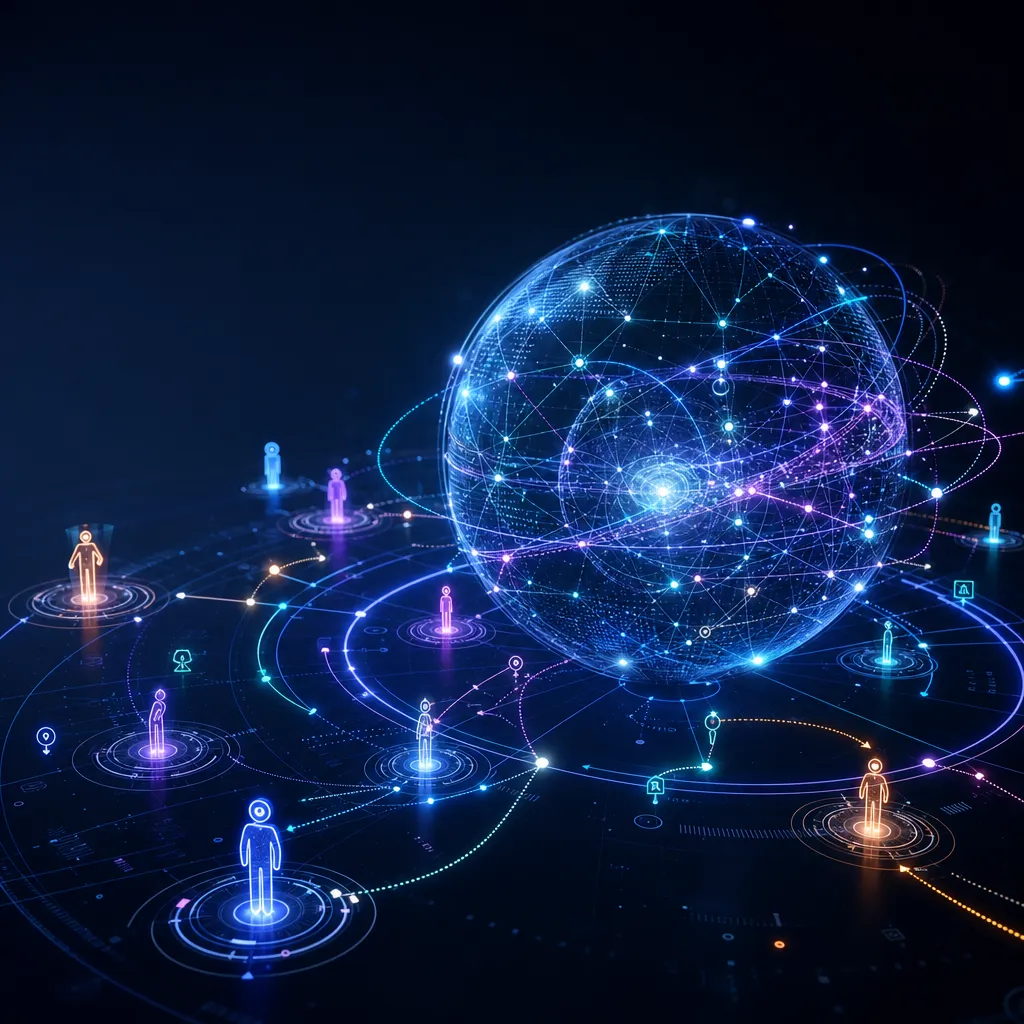
Odyssey has launched the world model **Agora-1**, designed for multi-agent environments, pushing the boundaries of world model capabilities from single-agent roaming to multi-agent coexistence and interaction. This is one of the few solutions in the current world model landscape that treats "multi-agent" as a fundamental problem.
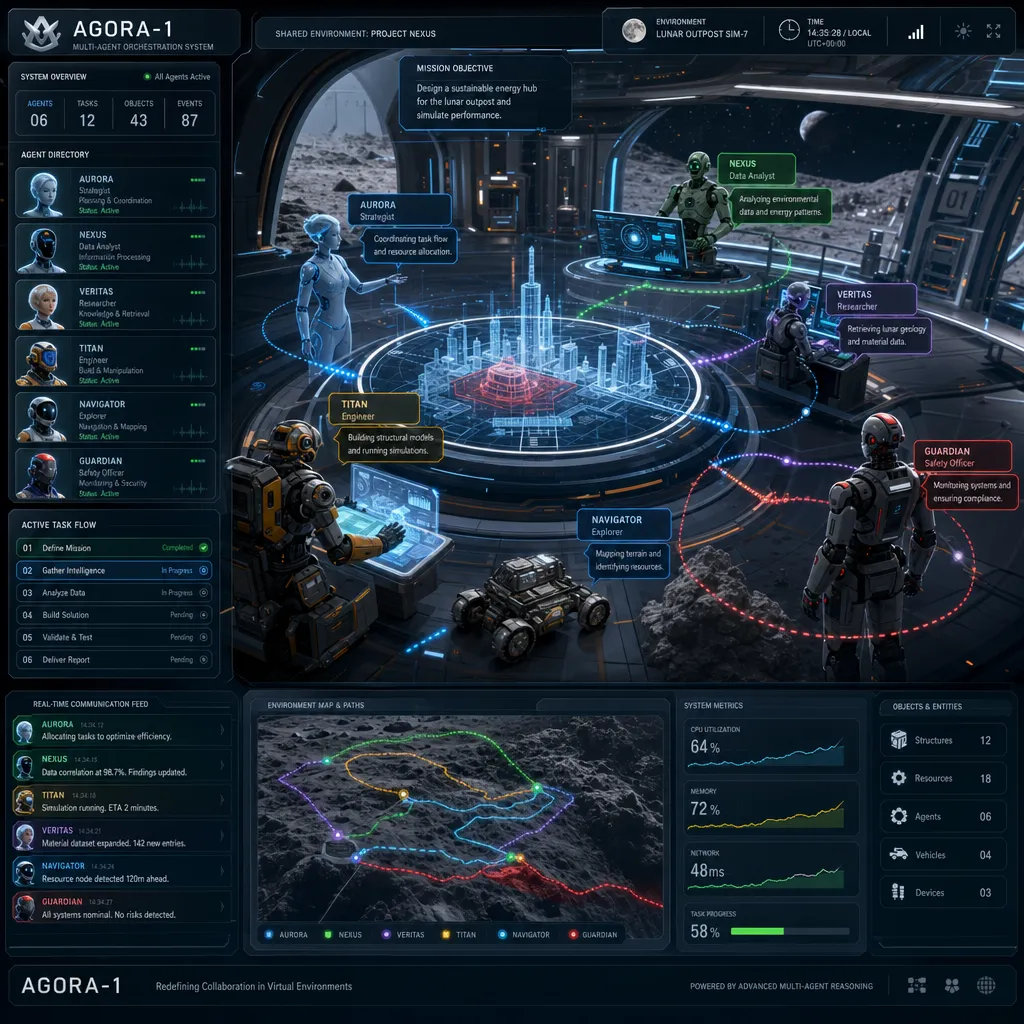
Odyssey released Agora‑1 today with a very clear positioning: the first world model to make “multi‑agent” its core mission. In one sentence—previous world models basically allowed only one “you” to move around in a generated world; Agora‑1 allows multiple independent agents to exist in the same world simultaneously, see each other, and influence each other’s next moves.
It may not sound explosive at first, but within the current world‑model landscape, it fills precisely the most critical gap.
Why “multi‑agent” is an unavoidable hurdle for world models
Over the past 18 months, world models have become one of the densest new battlegrounds in the AI space. DeepMind’s Genie 2, NVIDIA’s Cosmos, World Labs’ recently updated Marble 1.1, Huawei’s Pangu 5.5 world model, plus domestic players like XPeng’s X‑World, Zhiyuan, and Zhixiang Future’s HiDream‑O1—all have different focuses: some bet on spatial intelligence, some on full‑modality generation, some on embodied‑control foundations.
But if you compare these models side by side, you’ll find a common “assumption”: the world basically has only one observer/actor. Marble’s capability to move an entire room into 3‑D in minutes is amazing, but that’s a “static, explorable” world; Genie 2 is single‑player frame‑generation; Cosmos mainly serves autonomous‑driving contexts with the “ego‑vehicle viewpoint + other traffic participants as environment” setup.
This paradigm works fine for content generation, game demos, or single‑robot training. But once you need to handle scenarios like these, a single‑agent world model immediately falls short:
- Multi‑robot cooperation: two AGVs entering the same aisle simultaneously—who yields, how each adjusts its plan upon seeing the other’s next move
- Autonomous‑driving interaction: when changing lanes, the neighboring driver’s reaction isn’t mere environment noise—it’s another reasoning agent
- Multiplayer games / simulation training: NPCs need to interact logically, not each live in their own world
- Group embodied intelligence: humanoid robots sharing space with humans or other robots—their behaviors must remain consistent
If a world model cannot let multiple agents coexist within the same “physical” and “event” space, it’s modeling not the real world but a single‑player instance. Agora‑1 aims to solve exactly that.
What makes Agora‑1 different
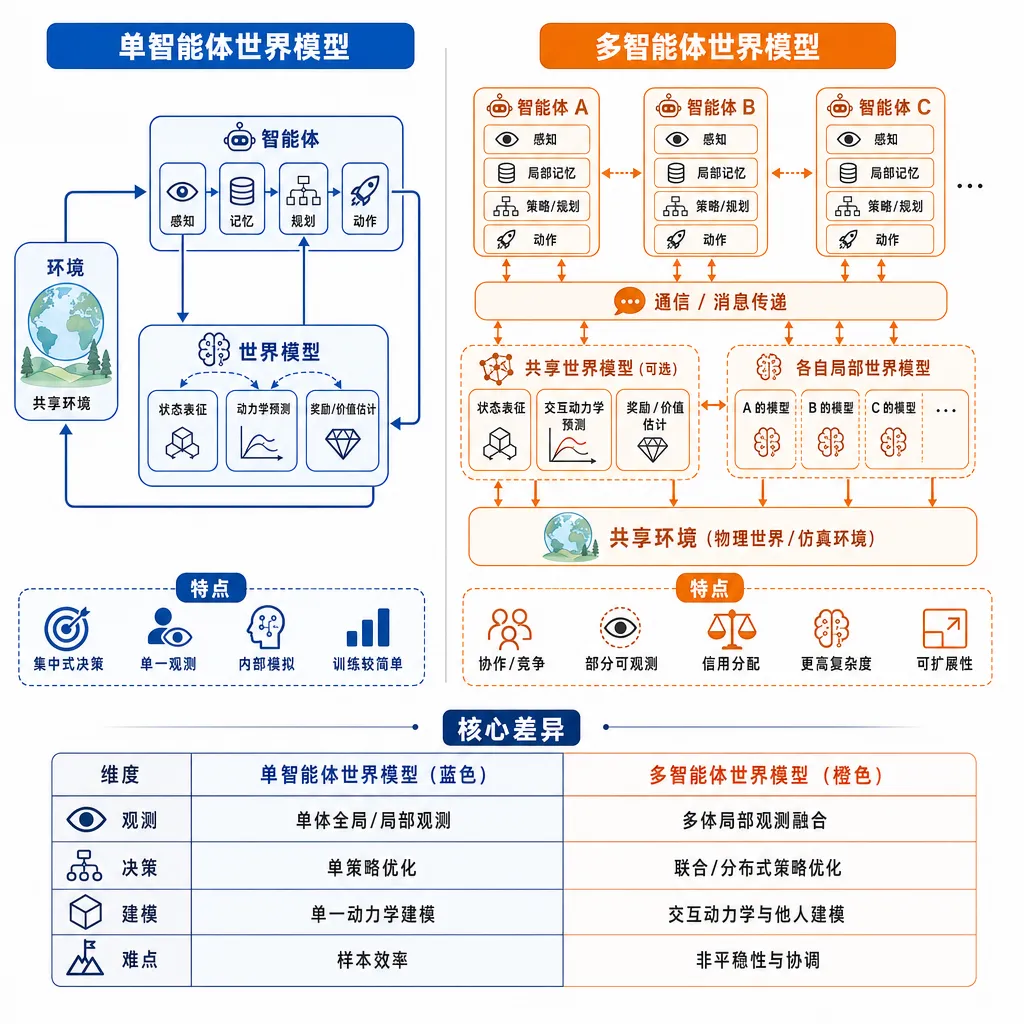
According to Odyssey’s release, Agora‑1’s core innovation isn’t simply “duplicating” a single‑agent world model—such an approach is fragile: each agent’s view of world state quickly diverges, and physics becomes inconsistent.
Agora‑1 treats multi‑agents as first‑class citizens during training:
- Shared world state. All agents share one underlying world representation rather than each maintaining its own illusion. When one agent pushes a door, the door’s state is identical from another’s perspective.
- Observation generation per agent. The world state is unified, but each agent’s observation is rendered from its own viewpoint—position, orientation, and visibility are individually computed.
- Parallel action resolution. Multiple agents provide actions in the same timestep; the model jointly resolves causal relationships and conflicts rather than serially pretending others don’t exist.
In short, it achieves at the world‑model level what previously required hard‑coded rules in a simulation engine—making the “world” consistent for everyone. The difference is that traditional physics simulators rely on hand‑written dynamics and collision detection; Agora‑1 learns a generative approach from data, theoretically generalizing to open scenarios where rules can’t be hand‑written.
This deserves elaboration. Traditional multi‑agent simulators—Habitat, Isaac Sim, CARLA—aren’t “generated,” they’re constructed: you need assets, rules, scripts. Their limit is how much content you can build. A generative world model like Agora‑1, if it stabilizes multi‑agent consistency, could directly produce training environments where other agents truly “strategize.” For embodied AI and RL training, that’s a potential supply‑side revolution.
Position among current world models
Horizontally comparing representative players in this field:
- World Labs / Marble series: bets on “spatial intelligence,” excels at generating high‑fidelity navigable 3‑D space from a single image; Marble 1.1 and 1.1‑Plus launched at end of April with trade‑offs between visual quality and scale. Essentially still a single‑observer world.
- DeepMind Genie 2: interactive video generation; a player can advance the world, but it’s single‑player.
- NVIDIA Cosmos: oriented toward autonomous driving and embodied‑robot pretraining; emphasizes physical‑world “common sense”; multi‑body behavior modeled as environmental noise, not separate agents.
- Huawei Pangu world model (the version released at HDC last June): focuses on point‑cloud and video dual‑modality generation, applied to intelligent driving and robotics digital‑physical space.
- Zhixiang Future HiDream‑O1: pursues native full‑modality generation; its UiT architecture aligns image, video, and action tokens within one model.
- Odyssey Agora‑1: explicitly focuses on multi‑agent consistency and interactive behavior.
Each team is slicing a different facet of the cake: World Labs tackles spatial aspects, Zhixiang full‑modality generation, Cosmos physical commonsense, Agora‑1 social and interactive dimensions—a world containing multiple reasoning “people.”
It’s not about one dominating another, more like complementary sides of world models that will likely converge eventually. But whoever solidifies their slice first will be more valuable in the next stage. Agora‑1’s chosen slice happens to be indispensable for robotics cooperation, autonomous driving, and crowd simulation.
Some measured assessments
A few points worth approaching calmly:
First, multi‑agent consistency is a long‑term challenge—not solved in one version. Everyone has seen consistency issues in video generation these past two years—characters change faces mid‑walk. Keeping N agents consistent over long sequences on a shared world is even harder. Agora‑1 achieving minutes‑long multi‑agent interaction in demos is impressive, but industrial deployment needs tens of minutes or hours without drift—the road ahead is long.
Second, generative world models vs. traditional simulators are short‑term complements, not replacements. For RL training or robot testing, repeatability, controllability, and interpretability remain simulators’ advantages. Generative world models shine in covering open, long‑tail scenarios that can’t be hand‑built. Agora‑1’s real value may emerge when traditional simulators hit their limits—keeping the supply of training data flowing.
Third, multi‑agent world models demand an order‑of‑magnitude more compute and data than single‑agent ones. Shared states, viewpoint distribution, joint action resolution—all add cost. Odyssey releasing Agora‑1 now means they’ve got it running technically, but commercialization and usability depend on further disclosure.
What it means for developers
If you’re working on any of these areas, Agora‑1 is worth attention:
- Multi‑robot scheduling and cooperative simulation training: previously you either hand‑coded simulators or gathered data in real environments; now there’s an option to let the model generate the training environment itself.
- Autonomous‑driving interactive‑scenario mining: long‑tail, game‑theoretic corner cases lack data; multi‑agent world models might generate them at scale.
- AI NPC and game content generation: moving from “talking NPCs” to “NPCs interacting with other NPCs in‑world” demands strong world‑model support.
- Collective‑behavior research and social simulation: economics and sociology have long relied on agent‑based simulation; now a generative foundation is available to plug in.
One note: world‑model tools today mainly exist as each company’s own SDKs and APIs, unlike the unified interfaces we have for LLMs. Aggregation platforms such as OpenAI Hub still center on language and multimodal‑generation models—GPT, Claude, Gemini, DeepSeek—ready to use instantly. World‑model frameworks remain “custom bases + proprietary toolchains.” As the field matures, once interface standards emerge, aggregation layers should finally be able to host them.
In closing
World‑model evolution this past year shows an interesting rhythm—every few weeks, some team pushes one dimension forward. Marble 1.1 improved visual fidelity and spatial scale, Pangu focused on point‑cloud and industrial deployment, HiDream advanced native full‑modality architecture, and Agora‑1 now advances multi‑agent consistency.
Whether these models will converge into one unified architecture is hard to say, but one thing seems clear: moving from “AI that can chat” to “AI that can act in a shared world,” world models are unavoidable. With Agora‑1 patching the multi‑agent shortfall, that path just lost another excuse.
References
- Comparative analysis of open‑source agent communication protocols: MCP, ANP, Agora (Zhihu column) — background introduction to Agora at the multi‑agent communication protocol level, useful for terminology reference.


