
Anthropic Acquires Stainless for $300 Million, Seizing Control of AI Model Distribution Infrastructure

Anthropic acquired Stainless — which provides SDK generation services to competitors such as OpenAI and Google — for at least $300 million. The essence of this deal lies in competing for control over the developer access layer, rather than a purely technological acquisition.
Anthropic Acquires Stainless for $300 Million, Seizing Control of AI Model Distribution Infrastructure
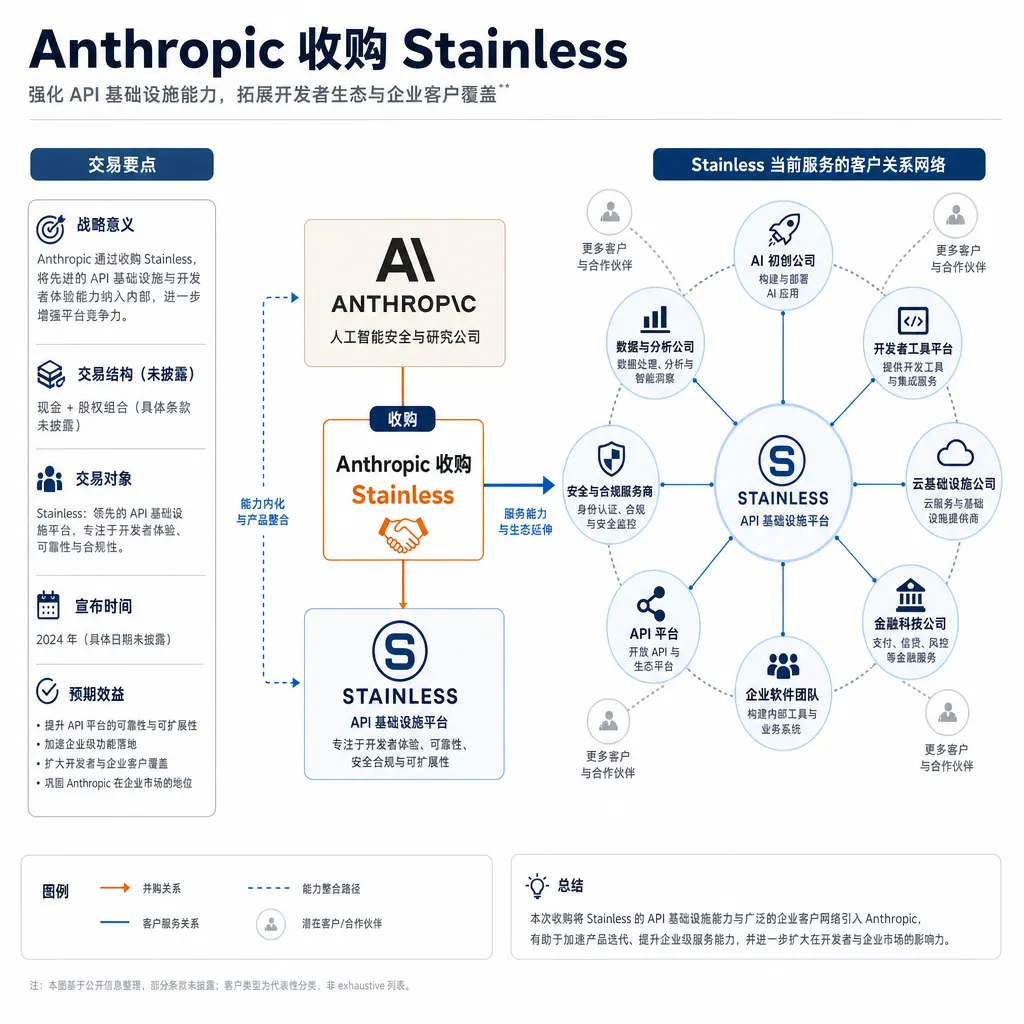
Anthropic has just completed a highly controversial acquisition—purchasing developer tools company Stainless for at least $300 million. Stainless, a New York-based startup, counts OpenAI, Google, and Cloudflare—Anthropic’s direct competitors—among its clients.
The subtlety of this deal lies in the fact that Anthropic didn’t just acquire an ordinary developer tool. It effectively gained control over the critical infrastructure that determines how AI models reach developers. To put it plainly, whoever controls the SDK generation layer decides how quickly and cheaply developers can connect to any AI model.
What Stainless Does: The “Plumber” of Automatic SDK Generation
Stainless’s core product is an automated SDK generation toolchain. In simple terms, when an AI company releases a new API, Stainless automatically generates SDKs in multiple languages (Python, TypeScript, Go, Java, etc.) based on the OpenAPI specification—and keeps them in sync with API updates.
It may sound like grunt work, but it’s actually the choke point in the commercialization of AI models. Developers rarely call raw HTTP interfaces directly—they need SDKs that are type-safe, well-documented, and idiomatic. Whoever can provide these SDKs faster and better lowers the barrier for developer adoption, and thus wins market share.
Stainless’s client list proves this:
- OpenAI: GPT series Python and Node.js SDKs were generated by Stainless
- Google: Parts of Gemini API’s SDK toolchain rely on Stainless
- Cloudflare: Workers AI development tools integrate Stainless solutions
- Anthropic: Claude API SDKs are also generated by Stainless
In other words, Anthropic has acquired an “arms dealer” supplying weapons to both itself and its competitors.
The Three Layers of Strategy in This Deal
Layer One: The Developer Experience Arms Race
Competition in AI models has evolved from “whose model is smarter” to “who can get developers up and running faster.” OpenAI’s rapid rise during the GPT-3 era largely came from its simple API design and polished SDK ecosystem.
Anthropic has long played catch-up here. Claude’s model capabilities rival GPT-4’s, but its developer toolchain, documentation, and community lag behind. Acquiring Stainless is like instantly buying a seasoned developer experience team, filling a critical gap.
More importantly, Stainless’s tooling can generate not just SDKs but also API docs, type definitions, and test suites. This means every time Claude’s API updates, Anthropic can simultaneously release SDKs and documentation in multiple languages—dramatically shortening developer onboarding time.
Layer Two: Positioning for the AI Agent Era
Stainless also holds value in supporting AI Agent use cases. With frameworks like OpenClaw and AutoGPT emerging, AI models are increasingly called not only by humans but also by other AI systems.
This “AI calling AI” scenario imposes new SDK requirements:
- Structured outputs: Agents must parse structured data, not natural-language text
- Function calling: Agents need to dynamically select and compose multiple APIs
- Error handling: Agents must automatically retry, degrade gracefully, or switch to backup options
Stainless has already built capabilities in these areas. Under Anthropic, these can be deeply integrated into Claude’s API—making Claude “the most agent-callable model.”
This is a strategic position most have underestimated. If AI agents become the dominant application form, the question shifts to “whose model is easiest to integrate into agents.” By acquiring Stainless, Anthropic has preemptively secured this layer of infrastructure.
Layer Three: The “Leverage Effect” on Competitors
This is the most delicate aspect of the deal. Since Stainless currently serves OpenAI and Google, Anthropic could theoretically:
- Access competitors’ API design details, gaining insight into OpenAI and Google updates
- Disrupt their developer experience if it were to cut off services, forcing them to rebuild their SDK pipelines and slowing iteration
- Influence industry standards, if Stainless’s tooling becomes the de facto SDK generation norm
Officially, Anthropic says it will “gradually wind down Stainless’s managed services.” This forces OpenAI and Google to find replacements soon—but that transition period itself acts as leverage: while competitors scramble to adapt, Anthropic can focus on perfecting its own infrastructure.
Industry View: The Infrastructure Battle Has Only Begun
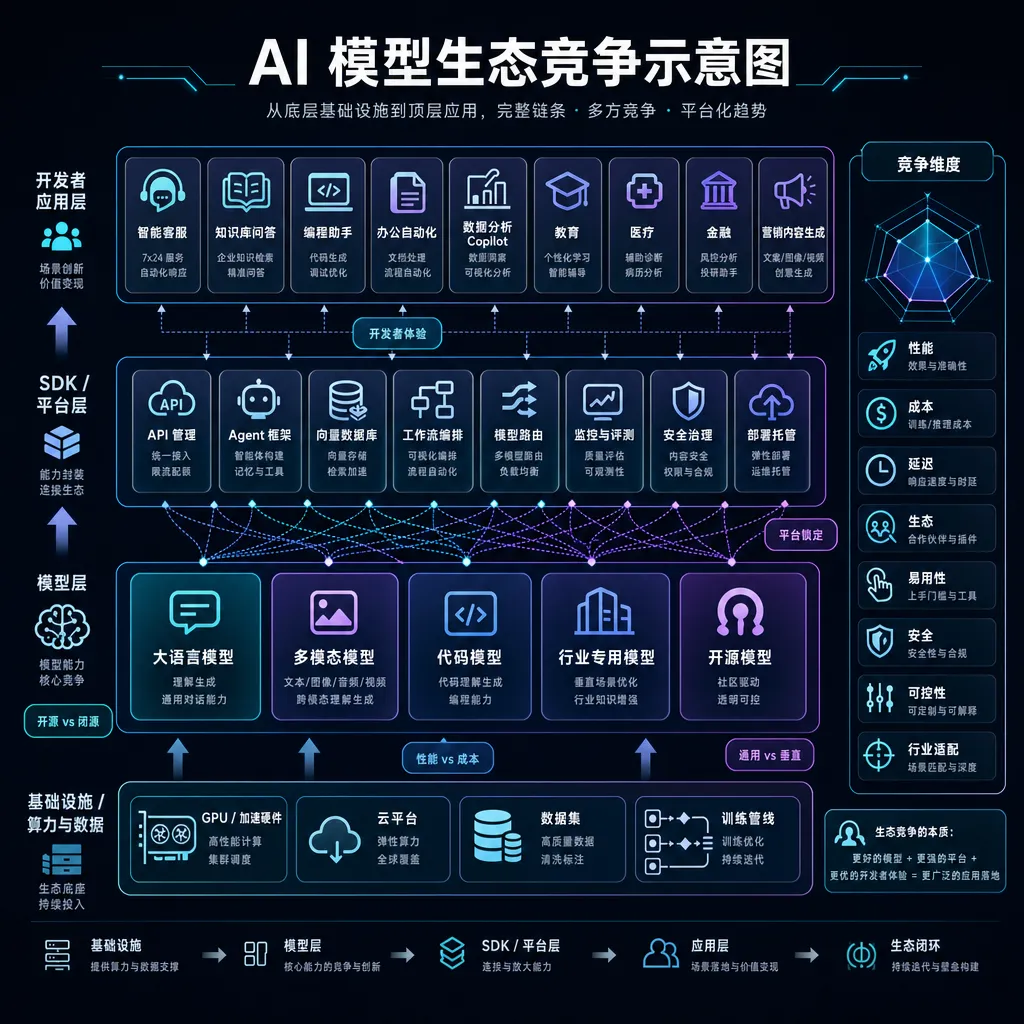
This acquisition sends a clear message: AI competition is shifting from “model quality” to “ecosystem control.”
Over the past two years, the race has been about “who has the most capable model.” OpenAI released GPT-4, Anthropic launched Claude 3, Google upgraded Gemini—competing on benchmarks, reasoning, and multimodal capabilities.
Now, model gaps are narrowing. Claude 3.5 Sonnet rivals GPT-4 in code generation, and Gemini 1.5 Pro surpasses Claude in long-text processing. As these differences diminish, the real moat becomes how easily developers can use your model.
And this extends beyond SDKs:
- OpenAI built GPTs and the Assistants API, enabling non-technical users to build AI apps
- Google integrated Gemini into Google Cloud to reduce enterprise migration costs
- Anthropic is now closing its developer tooling gap through Stainless
Expect similar moves soon:
- Vector databases (Pinecone, Weaviate) may be bought for RAG optimization
- Prompt engineering tools (LangChain, LlamaIndex) may be folded into model platforms
- Model evaluation tools (Weights & Biases, Humanloop) may become internalized capabilities
These may look “peripheral,” but they’re actually the arteries through which developers connect to AI models. Controlling them means controlling mindshare.
Developer Impact: Short-Term Pain, Long-Term Uncertainty
For current Stainless users, the immediate effect is clear—you’ll need to migrate to other SDK generation tools soon.
Anthropic has said it will “gradually wind down Stainless’s hosted service” but gave no timeline. That means:
- If your project depends on Stainless-generated SDKs, assess migration costs
- If you’re an OpenAI or Google user, expect possible SDK update delays
- If you’re an Anthropic user, anticipate better developer tooling
Long term, this might accelerate fragmentation in the AI ecosystem. Each company will prefer to maintain its own toolchains instead of relying on third parties—a headache for developers, who may have to learn different SDKs, APIs, and best practices for each platform.
Conversely, if Anthropic were to open-source Stainless or standardize SDK generation, developers could benefit greatly—but given Anthropic paid at least $300 million, open-sourcing is unlikely.
The Capital Logic Behind the Soaring Valuation
This acquisition also comes just as Anthropic seeks new funding. According to Bloomberg, Anthropic is pursuing a round at a $90 billion valuation, up from $38 billion in February—a more than twofold increase.
That sounds lofty, but breaking down its strategy clarifies the logic:
- Model capabilities: Claude 3.5 Sonnet excels in code and long-context comprehension
- Enterprise clients: Strong footholds in finance, healthcare, and legal sectors
- Developer ecosystem: Strengthened via Stainless acquisition
- Agent positioning: Early investment in “AI calls AI” infrastructure
If these bets play out, Anthropic could indeed become the next OpenAI—with Stainless as a crucial puzzle piece.
Final Thoughts
At face value, Anthropic’s $300 million acquisition of Stainless looks like a technical purchase. In reality, it’s a battle for control over how AI models are distributed.
This war isn’t about “whose model is better,” but “whose model developers can use more easily.” SDK generators, documentation pipelines, API design norms, tool integrations—these “boring details” are becoming new moats.
OpenAI leveraged its early GPT-3 developer ecosystem into an unshakable lead. Anthropic now hopes to leapfrog by acquiring core infrastructure. Whether that works depends on whether, over the next 12–18 months, Anthropic can deeply integrate Stainless into Claude—and deliver a genuinely delightful developer experience.
For Chinese developers, this is a reminder: In the AI era, model strength is just the baseline; developer experience wins the game. When choosing between Claude, GPT, or domestic models, a stable API, mature SDKs, and clear docs matter far more than chasing “the smartest model.”
References
As the sources referenced are from international media, there are currently no accessible domestic links. Readers may search for related Chinese reports for further information.


