
Cursor’s self-developed model Composer 2.5 revealed: Kimi K2.5 base + Colossus2 computing power
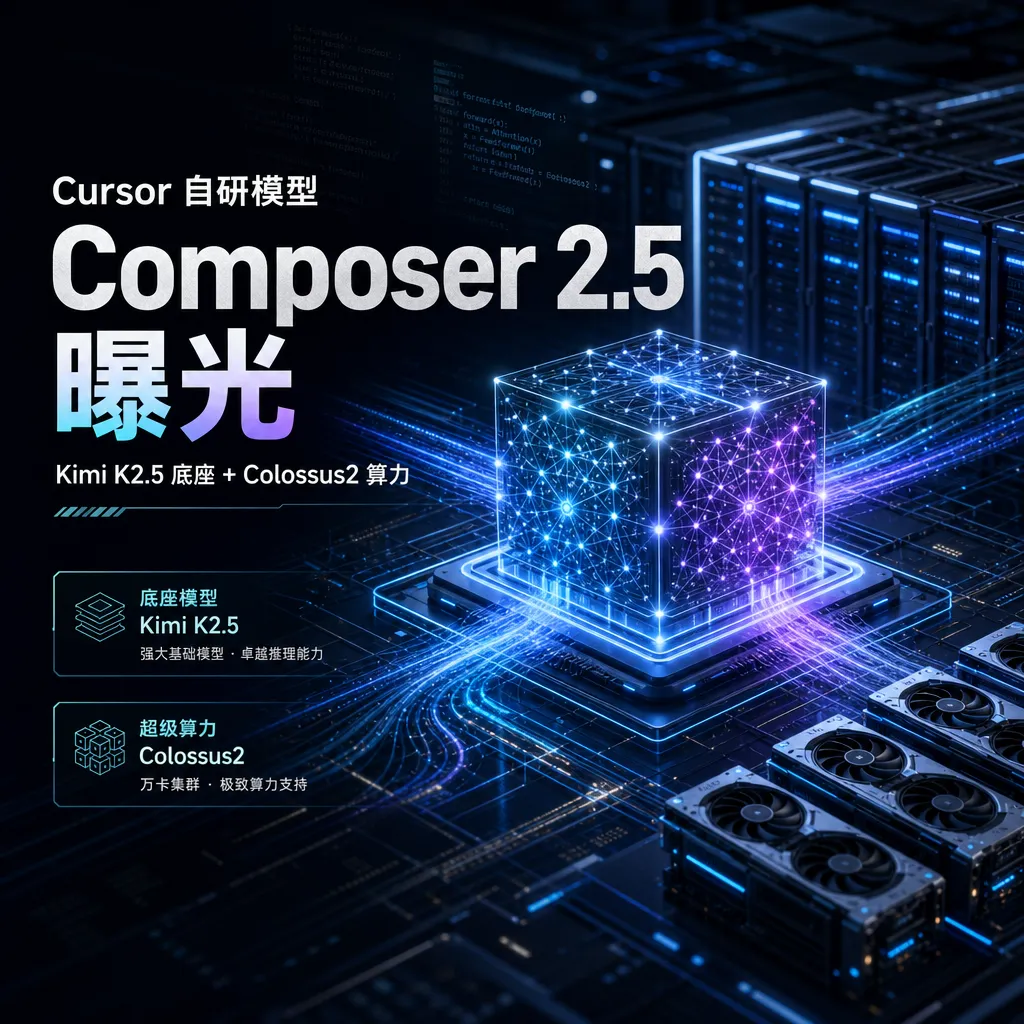
Cursor, valued at **$29.3 billion**, released **Composer 2.5**, built on **Moonshot AI’s Kimi K2.5** foundation and trained with **Colossus2**, an xAI system under **SpaceX**, using millions of **H100 GPUs**. This marks Cursor’s **second controversy within five months** over its use of **Chinese open‑source models**.
Cursor’s Self‑Developed Model Composer 2.5 Revealed: Kimi K2.5 Base + Colossus2 Compute
AI programming tool Cursor, valued at USD 29.3 billion, has just released its new model Composer 2.5.
This time it directly uses Moonshot’s Kimi K2.5 as the base model, and the training compute comes from xAI (a SpaceX subsidiary) via the Colossus2 cluster — a million‑scale H100 installation.
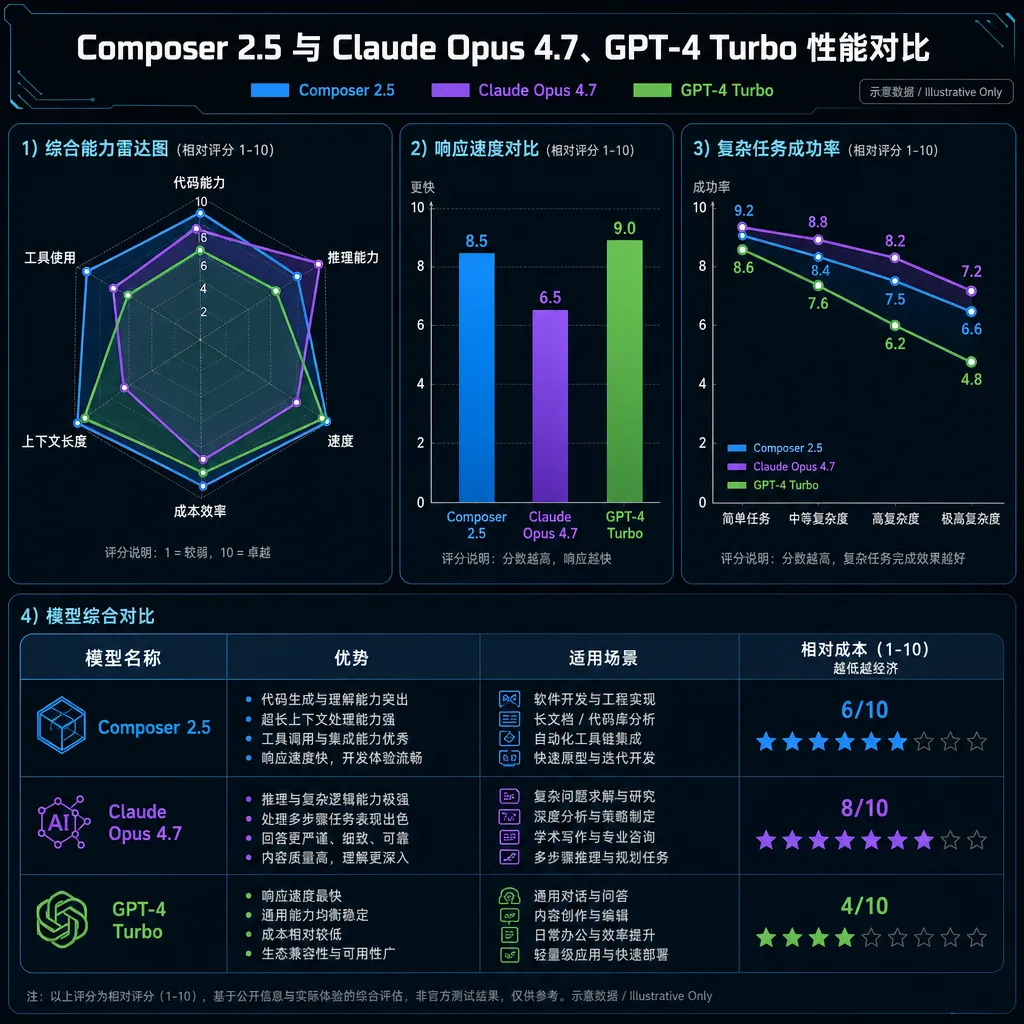
According to official information, the model’s performance already approaches Claude Opus 4.7.
There’s an interesting twist: this is the second time in five months that Cursor has sparked debate for using a Chinese open‑source model as its foundation. Last time, Composer 2 secretly used Kimi K2.5, which developers discovered through API requests. Moonshot initially accused Cursor of infringement, then reversed its stance within hours, calling it an authorized partnership. This time, with Composer 2.5, Cursor learned its lesson — it acknowledged the model’s origin directly in the official announcement.
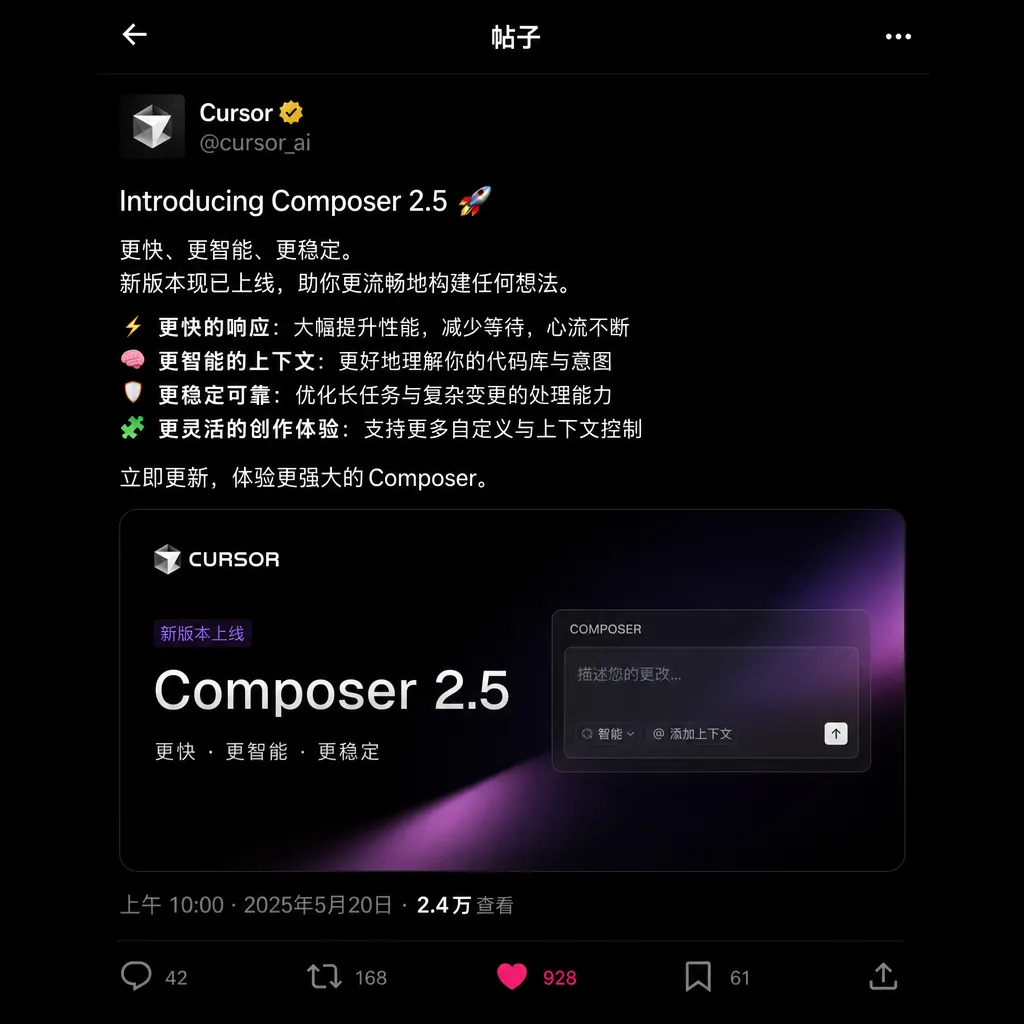
Technical Path: Kimi K2.5 + Continued Pre‑Training + Reinforcement Learning
Composer 2.5’s training pipeline is quite clear:
use Kimi K2.5 as the base, then conduct continued pre‑training, and finally apply reinforcement learning (RL) at 4× scale.
Cursor co‑founder Aman Sanger explained that the team benchmarked several base models on perplexity, and Kimi K2.5 “proved to be the strongest.”
The choice is unsurprising. Kimi K2.5, Moonshot’s flagship model launched in March 2026 under a modified MIT license, ranks among the top in long‑text understanding, code generation, and reasoning. Using it as a foundation gives Cursor an immediate head start.
The computing side is even more astonishing. Colossus2, completed by xAI at the end of 2025, hosts over a million H100 GPUs — the world’s largest single AI‑training facility.
Cursor’s access to this powerhouse signals genuine collaboration with xAI; recall that Elon Musk personally replied “Yeah, it’s Kimi 2.5” during the previous dispute. Cursor’s use of Colossus2 now serves as another implicit endorsement of Chinese open‑source models.
According to Lee Robinson, VP of Developer Education at Cursor, roughly ¼ of the compute in the final model comes from the base, and ¾ from Cursor’s own continued pre‑training and RL.
This ratio means Cursor invested three times more compute than the base to customize training for programming tasks such as code generation, multi‑file editing, and long‑range operations.
Performance: Near Opus 4.7, Long‑Range Tasks Still to Be Verified
Cursor claims Composer 2.5 performs close to Claude Opus 4.7.
Technically that’s plausible: Kimi K2.5 already targets GPT‑4‑level capability, and Cursor’s specialized continued pre‑training plus RL could indeed reach or exceed Opus 4.7 in coding tasks.
Actual capability depends on user feedback. Developers care mostly about two points: stability on long‑range tasks and accuracy in multi‑file edits. Cursor’s main use‑case is AI‑assisted programming, often involving simultaneous edits across dozens of files and thousands of code lines.
Such tasks demand extraordinary context comprehension and error recovery; a small misstep causes logical breaks or new bugs.
Kimi K2.5’s long‑text competence is one of its strengths, supporting a 200 K‑token context window, theoretically enough for most coding scenarios.
Whether this holds or improves after fine‑tuning and RL must be verified in practice. Developers are already testing Composer 2.5 on large codebases, and more benchmark results should appear within weeks.
Second Controversy: From DeepSeek to Kimi — China’s Open Source as Global AI Foundation
This is Cursor’s second controversy over using Chinese open‑source models.
In Nov 2025, Composer 1 was found to share a tokenizer with DeepSeek and occasionally output Chinese during inference. Cursor admitted it only after the community exposed it.
Then, in Mar 2026, Composer 2 appeared using Kimi K2.5. Developer @fynnso intercepted an API model ID:
kimi-k2p5-rl-0317-s515-fast — literally “Kimi K2.5 + RL.”
Moonshot’s head of pre‑training Du Yulun tweeted confirmation that the tokenizer matched and questioned Cursor’s Michael Truell: “Why not respect our license or pay any fee?”
Hours later the tone flipped. Moonshot’s official account changed from accusation to congratulations, confirming Cursor accessed Kimi K2.5 via Fireworks AI, under a commercial license. Co‑founders Aman Sanger and Lee Robinson admitted not mentioning Kimi in the blog post was “an oversight” and promised future transparency.
With Composer 2.5, Cursor again used Kimi K2.5, but this time acknowledged it up front. The lingering question:
Why would a company valued at USD 29.3 billion and earning over USD 1 billion annually “forget” twice to state its base model?
The answer is likely simple: marketing. “Self‑developed model” sounds more advanced than “fine‑tuned from an open‑source base,” and thus attracts investors and users. But such opacity erodes trust. The developer community demands transparency; hiding details only makes the fallout worse.
The broader backdrop: Chinese open‑source models are becoming foundational to global AI.
Hugging Face CEO Clément Delangue commented during the prior debate, “Chinese open‑source is the biggest force shaping the global AI tech stack.”
This is no exaggeration. In the last five months at least three top companies were found using Chinese open‑source bases: Cursor (DeepSeek & Kimi), Windsurf (Zhipu), and Rakuten (DeepSeek V3).
The reasoning is clear: Chinese open‑source models excel in performance, cost, and license flexibility.
DeepSeek, Kimi, and Zhipu models rival or even surpass GPT‑4 at a fraction of the training cost and with permissive licenses. For startups needing fast iteration and tight budgets, building on Chinese open‑source foundations is simply rational.
License Compliance: Mark Source If Monthly Revenue > USD 20 Million
Kimi K2.5 uses a modified MIT license, requiring that any commercial product with over 100 million monthly active users or revenue above USD 20 million must prominently label “Kimi K2.5” in its interface.
Given Cursor’s valuation and paying‑user base, that threshold is surely met.
However, when Composer 2 launched, its UI showed only “Composer 2,” with no Kimi label — a direct license violation. Moonshot’s public criticism stemmed from this. Later it clarified that Cursor accessed Kimi via Fireworks AI’s commercial agreement, whose licensing compliance Fireworks AI handled.
In short: Cursor didn’t directly use the open‑source code but the hosted model via Fireworks AI, which had a separate contract with Moonshot possibly waiving the UI attribution clause.
This intermediary setup is common, similar to cloud providers’ managed model services.
Yet that doesn’t excuse complete omission of the base’s name.
Open‑source consensus holds that even under commercial authorization, developers should disclose the base model in technical docs or blogs. It’s respect for original creators and transparency for users. Cursor’s failure to do so in both releases — until the community exposed it — is the core issue.
Market Signal: Moonshot’s Valuation Likely Underrated
A notable coincidence: on Mar 15 2026, Bloomberg reported that Moonshot sought up to USD 1 billion in a new funding round at a valuation of USD 18 billion — quadruple its level three months earlier, backed by Alibaba and Tencent.
Five days later, the world’s most valuable AI programming tool was revealed to be built atop Kimi K2.5.
That’s a powerful market signal. Cursor deemed Kimi K2.5 “the strongest base” and built its core product upon it — effectively endorsing Moonshot’s technology with billions in corporate weight.
From an investment perspective, USD 18 billion likely undervalues Moonshot.
Cursor, worth USD 29.3 billion, depends on Moonshot’s model. OpenAI exceeds USD 150 billion; Anthropic, USD 60 billion — and much of their worth comes from base‑model strength.
Given Kimi K2.5’s proven adoption in flagship products, USD 18 billion seems conservative.
Valuation encompasses execution and market share too, but Cursor’s case proves Moonshot’s technical power is globally recognized. The remaining challenge is to convert that into commercial advantage — API services, enterprise solutions, and a developer ecosystem moat.
Colossus2 Compute: xAI’s Open Strategy
Using Colossus2 also reveals xAI’s strategic direction.
Built at the end of 2025 with over one million H100 GPUs and total power exceeding 100 exaFLOPS, Colossus2 is the world’s largest AI training installation, funded with over USD 10 billion.
xAI didn’t build it solely for Grok. From Cursor’s case, it’s clear xAI is positioning Colossus2 as an open compute platform, offering training services to external clients — a striking contrast to OpenAI and Anthropic’s closed approach.
Benefits of this openness:
1. Higher utilization: renting out idle compute amortizes cost.
2. Ecosystem growth: attracting developers to xAI’s stack.
3. Data & feedback: client training tasks help optimize operations and uncover new use‑cases.
For companies like Cursor, access to Colossus2‑grade compute is a game‑changer.
Training a near‑Opus‑4.7‑level model on conventional clouds (AWS, GCP, Azure) could cost tens of millions and take months. On Colossus2, both cost and time shrink dramatically.
This explains how Cursor released three Composer versions in five months (1, 2, 2.5).
With a strong base (Kimi K2.5) plus massive compute (Colossus2), Cursor can iterate rapidly and continually refine programming performance.
Impact on Developers: Accelerating Toolchain Evolution
For developers, Composer 2.5 means faster‑evolving tools.
Over the past year, AI coding assistants—GitHub Copilot, Cursor, Windsurf, Cline, Continue—have surged, each exploring different interaction models and tech paths.
Cursor’s strategy is in‑house model + deep integration.
By training a model optimized specifically for programming, Cursor delivers more accurate completions, smarter multi‑file editing, and stabler long‑range execution—unlike Copilot, which relies on general models (GPT‑4, Claude).
From a user‑experience perspective, specialized models do perform better.
General models handle coding adequately but struggle with large codebases, contextual understanding, and strict style compliance.
Cursor’s continued pre‑training + RL directly target these gaps.
However, specialization comes at a cost: expensive training and heavy compute investment.
Cursor affords it thanks to ample funding (USD 29.3 billion valuation) and a sound technical route (open‑source base + xAI compute).
For other AI programming tools, Cursor’s recipe—Chinese open‑source base + top‑tier compute + scenario‑specific fine‑tuning—sets a clear precedent.
Competition will shift from “who integrates more models” to “whose specialized model performs better.”
Transparency: The Open‑Source Community’s Bottom Line
Back to the key question: why twice omit model origins?
Commercially, it’s marketing. “Self‑developed” sells better than “fine‑tuned open‑source,” but that disregards open‑source culture.
Transparency is a core value. Open‑source contributors share their work expecting license compliance and proper attribution; failing that undermines trust.
Cursor’s approach crossed that line. Even though its usage was legally authorized, not naming the source tries to monopolize credit while benefiting from open‑source fruits—unfair to creators like Moonshot and DeepSeek and disrespectful to technically‑minded users.
The good news: after two controversies, Cursor seems to have learned.
Both Aman Sanger and Lee Robinson publicly admitted it was a mistake and promised timely attribution in future releases. With Composer 2.5, they at least acknowledged Kimi K2.5 and Colossus2 in official channels.
For the industry, this is a lesson: using open‑source bases is perfectly valid—but must be transparent.
Regardless of license or contracts, companies should disclose base models, training methods, and compute sources. Besides legal and ethical duties, transparency builds lasting trust.
Conclusion
The release of Composer 2.5 looks like a routine product update but actually highlights key trends in AI:
- Chinese open‑source models are becoming global foundations. DeepSeek, Kimi, and Zhipu models are widely adopted, combining high performance, low cost, and flexible licensing.
- Compute is becoming a platform. xAI’s open Colossus2 contrasts OpenAI/Anthropic’s closed setups, turning compute from a moat into infrastructure.
- Specialized vs general models. AI coding tools now compete on model specialization and scenario optimization.
- Transparency is non‑negotiable. Leveraging open‑source bases is fine—hiding them isn’t; trust depends on openness.
Whether Cursor can keep its lead in AI programming will depend on real‑world results.
Technically, it has a clear path: strongest open‑source base + largest compute platform + deep task‑specific optimization.
Execution will tell.


