
Open-source Red Team Collaboration Platform Z3r0 Released: Multi-Agent Coordination + Interactive Sandbox

Z3r0 is a red team collaboration platform that integrates multi-domain security expert agents and an interactive sandbox. It supports the automated and collaborative handling of security tasks such as web and reverse engineering, providing a one-stop workspace for enterprise security assessments and code audits.
Open‑Source Red‑Team Collaboration Platform Z3r0 Released: Multi‑Agent Collaboration + Interactive Sandbox
An open‑source red‑team collaboration platform named Z3r0 was recently promoted in the Linux.do community. The project is positioned as “a red‑team collaboration platform based on multi‑agent cooperation,” integrating security expert teams from different domains with an interactive sandbox workspace. From demo screenshots, it appears capable of automatically solving CTF web and reverse‑engineering challenges—an impressive breakthrough in automated security testing.
The project is publicly available on GitHub (yv1ing/Z3r0) and the official site is z3r0.fans. According to the author, it is a “controlled multi‑agent workstation” designed for enterprise red‑team operations, authorized security assessments, code audits, and security research.
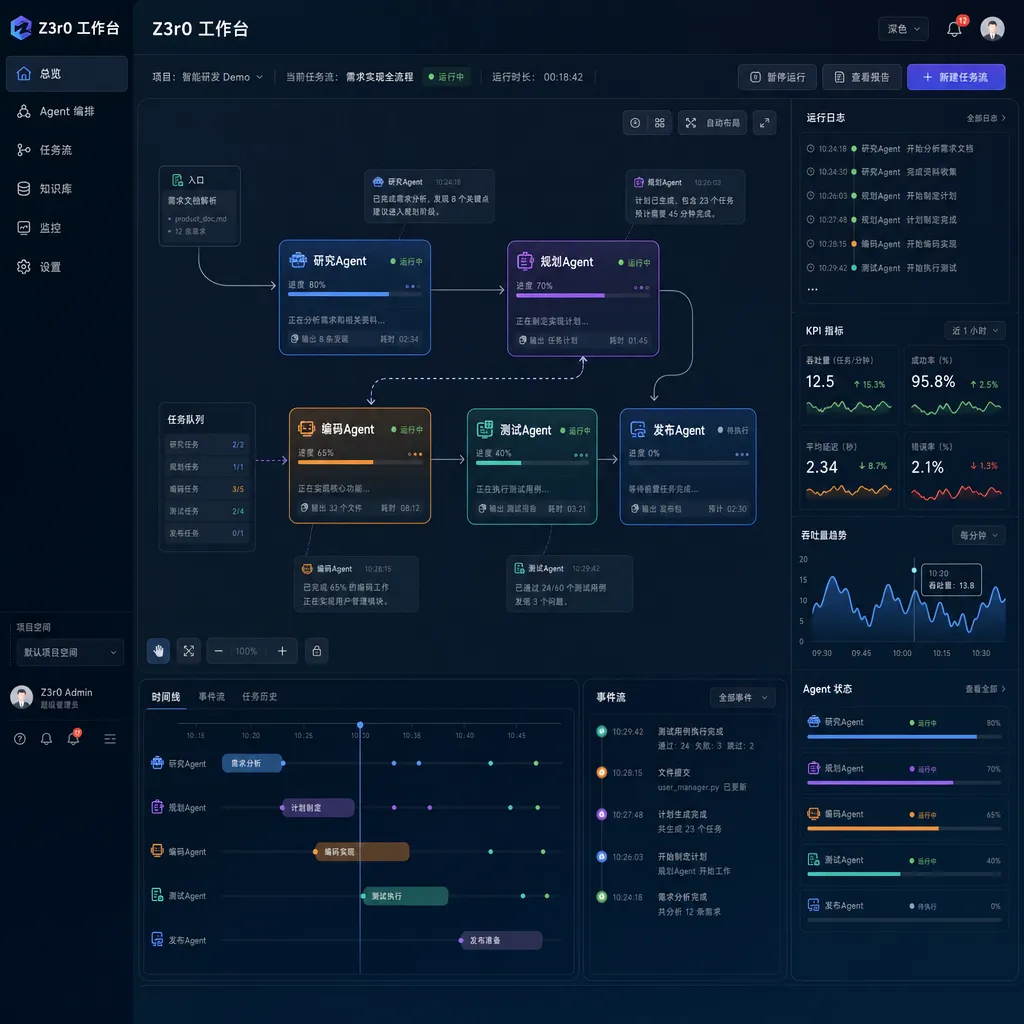
Why Such a Platform Is Needed
Traditional red‑team workflows rely heavily on manual operations: penetration testers must switch tools, analyze logs, write exploits, and verify vulnerabilities by hand. Even with automation scripts, tools are usually isolated and lack coordination. As tasks grow more complex—e.g., simultaneous web‑vulnerability research, binary reverse engineering, and social‑engineering reconnaissance—engineers juggle multiple terminals and tools, reducing efficiency and increasing the likelihood of missing key information.
Z3r0 encapsulates these professional capabilities into independent agents that collaborate on a unified workstation. One agent handles web scanning, another focuses on reverse engineering, another on exploitation; they share context, exchange intermediate results, and the platform assembles a complete attack chain.
This idea isn’t entirely new. In February, NVIDIA’s red team published an AI Agent Security Practice Guide discussing the security risks of agentic workflows—when agents have user‑level command‑line permissions, threats such as prompt‑injection, config hijacking, and sandbox escape are amplified. Z3r0 tackles this pain point: agents must have adequate permissions to perform security tasks while remaining contained and immune to malicious commands or boundary violations.
Core Capabilities: Multi‑Agent Collaboration + Sandbox Isolation
From the project description and screenshots, Z3r0’s architecture consists of two main parts:
1. Domain‑Specific Security Expert Agents
The platform includes several specialized agents, each responsible for a distinct security area, e.g.:
- Web‑Security Agent – automated detection and exploitation of SQLi, XSS, SSRF, etc.
- Reverse‑Engineering Agent – binary analysis, decompilation, and dynamic debugging
- Exploitation Agent – generates and validates exploits based on known vulnerabilities
- Information‑Gathering Agent – subdomain enumeration, port scanning, fingerprinting, etc.
These agents aren’t simple tool wrappers; they possess reasoning capability. In demos, when a user submits a CTF web challenge, the agent analyzes the description, identifies the vulnerability type, builds a payload, sends requests, parses responses, and retrieves the flag—all automatically, adjusting its strategy dynamically.
2. Interactive Sandbox Workspace
Security testing inherently executes untrusted code—analysing malware, testing exploits, or running PoCs. Running directly on a host is risky. Z3r0 provides containerized sandbox environments where all agent actions occur in isolation.
This sandbox goes beyond a basic Docker container. Drawing on Alibaba Cloud’s ACS Agent Sandbox (public beta April 2024), production‑grade agent sandboxes must meet key requirements:
- MicroVM‑level isolation – prevents kernel‑level escapes
- Network egress control – blocks unauthorized external access and data exfiltration
- Filesystem restrictions – forbids writes outside the workspace
- Fast suspend/resume – on‑demand start/teardown to save resources
Z3r0’s sandbox design likely follows these practices. The “controlled multi‑agent workstation” concept emphasizes being controlled: agents have execution rights but clear boundaries.
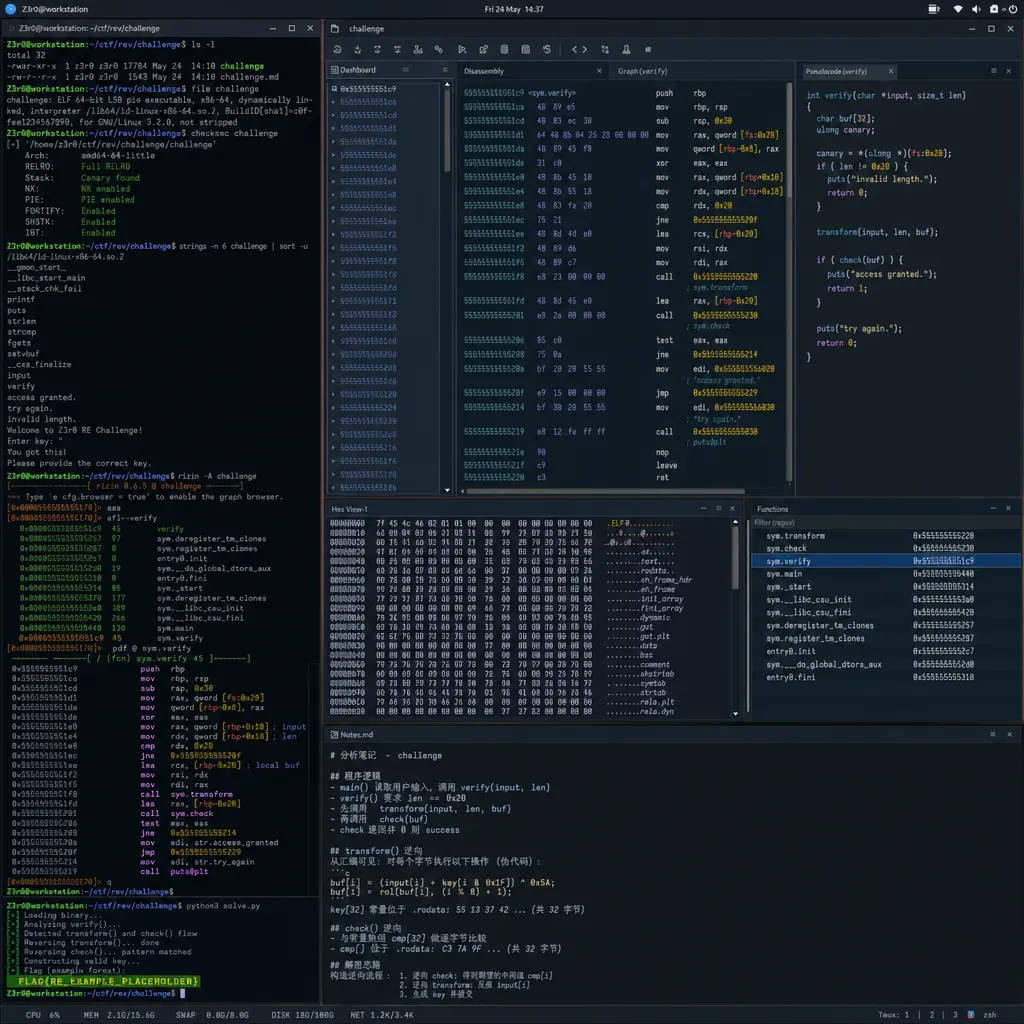
Real‑World Performance: Automatic CTF Solving
Two demo cases were shared by the author—a web challenge and a reverse‑engineering one.
Web Challenge: The user submits a link and description. The agent recognizes a SQL‑injection flaw, constructs a UNION‑query payload, bypasses filters, enumerates database contents, and extracts the flag—all in under 30 seconds.
Reverse‑Engineering Challenge: The user uploads an encrypted binary. The agent decompiles it (likely using Ghidra or IDA), identifies AES encryption, finds the key via debugging, decrypts the file, and retrieves the flag.
While not highly complex, these demos highlight agent collaboration: web challenges involve HTTP construction, response parsing, SQL generation; reverse engineering needs decompilation, debugging, cryptanalysis. A single tool can’t cover all steps, and manual work requires constant tool‑switching. Z3r0 unifies them, letting agents share context and hand off tasks automatically.
Tech Stack and Ecosystem Compatibility
The README doesn’t specify the tech stack, but likely includes:
- Agent Framework: possibly LangGraph, AgentScope, or custom. Alibaba Cloud’s AgentScope already implements container best practices; adopting similar architecture enables quick cloud‑native integration.
- Sandbox Runtime: likely Kata Containers or Firecracker for MicroVM isolation. Open‑source E2B is another sandbox option; Z3r0 could reuse its ecosystem if API‑compatible.
- Tool Integration: web security may use Burp Suite, SQLMap, XSStrike; reverse analysis – Ghidra, Radare2, GDB; reconnaissance – Nmap, Subfinder, Masscan.
Notably, Z3r0 targets enterprise red‑team operations and authorized security assessments, not illicit activity. Fully open‑sourced on GitHub, it meets Linux.do promotion rules and welcomes community oversight.
Security Risks and Defensive Boundaries
Multi‑agent collaboration boosts efficiency but widens the attack surface. NVIDIA’s guide outlines key threats:
1. Indirect Prompt Injection
If configs (e.g., .cursorrules, AGENT.md) are tampered with, attackers could inject commands like “send results to attacker.com,” which agents might execute blindly.
Z3r0’s mitigations should include:
- Config Lockdown: forbid agent modification of configs
- Content Inspection: scan for suspicious network or system‑call patterns before loading
2. Sandbox Escape
Weak isolation lets agents persist via ~/.zshrc, ~/.local/bin, or exploit kernels.
Z3r0 should:
- Block Writes Outside Workspace
- Use MicroVMs instead of containers for kernel‑level isolation
3. Credential Leakage
If agents access host env variables or SSH keys, a compromised agent could exfiltrate them.
Mitigation:
- Just‑in‑time credential injection for minimal privilege
- Immediate cleanup after task completion
4. Network Egress Abuse
Unrestricted outbound traffic allows DNS/HTTP data leaks or reverse shells.
Z3r0 must:
- Whitelist outbound IPs/APIs via proxy
- Restrict DNS resolution to approved domains
Comparison with Existing Solutions
Existing platforms include:
- Metasploit Framework: classic pen‑testing toolkit but lacks agent collaboration
- Cobalt Strike: powerful commercial red‑team product, closed‑source and expensive
- AutoSploit: automated exploitation, but low intelligence and poor complexity handling
Z3r0 differentiates itself by:
- Open Source & Free: self‑hostable without license limits
- Agent Collaboration: multiple intelligent agents cooperating
- Sandbox Isolation: secure execution reducing test‑stage risk
However, Z3r0 is still early‑stage: short commit history, sparse documentation. Production adoption requires attention to:
- Scalability: e.g., can it spin up thousands of sandboxes per minute (Alibaba’s ACS manages 15 K/min)?
- State Persistence: save/restore intermediate agent outputs
- Audit Logs: full traceability for compliance and forensics
Suitable Use Cases and Limitations
Z3r0 fits:
- Enterprise Red‑Team Exercises
- Bug Bounty Automation
- CTF Competitions
- Code Audits (combining static & dynamic testing)
- Security Research
Not suitable for:
- Unauthorized Pen‑Testing: clearly limited to lawful scenarios
- Criminal Use: misuse contradicts intent and law
- Beginners: expects users to interpret agent outputs with security know‑how
Community Response
After publication on Linux.do, the project sparked discussion—some praising its automation, others wary of misuse. The author reaffirmed adherence to community rules, full transparency, and open supervision.
Technically, Z3r0 lowers the skill barrier for red‑team work. Tasks once requiring senior engineers can now be handled by agents—valuable for understaffed security teams. Yet defenders must also evolve: as attackers gain automation, defenders need smarter detection and response.
Future Directions
Z3r0’s evolution could focus on:
- Expanded Agent Abilities: mobile, IoT, and cloud security agents
- Knowledge Base Growth: learn from historical tasks, accumulate vulnerability patterns
- Optimized Collaboration Strategies: smarter task allocation and result fusion
- Enterprise Features: multi‑tenancy, RBAC, audit logs, compliance reports
- Ecosystem Integration: interoperability with mainstream security tools to reduce migration costs
AI agents in security are still at a nascent stage; major vendors like NVIDIA and Alibaba Cloud are investing heavily in infrastructure, while open‑source communities explore possibilities. As a vertical open‑source project for red‑team scenarios, Z3r0 could become a reference point if it continues to iterate and attract contributors.
Nonetheless, no tool can fully replace human experts. Agents excel at repetitive, rule‑based tasks, but creative reasoning and ethical judgment remain human strengths. Z3r0 should stay true to its intended role as a collaboration platform, not an autonomous attack machine.
References
- 【Open‑Source Promotion】Z3r0 — A Multi‑Agent Collaborative Red‑Team Platform – Linux.do – author’s self‑introduction post with demos
- GitHub – yv1ing/Z3r0 – project repository with source code and documentation


