
Two Tencent Cloud AI models to be commercialized next week

Tencent Cloud announced that the free public preview of the Hy3 preview and DeepSeek-V4-Pro models will end on May 27, transitioning to a pay‑as‑you‑go commercial service. This marks a substantial step forward for Tencent in AI commercialization.
Two Tencent Cloud AI Models to Become Commercial Next Week
Today (May 19), Tencent Cloud announced that two models on its Agent Development Platform (ADP)—Hy3 preview and DeepSeek-V4-Pro—will end their limited free public beta and officially launch as commercial services at 10:00 a.m. on May 27. This marks a significant step in Tencent Cloud’s AI model commercialization, signaling the phased conclusion of its “free trial for market share” strategy.
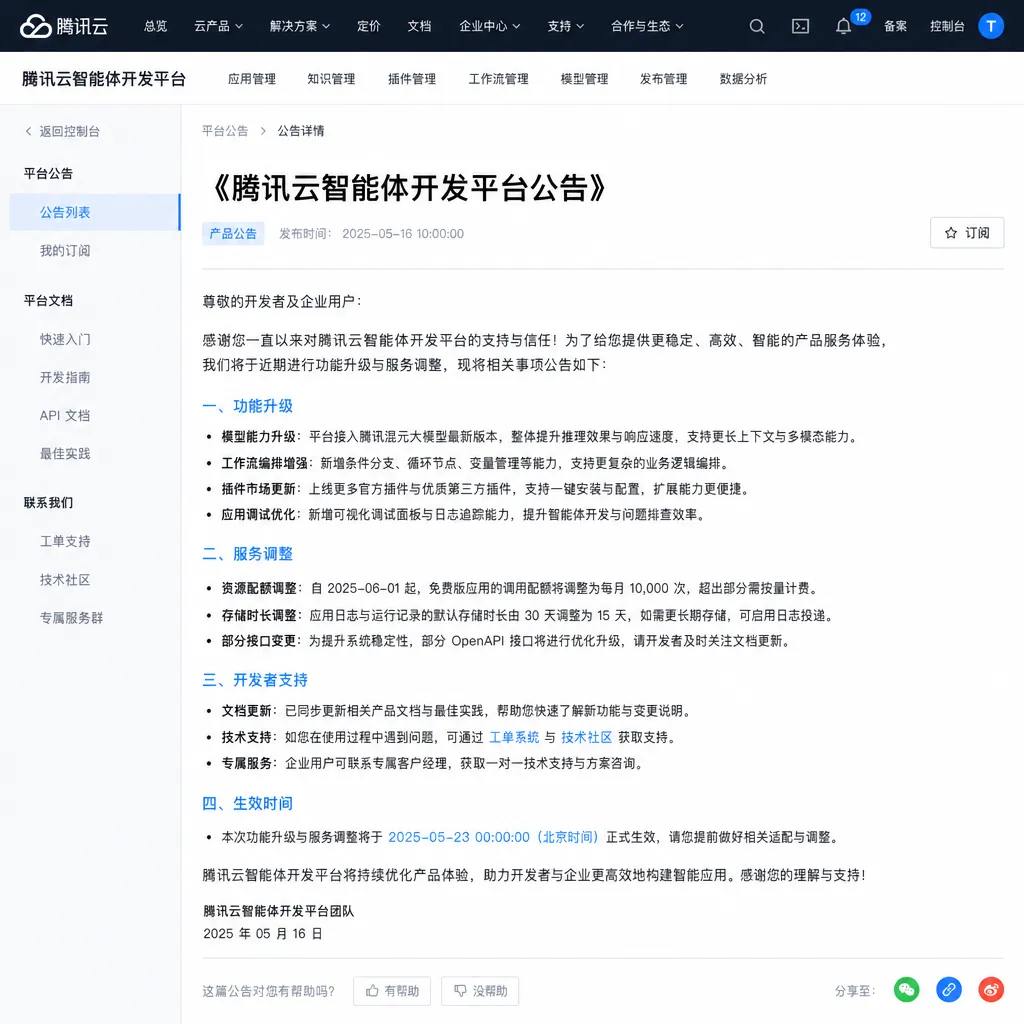
From Free to Paid: What’s Tencent Cloud’s Plan
The two models being commercialized have different backgrounds. Hy3 preview is Tencent’s self-developed model from the HunYuan series, positioned for multimodal capabilities and long-context processing. DeepSeek-V4-Pro, on the other hand, is a third-party model for which Tencent Cloud acts as a distribution channel. Both models were completely free during their public beta, allowing developers unlimited usage.
Free beta access has become standard in the AI industry—let developers use the product first, gather usage data and feedback, and charge only once the model stabilizes and an ecosystem forms. The timing of Tencent Cloud’s switch to commercial use, however, is somewhat delicate.
Hy3 preview’s public beta was relatively short—about three to four months. In contrast, Alibaba Cloud’s Tongyi Qianwen and Baidu’s ERNIE Bot had much longer free periods. This suggests Tencent Cloud is confident in these models’ commercial prospects—or perhaps that internal pressure for AI business profitability has reached the product level.
Another noteworthy factor is the timing at the end of May. Just a month earlier, on April 28, Tencent Cloud held its City Summit in Chongqing, where it launched several enterprise-grade Agent products—including ClawPro Dedicated Cloud Edition and the ADP Smart Workbench. These products heavily rely on Hy3 and DeepSeek-V4-Pro as foundational models. The strategy seems clear: release enterprise products first, then commercialize the models—allowing businesses to adopt them during the free period and be locked in once their operations depend on them.
Pricing Strategy: Packages + Pay-As-You-Go, Standard Cloud Approach
Tencent Cloud’s pricing uses a “platform subscription + add-on resource bundle” model, offered in four versions:
- Free Edition: One per account, one-month trial period
- Skill Plan Edition: ¥88/month, monthly purchase; auto-renewal discount to ¥79/month
- Professional Edition: ¥188/month, monthly or annual purchase; 10-month payment for 12 months (approx. 17% discount)
- Enterprise Edition: ¥4,880/month, for large-scale deployment scenarios
This tiered pricing follows typical SaaS logic: the free edition drives traffic, Skill Plan targets individual developers and small teams, Professional fits SMEs, and Enterprise serves large clients. The price range—from ¥88 to ¥4,880—creates a wide 55× spread, accommodating customers of various scales.
Aside from subscription packages, Tencent Cloud also provides prepaid resource packs (PU packs) for additional compute capacity. These range from 10,000 to 10 million PU units, priced from ¥10 to ¥100,000. This design offers flexibility—if you exhaust your subscription’s PU quota, you can top up with a standalone pack instead of upgrading the entire plan. Deduction priority is subscription package > prepaid resource pack, ensuring users use their subscription quota first.
However, there’s a catch: the announcement only said usage would be charged “based on per-model consumption,” without disclosing token pricing, model differences, or input/output token ratios. Developers can see subscription prices, but can’t accurately calculate real usage costs. This lack of transparency is common in cloud services—but not developer-friendly since you must first subscribe, then run experiments to estimate actual spending.
Hy3 and DeepSeek-V4-Pro: How Capable Are They?
Hy3 preview is the latest generation of Tencent’s HunYuan series, focusing on multimodal and long-context capabilities. Public information suggests it supports mixed image-text input, with a context window around 128K tokens, and ranks among the top domestic self-developed models in inference speed and accuracy. Tencent Cloud showcased Hy3’s performance in customer service, document analysis, and code generation at its April summit—with impressive results.
However, Hy3 faces positioning challenges. Compared to global leaders like GPT-4o and Claude Opus 4.7, Hy3 lags in reasoning and generalization. Against domestic competitors such as Tongyi Qianwen, ERNIE Bot, and Kimi, it struggles on price and ecosystem strength. To find its niche, Hy3 must differentiate in vertical scenarios—like integrations within Tencent’s ecosystem, such as Enterprise WeChat and Tencent Docs.
DeepSeek-V4-Pro tells a different story. DeepSeek represents China’s open-source model movement; its V3 version already reached near GPT-4-level reasoning, while V4-Pro further enhances math, coding, and logic skills. Tencent Cloud’s adoption of DeepSeek both expands its model portfolio and hedges risk—if Hy3 underperforms, DeepSeek can still anchor its lineup.
For developers, DeepSeek-V4-Pro’s appeal lies in its open-source foundation. Although Tencent Cloud’s version is commercialized, its underlying model remains open-source—meaning developers can self-deploy, fine-tune, or modify it. For enterprises needing data security or deep customization, that’s a major advantage.
Impact on Developers: Cost and Migration
Commercialization’s most direct impact on developers is cost. Previously, many developers used Hy3 and DeepSeek-V4-Pro for experimentation, demos, or small production apps. Now that fees apply, those projects must either pay to continue or migrate elsewhere.
Migration cost depends on integration depth. If you only use simple API calls, switching providers is easy—China’s AI API aggregation platforms (like OpenAI Hub) support multiple sources. But if your application relies on Tencent Cloud ADP’s ecosystem features—like Smart Workbench, Agent Memory, or Agent Storage—migration becomes difficult since those are proprietary.
This is Tencent Cloud’s strategy: bind developers through platform capabilities. Selling only model APIs leads to price wars with Alibaba and Baidu; but bundling models, tools, data storage, and collaboration into an ecosystem significantly raises switching costs. It’s a proven tactic—AWS and Azure do the same.
For developers still evaluating options, two choices remain:
- Grab the free edition now for one month and test whether Hy3 and DeepSeek-V4-Pro fit your needs.
- Wait for full commercial rollout and assess real user feedback and cost-performance before deciding.
Tencent Cloud’s AI Commercialization Challenges
This shift to paid usage reflects broader pressure on Tencent’s AI business to generate revenue. Over the past two years, Tencent has heavily invested in AI R&D, compute infrastructure, and ecosystem partnerships—but income remains weak, largely due to extended free access and insufficient conversion to paid users.
Compared to Alibaba and Baidu, Tencent Cloud has been slower to monetize AI. Alibaba’s Tongyi Qianwen began charging last year; Baidu’s ERNIE Bot followed earlier this year. Tencent’s cautious timing—charging later—stems partly from model maturity concerns and partly from a conservative strategy fearing user attrition.
But the market has evolved. AI model homogenization is rising, and technical superiority alone no longer guarantees success. Competition now revolves around ecosystem and service—who offers a more complete toolchain, easier onboarding, and better support wins developers. Tencent Cloud holds distinct advantages here—deep integrations with Enterprise WeChat, Tencent Docs, QQ, and WeChat data—none of which rivals can match.
Turning those advantages into revenue, however, depends on execution. Set prices too high, and developers will leave; offer poor service, and enterprises will switch to mature alternatives. Tencent Cloud’s performance over the coming months will determine whether Hy3 and DeepSeek-V4-Pro can gain market traction.
Industry Perspective: The Turning Point of AI Model Commercialization
Tencent Cloud’s move mirrors a broader industry turning point. Over the past year, nearly all leading AI models have transitioned from free to paid—OpenAI’s GPT-4 Turbo, Anthropic’s Claude 3, Google’s Gemini, and domestically, Tongyi Qianwen, ERNIE Bot, and Kimi—all did so.
This marks the industry’s shift from a “technology race” to a “business race.” Previously, competition centered on model strength, parameter count, and benchmark scores; now it’s about cost efficiency, ecosystem completeness, and customer retention.
For developers, this turning point offers more options—but also complicates decisions. When models were free, you simply used what worked best. Now, you must calculate: does this model’s capability justify its cost? Does my use case need such power? Is there a cheaper alternative?
Hence, AI API aggregation platforms are gaining popularity—using a single key to access all models and switch flexibly per task optimizes both cost and performance. For most developers, multi-cloud strategies are safer and more rational than relying on a single provider.
In Conclusion
Tencent Cloud’s timing isn’t early but not too late either. The market is sufficiently educated, and developers expect to pay for AI models. The key lies in reasonable pricing, solid service, and a strong ecosystem.
Based on the announcement, Tencent Cloud’s approach seems prudent—tiered subscriptions lower entry barriers, resource packs provide flexibility, and the free edition maintains a trial option. However, undisclosed token rates remain a hidden risk—if prices are too high, developers will migrate; too low, and Tencent’s profit margins suffer.
For developers, the sensible move is to wait and observe market feedback before committing. If your project is deeply integrated with ADP, renewing may be simpler; if you only use basic API calls, test other platforms and compare cost-effectiveness.
AI model commercialization is just beginning, and more changes are ahead. One thing is certain—free lunches are disappearing, and developers must learn to budget wisely.
References
- Tencent Cloud: Hy3 preview and DeepSeek-V4-Pro on ADP end free beta and become commercial May 27, 10:00 a.m. – IT Home - Tencent Cloud official announcement and pricing details


