
Lenovo Tianxi AI 4.0: 1.7B Local Memory Model and Personal Knowledge Base Are Here

Lenovo releases Tianxi AI 4.0, featuring a 1.7B multimodal memory model fully deployed locally, combined with a personal knowledge base system to enable offline intelligence. At the same time, two AI hosts, P7 and mini, are launched, offering up to 190 TOPS of computing power, starting at 2,999 yuan.
Lenovo Tianxi AI 4.0: The 1.7B Local Memory Model and Personal Knowledge Base Are Here
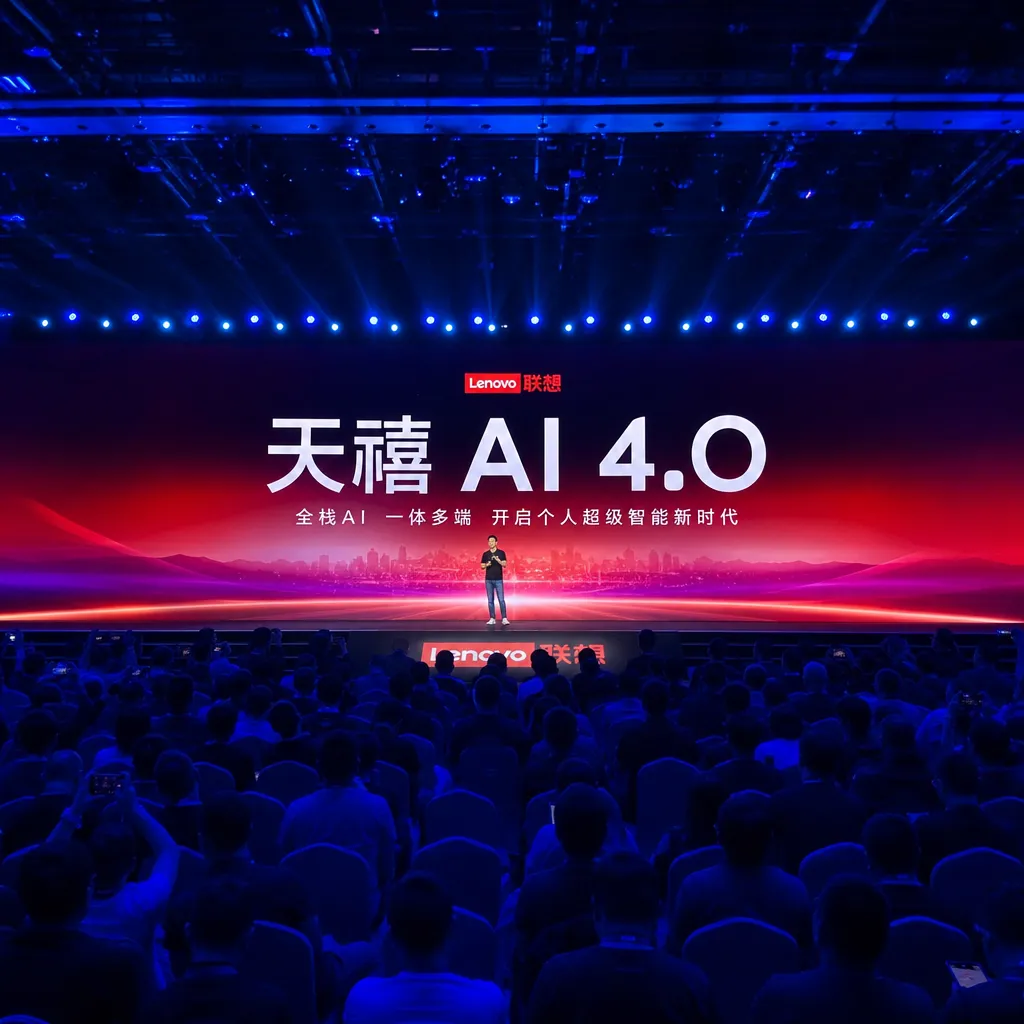
Today (May 19), Lenovo released Tianxi AI 4.0. The core of this update lies in bringing both “memory” and the “knowledge base” to the local device.
Officially, the shift is from “passive invocation” to “autonomous execution,” but the actual move is more straightforward: a 1.7B-parameter multimodal memory model, running completely on-device; and a personal knowledge base system that can structure raw data such as PDFs, Word documents, audio/video files, and chat logs into a searchable knowledge graph. Lenovo also released two AI host devices, P7 and mini, targeting high-performance and portable use cases respectively.
Local Memory Model: 1.7B Parameters, Three Types of Memory
Tianxi Claw is the new component this time, with its core function called “bionic memory.” Lenovo uses a 1.7B multimodal model to achieve three memory mechanisms:
- Episodic memory: Records the user’s operational context, such as what files were opened and what actions were performed at a given point in time
- Semantic memory: Understands the meaning of content, not just simple keyword matching
- Procedural memory: Learns the user’s operating habits to form reusable execution patterns
The model is deployed entirely locally without an internet connection. Lenovo stresses “offline security”—data never leaves the device. At 1.7B parameters, it’s a pragmatic choice: small enough to run on the edge, yet large enough to handle basic multimodal understanding tasks. Compared with cloud models boasting tens of billions of parameters, this scale is better suited for continuous background memory capture with controllable power and latency.
However, the limits of a 1.7B model are clear. It’s not meant for complex reasoning or creative generation; its purpose is simply to “remember what you did” and recall relevant context quickly when needed. For actual task execution, larger models are still required—either local 7B/13B models or cloud models of 70B+ scale.
Personal Knowledge Base: From Documents to Knowledge Graphs
Another key feature of Tianxi AI 4.0 is the personal knowledge base. This isn’t a simple file index but a system that transforms raw documents into structured knowledge.
Supported data sources include:
- PDFs, Word, Excel documents
- Audio and video files (likely converted to text first)
- Chat logs
- Other unstructured data
The processing flow: content extraction → knowledge graph construction → ontology formation. A knowledge graph connects entities and relationships, while an ontology defines the hierarchical structure of domain concepts. The combination allows AI not just to retrieve relevant documents but to understand their relationships and even infer hidden knowledge.
For example, given a set of project documents, traditional search might only locate files containing keywords. But a knowledge graph can tell you “which technologies this project used,” “who participated,” and “how it relates to earlier projects.” Such structured knowledge representation is highly valuable in work scenarios requiring frequent historical review—like R&D, consulting, or legal services.
Lenovo hasn’t revealed implementation details of the knowledge base yet, but its description of “knowledge graph + ontology” suggests a pipeline based on entity recognition, relation extraction, and ontology alignment. These techniques aren’t new—the key is whether they can run efficiently on-device and whether the quality of the knowledge graph meets practical usability levels.
Hardware Platforms: Two AI Hosts—P7 and Mini
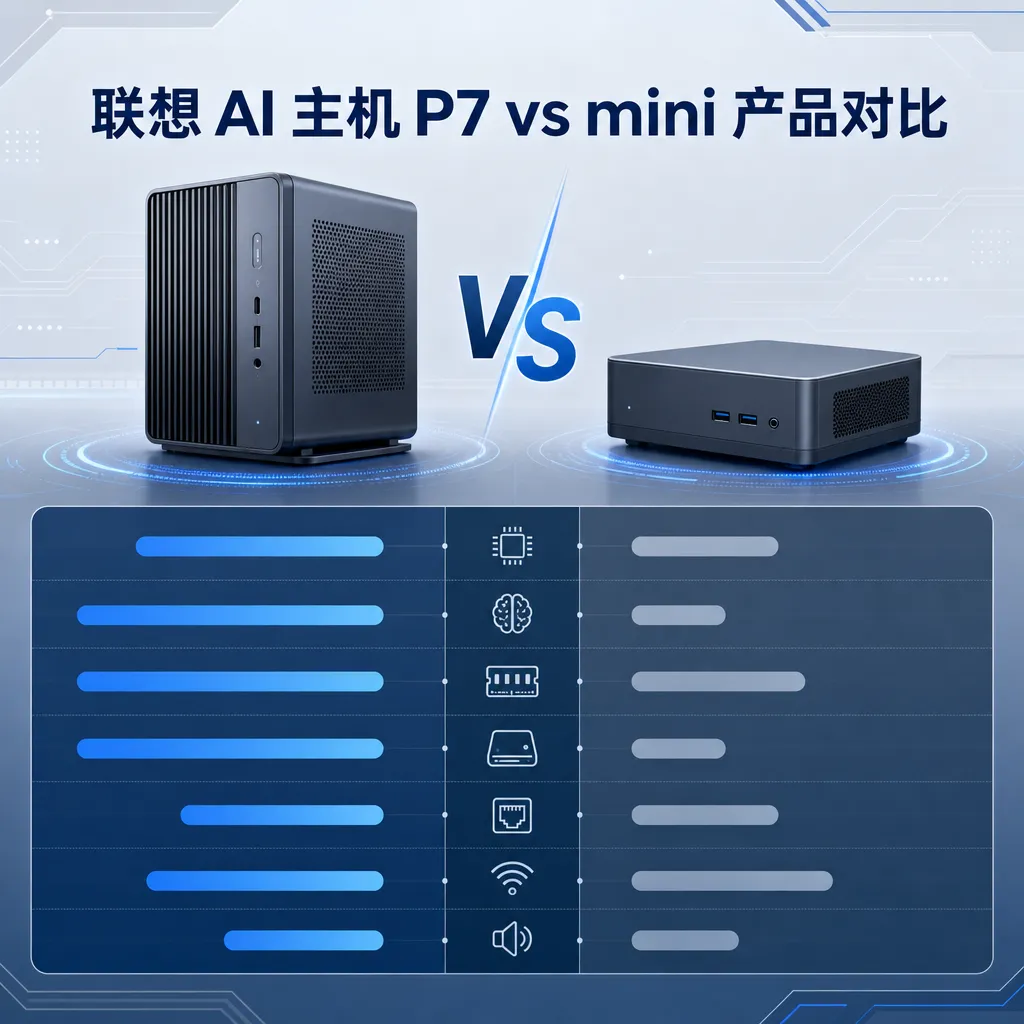
Tianxi AI 4.0 isn’t just a software update; Lenovo also launched two AI hosts to serve as hardware platforms.
P7: 190 TOPS Computing Power, Palm-Sized
P7 is the high-performance version with the following core specs:
- Chip: Xinqin P1 (likely Lenovo’s in-house or customized SoC)
- Compute power: 190 TOPS
- Memory: Up to 80GB RAM
- Context window: 128K
- Power consumption: Max 30W
- Cooling: 5000+ mm² vapor chamber heat plate
- Noise: Under 35dB at full load
- Size: Palm-sized
190 TOPS is quite powerful for an edge device—enough to run 13B or even larger models. 80GB of RAM is impressive, close to workstation levels. A 128K context window means it can handle long documents or dialogue histories, useful for knowledge base search and multi-turn conversations.
Its 30W consumption allows operation from a power bank—a smart design choice. Lenovo says P7 supports “dual-mode operation”: as a stationary computational hub or as a portable unit. This positioning is similar to a portable edge computing node, ideal for users needing access to the same AI capabilities across different locations.
Crowdfunding for P7 starts July 1, price undisclosed.
Mini: 45 TOPS, Starting at ¥2999
Mini is the entry-level version designed for “plug-and-play” usage:
- Compute power: 45 TOPS
- Power consumption: Average 15W
- Size: Half that of a Mac Mini
- Price: ¥2999
- Pre-sale: June 12
45 TOPS can handle 7B-level models—sufficient for everyday text generation, code completion, and simple multimodal tasks. With only 15W of power draw, it’s energy-efficient and generates low heat.
At ¥2999, the price is competitive. Compared with other AI boxes or edge devices, it offers good value: 45 TOPS performance plus Lenovo’s software ecosystem. However, details such as memory, storage, and interface configurations are still undisclosed—these will affect real-world usability.
Ecosystem: Model Plaza, Agent Plaza, Skill Plaza
Tianxi AI 4.0 also introduces three “Plazas”:
- Model Plaza: Users can choose among different models, presumably supporting local deployment of open-source models
- Agent Plaza: Predefined or third-party AI agents, similar to the GPTs concept
- Skills Plaza: Users can upload their own skills (likely executable scripts or workflows) for others to share
The logic behind this design is: models provide the core capabilities, agents encapsulate scenario-specific solutions, and skills act as fine-grained functional modules. Users can combine these three layers to build custom AI workflows.
Lenovo mentions nearly ten thousand developers and over 5,000 ecosystem partners. The numbers sound impressive, but actual activity and content quality remain to be seen. Bootstrapping a healthy AI ecosystem is always challenging—low-quality agents or skills could hurt user trust and platform reputation.
What Is “One-Click Shrimp Farming”?
Lenovo repeatedly mentioned terms like “one-click shrimp farming” and “one-click team forming” in the launch without detailed explanation. Based on context, “shrimp farming” likely metaphorically refers to the local deployment and running of models—similar to a “nurturing” process where the model learns and adapts to the user’s habits over time.
The “one-click” part emphasizes simplified deployment. Traditionally, running a local model requires environment setup, downloading weights, and parameter tuning—tedious for regular users. Lenovo’s goal seems to be encapsulating all these steps so that users can simply click a button and have the system automatically download, deploy, and optimize the model.
This is the right direction. The biggest barrier for edge AI isn’t compute power—it’s usability. If deploying a model takes too much effort, most users won’t bother. But how far Lenovo’s “one-click” simplicity can go will depend on real product experience.
How Does It Compare to Competitors?
The edge AI race is heating up. Apple has Apple Intelligence, Microsoft has Copilot+, Qualcomm and MediaTek are pushing AI PC chips, and smartphone makers are also launching on-device large models. So where does Lenovo Tianxi AI 4.0 fit in this landscape?
Advantages:
- Local memory model: The 1.7B fully local multimodal memory model is quite an aggressive move among domestic vendors. Most still keep memory features cloud-side or limited to local caching.
- Knowledge base system: If the document-to-knowledge-graph transformation achieves practical usability, it could greatly appeal to professional users.
- Integrated hardware + software: Lenovo’s hardware lineup—from PCs to smartphones and IoT devices—enables multi-device collaboration that pure software companies cannot match.
Challenges:
- Model capability: How far can a 1.7B model go? Compared to large cloud models, will users find it “not smart enough”?
- Ecosystem maturity: The Model, Agent, and Skill Plazas sound rich in concept, but quality and variety need time to prove themselves.
- User education: For most users, edge AI is still a new concept. Lenovo must explain why to use local models, what they can do, and how they differ from cloud models.
From a product perspective, Tianxi AI 4.0 targets professional users concerned with privacy, offline operation, and management of large personal data volumes. This audience is real but niche. Whether Lenovo can expand it into the broader consumer market will depend on market strategy and product iteration.
Technical Questions That Remain
1. Memory model accuracy
How accurate can a 1.7B multimodal understanding model be? If the memory frequently errs (e.g., recalling the wrong file or misinterpreting user intent), trust quickly erodes. Memory systems demand high fault tolerance since they underpin all subsequent operations.
2. Quality of knowledge graph construction
Automatically building knowledge graphs from unstructured documents is challenging. Each step—entity recognition, relation extraction, coreference resolution, ontology alignment—can introduce errors. If graph quality is poor, retrieval becomes unreliable, making keyword search more useful by comparison.
3. Cross-device synchronization
Lenovo emphasizes “one system across multiple devices,” but how is data sync handled? If memory and knowledge bases are local, how do devices stay consistent? Through Lenovo’s personal cloud or via P2P sync? What about latency and conflict resolution?
4. Privacy and security
Local deployment protects privacy, but if a device is lost or compromised, local memory and data are exposed. Does Lenovo provide encrypted storage or remote wipe functionality? These security details have not been disclosed.
Points Worth Watching
The most noteworthy aspect of Tianxi AI 4.0 is its local memory model + personal knowledge base combination. If successfully implemented, this could solve a key issue in edge AI—how to make AI truly understand the user’s personal context.
Cloud models are powerful, but they don’t know who you are, what you’ve done, or how you work. Each interaction starts from scratch, requiring manual background input. Local memory and knowledge bases can change that—letting AI remember your history, understand your preferences, and proactively provide relevant assistance.
This personalization is the core advantage of edge AI over cloud AI. Lenovo’s exploration in this direction is worth following.
Still, real adoption depends on user experience: Is memory accurate? Is the knowledge base useful? Is cross-device operation seamless? Only actual usage can answer these questions.
The launch of P7 and mini indicates Lenovo’s serious commitment to edge AI—not just software wrapping, but full-stack investment from chips and hardware to software. Such an approach requires patience and iteration, but if successful, it creates a strong moat.
Tianxi AI 4.0 is an ambitious product. It aims not to be just an AI assistant but an intelligent system that truly understands, remembers, and manages your personal knowledge. The vision is exciting, but execution is difficult. We’ll be watching closely.
References
- Lenovo Releases Tianxi AI 4.0 Version: Introduces Claw “Shrimp Farming” Ability, Personal Knowledge Base, Skills Plaza... — IT Home’s coverage of Tianxi AI 4.0 core features
- Lenovo AI Host Family Officially Announced: Equipped with Tianxi AI 4.0, Supports “One-Click Shrimp Farming” — IT Home’s detailed specs for the P7 and Mini AI hosts


