
OpenAI launches “Guaranteed Capacity” service: securing computing power becomes a rigid demand

OpenAI has officially launched the "Guaranteed Capacity" service, allowing enterprises to lock in AI computing power with 1–3 year contracts. The higher the annual spending, the greater the discount. This marks a key step for OpenAI to address compute shortages and stabilize major clients.
OpenAI Launches "Guaranteed Capacity" Service: Compute Lock-In Becomes Essential
OpenAI announced today (May 20) the launch of its Guaranteed Capacity service, allowing enterprise customers to lock in AI compute resources and API quota via 1–3 year contracts. This marks a key step for OpenAI in addressing the compute shortage and stabilizing relationships with large clients. It also signals a shift in AI infrastructure from a “pay-as-you-go” model to a “prepaid lock-in” business model.
Compute Shortage Drives Business Model Innovation
Over the past year, OpenAI’s compute supply has been under significant strain. The inference costs for GPT‑4 and GPT‑4 Turbo remain high, while enterprise demand for stability and predictability has been growing rapidly. Companies that deeply integrate AI capabilities into their products—such as Notion, Intercom, and Shopify—need assurance that compute shortages won’t affect their user experience during peak business periods.
The Guaranteed Capacity service is essentially a risk transfer mechanism: enterprises pay upfront to lock in compute capacity, while OpenAI gains a stable cash flow and a solid basis for capacity planning. This model isn’t new in cloud computing—AWS Reserved Instances and Azure Reserved Capacity follow a similar logic—but it’s the first time a major AI model provider has formally introduced long‑term capacity commitments.
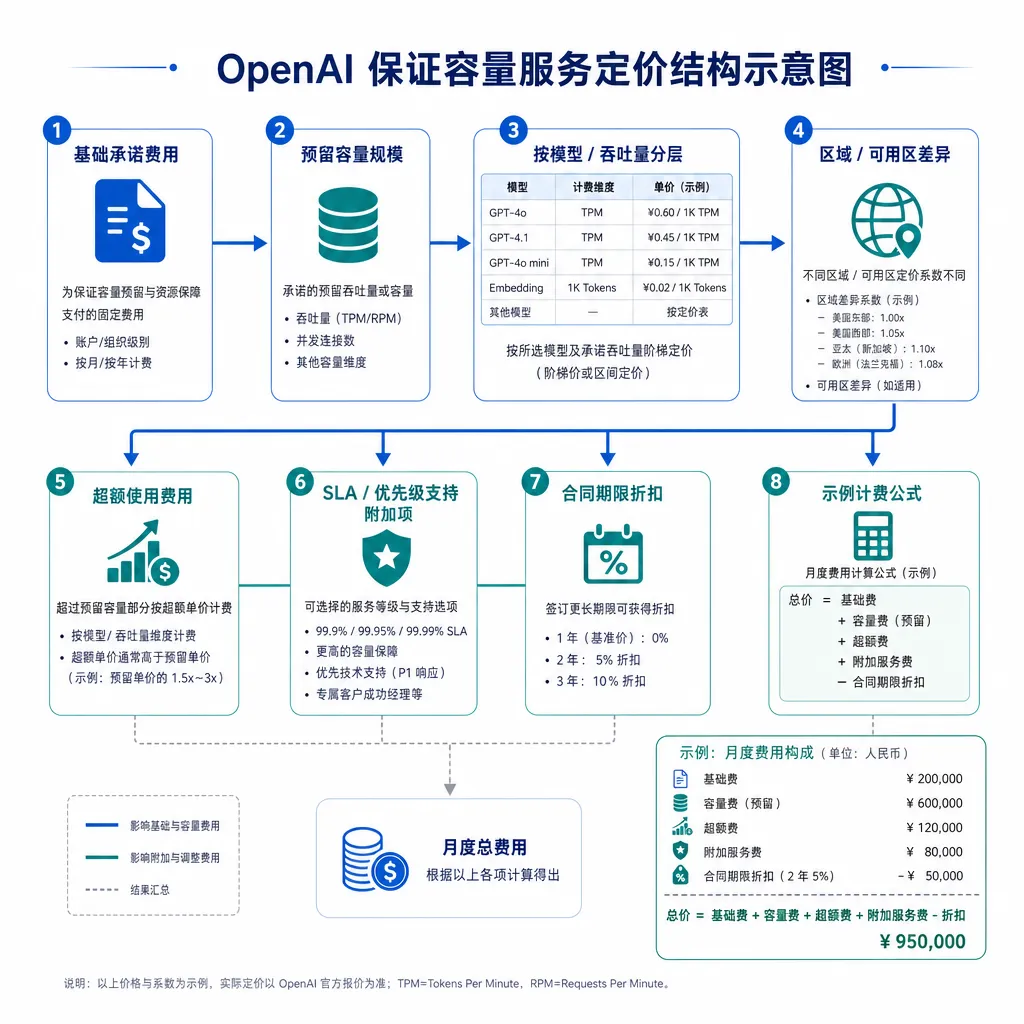
Pricing Logic: Higher Annual Spend, Greater Discount
According to OpenAI, the core mechanisms of the Guaranteed Capacity service are:
- Contract Term: 1-year or 3-year options
- Discount Structure: The higher the annual spend, the greater the discount (exact rates not disclosed)
- Flexible Usage: Committed quota can be allocated across OpenAI’s full product line (GPT‑4, GPT‑4 Turbo, GPT‑3.5, Embeddings, Whisper, etc.)
- Cloud Provider Support: Usable across multiple providers (e.g., Azure, AWS)
The goal of this pricing strategy is clear: to lock in large customers. For enterprises spending millions annually, committing for three years and receiving an estimated 20–30% discount is far more cost‑effective than competing for compute during peak demand.
However, this also means OpenAI is passing its compute supply uncertainty onto smaller customers. Once large clients reserve substantial capacity, the remaining “pay‑as‑you‑go” pool shrinks, resulting in more volatile prices. For startups unable to forecast AI usage over the next 1–3 years, this is hardly good news.
The Supply Chain Game Behind Compute Lock-In
The launch of Guaranteed Capacity reflects a complex supply chain dynamic.
In March, OpenAI signed a $11.9 billion compute procurement contract with CoreWeave—by far the largest single compute deal in AI history. CoreWeave specializes in GPU cloud services, mainly providing high-end NVIDIA GPU clusters such as H100 and A100 for AI training and inference. This contract secures massive compute supply for OpenAI over the coming years, but also burdens it with enormous fixed costs.
The Guaranteed Capacity service essentially transfers part of that fixed cost to customers. By collecting advance payments, OpenAI can better balance cash flow and avoid capacity idling risks.
Yet this reveals OpenAI’s internal tension: it wants to retain the flexibility of “pay‑as‑you‑go” for smaller clients, while relying on long‑term contracts with large enterprises to cover hefty infrastructure costs. This dual-track pricing scheme balances diverse user needs in the short term but may lead to long‑term pricing complexity and opacity.
Who Will Sign Up?
The target customers for Guaranteed Capacity are clear:
- AI‑native product companies: e.g., Jasper, Copy.ai, Character.AI — their core products rely entirely on OpenAI’s APIs, so compute stability directly affects business survival.
- Enterprise AI application developers: e.g., Salesforce, ServiceNow, SAP — integrating AI capabilities into existing products requires stable long‑term compute support.
- AI Agent platforms: e.g., LangChain, AutoGPT, BabyAGI — with fast-growing user bases and call volumes, they must secure capacity to meet future demand.
For these clients, the value of Guaranteed Capacity is not just the discount—it’s certainty. In a compute‑constrained environment, guaranteed access to capacity at any time is itself a competitive advantage.
For small developers and startups, however, the appeal is limited. They struggle to forecast 1–3 years of usage, and upfront payments tie up precious cash flow. More importantly, AI models evolve rapidly—locking in GPT‑4 capacity today may prove disadvantageous once GPT‑5 launches a year later. Although OpenAI claims quota can be used across its product line, new model pricing and performance may differ significantly.
Industry Impact: The Financialization of Compute
The rollout of Guaranteed Capacity marks the beginning of compute financialization.
In traditional cloud computing, Reserved and Spot Instances already support mature secondary markets—enterprises can resell unused capacity or buy surplus from others. If OpenAI’s program scales, similar secondary markets for compute commitments could arise.
This could lead to several long‑term effects:
- More complex pricing: beyond official rates, secondary and futures market prices may emerge.
- Compute as a tradable asset: companies could sell or lease unused capacity, opening new business models.
- Financialized supply chains: the appearance of compute brokers, futures exchanges, and other intermediaries.
However, excessive financialization introduces risk. Speculation could drive hoarding of compute credits for profit, leaving genuine developers unable to acquire needed resources—similar to the GPU price surge during the crypto mining boom.
Will Competitors Follow?
After OpenAI’s Guaranteed Capacity launch, will Anthropic, Google, and Meta follow?
Anthropic has not announced an equivalent service yet, but considering Claude 3’s high inference costs, long‑term capacity commitments seem inevitable. Anthropic’s close integration with AWS allows it to leverage AWS’s existing Reserved Capacity model without reinventing the wheel.
Google’s Gemini series primarily runs on Google Cloud, which already features Committed Use Discounts. Thus, Google will likely fold Gemini capacity commitments into its current pricing rather than launch a standalone product.
Meta’s Llama series being open-source doesn’t require “capacity lock‑in,” since enterprises can self‑host and control their own compute. Still, Meta provides hosted Llama variants through Azure and AWS, and may introduce capacity commitment options in the future.
The most probable early followers are Cohere and AI21 Labs—enterprise AI vendors facing similar compute shortages and targeting overlapping client bases. A capacity‑guarantee program helps stabilize relationships with big customers and improve cash flow—a win‑win move.
Recommendations for Developers
If you are an enterprise developer considering OpenAI’s Guaranteed Capacity, keep these points in mind:
1. Assess Real Needs
Don’t be swayed by discounts. Review your actual API usage over the past 6–12 months and project future demand for 1–3 years. Overestimating may result in costly and wasted capacity.
2. Factor in Model Evolution Risks
Model iterations happen quickly—GPT‑5 rumors are already swirling less than two years after GPT‑4. If you commit to GPT‑4 for three years and GPT‑5 launches soon with better cost‑performance, your contract could become a liability.
Although OpenAI allows quota use across “all products,” next‑gen model pricing may differ drastically. For example, GPT‑4 Turbo costs about ten times GPT‑3.5; exchanging GPT‑3.5 quota for GPT‑4 Turbo results in greatly reduced usable capacity.
3. Compare Multiple Providers
Avoid putting all your eggs in one basket. Competitors such as Anthropic’s Claude 3, Google’s Gemini 1.5, and Meta’s Llama 3 are robust alternatives. If OpenAI experiences compute supply issues, you’ll need contingencies.
For domestic developers, OpenAI Hub and similar API aggregation platforms provide flexible access: one key can call GPT, Claude, Gemini, DeepSeek, and other major models. No need to pre‑commit to one provider, and connection stability is better.
4. Review Contract Terms Carefully
Read the fine print—refund policy, capacity adjustment options, force‑majeure clauses. If OpenAI cannot meet its capacity commitments due to technical or regulatory reasons, what remedies are available? Is there an SLA (Service Level Agreement) guarantee? Verify these before signing.
Conclusion
The Guaranteed Capacity service marks OpenAI’s shift from a “technology‑driven” company to a “business‑driven” one. It’s evolving beyond an API provider, now adopting complex pricing and capacity management strategies similar to traditional cloud vendors to optimize revenue and profitability.
For enterprise clients, this is a double‑edged sword: long‑term contracts offer predictability and lower costs but introduce lock‑in risks and complex decision‑making.
Across the AI industry, compute financialization is inevitable. As AI adoption grows, compute will become a fundamental resource—like electricity or bandwidth—and markets around compute pricing, trading, and risk management will grow more sophisticated.
OpenAI’s Guaranteed Capacity is only the beginning. In the future, we may see compute futures, compute insurance, and compute‑based derivatives. AI developers must learn not only how to call APIs but also how to manage compute costs, hedge compute risks, and optimize compute portfolios.
It’s a new game—and it has only just begun.
References
- OpenAI Launches “Guaranteed Capacity” to Address Compute Shortage – IT Home – Detailed information from OpenAI’s official announcement


