
Qwen3.7-Max Debuts: Alibaba Places Its Bet on Agents

Alibaba officially released Qwen3.7-Max today, positioned as the flagship model for the era of intelligent agents. It autonomously completed over 1,000 tool calls in 35 hours, ranks first domestically on Arena, and its programming and agent capabilities are on par with Opus-4.6.
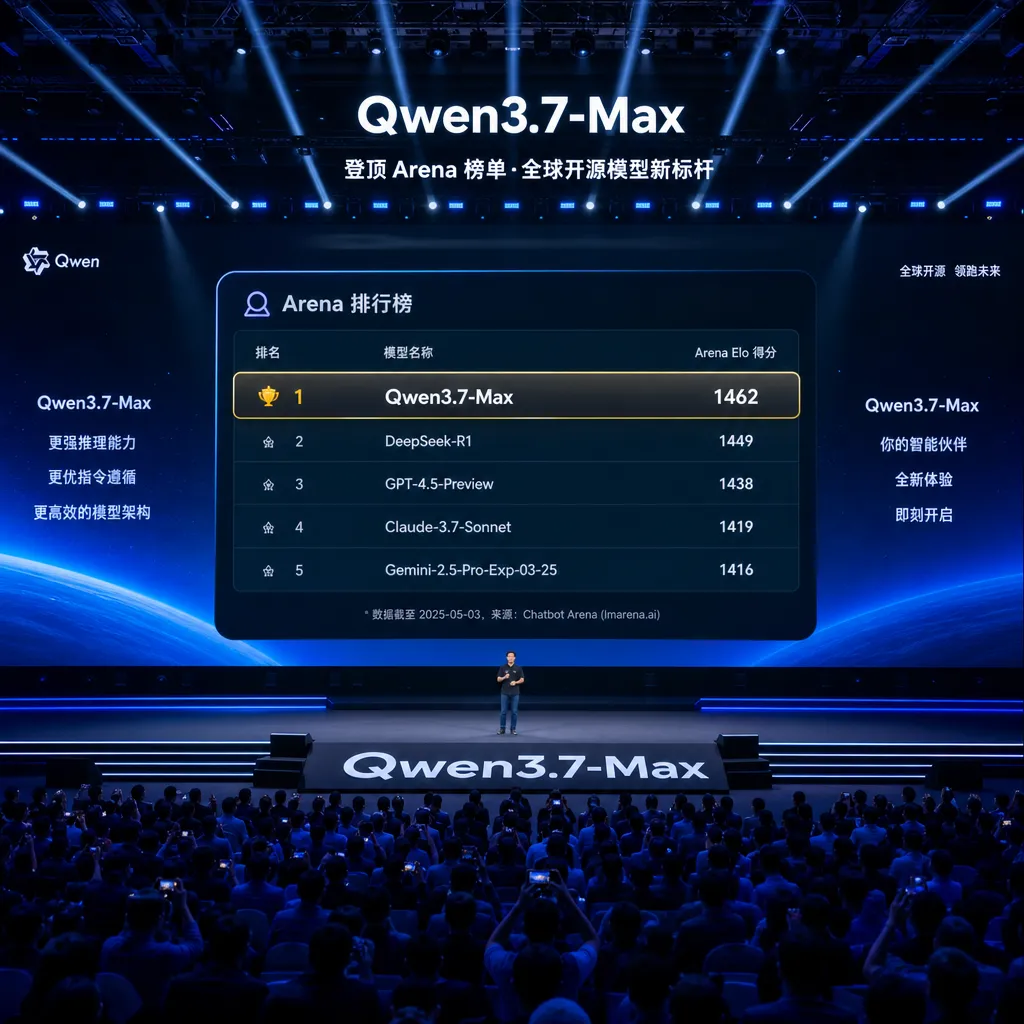
On May 20, at the Alibaba Cloud Summit, the latest flagship model in the Qwen family, Qwen3.7-Max, was officially launched. The preview version had quietly appeared on Qwen Chat and Arena AI the day before, spreading quickly among developers — this time, Alibaba is betting everything on one word: “Agent.”
According to its official positioning, Qwen3.7-Max no longer aims to be merely a “smarter conversational model,” but is designed directly for the Agent era: programming, reasoning, tool use, long-horizon task execution — everything revolves around one question: can the model work autonomously? In Arena’s global blind test leaderboard for large models, Qwen3.7-Max ranked first among domestic models, 13th in comprehensive text ranking, and 10th in programming. That’s a leading performance among Chinese models, though it still trails the top-tier global models like Opus-4.6 and GPT series.
35 hours, 1,000 tool calls: the long-horizon task is the main highlight
If there’s one statistic worth focusing on, it’s the officially emphasized “35-hour fully autonomous kernel optimization experiment.”
Here’s the scenario: on a brand-new chip platform, Qwen3.7-Max autonomously programmed and called over 1,000 tools to iteratively optimize a key kernel, ultimately achieving a tenfold improvement in inference speed over the original version. The entire process was unmanned — the model decomposed the task, wrote code, ran tests, reviewed results, and refined solutions all by itself.
The difficulty wasn’t in the 1,000 tool calls — since the MCP protocol became common, calling that many tools isn’t rare — the challenge was maintaining 35 hours of continuous reasoning. Most models tend to collapse on long tasks: either the context gets too messy and they forget early goals, or they enter infinite loops, retrying failed approaches. Qwen3.7-Max achieved a 1.98× median speedup and 96% improvement rate on the Kernel Bench L3 test — proving it can indeed “keep doing the right thing” over extended periods of GPU kernel optimization.
That’s why Alibaba’s messaging this time doesn’t emphasize parameter count or tokens, but “ultra-long-horizon agent-level complex tasks.” The market already has plenty of models — what’s missing are models that can actually finish the work.
Programming ability: closing in on Opus-4.6, surpassing in some metrics
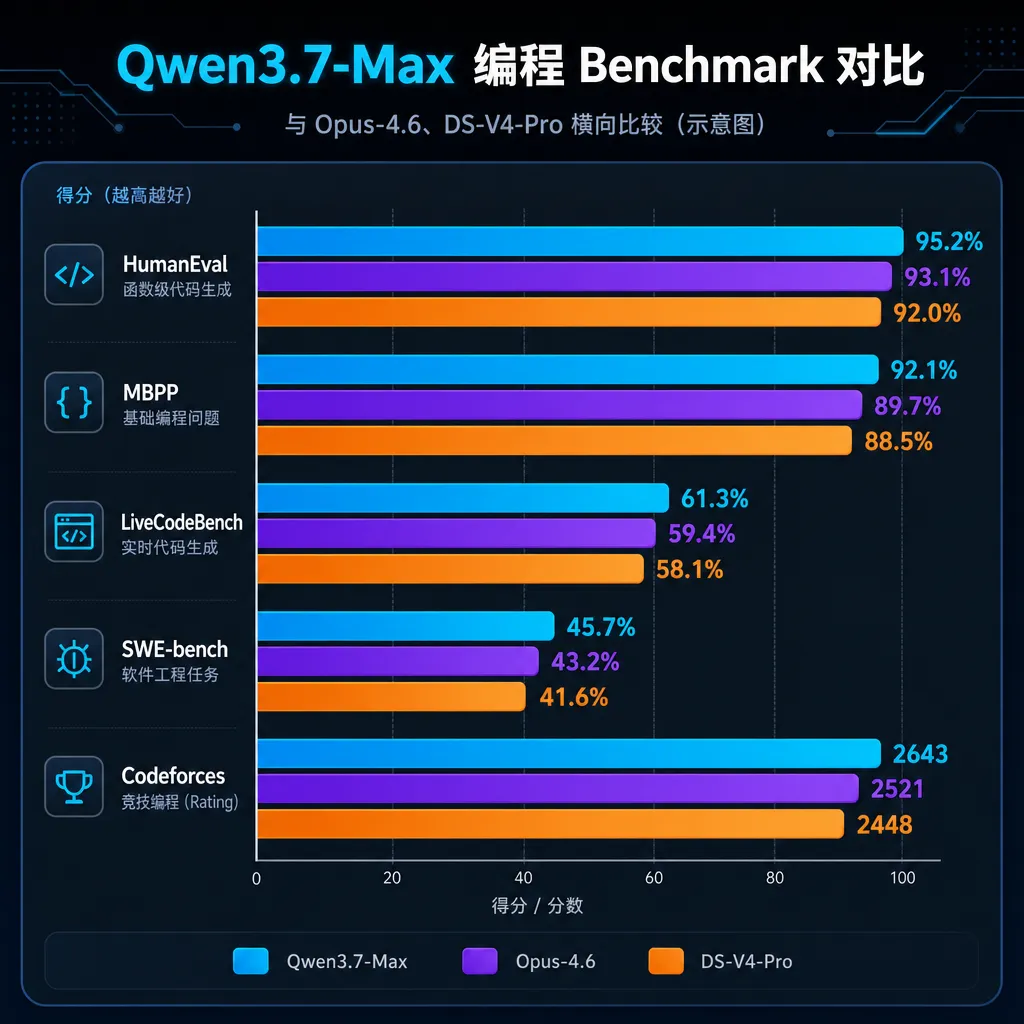
Programming has long been a strength of the Qwen series, and Qwen3.7-Max further consolidates it. According to official eval data:
- SWE-Verified: 80.4 — on par with Opus-4.6 Max (80.8) and DS-V4-Pro Max (80.6)
- SWE-Pro: 60.6 — leading
- SWE-Multilingual: 78.3 — strong multilingual performance
- SciCode: 53.5
- QwenSVG: 1608
- Terminal Bench 2.0-Terminus: 69.7 — surpasses DS-V4-Pro Max’s 67.9
SWE-Verified is considered the most realistic engineering benchmark in the field, requiring models to locate bugs, write patches, and run tests in real open-source repositories. Qwen3.7-Max now stands nearly shoulder to shoulder with Opus-4.6, the gap within the margin of error. Its better performance on Terminal Bench suggests greater stability in everyday engineering use, like terminal commands and shell scripts.
Even more noteworthy is cross-framework compatibility. Officially, Qwen3.7-Max performs reliably across Claude Code, OpenClaw, and Qwen Code agent frameworks. This is key — many models boast top numbers only within their home frameworks but degrade under others. True cross-framework generalization means Qwen3.7-Max’s tool-use ability is internalized, not just a result of special prompting.
General Agent: the strongest domestic performer in the MCP ecosystem
When it comes to general agent capability, Qwen3.7-Max shows even more significant gains. Key metrics:
- MCP-Mark: 60.8 (vs. GLM-5.1’s 57.5)
- MCP-Atlas: 76.4 (vs. Opus-4.6’s 75.8)
- Skillbench: 59.2 (vs. K2.6’s 56.2)
- BFCL-V4: 75.0
- Qwenclaw: 64.3
- ClawEval: 65.2
MCP (Model Context Protocol) is now the de facto standard for agent tool use. MCP-Mark and MCP-Atlas evaluate a model’s tool selection, parameter passing, and return-value parsing skills under the MCP protocol. Qwen3.7-Max surpassing Opus-4.6 on MCP-Atlas marks the first time a Chinese model has topped Anthropic’s flagship on the main MCP leaderboard.
Why does that matter? Many enterprise agent applications now use MCP to connect to internal tools — file systems, databases, CRMs, APIs — all exposed to the model. How well it performs directly affects product viability. Qwen3.7-Max’s arrival at near-Opus-4.6 levels makes it a pragmatic domestic option: compliant, directly connectable, and cost-effective.
How to use: Alibaba Cloud Bailian + OpenAI Hub
Qwen3.7-Max will soon be available via Alibaba Cloud’s Bailian platform, with API invocation maintaining Qwen’s familiar OpenAI-compatible format.
For developers who don’t want to juggle multiple API keys, OpenAI Hub (openai-hub.com) will also quickly bring Qwen3.7-Max online. One unified key can call GPT, Claude, Gemini, DeepSeek, and Qwen models — all domestically routed — avoiding repetitive switching between Bailian, Anthropic, and Google AI Studio. For teams comparing models or orchestrating agents, this aggregation greatly reduces infrastructure overhead.
Some observations
The release timing of Qwen3.7-Max is revealing. In January, Alibaba unveiled Qwen3-Max-Thinking, a trillion-parameter model with top HLE scores. Less than four months later, the 3.7 series has pivoted heavily toward Agents. This rapid iteration is likely based on market feedback since Qwen3-Coder’s explosive usage last year — developers don’t want just higher benchmarks, they want agents that actually run.
Some takeaways to note:
1. Qwen has shifted from “benchmarking” to “differentiation.” Alibaba didn’t force a head-to-head comparison with GPT-5.2 or Opus-4.6 in general intelligence, instead focusing on real-world metrics like long-horizon tasks and MCP tool use. That’s a mature move — it’s unrealistic to win in all dimensions, but being top-tier in the hottest applied segment (Agents) is enough for commercialization.
2. The 35-hour long task demo matters more than leaderboard stats. The industry has moved past pure benchmarking. The ability to complete a real multi-step task — and self-correct when errors occur — is what separates productive models from experimental ones. Qwen3.7-Max provides tangible, verifiable proof (chip kernel optimization, 10× acceleration), which is far more convincing than a score.
3. Cross-framework generalization signals goodwill toward open ecosystems. Listing Claude Code, OpenClaw, and Qwen Code equally shows Alibaba isn’t forcing developers into a closed ecosystem. This aligns with Tongyi Qianwen’s open-source strategy of releasing 300+ models and inspiring 200,000 derivatives — it’s about ecosystem, not enclosure.
4. Opus-4.6 remains the ceiling. While Qwen3.7-Max reaches or exceeds it on some metrics, Anthropic’s flagship remains more consistent overall. Still, the fact that Chinese models have closed the gap this far is the biggest leap of the past two years. Bridging from “almost equal” to “half a generation ahead” will take more refinement.
Final thoughts
The term “Agent” has been trending for nearly two years, but only now are models emerging that can actually support 35 hours of sustained autonomous execution. Qwen3.7-Max isn’t the endpoint, but it pushes Chinese models a real step forward in agent capability — from “can run a demo” to “can get real work done.”
For developers, the practical question now is: Should you try replacing Claude/GPT with Qwen3.7-Max in your current agent project? Considering the advantages — price, compliance, direct domestic connectivity — plus its strong benchmark metrics, it’s probably worth an A/B test.
More live results will emerge once the API is public. Then we’ll see how steady it truly is.
References
- Qwen3.7-Max release discussion - linux.do — first community discussions and developer feedback
- Alibaba Qwen’s strongest agent model Qwen3.7-Max released - IT Home — official release details and benchmark data
- Qwen3.7-Max-Preview debuts on Arena AI - IT Home — preview version performance on Arena leaderboard


