
Mistral suddenly released four models in one go, driving inference costs down to the floor.
Mistral released four new models from 7B to 123B at dawn. The MoE architecture reduces inference costs to one-fourth of others at the same level. The 31B dense model surpasses GPT-4o in benchmark scores, and the open-source community has already successfully run it locally.
Mistral’s “Midnight Ambush”: Four Models Released, Covering Everything from Mobile to Data Centers
In the early hours of April 5 (Beijing time), Mistral dropped four new models all at once—without any teaser or countdown. CEO Arthur Mensch simply posted a benchmark comparison chart on X, with one line: “Efficiency is the new scale.”
That statement wasn’t made lightly.
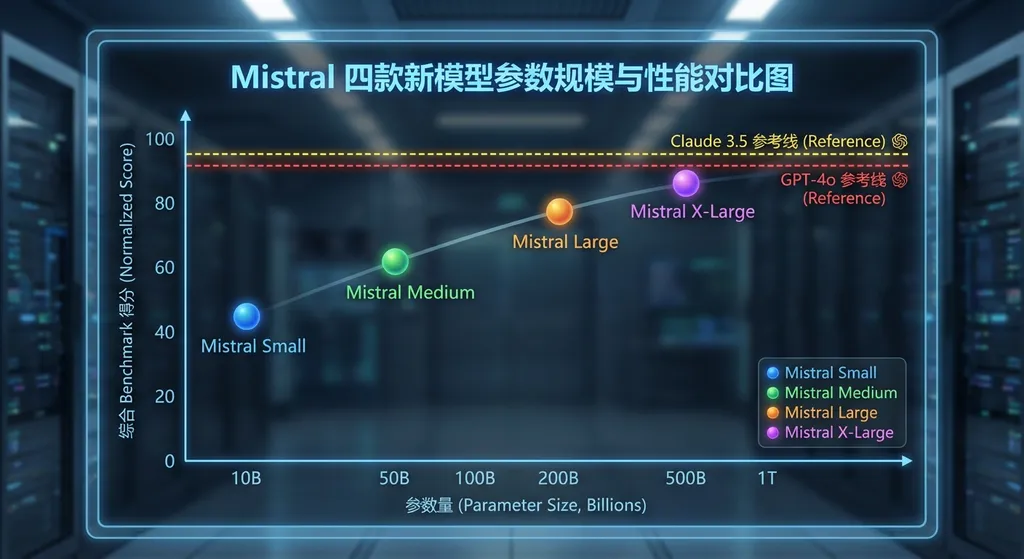
The four models range from 7B to 123B parameters, covering the full spectrum from on-device inference to enterprise deployment. More importantly, two of them—31B Dense and 26B MoE—have less than half the parameters of GPT-4o, yet matched or even exceeded its scores on several major benchmarks.
The timing is interesting. Just last week, reports surfaced that OpenAI’s GPT-5 training had hit a bottleneck, causing internal debate over the scaling law approach. Mistral’s release at this moment sends a clear message: piling on parameters isn’t the only path forward.
Four Models, Four Missions
Let’s lay out the lineup:
| Model | Parameters | Architecture | Active Parameters | Context Window | Positioning | |--------|-------------|---------------|------------------|----------------|--------------| | Mistral 7B v2 | 7B | Dense | 7B | 128K | On-device / lightweight deployment | | Mistral 12B | 12B | Dense | 12B | 128K | Mobile / edge computing | | Mistral 31B Dense | 31B | Dense | 31B | 128K | Enterprise-grade | | Mistral 123B MoE | 123B | MoE | 32B | 128K | Flagship / complex reasoning |
The product matrix is clear: Mistral isn’t trying to build “the strongest model”—it’s aiming for “the most efficient solution.”
7B and 12B: Serious Models That Fit in a Phone
Let’s start with the smaller ones. The 7B v2 is a major upgrade of Mistral’s 2023 debut model, with the most noticeable improvement being the jump to a 128K context window. The original version had only 8K—this is a 16× leap.
What does a 128K context mean for a 7B model? It means you can load an entire mid-sized codebase for analysis or have it read a 200-page technical document before answering questions—all locally on a MacBook, no API calls, no fees, no data leaving your network.
The open-source community’s reaction speaks volumes. Developers on Hugging Face tested 7B v2 on an M3 MacBook Pro and found it generated code faster than calling Claude 3.5 Sonnet via API. That’s not to say 7B outperforms Claude 3.5 Sonnet in capability—it doesn’t—but for everyday dev tasks, local inference latency makes up for the difference.
The 12B model targets a similar niche but with 5B more parameters, giving it more stability for complex instructions and multi-turn dialogues. If 7B is “usable,” 12B is “pleasant to use.” For teams running AI on mobile or edge devices, 12B may be the best cost-effective option available.
31B Dense: The True Star of This Release
The real highlight this time is the 31B Dense model.
Why? Because it hits a sweet spot.
A 31B dense model can run full-precision inference on a single A100 80G GPU—no quantization, no multi-GPU setup. Just one card. For most enterprises, that means deployment cost drops from “a small cluster” to “a single server.”
The performance is even more impressive. Mistral’s data shows 31B Dense matches or slightly beats GPT-4o across major benchmarks like MMLU, HumanEval, and GSM8K. A 31B model beating one many times larger—something unthinkable a year ago.
The technical story behind this isn’t complicated: Mistral invested heavily in data quality and training strategy. Arthur Mensch once said the performance ceiling of models depends increasingly on data quality rather than size. The 31B Dense model is proof of that idea.
For developers, the biggest value of 31B Dense is clear—you can now run a GPT-4o-level model entirely in your own data center. No sending data overseas, no paying per token, no API rate limits. For finance, healthcare, and government sectors where data sovereignty is critical, that’s huge.
123B MoE: Flagship Power at One-Fourth the Cost
Finally, the 123B MoE flagship.
123B sounds massive, but the beauty of the Mixture-of-Experts architecture is that only 32B parameters are active during inference—the rest are “standby experts” activated only when needed.
Meaning: inference costs are roughly one-fourth that of an equivalent dense model.
Put simply—if you were previously using a 120B dense model and paying $40,000 per month for API calls, switching to Mistral 123B MoE would drop that to roughly $10,000, for the same workload. Enough to hire another engineer with the savings.
Mistral has a track record in MoE. Its Mixtral 8x7B from late 2023 was an early experiment on this path, causing a major stir in the open-source community. The 123B MoE is that evolution matured—more experts, smarter routing, better training.
Benchmark results show the 123B MoE shines especially in reasoning tasks (math, code, logic chains), coming close to Claude 3.5 Opus in some cases. Considering the cost gap, the performance-per-dollar is striking.
A Bigger Message: The Efficiency Camp Is Winning
Viewing these four models together, the signal Mistral is sending is bigger than the product launch itself.
For the past two years, the dominant theme in AI has been “bigger is better”—more parameters, more compute, more massive training clusters. GPT-4 supposedly has over a trillion parameters; Google’s Gemini Ultra likewise. The industry chased the scaling law at full speed.
But from late 2025 onward, the wind is shifting.
DeepSeek used MoE and engineering optimization to train GPT-4-level models at a fraction of OpenAI’s cost. Meta’s Llama 3 series proved open-source models can match proprietary ones. Now Mistral has beaten GPT-4o with just 31B parameters.
All signs point to the same conclusion: the scaling law still holds, but its marginal returns are shrinking fast. Going from 100B to 1T may give only 10% better performance—at 10× the cost.
Mistral is betting on a different approach: smarter data, smarter architecture, smarter training—achieving big-league results with smaller models. Arthur Mensch’s “Efficiency is the new scale” isn’t a slogan; it’s a technical stance.
And the market seems to agree. Mistral just completed a $570 million funding round and plans to purchase 13,800 NVIDIA GPUs. A solid sum—but still “doing big things with small money” compared to OpenAI and Google’s billion-dollar budgets.
What This Means for Developers
Let’s talk practical.
If you’re an indie developer or a small team, try 7B v2 and 12B right away. Their 128K context fits perfectly for local code assistants, document Q&A, or RAG pipeline generation after quantization with llama.cpp.
If you manage enterprise AI infrastructure, 31B Dense deserves a place on your evaluation list. Single-GPU deployment, GPT-4o-level performance, full data privacy—no other model currently offers all three.
If your business depends on API services, 123B MoE’s cost structure will make you rethink your math. The same results at one-fourth the inference cost means more room for user experience investment—or to cut prices and grab market share.
Most major AI API aggregators already support Mistral’s new models. For instance, OpenAI Hub lets you call Mistral models directly with OpenAI-compatible syntax—no network hassles. Example code:
from openai import OpenAI

client = OpenAI(
    base_url="https://api.openai-hub.net/v1",
    api_key="your-openai-hub-key"
)

# Call Mistral 31B Dense
response = client.chat.completions.create(
    model="mistral-31b-dense",
    messages=[
        {"role": "system", "content": "You are a senior Python developer."},
        {"role": "user", "content": "Write a concurrent web scraping framework using asyncio with rate limiting and automatic retries."}
    ],
    max_tokens=4096,
    temperature=0.7
)

print(response.choices[0].message.content)
# Call the Mistral 123B MoE flagship model
response = client.chat.completions.create(
    model="mistral-123b-moe",
    messages=[
        {"role": "user", "content": "Analyze the time complexity of the following code and suggest optimizations..."}
    ],
    max_tokens=8192,
    temperature=0.3
)
Fully OpenAI SDK compatible—just change the model parameter, and migration cost is nearly zero.
What to Watch Next
A few points worth keeping an eye on:
- Completeness of open-source weights – Mistral says all four models will be open-sourced, but license terms aren’t out yet. If it’s Apache 2.0, that’s a huge win for commercial use; if restricted like Llama, it’s less appealing.
- Community fine-tuning ecosystem – 7B and 12B are easy to fine-tune; expect specialized variants (for code, healthcare, legal, etc.) within weeks. 31B will take more resources, but LoRA/QLoRA should follow soon.
- Cloud provider adoption speed – How quickly AWS, Azure, and GCP add these to Model Garden / Bedrock / Model API will affect enterprise adoption directly.
- OpenAI’s response – GPT-5 updates, GPT-4o price cuts, or new lightweight models—Mistral’s punch won’t go unanswered.
In Closing
The AI industry is undergoing an aesthetic shift.
Two years ago, the game was about size, hardware, and budget—a military race only the richest could join.
Now, the rules are changing. Mistral beat GPT-4o with 31B parameters. DeepSeek trained top-tier models at one-tenth the cost. The open-source community is running usable AI assistants on MacBooks. Efficiency, architecture, and data quality—the “soft power”—are replacing brute-force scaling as new competitive moats.
For developers, that’s great news. Models are getting stronger, cheaper, easier to deploy. More choices, fewer lock-ins.
Whether Mistral’s four models can truly deliver on their benchmark promises still awaits real-world validation. Benchmarks aren’t the finish line—products are.
But as of today, “small models can do big things” is no longer just a slogan.
References
- Mistral “Ambushes” OpenAI: Four New Models Released – Netease: Details and benchmark analysis of the four models
- Mistral Drops 4 New Models, 31B Parameters Lower Local Deployment Barrier – Netease: Technical details including 7B’s 128K context window
- $570 Million! Another AI Unicorn Raises Big – Baidu Baijiahao: Background and growth story of Mistral
- $570 Million! Another AI Unicorn Raises Big – Phoenix Tech: GPU procurement plans and strategic layout


