
OpenAI reasoning model overturns 80-year-old geometric conjecture

OpenAI’s latest reasoning model has independently produced a proof that disproves the geometric conjecture proposed by Paul Erdős in 1946. This marks the first time AI has autonomously solved a major unsolved problem in a core area of mathematics, representing a key breakthrough in general reasoning capabilities.
OpenAI Reasoning Model Overturns 80-Year-Old Geometry Conjecture: A Key Breakthrough in General Reasoning Capability
OpenAI has just announced an achievement worthy of the AI history books: its latest reasoning model independently derived an original mathematical proof that overturned a famous geometric conjecture proposed in 1946 by Hungarian mathematician Paul Erdős. This isn’t the first time AI has solved a math problem, but it is the first time a general-purpose model—without any task-specific training—has autonomously conquered a major unsolved problem in a core mathematical field.
This time, OpenAI played it smart. Seven months ago, then–VP Kevin Weil posted on X claiming that GPT-5 had solved ten Erdős problems, only for it to be revealed that it had merely located published answers in the literature. The incident drew mockery from luminaries like Yann LeCun and DeepMind CEO Demis Hassabis, prompting Weil to quietly delete the post. This time is different—OpenAI brought in several mathematicians to validate the result, including Noga Alon, Melanie Wood, and Thomas Bloom, the very person who had most publicly criticized Weil’s earlier claim. Bloom, who runs a website dedicated to Erdős problems, has now publicly voiced support for OpenAI.

What Conjecture Was Overturned?
Erdős posed many problems in combinatorial geometry, and the conjecture overturned this time deals with the optimal configuration of point sets. For nearly 80 years, mathematicians believed that the optimal configuration should approximate a square lattice structure—a symmetry-based assumption that felt intuitively natural. OpenAI’s model, however, discovered an entirely new constructive system that significantly outperformed the traditional grid, thus overturning this long-held consensus.
Although these problems seem abstract, they have wide-ranging applications. Point-set configuration relates to fields such as coding theory, network design, and lattice structure optimization in materials science. More importantly, this problem lies at the heart of combinatorial mathematics, with solutions that often require crossing multiple subfields—demanding exceptional depth of reasoning and integrative knowledge from AI.
Why Is This Credible?
First, OpenAI has presented an original proof, not something copied from existing literature. Bloom stated explicitly that this constructive system has never appeared in mathematical publications before—it was discovered independently by the model. Second, the proof has been verified by multiple professional mathematicians; it’s not just OpenAI’s own claim.
Crucially, this model isn’t a specialized system trained solely for mathematics—it’s a general reasoning model. OpenAI emphasizes that the same model shows similar reasoning ability across various tasks, meaning it wasn’t fine-tuned specifically for the Erdős problem. This implies that its reasoning capability is transferable and not confined to mathematics alone.
Technically, this appears to be a successor of OpenAI’s o1 series reasoning models released in September last year. The o1 models employ a chain of thought mechanism, performing lengthy internal reasoning before outputting an answer—similar to how humans use scratch paper while solving problems. The fact that it successfully overturned an Erdős conjecture indicates a qualitative leap in reasoning depth and exploratory capability.
What Makes the Reasoning Model So Powerful?
Traditional large models like GPT-4 are already strong at mathematical reasoning, but when faced with truly unsolved problems, they often produce speculative attempts lacking rigor. The core differences in reasoning models include:
1. Longer Reasoning Chains
The o1 series can maintain reasoning over thousands of steps, with each step verifying earlier conclusions and exploring new directions. This “slow thinking” mode gives the model time to try multiple strategies instead of giving an impulsive first response.
2. Self-Verification Mechanism
The reasoning model actively checks for logical flaws in its derivations and backtracks when it finds errors—akin to a mathematician rigorously reworking a proof rather than charging ahead blindly.
3. Cross-Domain Knowledge Integration
OpenAI highlights that the model can “connect knowledge across disciplines in ways researchers hadn’t envisioned.” The Erdős solution likely draws on techniques from algebra, topology, and probability—an integrative ability specialized systems lack.
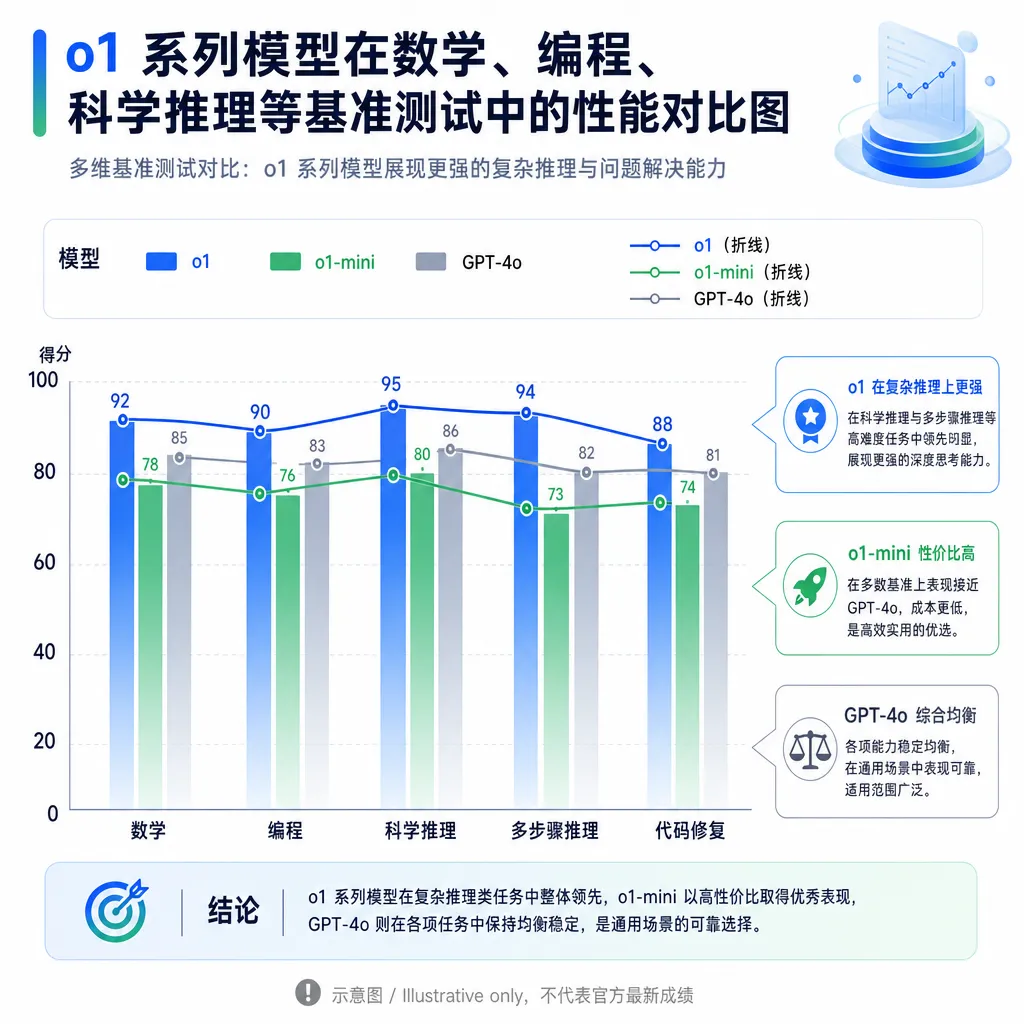
When o1 was released last year, its benchmark results were already stunning: on International Mathematical Olympiad (IMO) problems, o1 achieved an 83% accuracy rate, while GPT-4o managed only 13%. It also far outperformed previous models on doctoral-level problems in physics, chemistry, and biology. But those had known correct answers; overturning an Erdős conjecture marks a true original breakthrough.
What Does This Mean for Other Fields?
OpenAI believes this breakthrough extends far beyond mathematics. If the model can make original contributions in such an abstract area as combinatorial geometry, it may have similar potential in other scientific domains:
Biology: Protein folding and gene regulation network analysis involve vast combinatorial complexities. Reasoning models could uncover new structural patterns or regulatory mechanisms.
Physics: Theoretical conjecture verification or new material property prediction both require long chains of logic and cross-disciplinary synthesis.
Engineering: Complex system optimization—such as chip layout and network topology—is also a combinatorial problem with parallels to the Erdős challenge.
Medicine: Drug design and disease mechanism inference demand exploration of vast chemical and biological search spaces; reasoning models could accelerate discovery.
Bloom’s comment is intriguing: “Artificial intelligence is helping us explore the grand edifice of mathematical knowledge human beings have built over centuries—how many hidden subtle truths still await discovery?” This implies that many long-standing conjectures may remain unsolved not because they’re fundamentally unprovable, but because human intuition and experience limit exploration. AI, free from such constraints, might find breakthroughs in seemingly unrelated domains.
Is This the Arrival of AGI?
When OpenAI released the o3 model in December, it achieved near-human performance on the ARC-AGI benchmark, sparking discussions that “AGI has arrived.” The ARC-AGI test focuses on abstract reasoning ability, widely considered a key indicator of progress toward general intelligence. Mathematician Terence Tao had predicted that such tasks would stump AI for years—yet o3 cracked them early.
This new achievement further supports that reasoning models are advancing in abstract thinking. But to claim that AGI has arrived would be premature. Mathematical proof is a relatively contained domain—its rules are explicit and its feedback immediate, allowing AI to easily verify its own reasoning. Real-world problems, by contrast, are ambiguous, dynamic, and lack clear feedback. Whether reasoning models can sustain the same capability in such settings remains to be seen.
Still, one thing is clear: improved reasoning is reshaping the application boundaries of AI. Large models were once mainly used for generative or summarization tasks—“shallow thinking.” Now, they are entering domains requiring deep thought. If reasoning models can reliably make original contributions in research, engineering, and medicine, their value will far exceed that of today’s general-purpose AI tools.
OpenAI’s Strategic Pivot
From GPT-4 to o1, OpenAI’s technical direction has clearly shifted. GPT-4 pursued scale—more data, more patterns, faster results—the pinnacle of “fast thinking.” The o1 series introduced “slow thinking,” trading speed for deeper reasoning—a qualitative evolution.
Overturning the Erdős conjecture may be part of OpenAI’s strategy to build momentum for its next-generation model. If new versions can deliver breakthroughs in multiple research domains, OpenAI can reposition itself not merely as a “chatbot maker” but as a “scientific assistant”—a far more lucrative and prestigious identity. After all, an AI that helps solve unsolved scientific problems is much more valuable than one that writes emails.
However, hype must be tempered with caution. The GPT-5 fiasco from seven months ago is still fresh. Although OpenAI now has mathematicians’ endorsements, it has yet to release detailed proofs, model architectures, or training methods. Until peer-reviewed publications appear, skepticism is warranted.
Implications for Developers
What does the rise of reasoning models mean for AI developers?
First, stop viewing large models as mere “text generators.” If your application needs complex decision-making, multi-step planning, or logical deduction, reasoning models may be more suitable—even if they’re slower and more expensive.
Second, the boundaries of reasoning capability are rapidly expanding. Today it overturns a mathematical conjecture; tomorrow, it could design drugs, optimize chips, or discover physical laws. If you’re building research tools, professional decision systems, or complex optimization platforms, now is the time to integrate reasoning models.
Finally, reasoning models may transform AI user interaction. Users may no longer demand instant answers—they’ll wait minutes (or more) for a deeply reasoned result. Product designers must therefore consider: how to communicate what the model is “thinking”? How to visualize its reasoning process? How to earn users’ trust in an AI that takes time to compute?
OpenAI Hub already supports calling the o1 model series. Developers can test reasoning performance in their own contexts using a unified API. Given the high computational cost, it’s advisable to validate results on small datasets first, then scale only if clear gains emerge.
from openai import OpenAI

client = OpenAI(
    api_key="your-openai-hub-key",
    base_url="https://api.openai-hub.net/v1"
)

response = client.chat.completions.create(
    model="o1-preview",  # or "o1-mini"
    messages=[
        {
            "role": "user",
            "content": "Please prove: For any positive integer n, there exist n distinct positive integers whose reciprocals sum to 1."
        }
    ],
    # Reasoning models do not support parameters like temperature
    # They perform internal reasoning, which takes longer to respond
)

print(response.choices[0].message.content)
Final Thoughts
Overturning an Erdős conjecture marks a milestone for AI, but for mathematics, it’s only the beginning. Countless unsolved problems remain—from the Riemann Hypothesis to P vs NP, from the Twin Prime Conjecture to Goldbach’s Conjecture—each more difficult and profound than Erdős’s geometric puzzle. How far AI can go will depend on how deeply its reasoning capabilities continue to evolve.
But one thing is certain: AI will not replace mathematicians—just as calculators didn’t. The essence of mathematics lies not in computation or proof, but in asking good questions, forming new concepts, and uncovering deep connections. AI can be a powerful tool, expanding the horizons mathematicians can explore—but the direction of mathematics will still be guided by humans.
As Bloom aptly put it: “How many hidden gems of mathematical beauty still await discovery?” Now, we have a new partner in the quest.
References
-
AI Overturns Famous Geometry Conjecture: OpenAI Solves 80-Year-Old Math Problem – ITHome
Detailed report on OpenAI’s announcement of its reasoning model overturning the Erdős geometric conjecture. -
Evaluation of Major Models’ Innovation Ability in Mathematical Conjecture Proof – Zhihu
Comparative analysis of different models’ reasoning and conjecture-proving abilities.


