
Tencent Meeting AI Simultaneous Interpretation Launched: 3-Second Delay with Voice Cloning
Tencent Meeting has officially launched its AI simultaneous interpretation feature, achieving end-to-end latency of under 3 seconds. It supports voice cloning and independent language selection, directly competing with Alibaba’s recently released Tongyi Qianwen 2.8-second simultaneous interpretation solution.
Tencent Meeting AI Simultaneous Interpretation Goes Live: 3-Second Latency with Voice Cloning, Directly Challenging Alibaba’s Tongyi
Today (May 21), Tencent Meeting officially launched its “AI Simultaneous Interpretation” feature, highlighting three main advantages: end-to-end latency under 3 seconds, real-time voice cloning, and independent language selection for each participant. The timing is intriguing — just one day earlier, Alibaba Tongyi Qianwen released its Qwen3.5-LiveTranslate model, boasting a 2.8-second delay. Both companies are now competing to the decimal point in the real-time interpretation race.
No Plugins, No Devices — Start Directly During Meetings
Tencent Meeting’s product logic is simple: no external devices or plugins required. Participants can just click “Apps” → “AI Interpretation” on the meeting interface to use it. More importantly, each participant can enable interpretation independently — you hear Chinese, I hear English, he hears Japanese — without interfering with one another. This design solves a key pain point in traditional interpretation, where all participants either had to share a single language channel or pre-select specific channels beforehand.
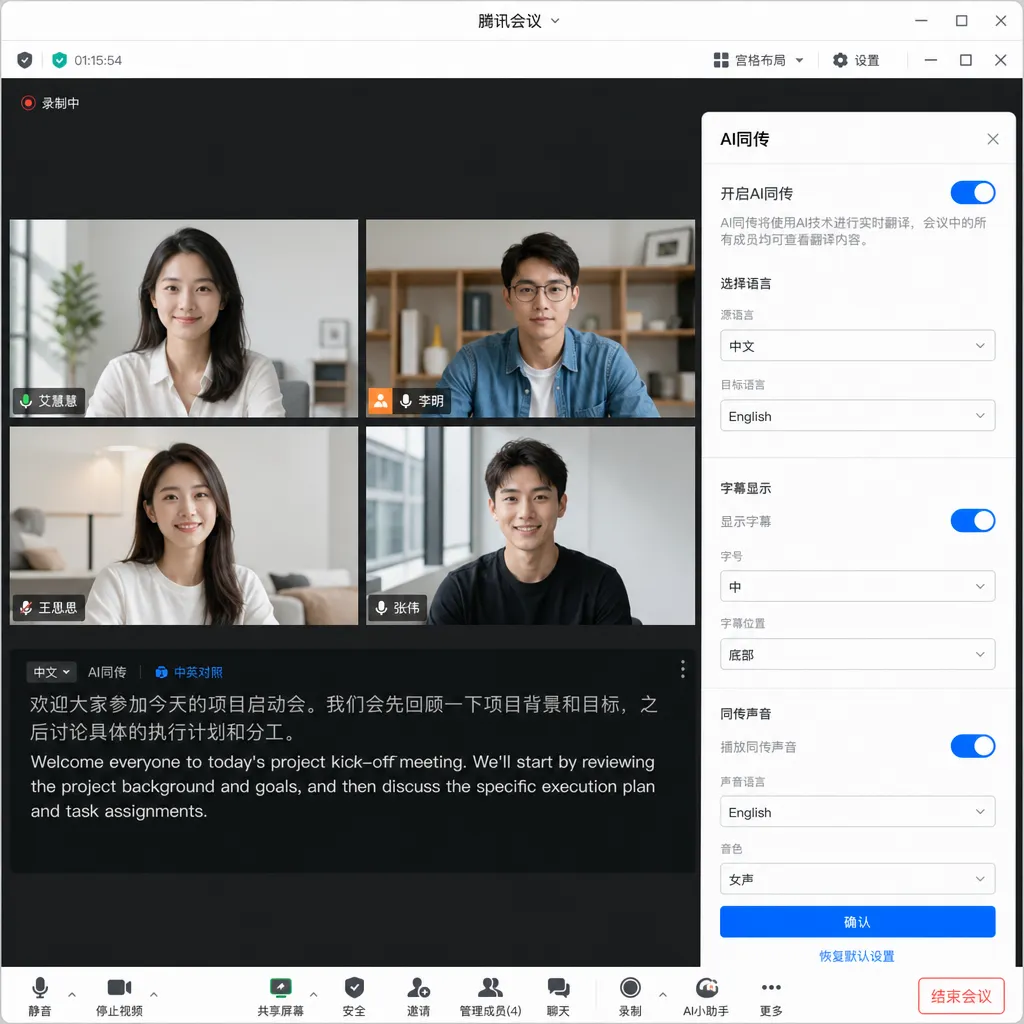
When “Imitate Your Voice” is enabled, the listener hears not a mechanical synthetic voice but one that sounds like you speaking fluently in another language. How this performs in real meeting scenarios remains to be seen, but from a product-positioning perspective, Tencent clearly aims to make cross-lingual communication feel as natural as native-language conversation.
The Technology Battle Behind the 3-Second Latency
Tencent Meeting claims that its “under 3 seconds” latency refers to the end-to-end delay — from when the speaker begins speaking to when the listener hears the translation. This is quite aggressive in the real-time interpretation field. Traditional human interpretation usually has a 5–10 second delay, and earlier AI-based solutions typically ranged from 8 to 15 seconds.
By comparison, Alibaba Tongyi Qianwen’s Qwen3.5-LiveTranslate-Flash, released yesterday, touts a 2.8-second “average per-character delay,” which may be a stricter metric — measuring the average latency per character instead of whole-sentence delay. Either way, both companies have reduced latency to below 3 seconds, signaling that real-time interpretation has entered the “high usability” phase.
Latency optimization for real-time interpretation is a systemic engineering challenge involving several key components:
- ASR Speed (Automatic Speech Recognition) – recognition must begin before the entire sentence is spoken
- Translation Model Response – translation must happen on the fly, not after full input
- TTS Streaming (Text-to-Speech) – synthesis should start as soon as partial results are ready
- Network Transmission – efficient encoding, decoding, and transfer of audio streams
As a mature conferencing product, Tencent Meeting has years of experience optimizing A/V transmission and network performance — the foundation for reducing latency to under 3 seconds. However, it has not disclosed details about its models or streaming strategies.
Voice Cloning: From “Understandable” to “Sounding Like You”
Voice cloning is another major highlight of this update. The biggest problem with traditional AI interpretation is the overly “robotic” sound — everyone’s translation uses the same synthetic voice, making it tiring to listen to and difficult to tell who’s speaking. Tencent Meeting’s solution captures the speaker’s vocal characteristics in real time and preserves them in translation.
This is especially useful in multi-speaker meetings. Imagine a session between a Chinese and U.S. team, each with five speakers. If every translation sounded identical, listeners would struggle to trace who’s talking. But if each translation retained the original speaker’s tone, both information clarity and communication efficiency would greatly improve.
Voice cloning itself, however, is not easy. Alibaba Tongyi employs “Dynamic Cross-Language Voice Cloning,” which captures and replicates timbre in real time. Tencent hasn’t revealed the details of its implementation, but based on its product description, it’s likely a similar real-time cloning scheme rather than relying on pre-recorded samples.
Adjustable Original Audio Volume: A “Safety Net” for Users
Tencent also added a thoughtful design touch: users can adjust the volume ratio between the interpreted audio and the original speech. This is highly practical.
In important business or technical meetings where accuracy of numbers or jargon is critical, keeping some original audio allows participants to cross-check the translation in real time. In everyday communication or training scenarios, the original audio can be muted altogether for smoother conversation flow.
Although simple, this feature shows a deep understanding of real-world needs. Even the best AI interpretation isn’t 100% error-free. Allowing users a safety option is both a sign of technical confidence and respect for user needs.
Unified Transcription and Subtitles: Four Dimensions in Parallel
Tencent Meeting has now fully integrated AI interpretation with its existing transcription and live subtitles. In a single cross-language meeting, participants can simultaneously enjoy:
- Hearable – real-time voice translation
- Translatable – multi-language mutual translation
- Visible – real-time subtitle display
- Recordable – full-text transcription
This integration gives each participant flexibility in how to receive information: those with hearing difficulties can read subtitles, those needing post-meeting summaries can export transcripts, and those wanting faster comprehension can simply listen.
From a product design perspective, Tencent Meeting is embedding AI deeply into the meeting workflow — not merely stacking features, but building a multimodal collaboration system.
Competing with Alibaba: Where Does Tencent Have the Edge?
Alibaba’s Qwen3.5-LiveTranslate shines with technical metrics: support for 60 input languages, 29 output audio languages, and 2.8-second average per-character delay. Tencent’s strengths, however, lie in product maturity and real-world application.
First, Tencent Meeting has a massive enterprise user base. Public data shows over 30 million daily active users across diverse industries. Because AI interpretation is built right into the product, users don’t need to switch tools or integrate APIs — it’s instantly available in any meeting.
Second, Tencent’s advantage in audio-video technology is deep. Real-time interpretation isn’t just about models; it involves complex engineering challenges like network transmission, audio processing, and multi-user concurrency. Tencent Meeting has already handled tens of millions of concurrent users during the pandemic — experience that pure model vendors can’t easily replicate.
Third, Tencent’s commercialization path is clearer. Enterprise users are more willing to pay for enhanced conferencing features than for standalone AI model APIs. Bundling AI interpretation as a premium feature within enterprise plans simplifies monetization.
Of course, Alibaba’s edge lies in the openness of its model capabilities. Qwen3.5-LiveTranslate can be integrated into diverse ecosystems — live streaming, online education, smart hardware (like AI glasses). Tencent Meeting’s interpretation, by contrast, is currently confined to its own ecosystem, limiting openness for now.
The Next Step for Real-Time Interpretation: Beyond Meetings
The nearly simultaneous announcements from Tencent and Alibaba signal that this market is moving from technical validation toward scaled deployment.
Technologically, real-time interpretation has already solved three core issues:
- Latency – reduced from 10 seconds to under 3, approaching human performance
- Language Coverage – expanded from a few dominant languages to dozens
- Voice Naturalness – from robotic synthesis to human-like timbre
The next phase of competition will focus on several fronts:
Accuracy Improvement – especially for technical jargon, industry lingo, and regional accents. Current AI interpretation performs well in standard Mandarin and English but struggles with dialects or specialized domains.
Contextual Understanding – meetings are full of references and implicit meaning. AI must understand the context across turns, not just translate sentence by sentence.
Multi-Speaker Handling – in real meetings, people interrupt and overlap frequently. AI needs to detect speakers accurately, handle overlapping speech, and maintain conversational coherence.
Scenario Expansion – extending beyond meetings to livestreaming, education, customer service, healthcare, and more, each requiring unique optimizations for latency, accuracy, and voice style.
Tencent Meeting’s launch marks a turning point as real-time interpretation moves from lab demos to large-scale commercialization. Yet human interpreters remain irreplaceable in high-risk scenarios like diplomacy or legal proceedings. For now, AI interpretation fits best for daily communication or general meetings.
How to Use Tencent Meeting AI Interpretation
Using it is straightforward:
- Join a Tencent Meeting and click the “Apps” button in the toolbar
- Find “AI Interpretation” in the app list and enable it
- Click the “Interpreting” icon at the top to access settings
- Choose your listening language, enable or disable voice imitation, and adjust volume balance between the original and interpreted voices
Note that the official list of supported languages, potential pricing, and network bandwidth requirements have not yet been disclosed. These details may appear later in product documentation.
Based on Tencent’s release cadence, it will likely soft-launch with select enterprise clients first to gather feedback before a full rollout. Since translation errors in cross-language communication can have serious consequences, the team is treading carefully.
Final Thoughts
The launch of Tencent Meeting’s AI Simultaneous Interpretation marks a major milestone for the commercialization of real-time interpretation technology in China. It shows that AI interpretation has progressed from “usable” to “practical”, with latency, audio quality, and usability reaching mass adoption levels.
More importantly, the head-to-head competition with Alibaba will accelerate industry-wide iteration. As both drive latency below 3 seconds, adopt voice cloning, and expand language coverage, the next battleground will be deeper technical capability — context comprehension, domain adaptation, and multimodal integration.
For developers, this means APIs and SDKs for real-time interpretation will mature rapidly, reducing integration costs. For enterprises, it means significantly lower barriers to cross-lingual collaboration and higher communication efficiency for global teams.
The real-time interpretation race has only just begun.
References
- Tencent Meeting "AI Interpretation" Feature Launch: Voice Imitation and Latency Under 3 Seconds - ITHome – Official release information for Tencent Meeting’s AI Interpretation
- AI Interpretation with 2.8-Second Latency: Alibaba Tongyi Qianwen Releases Real-Time Translation Model Qwen3.5-LiveTranslate - ITHome – Technical details and comparison data for Alibaba Tongyi Qianwen’s model


