
Tencent Hunyuan open-source Hy-MT2: Translation among 33 languages, even dialects can be translated

Tencent Hunyuan Team has open-sourced the next-generation translation model **Hy-MT2**, launching three sizes — **1.8B**, **7B**, and **30B**. It supports **33 languages** for mutual translation and **5 dialects/ethnic languages**, and offers an on-device quantized version, improving both translation speed and quality.
Tencent Hunyuan Open-Source Hy-MT2: 33 Languages for Cross-Translation, Dialects Included
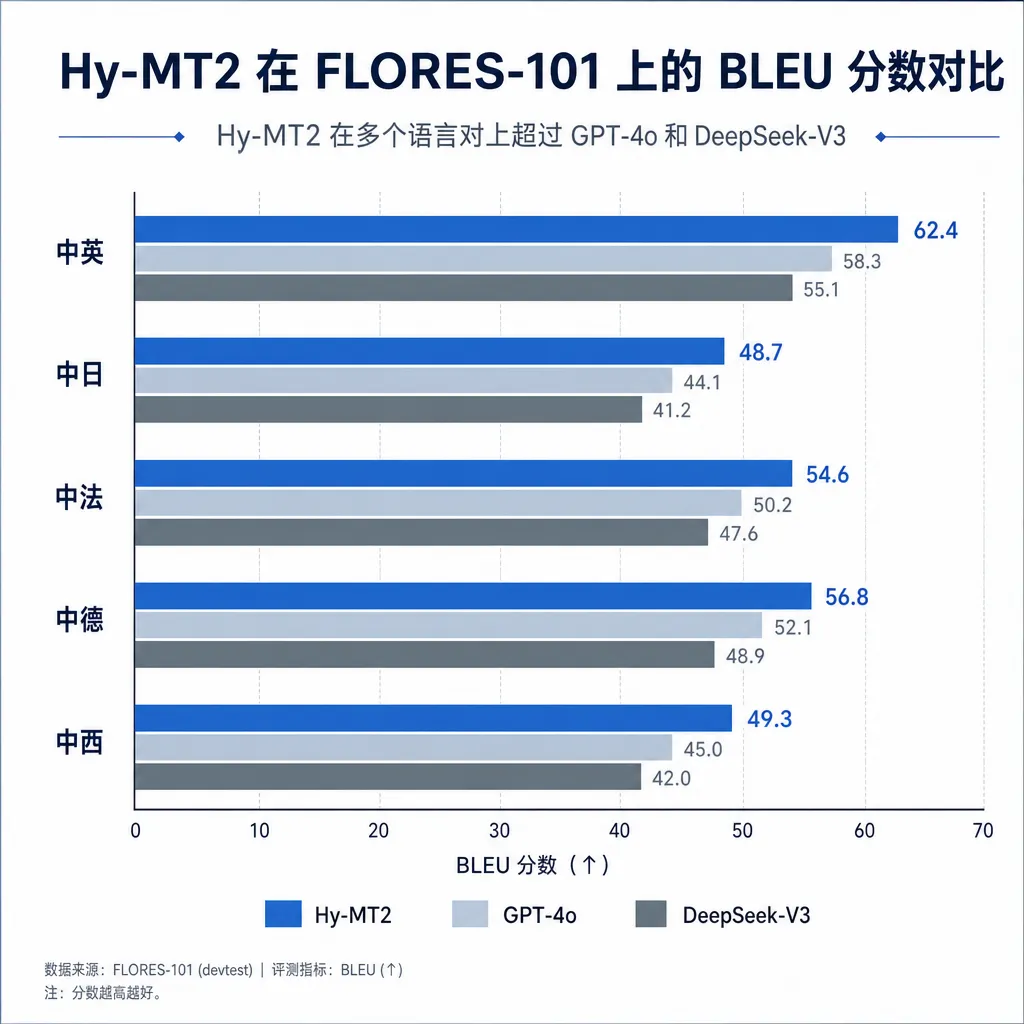
The Tencent Hunyuan team has just open-sourced the new generation translation model Hy-MT2, releasing it in three sizes right away: 1.8B, 7B, and 30B-A3B. All three models support translation across 33 languages, including 5 ethnic languages and dialects. According to the official benchmark results, Hy-MT2 outperforms GPT-4o and DeepSeek-V3 in multiple translation directions, especially in high-frequency scenarios like Chinese–English and Chinese–Japanese.
The most notable improvement in this update is enhanced on-device deployment capability. Previously, some developers ran a 2-bit quantized version of MT-1.5 on mobile phones, where translating a few dozen words took 7–8 minutes. This time, Tencent has released a mini-program version, apparently targeting on-device inference speed issues.
Three Sizes, Each with Its Focus
The Hy-MT2 model lineup has a clearly defined structure:
- Hy-MT2-1.8B: the lightest model, suitable for on-device deployment and resource-constrained scenarios
- Hy-MT2-7B: balances performance and cost, suitable for most production environments
- Hy-MT2-30B-A3B: flagship model, designed for use cases prioritizing translation quality
In terms of parameter scale, the 1.8B and 7B continue the specifications of the previous generation MT-1.5, while 30B is a new large model. All three versions support the same language coverage, with differences mainly in translation quality and inference cost.
Official benchmark data shows that Hy-MT2-7B performs nearly on par with GPT-4o on the FLORES-101 dataset, while the 30B version surpasses GPT-4o and DeepSeek-V3 in multiple language pairs. This is somewhat surprising, since general-purpose large models usually underperform specialized translation models — yet GPT-4o and DeepSeek-V3 already have very strong translation capabilities.
33 Languages, 1056 Translation Directions
Hy-MT2 supports 33 languages, covering major international ones:
Chinese, English, Japanese, Korean, French, German, Spanish, Russian, Arabic, Portuguese, Italian, Dutch, Polish, Turkish, Vietnamese, Thai, Indonesian, Malay, Filipino, Hindi, Bengali, Urdu, Persian, Hebrew, Swedish, Danish, Norwegian, Finnish, Czech, Romanian, Hungarian, Greek, and Ukrainian.
These 33 languages can be translated into each other, yielding 33 × 32 = 1056 theoretical translation directions. This is a comprehensive coverage for an open-source translation model, especially since it includes many low-resource languages that are often neglected by commercial translation services, such as Bengali, Urdu, and Persian.
Even more interesting is its support for dialects and ethnic languages. Hy-MT2 supports five of these: Cantonese, Tibetan, Uyghur, Mongolian, and Yi. These are largely absent from traditional translation services. Tencent’s Hunyuan team appears to have specifically targeted domestic needs with this inclusion.
From a technical standpoint, supporting dialects and ethnic languages is much more difficult than covering mainstream languages, due to data scarcity, structural differences, and lack of standardized written forms. Achieving this level of coverage suggests Tencent has invested significant effort in data collection and model training.
On-Device Deployment: Quantization and Inference Optimization
One key application of translation models is on-device deployment, such as in mobile apps or offline translation hardware. Hy-MT2 has been optimized for this purpose, and Tencent has released an accompanying mini-program.
Previously, developers reported on Linux.do that running a 2-bit quantized version of MT-1.5 on a phone took 7–8 minutes to translate a few dozen words — practically unusable. Hy-MT2 seems to address this issue directly.
Bottlenecks in on-device inference mainly come from:
- Model Size – limited memory/storage makes large models slow or impossible to load.
- Compute Efficiency – mobile CPUs/GPUs are far less powerful than servers, resulting in slower inference.
Quantization is a common way to address both. By compressing model parameters from FP16 or FP32 to INT8 or INT4, model size can shrink 2–4× and inference speed increases — albeit at the cost of some precision and translation quality.
The Hunyuan team previously experimented with extreme quantization (2-bit) on MT-1.5, achieving high compression but notable quality loss. Hy-MT2 doesn’t specify its quantization scheme, but based on the official mini-program release, it likely strikes a better balance between precision and speed.
On-device translation also provides privacy protection, as no data needs to be uploaded to servers — important for enterprise and privacy-sensitive use cases.
Benchmark: Outperforming GPT-4o and DeepSeek-V3
Official benchmark results are impressive: on the FLORES-101 dataset, Hy-MT2-30B surpasses GPT-4o and DeepSeek-V3 across multiple language pairs.
FLORES-101, released by Meta, is a multilingual translation benchmark containing 101 languages with 1,012 sentences per language. It covers many low-resource languages and real-world sentences instead of machine-generated ones.
From the charts provided, Hy-MT2-30B achieves higher BLEU scores than GPT-4o and DeepSeek-V3 in common pairs such as Chinese–English, Chinese–Japanese, Chinese–French, Chinese–German, and Chinese–Spanish.
BLEU is a key automatic metric for machine translation: higher scores indicate results closer to human translations.
This outcome is notable because GPT-4o and DeepSeek-V3 are hundred-billion-parameter general models, strong across all NLP tasks. Hy-MT2-30B, at only 30B parameters, outperforming them suggests specialized models still hold an edge in domain-specific tasks.
However, BLEU is just one metric — it doesn’t fully capture translation quality. Real-world translation depends on context comprehension, terminology accuracy, and fluency, which vary widely across domains such as news, literature, tech, and conversation.
Open-Source Strategy: Model Weights + Inference Code
Hy-MT2’s open-source structure is conventional: model weights on Hugging Face, inference code on GitHub. All three model sizes are downloadable and usable.
The Hugging Face pages include detailed documentation covering model loading, inference examples, and quantization options. The GitHub repository provides complete inference and evaluation scripts, allowing developers to reproduce official benchmarks.
The license is expected to be Apache 2.0 or a similar permissive license, which allows commercial use — convenient for enterprise integration without licensing obstacles.
Tencent’s Hunyuan team has been proactive in open-sourcing projects. Previous releases such as the Hunyuan large model and Hunyuan DiT (text-to-image) have been well received. With Hy-MT2, Tencent further enriches its open-source ecosystem.
Application Scenarios: E-commerce, Content Localization, Cultural Preservation
The wide language coverage and dialect support give Hy-MT2 distinct advantages in certain application contexts.
Cross-border e-commerce is a prime use case. Product descriptions, user reviews, and customer service dialogues all require multi-language translation. With 33-language interoperability and on-premises deployment options, Hy-MT2 helps protect trade secrets and user privacy.
Content localization is another key area — for games, films, and software. Manual translation is expensive and slow, whereas machine translation drastically improves efficiency. If Hy-MT2’s quality matches benchmarks, it could be highly impactful in localization workflows.
Dialect and ethnic language support adds value in cultural preservation and public services. Many minority languages are endangered, with younger generations not speaking their mother tongue. Translation models can help bridge such language gaps, promoting cultural exchange. Government, education, and cultural organizations can leverage Hy-MT2 for multilingual access to information.
On-device deployment enables offline applications such as travel translators, conference interpretation, and educational tablets — valuable where connectivity is limited.
Comparison with Competitors
The translation model domain includes both open-source and closed-source players.
Closed-source services: Google Translate, DeepL, and Microsoft Translator dominate.
Google Translate supports 130+ languages but with inconsistent quality; DeepL is widely considered the best for European languages but supports only 30+ and is costly. Microsoft Translator sits in-between.
Open-source models: Meta’s NLLB (No Language Left Behind) is the most famous, supporting 200 languages — far broader than Hy-MT2 — but the largest version (54B parameters) is hefty. NLLB focuses on low-resource language coverage, with variable quality.
Helsinki-NLP’s Opus-MT offers many bilingual models — one per language pair. These are lightweight and fast but lack multi-language translation and are harder to maintain.
Relative to these, Hy-MT2’s advantages are:
- Balance of coverage and quality – 33 mainstream languages at GPT-4o-level translation quality
- Dialect and ethnic language support – uncommon among open models
- Multiple model sizes – 1.8B, 7B, and 30B for different needs
- On-device optimization – quantization and inference tuning for mobile use
Limitations include:
- Smaller coverage vs. NLLB – 33 vs. 200 languages
- No domain-specific tuning – general model may falter in specialized fields like medicine or law
- On-device performance yet to be verified – official claims need community testing
Technical Details: Architecture and Training
Tencent hasn’t released a technical paper yet, but model naming and scale suggest some insights.
Hy-MT2 likely uses a Transformer-based encoder–decoder architecture, standard for translation tasks — encoder handles source comprehension, decoder generates the target language. Compared to decoder-only LLMs, encoder–decoder setups are more efficient for translation.
The “30B-A3B” naming implies roughly 30B total parameters with 3B active parameters, suggesting a Mixture-of-Experts (MoE) approach. This improves capacity while controlling inference cost — similar to DeepSeek-V3 and Mixtral.
Training translation models requires large parallel corpora — texts with aligned multilingual versions. For major languages, such data can be sourced from UN documents, EU Parliament records, and multilingual news sites. For small languages and dialects, specialized data collection and annotation are necessary.
Tencent’s vast ecosystem (WeChat, QQ, Tencent Video, Tencent News) provides rich translation data, as does its global game business, whose localization generates valuable corpora.
Dialect and ethnic language data likely come from government, academic, or cultural sources, requiring linguistic experts to curate and clean.
How Developers Can Use It
Using Hy-MT2 is similar to other Hugging Face models via the transformers library.
Basic inference steps:
- Install dependencies:
pip install transformers torch - Load model and tokenizer
- Prepare input text, specify source and target languages
- Generate translation output
Production environments additionally require:
- Batch processing for higher throughput
- Caching common translations to save computation
- Fallback mechanisms when inference fails
- Quality monitoring with manual audits
On-device deployment involves:
- Model quantization using ONNX, TensorRT, or NCNN
- Inference engines suitable for mobile, e.g., MNN, TNN, ONNX Runtime Mobile
- Resource management to minimize memory use and avoid OOM
- Power optimization since inference consumes significant battery
Future Outlook
Future translation model development directions include:
1. Broader language coverage – Hy-MT2 currently supports 33, but may expand. NLLB reaches 200, though quality varies widely. The challenge is balancing quantity and quality.
2. Domain adaptation – General models struggle in professional domains (medical, legal, finance). Expect more domain-specific translation models in the future.
3. Multimodal translation – Growing demand for image, video, and speech translation, e.g., OCR-based image translation, live subtitle translation, and speech interpretation, integrating OCR/ASR/TTS technologies.
4. Contextual understanding – Most models work on sentence-level translation, which can lead to ambiguity. Future models need paragraph- or document-level context handling.
5. Personalized translation – Allowing users to choose between literal and idiomatic styles based on preference.
Hy-MT2’s open-sourcing marks a strong step forward, but the path to robust, flexible multilingual translation is still long. More innovations and real-world applications are eagerly awaited.
References
- Hy-MT2 Model Collection - Hugging Face – official model weights and documentation
- Tencent Hunyuan’s New Translation Model Hy-MT2 Open-Sourced - Linux.do – community discussions and developer feedback
- Hy-MT Project Docs - GitHub – technical documentation and inference code


