
Multi-Stream LLM: A New Parallel Inference Architecture That Breaks the Single-Stream Bottleneck
Institutions such as Stanford have proposed a **Multi-Stream LLM** architecture, which separates prompts, reasoning, and input/output into parallel streams. This approach breaks through the computational bottleneck of traditional single-stream LLMs, achieving several-fold improvements in reasoning efficiency in agent scenarios while also enhancing security isolation capabilities.
Multi-Stream LLM: A New Parallel Inference Architecture Breaking the Single-Stream Bottleneck
The performance bottleneck in large model inference has always been an old problem. From KV cache optimization to FlashAttention, the industry has already pushed the single-stream architecture to its limits. But researchers from Stanford, MIT, and Anthropic have recently taken a new approach: if the single stream is the bottleneck, then don’t run everything on one track.
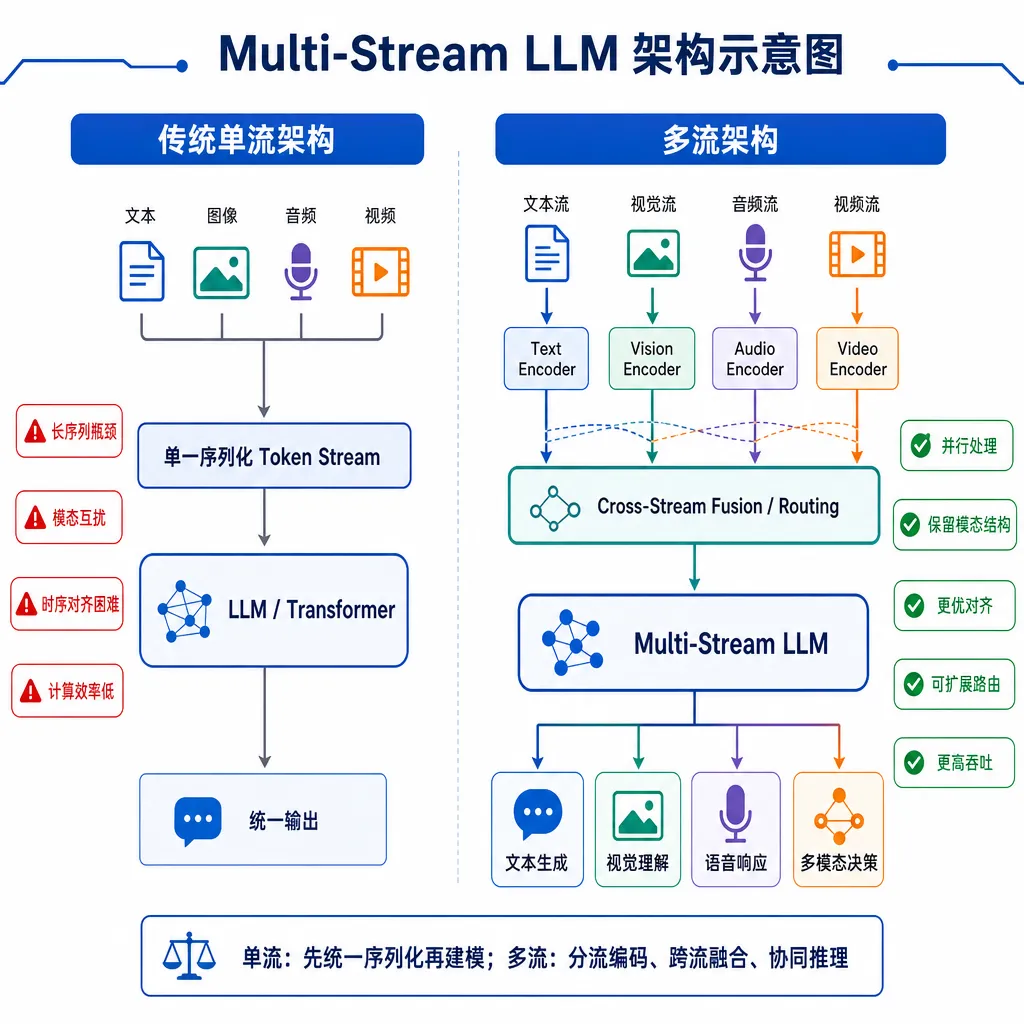
The paper released on May 13, “Multi-Stream LLMs: Unblocking Language Models with Parallel Streams of Thoughts, Inputs, and Outputs,” proposes a completely new multi-stream architecture that splits the traditional LLM’s single token sequence into several parallel streams—prompt stream, thought stream, input stream, and output stream—each running independently and without blocking one another. This isn’t a simple engineering tweak; it’s a complete rethinking of the LLM computation paradigm at the architectural level.
The Fundamental Problem of Single-Stream Architecture
Existing LLMs are essentially autoregressive models that generate tokens in a sequential queue. This works fine for pure text generation, but once you involve Agent applications—which must handle user inputs, tool calls, internal reasoning, and output generation simultaneously—the single-stream architecture becomes a disaster.
Consider a real scenario: You ask an Agent to analyze a financial report. It needs to:
- Read the uploaded PDF (input stream)
- Call computation tools to process the data (tool invocation)
- Reason internally and analyze trends (thought stream)
- Generate a readable report (output stream)
In traditional architecture, these steps must execute serially. When the Agent waits for a tool’s result, the entire reasoning process halts; when it’s generating text, it can’t take new user instructions. More critically, all content—including sensitive internal reasoning, tool parameters, and user data—is mixed in the same token sequence, which is neither secure nor efficient.
This isn’t an implementation problem—it’s a fundamental architectural limitation. The single-stream design inherently assumes all computations are linearly dependent, but in Agent scenarios, many operations could be executed in parallel.
The Core Design of Multi-Stream
The Multi-Stream LLM concept is simple: since different types of content have different computational characteristics and security requirements, physically separate them. The paper proposes four independent streams:
1. Prompt Stream
Stores system prompts, few-shot examples, and other static context. This content is usually long but infrequently updated, so its KV cache can be precomputed and reused across inferences. In traditional architectures, these tokens are reprocessed every time; Multi-Stream isolates and caches them to avoid redundant computation.
2. Thought Stream
Represents the model’s internal reasoning process, similar to Chain-of-Thought intermediate steps. This content is invisible to users and shouldn’t slow down output generation. Multi-Stream allows thought streams to run asynchronously—the model can think while generating output, instead of waiting to finish reasoning first.
3. Input Stream
Handles real-time user inputs, tool results, and external data sources. This data can arrive at any time; traditionally the model must finish current generation before handling new input. Multi-Stream lets the input stream update independently so the model can respond to new events mid-generation.
4. Output Stream
Produces the final user-facing output. It’s the only stream that requires strict autoregressive generation, but it’s no longer blocked by others. The model can generate output while processing new input data or planning the next step in the thought stream.
These streams share underlying representations within the Transformer but are logically isolated using attention masks and stream tokens. Each stream has its own KV cache that can be updated independently.
Key Technical Aspects
Switching from single-stream to multi-stream is not just splitting token sequences—it requires solving several core challenges:
Inter-stream Communication Mechanism
Although the streams compute independently, they still need to exchange information. For example, reasoning results from the thought stream must influence the output stream, and new data in the input stream should trigger updates in the thought stream. Multi-Stream achieves this via specialized cross-stream attention: each stream can selectively attend to others without blocking generation.
This design is clever. Traditional attention is global—every token can see each other. In Multi-Stream, the attention mask is block-structured—each stream can only see itself and explicitly allowed streams. This ensures necessary information flow without unnecessary dependency.
Dynamic Stream Scheduling
Not all streams need computation at all times. When there’s no new user input, the input stream can sleep; when internal reasoning isn’t required, the thought stream can pause. Multi-Stream implements dynamic scheduling to allocate compute resources based on each stream’s active state.
This greatly improves efficiency. In traditional architectures, GPUs idle or generate meaningless padding tokens while waiting for input. Multi-Stream focuses resources on active streams—idle streams don’t consume GPU cycles.
Stream-level Security Isolation
Separating thought and output streams brings security benefits. The model’s internal reasoning—which may include sensitive intermediate results, tool parameters, or user data analysis—won’t leak into the output stream. Even if an attacker observes the output, they can’t infer the thought stream’s contents.
That’s critical for enterprise use. Many applications handle sensitive data (financial, medical, codebases) that must be sanitized before output. Traditionally, this is handled with prompt engineering or post-processing filters; Multi-Stream ensures isolation by design.
Performance: More Than a Theoretical Advantage
The paper tested Multi-Stream architecture on several Agent benchmarks, yielding solid results:
Inference latency reduced by 40–60%
For tasks requiring frequent tool calls (e.g., WebShop, ALFWorld), Multi-Stream’s end-to-end latency was 40–60% lower than traditional setups. Gains came from parallel handling of input/thought streams and prompt cache reuse.
These improvements come not from faster hardware or aggressive quantization but smarter compute organization—the same model, same hardware, just a new inference architecture.
Throughput increased 2–3×
In multi-user concurrent scenarios, throughput improvements are even more significant, since different user requests can share prompt stream caches while computing independently for input/output streams. Traditional architectures cannot reuse any computation.
This is attractive for API providers: the same GPU cluster can serve more concurrent users, reducing per-query cost.
Memory usage reduced by ~30%
Prompt stream cache reuse and dynamic scheduling reduce redundant computation, lowering peak memory usage by around 30%. This allows larger batch sizes or longer contexts with the same GPU memory.
Limitations: Not a Silver Bullet
The multi-stream architecture has trade-offs. The paper openly acknowledges several issues:
Increased Training Complexity
Multi-Stream models must learn coordination among streams, which is more complex than single-stream training. The paper uses two stages: pretrain on single-stream data, then fine-tune on multi-stream data. However, constructing multi-stream datasets is challenging—existing corpora are single-stream, requiring manual or heuristic splitting.
This may slow adoption. Without large multi-stream datasets, training high-quality models from scratch is difficult. A more practical route is converting existing models, but that demands extensive fine-tuning.
Not All Tasks Benefit
For pure text generation (writing, translation, summarization), Multi-Stream offers little advantage. Those tasks are inherently linear with limited parallelization opportunities. The architecture may even introduce scheduling overhead, potentially making it slower.
Multi-Stream’s value shines in Agent scenarios—handling diverse inputs, complex reasoning, and structured outputs. For simple Q&A or text creation, the single-stream model may remain optimal.
Engineering Challenges
Multi-Stream puts higher demands on inference engines. Existing frameworks (vLLM, TensorRT-LLM, SGLang) are built for single-stream operation. Supporting Multi-Stream requires extensive low-level refactoring: inter-stream communication, dynamic scheduling, cache management, etc.
The paper offers a prototype, but it’s not production-ready. Near-term, Multi-Stream is likely to remain a research prototype rather than being integrated into mainstream systems.
Implications for the Industry
Multi-Stream LLM isn’t just a new architecture—it introduces a new way of thinking: inference paradigms need not mirror training paradigms.
Current inference processing is essentially a reflection of training—tokens are generated the same way they were fed during training. But training optimizes for model capability; inference optimizes for efficiency. Copying the training paradigm leads to mismatches.
Multi-Stream demonstrates that rearchitecting inference—without changing model capability—can deliver substantial performance gains. This approach can inspire other directions:
- Heterogeneous inference: Use different decoding strategies for different token types (text, code, structured data).
- Layered inference: Split reasoning into planning, execution, and verification layers, each optimized independently.
- Speculative inference: Use small models to generate candidates and large models to verify them in parallel rather than serially.
All these approaches explore the same question: how to make inference more efficient, flexible, and secure without compromising capability. Multi-Stream offers one concrete answer—but surely not the only one.
Opportunities for Open-Source Models
Interestingly, the Multi-Stream architecture may favor open-source models.
Closed-source models (GPT, Claude, Gemini) have opaque inference architectures—users interact through APIs and can’t control internal computation. Even if those models use Multi-Stream internally, users can’t perceive or customize it.
Open-source models differ. If Llama, Qwen, DeepSeek, etc., adopt Multi-Stream and release inference code, developers could tailor stream partitioning and scheduling for their applications. For example:
- RAG systems could place retrieved results into a separate input stream to avoid blocking generation.
- Code Agents could use a feedback stream for execution results, enabling "write-while-test" workflows.
- Multimodal apps could assign image, audio, and text streams independently for parallel handling.
Such flexibility is something closed APIs can’t offer. Multi-Stream may become an open-source differentiator—not by improving model capability, but by making inference architecture more open and customizable.
Of course, this demands significant development in open inference engines. Currently, frameworks like vLLM and TGI remain single-stream. Adding Multi-Stream support requires major work—but if the value is proven, the open community tends to move fast.
Final Thoughts
Multi-Stream LLMs aren’t a flashy breakthrough; they’re a pragmatic engineering innovation—identifying an architectural bottleneck and delivering a well-reasoned, experimentally validated solution.
But pragmatic innovations often have deeper long-term impact. FlashAttention, KV cache, and speculative decoding are similar examples—without changing the model itself, they made inference dramatically more efficient and affordable.
Will Multi-Stream become the next FlashAttention? It’s too early to tell. But it already shows that optimization space in LLM inference is far from exhausted—architectural innovation remains very promising.
For developers, this is a direction worth tracking. Even if you don’t adopt Multi-Stream soon, understanding its design can help improve existing Agent applications—knowing what can run in parallel, what data can be reused, and what processes can be asynchronous. These same questions exist in single-stream setups; Multi-Stream simply provides a systematic way to address them.
It offers a structured framework; now we’ll see if engineering can catch up.
References
- Multi-Stream LLMs Paper – Original paper jointly released by Stanford, MIT, and Anthropic
- Reddit Discussion – Technical discussion of the Multi-Stream architecture
- Hugging Face Discussions – Open-source community exploration of multi-stream implementation


