
Delta Attention Residuals: Upgraded the residual connections once

Researchers proposed Delta Attention Residuals, which switch cross-layer attention routing from redundant cumulative hidden states to the incremental contributions of each sublayer. At the 7.6B scale, this approach achieved an 8.2% reduction in PPL, addressing the deep-layer routing collapse problem.
This Old Friend, the Residual Connection, Gets a Makeover
On May 24, a post on r/MachineLearning drew considerable attention: Delta Attention Residuals, a mechanism claiming it can plug-and-play replace the Transformer residual connection. The researchers positioned it as a “drop-in upgrade,” testing from 220M up to 7.6B parameters, with validation set PPL steadily dropping by 1.7% to 8.2%.
The number isn’t earth‑shattering today, but it points toward an old, repeatedly attempted yet never successfully scaled problem in large models: routing collapse in cross‑layer attention. In other words, past methods trying to make deep networks “look back” at shallow‑layer information fail as soon as the size gets large. Delta Attention Residuals offer quite an elegant solution—not by changing the router, but by changing what’s being routed.
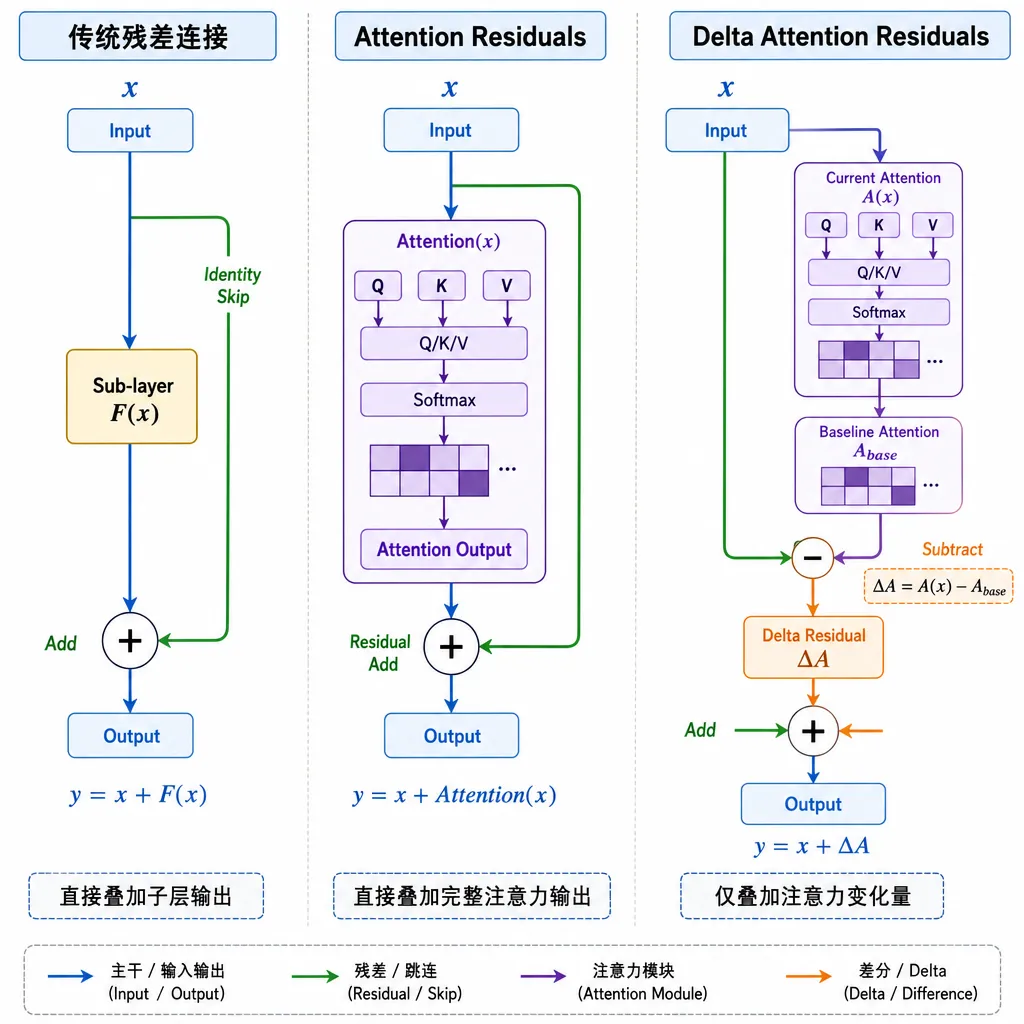
Let’s Review Where the Problem Lies
A standard Transformer residual connection looks like this:
h_{i+1} = h_i + Sublayer(h_i)
Each layer adds its own computed output back into the main path, a legacy from the 2015 ResNet—simple, brute‑force, but effective. The problem is that in deep Transformers, each layer can only “see” the output h_i from the previous layer; the fine‑grained syntactic and morphological information from shallow layers has already been diluted through multiple additions.
This led to works like Attention Residuals, whose idea is to give each layer a small attention module so it can perform weighted selection over all past hidden states {h_0, h_1, ..., h_i} rather than just receiving h_i. Sounds reasonable—you can look at whichever layer you want, and the router learns it.
But actually running it brings problems: high redundancy among accumulated hidden states.
This should have been noticed long ago. Residual connections are fundamentally additive—h_5 contains all accumulated contributions from h_0 to h_4, then h_6 contains h_5. These vectors are extremely close to each other in representation space, with frighteningly high cosine similarity. When a softmax router tries to select from a bunch of nearly identical vectors, the result can only be—giving up—weights flatten to near‑uniform distribution.
The numbers in the paper are straightforward: in deep layers, standard Attention Residuals’ max attention weight is only about 0.2. For a router that’s supposed to “choose,” this means it didn’t choose at all. This is the so‑called routing collapse. Worse, when scaling up, the mechanism not only fails to help but can perform worse than baseline—on 7.6B, PPL is 18.58, while plain residuals achieve 17.43.
Delta’s Core Idea: Route “Contributions” Instead of “States”
The authors’ starting point is simple: since h_i are highly redundant, don’t route h_i—route their differences.
v_i = h_{i+1} - h_i
This v_i is what the i‑th sublayer actually contributed, a discrete differentiation of the accumulation. Compared to h_i as a state quantity, v_i is an incremental quantity, structurally inherently distinct—an attention layer’s contribution direction differs from that of an FFN layer, and shallow vs. deep layer contributions differ in semantic levels.
An imprecise analogy: originally the router got a pile of “account balances,” each looking similar; now it gets “monthly transactions,” where ins/outs are clear. If you have to choose which balance is most worth referencing, you’re guessing; if you choose from transactions, you instantly know what happened.
The effect is immediate:
- Deep‑layer max attention weight rises from ~0.2 to ~0.6
- Average max weight increases from 0.35 to 0.62
- Routing distribution sharpness increases by about 1.8×
This means the router is actually making selections, instead of averaging across all past layers.
Data Speaks: Scale Curve From 220M to 7.6B
What’s truly noteworthy here is the scaling experiments. In recent years, the AI world has been full of “works on small models, collapses on large” stories; cross‑layer attention is a typical casualty. The authors fully loaded the control groups:
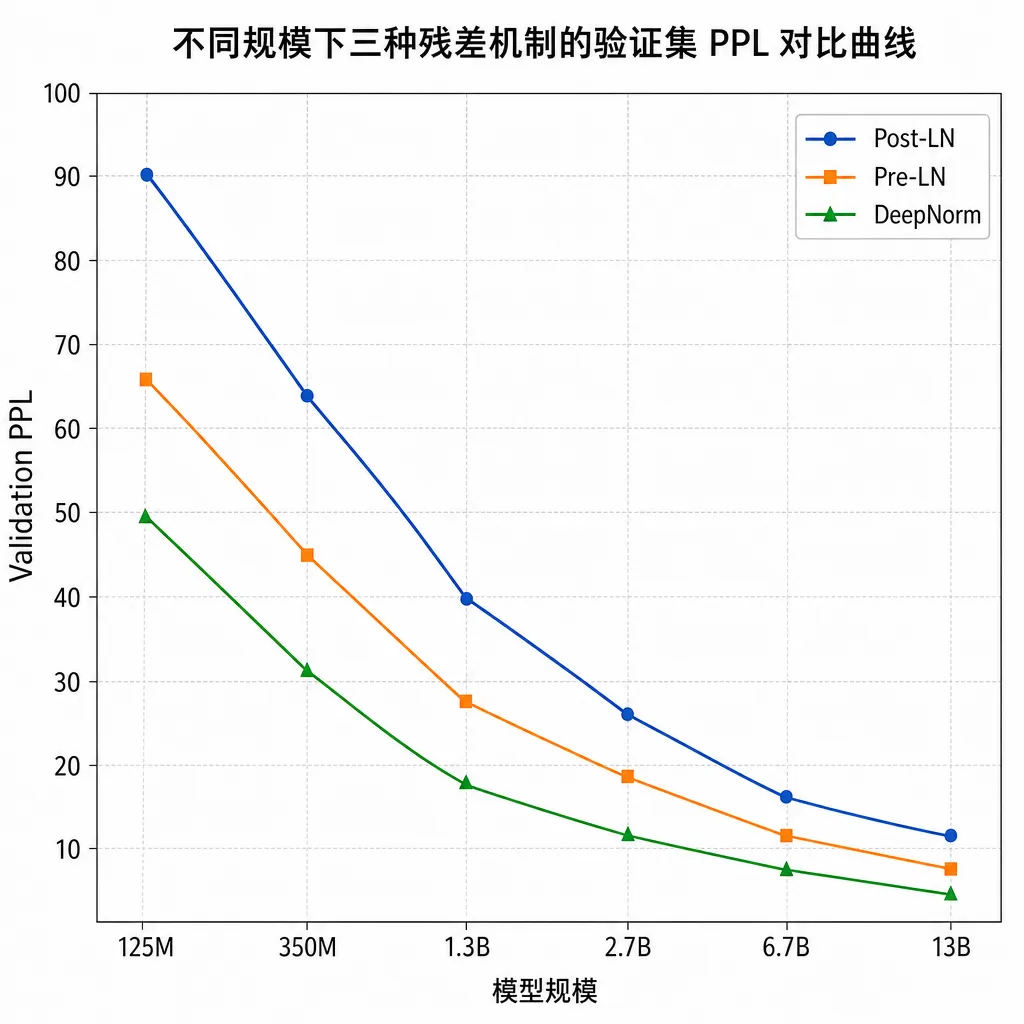
| Scale | Standard Residual PPL | Attention Residuals PPL | Delta Attention Residuals PPL | |-------|-----------------------|--------------------------|-------------------------------| | 220M | Baseline | Slightly better | -1.7% ~ -3% | | 1B+ | Baseline | Tied or slightly worse | Steadily better than baseline | | 7.6B | 17.43 | 18.58 (actually worse) | -8.2% (best) |
This curve tells two things.
First, Attention Residuals on large models are not only useless but harmful—this isn’t experimental error, it’s the inevitable result of routing collapse at scale: router dimension grows, depth deepens, redundancy worsens exponentially. Second, Delta’s advantage scales with size. An 8.2% drop in PPL at 7.6B isn’t small—under the same training token count, the model’s language modeling capability truly steps up.
Implementation Cost: Almost Zero
According to the authors, Delta Attention Residuals are “drop‑in”—you don’t need to change the architecture, just add a lightweight routing module between each layer, switching input from {h_0, ..., h_i} to {v_0, ..., v_{i-1}}. Rough pseudocode:
# Standard residual
h_next = h + sublayer(h)

# Delta Attention Residuals
v_i = h_next - h          # delta of current sublayer
deltas.append(v_i)        # accumulate historical deltas
routed = attention_route(deltas, query=h_next)  # route over deltas
h_next = h_next + routed  # add routing result back to main path
The additional state to store is the historical delta sequence; memory cost is similar to storing accumulated hidden states—actually lower, since you no longer need h_0, only differences. Compute cost mainly comes from the router’s attention calculations; authors say this is negligible relative to total FLOPs.
On training, no special tricks—no warm‑up tricks, no auxiliary loss—just insert the module and start. This is much friendlier than many schemes needing complex training schedules.
Why This Matters
Beyond the numbers, some judgments.
First, it reopens an old topic as an open problem. Cross‑layer connections were researched thoroughly in DenseNet days; in recent years many thought Transformer residual structures were fixed and not worth tinkering with. Delta’s results show there’s room to dig here, and the gain isn’t some mystical 0.5%—it’s a solid ~8%.
Second, it provides new experimental basis for “how information flows inside a Transformer.” Raising routing weight from 0.2 to 0.6 means the model is indeed “selecting” historical layers—a point explainability researchers will care about. Which deltas are frequently selected? Early syntactic ones, or mid‑level semantic ones? These are worthwhile follow‑up questions.
Third, it’s orthogonal to directions like MoE and KV cache optimization. You can use Delta Residuals in an MoE model, and stack variations like GQA, MLA. This orthogonality means it might quickly be absorbed into next‑gen open‑source large model architectures.
To pour some cold water—currently public experiments mainly show PPL; downstream benchmarks (MMLU, HellaSwag, coding tasks, etc.) haven’t been fully disclosed yet. PPL reduction doesn’t strictly map linearly to downstream capability, especially after instruction‑tuning and RLHF—the PPL advantage from pretraining may be partially washed out. Also, 7.6B isn’t truly “big‑model” era—whether the linear scaling advantage holds at 30B, 70B remains to be verified with more compute.
What It Means for Developers
If you’re doing pretraining or architecture adjustments from scratch, Delta Attention Residuals are worth adding to your short‑term ablation list. Small change, clear potential gain, low failure cost.
If you’re only fine‑tuning or running existing open‑source models, this work is irrelevant to you short‑term—it needs training from scratch to deliver value, can’t retrofit onto already‑trained weights. But mid‑long term, if the next wave of open‑source large models adopt similar mechanisms, inference frameworks may need to adapt to new inter‑layer connection styles; vLLM, SGLang, and similar projects will likely follow suit.
As for calling existing models via API—mainstream GPT, Claude, Gemini, DeepSeek APIs stay as‑is; OpenAI Hub integration is unaffected. Architectural innovations only reach API users when the next‑gen models are released.
In Closing
By 2026, marginal gains from the pretraining paradigm are thinning, and scaling law curves are slowing at levels everyone can feel. In this context, micro‑innovations at architecture level are more valuable—a change of a few dozen lines of code, same training cost, yet stably cutting PPL by 8%, might have been ignored two years ago, but is now genuine and valuable optimization.
Delta Attention Residuals aren’t revolutionary, but they’re the kind of work that “gets one small thing right.” At a time when everyone is competing on data and compute, research that extracts gains from structural assumptions is becoming more rare.
References
- Original release discussion of Delta Attention Residuals – r/MachineLearning — Reddit thread where the researchers first published the method and experimental data, including author Q&A in comments.


