
Open-source framework Spice: Agents need traceable states, not longer context

Post-2000 developer Jia has launched the open-source decision-layer framework Spice, advocating that Agent systems should shift from Context Engineering to State Engineering, addressing consistency issues in long-term interactions through explicit decision-making processes and state traceability.
Open-Source Framework Spice: What Agents Need Is Traceable State, Not Longer Context
A Gen Zer developer, Jia, with 9 years of AI experience, recently released an open-source project called Spice on Reddit and the Linux.do community, presenting a counterintuitive idea: what Agent systems truly need is not a longer context window, but a traceable state management mechanism.
The core concept of this project is to build a decision layer on top of the execution-layer Agents, making the AI system's decision process explicit, traceable, and auditable. The project is now open-sourced on GitHub and has attracted many developers for research, product manager Agents, quantitative trading, and other scenarios.
What Is the Decision Layer? Why Do We Need It?
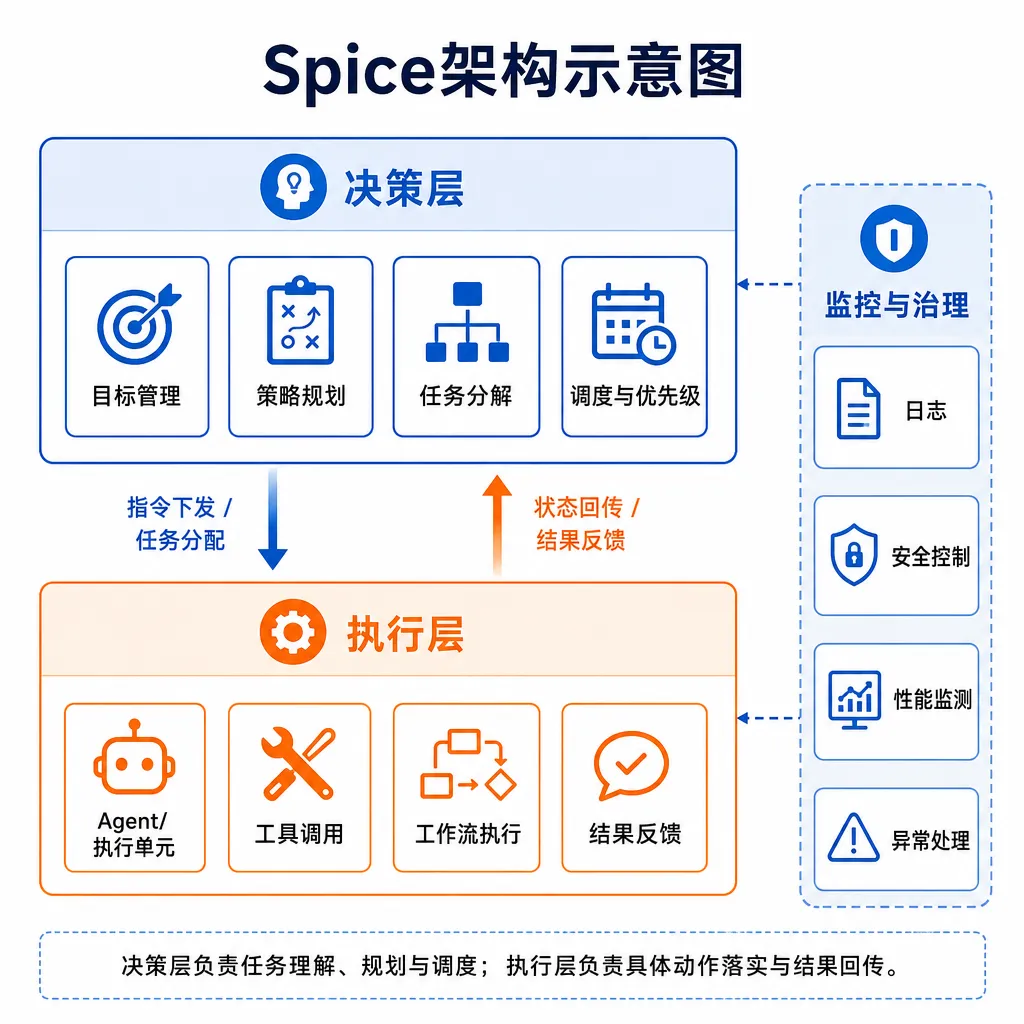
Spice has a very clear positioning: a decision layer above the Agent execution layer.
Current mainstream Agent systems—whether Claude Code, Codex, or Hermes—focus on enhancing execution capabilities. Give them a clear intent, and they can perform tasks increasingly well. But there’s a higher-level question usually left to the user: What should be done next, and why?
Spice does not intend to replace these execution Agents, but rather to sit in front of them, breaking down the decision process into inspectable steps:
- What was observed
- What options were considered
- Why a certain option was chosen
- What trade-offs were rejected
- What happened after execution
- How this result impacts the next decision
This change in design philosophy essentially shifts from “make the model perform better” to “make the system’s decisions clearer.”
From Prompt to Context, and Then to State
When introducing Spice, Jia proposed an evolutionary path that well explains why State Engineering is necessary:
Prompt Engineering (2024): Solves “what should the model say this time.” Focus on designing prompts to make the model respond as expected.
Context Engineering (2025): Solves “what can the model see this time.” Focus on putting correct information into the context window.
State Engineering (2026 and beyond): Solves “what does the system believe now, and what does the model base its next decision on.” Focus on long-term, in-depth maintenance of user state.
This evolution is not a simple technical iteration but a fundamental shift in engineering focus.
Why Context Isn’t Enough
Many people’s first reaction is: just make the context window longer, right? From 8K to 128K to 1M tokens—problem solved?
But Jia thinks this is a directional misjudgment. Longer context solves “how much historical information can be seen,” but not “how to extract effective state from history” or “how to ensure decision consistency.”
Example: A product manager Agent learns on day one that the user prefers a minimalist UI design, then learns on day three that they need rich data visualization. These two requirements may conflict. If you simply throw all conversations into context, the model may forget the day-one preference on day five or fail to explicitly handle this trade-off.
State Engineering aims to:
- Explicitly record “User prefers minimalist UI” state
- Explicitly record “User needs rich visualization” state
- Explicitly identify conflicts during decisions
- Explicitly make trade-offs and record reasons
- Make this decision process traceable and auditable
This cannot be solved just by longer context—it requires a state management and decision tracing mechanism.
The Technical Implementation of Spice
From currently available information, Spice’s runtime is still in early stages but already installable. Basic flow:
- Install Spice
- Configure LLM provider (supports mainstream models)
- Run in terminal
- Inspect Decision objects (decision records)
The core data structure is the Decision object, which records a complete decision process. This design makes decisions a first-class citizen, rather than hidden in the black box between prompt and response.
Difference from Traditional Agents
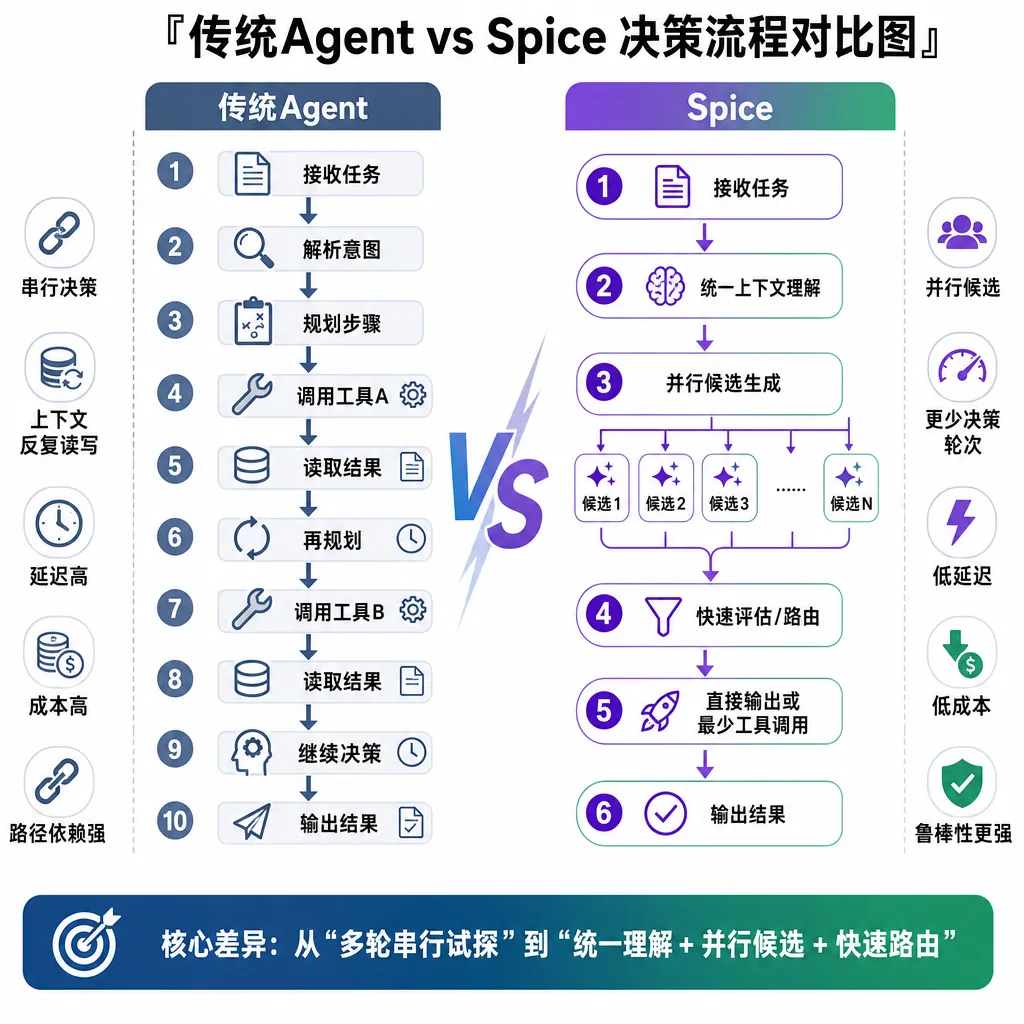
Traditional Agent workflow often is:
User input → LLM reasoning → Tool invocation → Return result
Spice workflow is:
Observe environment → Generate candidate decisions → Evaluate trade-offs → Choose decision → Record reasons → Execute → Update state
Key differences:
- Explicit candidate generation: Not directly outputting an answer, but first generating multiple possible options
- Explicit trade-off evaluation: Recording pros, cons, risks, costs for each option
- Explicit decision reasons: Persisting why choosing A over B
- Ongoing state updates: Decision outcomes update system state and influence subsequent decisions
This design turns Agent systems from “black box executors” into “explainable decision systems.”
Real-World Scenarios
Based on community feedback, Spice is already used in some interesting scenarios:
Research: Researchers use Spice to track experimental decision processes. For example, when tuning parameters, record reasons for each adjustment, expected effects, actual results, and how these results influence the next adjustment. This is more valuable than simple experiment logs because it captures the causal decision chain.
Product Manager Agent: Agents act as product managers, gathering requirements, analyzing competitors, developing roadmaps. Spice’s decision tracing makes the process auditable—you can see why the Agent prioritized feature A over B, based on what assumptions, and how it plans to verify them.
Quantitative Trading: In quantitative strategy, decision traceability is critical. Spice records basis of each trade decision, risk assessment, expected return, and how the actual result feeds into the next decision. Valuable for strategy optimization and risk control.
Common features of these scenarios: require long-term interaction, decision consistency, and explainability—exactly what Spice aims to solve.
Open-Source Community Response
The project gained traction after release on Linux.do. Some developers found the idea novel; others questioned practical performance.
Supporters believe Spice addresses a real pain point in current Agent systems: execution capabilities are improving, but decision-making and long-term consistency remain weak. With explicit state management and decision tracing, Agent systems can become more controllable and trustworthy.
Skeptics worry adding this decision abstraction layer may introduce extra complexity and performance overhead. In real applications, can this mechanism truly improve Agent performance, or merely add engineering burden?
More practice is needed to answer these questions. Fortunately, Spice is fully open-sourced—anyone can try, improve, and verify.
The Future of State Engineering
Jia’s State Engineering concept essentially asks a deeper question: How can AI systems maintain consistency and reliability in long-term interactions?
Current LLMs are stateless—each inference is independent, relying on context to “remember” history. This is fine for short dialogues but hits bottlenecks in long-term interactions:
- Physical limit of context window: Even with 10M tokens, it cannot grow indefinitely
- Efficiency of information retrieval: The longer the context, the harder it is for the model to find key information
- Decision consistency challenges: Without explicit state management, models can “forget” previous decisions or contradict themselves long-term
State Engineering tries to solve these with explicit state abstraction. Instead of stuffing all history into context, it:
- Extracts key states: From history, pull information that affects decisions
- Maintains state consistency: Ensure new decisions don’t cause unexplained contradictions with existing state
- Traces decision chain: Every decision can be traced back to its basis and reason
This mindset can influence not only Agent systems but broader AI application design.
Relationship with Existing Tools
Spice is not meant to replace existing Agent frameworks, but to serve as a supplementary layer. You can still use LangChain, AutoGPT, Claude Code, etc. for execution; Spice sits above them for decision management.
Layered design benefits:
- Execution layer can continue optimizing: Faster inference, better tool calls, stronger code generation
- Decision layer focuses on consistency: State management, decision tracing, trade-off evaluation
- Two layers evolve independently: Changes in decision layer won’t affect execution layer performance
Architecturally, this is a reasonable separation of concerns.
Technical Challenges and Future Directions
Spice is still early-stage; several technical challenges remain:
State representation problem: How to represent complex decision state in a structured way? Natural language is flexible but hard to compute; structured data is precise but limited in expressiveness. Need a balance.
State update strategy: When to update state? How to handle state conflicts? How to avoid state explosion? All require carefully designed strategies.
Performance overhead: A decision layer adds extra LLM calls and computation. Balance explainability and efficiency.
Interaction with humans: With explicit decision processes, how can humans effectively intervene and supervise? UI/UX design is also a challenge.
Jia notes in the community that these are all being explored and welcomes developer contributions.
Industry Insights
The value of Spice lies not only in providing a usable tool but in proposing a direction worth considering: the next evolution of Agent systems may be in the decision layer, not the execution layer.
In the past two years, the industry has poured resources into execution capabilities: stronger models, better tool calls, faster inference. These are important but may not be enough.
For AI systems to truly integrate into users’ lives and handle long-term tasks, reliability and explainability of decisions could be key. Users need to know why AI made a particular choice, trust it won’t “split personalities” in long-term interaction, and be able to intervene when necessary.
Spice’s State Engineering approach offers a concrete exploration path toward this direction. It may not be the final answer, but it’s certainly a valuable attempt.
For developers, the project offers some insights:
- Don’t only focus on model capability: System design and architecture are equally important
- Explicit beats implicit: Make key decision processes explicit, not hidden in a black box
- Long-term consistency is a real issue: Longer context alone cannot solve everything
How to Get Started
If you’re interested in Spice, start from its GitHub repository:
- Clone project code
- Configure LLM provider as per README (supports OpenAI, Anthropic, and other mainstream APIs)
- Run sample code to inspect the structure of Decision objects
- Try integrating into your own project
The project is rapidly iterating; docs and examples will keep improving. Share ideas or issues via GitHub or Linux.do community discussions.
The emergence of Spice marks a shift in Agent system engineering focus from “how to execute” to “how to decide.” This is not a simple technical upgrade—it’s a change in mindset.
From Prompt Engineering to Context Engineering to State Engineering, each step addresses deeper issues. Whether Spice will succeed needs time to verify, but the problems and direction it raises are worth every AI developer’s attention.
After all, making AI execute faster is one thing; making it execute correctly and reliably is another. The latter may be the real challenge.
References
- Spice GitHub Repository – Project source code and documentation
- Reddit Discussion Thread – Author’s post on r/MachineLearning
- Linux.do Community Thread – Detailed introduction and discussion in Chinese community


