
Alibaba Cloud Launches Qwen Cloud Overseas, Fully Upgrades Agent Infrastructure

Alibaba Cloud has launched the Qwen Cloud AI product website in Singapore for overseas markets, simultaneously releasing the Agent product MuleRun, the intelligent agent programming platform Qoder, and updates to the desktop intelligent agent QoderWork, as well as completing the agent-based transformation of its cloud infrastructure.
Alibaba Cloud Releases Qwen Cloud Overseas, Fully Upgrades Agent Infrastructure
Today in Singapore, Alibaba Cloud launched its brand-new overseas AI product website Qwen Cloud, along with the Agent product MuleRun, and a series of updates to the intelligent agent programming platform Qoder and the universal desktop agent QoderWork. This launch is not just a product-level iteration—it’s backed by a full-stack cloud infrastructure overhaul tailored for the Agent era.
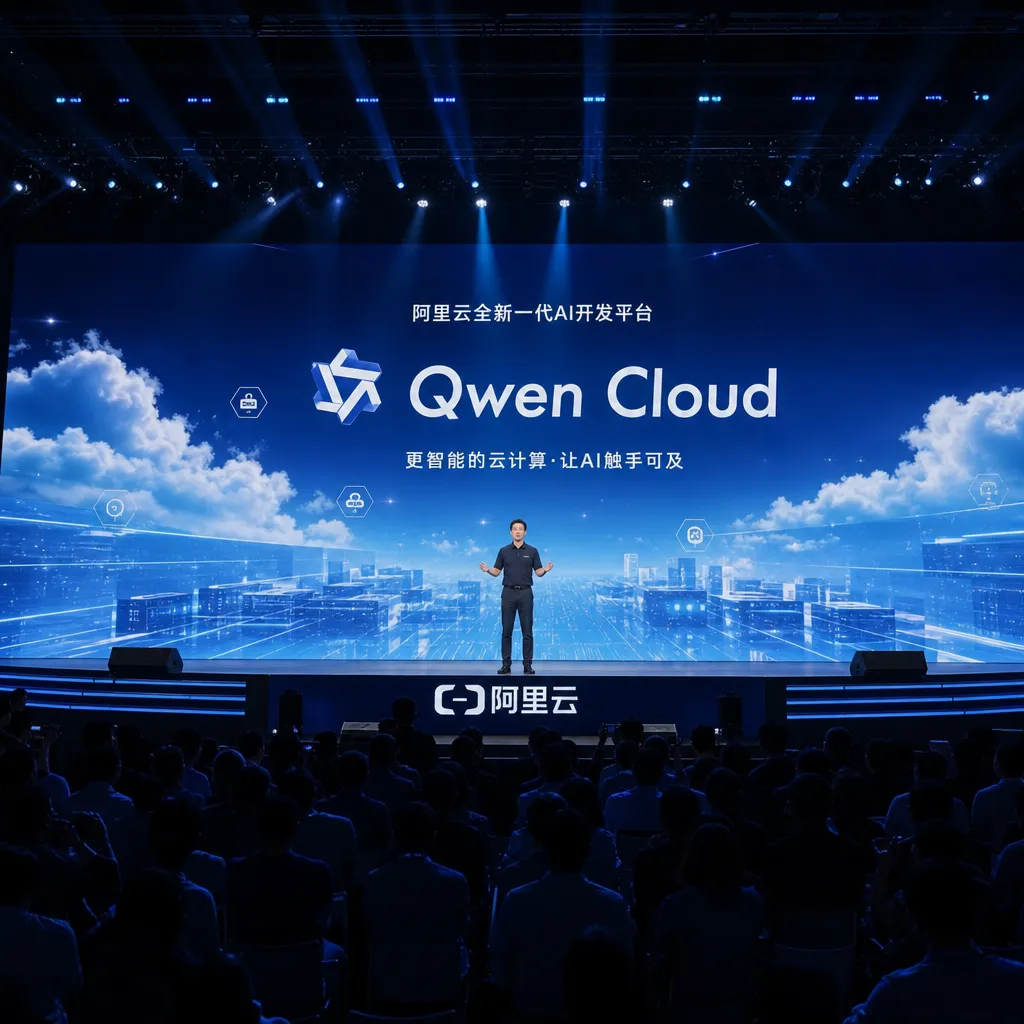
Qwen Cloud: A Dedicated Front for the Overseas Market
Qwen Cloud is an AI product website specifically designed for overseas markets. It currently offers APIs for over 150 mainstream models, including Qwen, GLM, Kimi, DeepSeek, Wan, and HappyHorse. The product applies what is called an "Agent-Friendly" design concept, optimizing key processes like model selection, calling, and monitoring.
From a positioning perspective, Qwen Cloud represents a standalone attempt by Alibaba Cloud in the overseas market. While the domestic market has the Bailian platform, overseas operations are run under the Qwen Cloud brand. The rationale is clear: overseas developers have much higher recognition of the Qwen series models compared to the Chinese brand “Tongyi,” making Qwen a more effective gateway for market entry.
Notably, Qwen Cloud integrates not only Alibaba’s own models. Among the 150 models, there are offerings from prominent Chinese AI vendors such as Zhipu, Moonshot AI, and DeepSeek. This level of openness is uncommon among Chinese giants’ overseas products and shows Alibaba Cloud’s focus on ecosystem completeness overseas rather than solely pushing in-house models.
Agent Product Matrix: Full Chain from Development to Deployment
The newly released Agent product line consists of three layers:
MuleRun: Enterprise-Grade Agent Operating Platform
MuleRun is Alibaba Cloud’s new Agent product, positioned as an enterprise-level multimodal cloud operating environment. Functionally, it resembles the overseas version of AgentBay but with targeted enhancements:
- Self-Evolution Engine: Agents can automatically optimize decision logic based on execution outcomes
- Custom Images: Supports enterprise-built runtime environments to solve dependency management issues
- Built-In Compliance Controls: Preconfigured for overseas data compliance requirements
These features are highly practical. The self-evolution engine addresses the need for ongoing tuning in real-world Agent applications; custom images are essential for enterprises—no one wants to run core business logic in a standardized environment.
Qoder: Major Upgrade to the Intelligent Agent Programming Platform
Qoder is Alibaba Cloud’s intelligent agent programming platform, with this update focusing on the development framework. The new Model Studio-ADK (Agent Development Kit) is a high-code framework aimed at professional developers. The official claim: building DeepResearch or Agentic RAG projects takes just 1 hour.
This is a bold performance promise. DeepResearch Agents involve multi-round reasoning, dynamic planning, tool invocation, and other complex logic—traditional development typically takes days. Achieving this in 1 hour suggests that ADK provides extensive encapsulation for task orchestration, tool integration, and state management.
Meanwhile, the low-code platform Model Studio-ADP has been upgraded to lower the threshold for non-technical personnel to create lightweight Agents. This dual-track high/low-code strategy is pragmatic—professionals want flexibility, business personnel want ease of use, and both needs are met.
QoderWork: Practical Exploration of Desktop Agents
QoderWork is a universal desktop Agent. This update’s specifics weren’t fully disclosed, but based on its positioning, it is likely a competitor to Anthropic’s Computer Use and OpenAI’s Operator. The core capability of desktop Agents is GUI manipulation, which demands strong visual understanding and action planning.
The visual programming (generating code directly from images/videos) and 3D spatial understanding capabilities demonstrated in Qwen3-VL at this launch are likely the underlying support for products like QoderWork.
Agent-Oriented Cloud Infrastructure Overhaul
The most noteworthy aspect of this launch is not the products themselves, but Alibaba Cloud’s infrastructure upgrades for Agent workload characteristics. Agent workloads differ greatly from traditional applications:
- High Burstiness: Agent call volume fluctuates far more than regular APIs
- Uneven Resource Consumption: Inference, tool calls, and data retrieval have vastly different resource needs
- Stringent Security Isolation: Agents in multi-tenant environments must be strictly isolated
In response, Alibaba Cloud has made the following modifications:
Storage Layer: Vector Buckets
OSS now features "Vector Buckets", unifying management of raw and vector data in one service. This solves a pain point for RAG applications: previously, vector data lived in a separate vector database, with raw data in object storage—syncing and maintaining consistency was cumbersome.
By performing vectorization and retrieval directly within OSS, developers just need to call standard OSS APIs, eliminating the need to integrate an extra vector database. This greatly reduces RAG application development and operation costs.
Network Layer: HPN 8.0 Architecture
The new HPN 8.0 network architecture delivers 800 Gbps throughput, twice the previous generation. More importantly, it supports hybrid workloads—training, inference, reinforcement learning—which is critical for Agent scenarios.
Agent workflows usually involve multiple stages: inference for decision-making, tool invocation for execution, and strategy adjustment based on results. These stages have vastly different network requirements. HPN 8.0’s hybrid workload capabilities mean a single cluster can run these heterogeneous tasks simultaneously, without frequent resource scheduling.
Container Layer: ACS Elastic Scaling Enhancements
The Container Computing Service (ACS) upgrade focuses on elasticity: it can scale 15,000 pods per minute. This is ideal for large-scale concurrent Agent requests.
Consider a customer support Agent during a promotional event, where tens of thousands of sessions flood in instantly. Traditional scaling speeds can’t keep up, hurting user experience. Scaling 15,000 pods per minute can handle most burst scenarios.
Another key update is container sandboxing. Strong separation between Agents is essential, especially in multi-tenant setups. ACS isolates user space and execution environments to prevent cross-Agent exploits and data leaks—an indispensable security guarantee for enterprise customers.
Database Layer: PolarDB Data+AI Optimization
PolarDB now supports CXL (Compute Express Link) technology, reducing latency by 72.3% and increasing memory expansion capability 16-fold. Both metrics directly impact Agent responsiveness and processing power.
When executing complex tasks, Agents frequently read and write to databases. Lower latency means faster database operations, significantly cutting task completion time. Enhanced memory capacity allows caching more hot data, reducing disk I/O.
The new Lakebase architecture supports open data formats such as Lance, Iceberg, and Apache Hudi—valuable for multimodal data management. Agents handle diverse data types: text, images, audio, video, and structured data. A unified storage architecture simplifies data management and cuts costs.
Security Layer: AI-Driven CTDR Upgrade
The Cloud Threat Detection & Response (CTDR) solution now includes 5 AI Agents powered by Qwen, automating security operations from alert assessment to execution.
Official data shows automated incident investigation success rates rose from 59% to 74%, with 70% of response actions requiring no human intervention—a significant improvement. Security operations suffer from excessive alerts, high false positives, and low manual handling efficiency. AI Agents can automatically correlate events, analyze threats, and generate actionable reports, greatly lightening the load on security teams.
A Complete Loop from Models to Infrastructure
Looking at the release holistically, Alibaba Cloud’s strategy is clear: use the Qwen series models as the foundation, build a complete Agent development and operation platform on top, and overhaul lower-level cloud infrastructure to support Agent workloads.
This “Model–Platform–Infrastructure” three-layer architecture differs from other cloud vendors. AWS, Azure, and Google Cloud tend to offer model APIs and basic resources, relying on third-party ecosystems for Agent development platforms. Alibaba Cloud, in contrast, runs the entire chain—from model training to app deployment—under one roof.
The advantage is a more unified experience and deeper integration. Developers don’t switch between disparate services, and infrastructure is specifically optimized for Agent scenarios. The drawback is a relatively closed ecosystem, potentially less flexible in supporting third-party tools and frameworks compared to open platforms.
From a market perspective, the timing is good. Agents are moving from proof-of-concept to large-scale implementation, and enterprise customers need full solutions—not just model APIs. Qwen Cloud and the supporting infrastructure upgrades hit this demand squarely.
Competition overseas will be intense. OpenAI, Anthropic, and Google are all pushing Agent-related products, and AWS and Azure are iterating rapidly. Alibaba Cloud’s strengths lie in the Qwen model’s open-source ecosystem and cost-effectiveness; its weaknesses are brand recognition and channel coverage, which need time to grow.
Finally, the choice to hold the launch in Singapore rather than the US or Europe is interesting. For Chinese cloud vendors, emerging markets like Southeast Asia, the Middle East, and Latin America may offer more practical breakthrough opportunities.
References
- Alibaba Cloud Launches New Overseas AI Product Website Qwen Cloud - 36Kr - Official announcement from Alibaba Cloud Singapore launch
- Alibaba Cloud Monthly Product Bulletin - Official Website - Summary of Alibaba Cloud product feature updates


