
Microsoft Open Sources Webwright: 1,000 Lines of Code Boost GPT-5.4 Web Task Success Rate by 81%
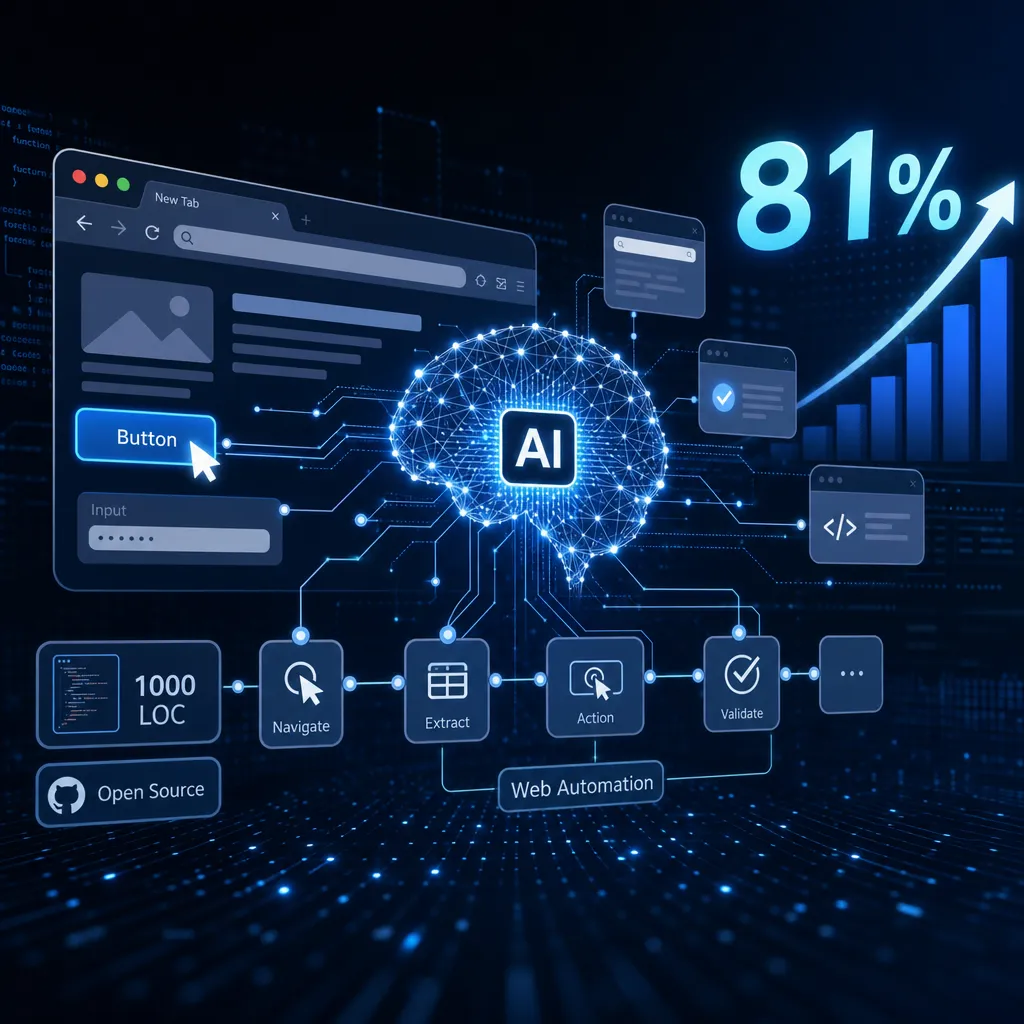
Microsoft Research has open-sourced the web agent framework **Webwright**, allowing AI to directly write Playwright code instead of predicting clicks. GPT-5.4 achieves a success rate of 60.1% on complex web tasks, an 81% improvement over the base version, with an architecture of only about 1,000 lines of code.
Microsoft Open Sources Webwright: 1000 Lines of Code Boost GPT-5.4 Web Task Success Rate by 81%
This month, Microsoft Research open-sourced the web agent framework Webwright, a framework of only around 1000 lines of code that takes GPT-5.4’s performance on complex web tasks to a whole new level. In the Odysseys benchmark tests, the Webwright + GPT-5.4 combo achieved a 60.1% success rate — 26.6 percentage points higher than the base GPT-5.4 rate of 33.5%, an improvement of 81.49%.
What does this mean? In April, the top model on the Odysseys leaderboard, Claude Opus 4.6, scored 44.5%. Webwright directly raised that record by 35.1%. And the tasks involved were not simple form fills, but real-world scenarios averaging 272.3 words in instructions — long-chain, cross-site tasks requiring navigation between multiple websites, contextual understanding, and completion of complex sequences of operations.
Not Predicting Clicks, But Writing Code Directly
Traditional web agent methods work like this: “screenshot or parse DOM → predict next click/input/scroll.” This works okay for simple tasks, but falls apart in multi-step scenarios. Think about filling a complex form, picking dates, or repeating actions across pages — representing this with click sequences is awkward.
Webwright takes a different approach: let the model write Playwright code directly in the terminal. Playwright is Microsoft’s own browser automation library, familiar to developers for E2E testing. Now, AI uses the same tools — writing code, executing shell commands, checking logs and screenshots, spotting issues, then modifying code — the process is just like a human developer debugging scripts.
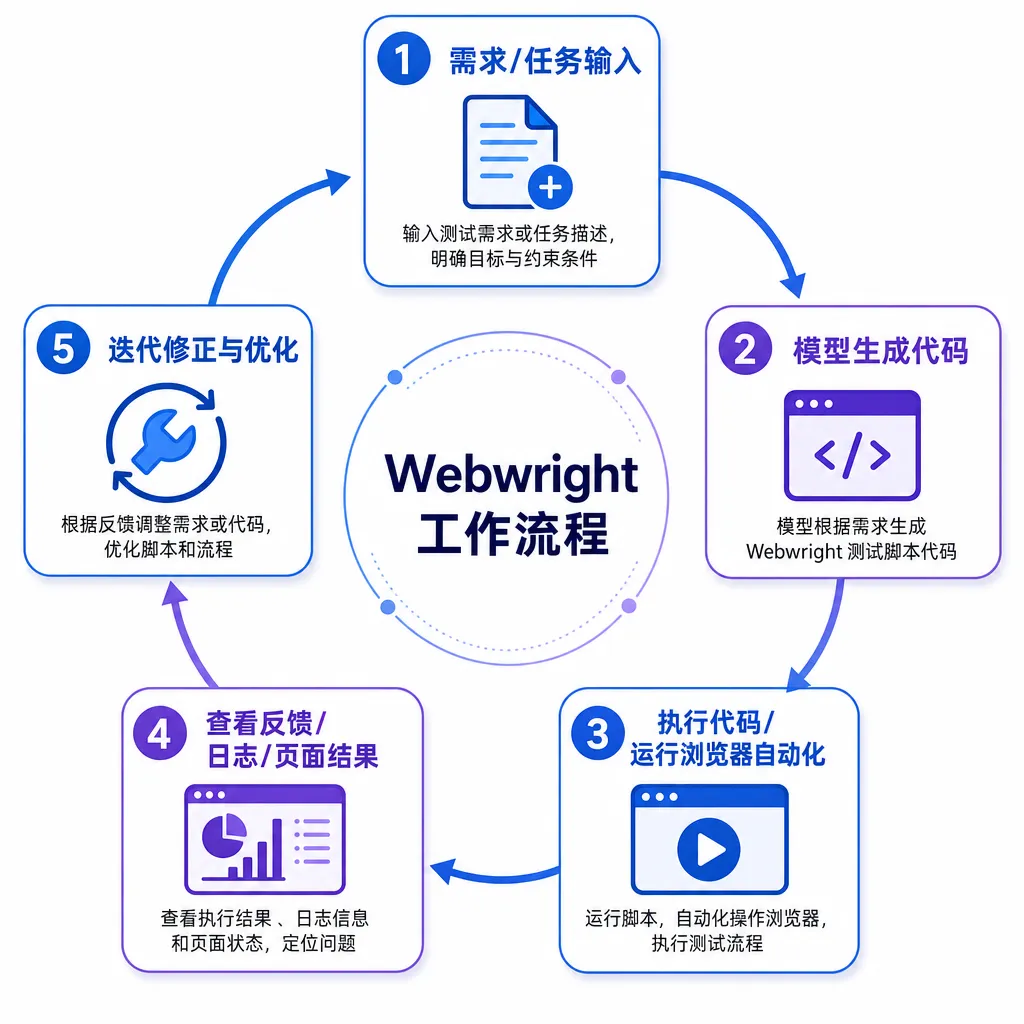
The advantages are obvious. Code naturally expresses multi-step logic — loops, functions, abstractions all come into play. Filling a form? Write a loop to traverse the fields. Selecting a date? Call the date-picker API. Cross-page actions? Encapsulate into reusable functions. Compared to predicting one low-level action at a time, code is vastly more expressive.
Simple Architecture: Three Components
Webwright’s architecture is surprisingly simple: Runner (~150 lines), Model Endpoint (~550 lines), Terminal Environment (~300 lines) — totaling about 1000 lines. No multi-agent orchestration, no complex layered planning — just a direct “model↔environment” interaction loop.
Execution flow is straightforward:
- Runner sends current context to model
- Model returns its thought process and a shell command
- Environment executes the command, returns terminal output, logs, screenshots, or error stack
- Next round begins
This design philosophy runs counter to the current trend of “stacking agents and adding planning layers.” Microsoft’s choice: rather than complex architecture, let the model face a real development environment head-on, using code — a far more powerful expressive medium — to solve problems. And the results show it was the right choice.
Clever Solutions to Two Engineering Problems
Simple doesn’t mean crude. The team solved two real engineering problems in smart ways.
First: “Premature completion declarations.” Sometimes the model declares “done” before the task is truly complete — a fatal flaw in automation. Webwright’s fix is to add a gating step: the model must first generate a self-check configuration, then execute the final script in a brand-new folder, reflect based on logs and screenshots, judge success or failure, and only then output a completion flag.
This forces the model to take responsibility for its work. It can’t just say “done” — it must provide evidence that the task is indeed finished. This self-verification mechanism is especially important in production — nobody wants an agent that thinks it’s done but hasn’t actually accomplished anything.
Second: “Context bloat.” Long trajectory tasks can easily exceed context limits, especially when logs, screenshots, and errors pile up. Every 20 steps, Webwright compresses history into a summary, keeping key info and discarding redundant details. This balances context coherence with token consumption.
Benchmark Results: First Tier in Two Leaderboards
Webwright delivered strong results in two mainstream benchmarks.
Online-Mind2Web includes 300 tasks across 136 popular sites. With GPT-5.4, Webwright achieved 86.67% overall accuracy, ranking near the top among public recipes under a 100-step budget. This dataset leans toward single-site, moderately complex tasks — Webwright’s high accuracy shows it’s solid in routine scenarios.
Odysseys is the real challenge. Task instructions average 272.3 words, requiring long-chain cross-site operations. This demands strong planning ability, contextual understanding, and error recovery from agents. The earlier-mentioned 60.1% success rate is from this benchmark — 35.1% higher than the previous best (Opus 4.6 at 44.5%), and 81.49% above base GPT-5.4 (33.5%).
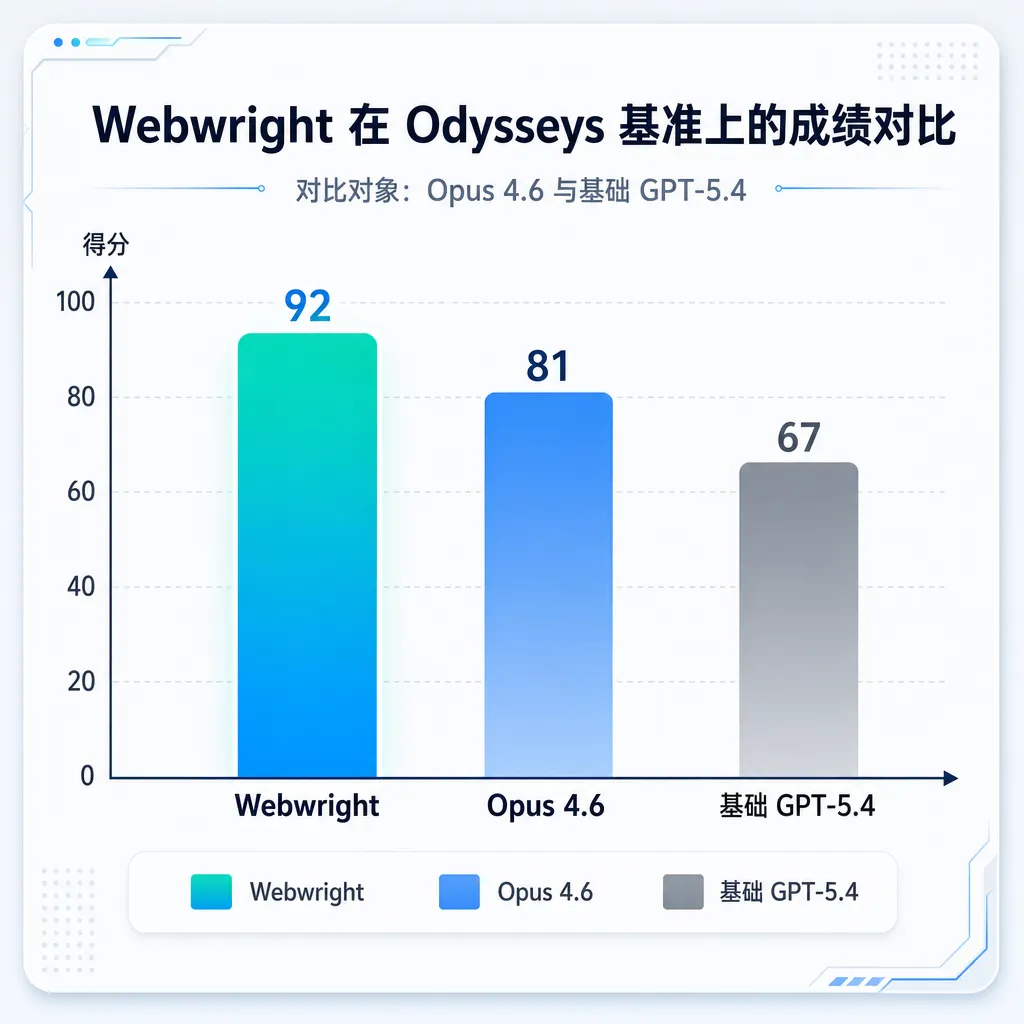
This improvement isn’t from parameter tuning — it’s the result of a fundamental architectural difference. The advantages of code in handling complex multi-step tasks shine in Odysseys-like scenarios.
Deeper Advantages of Code
Why is writing code so much stronger than predicting clicks? Beyond expressive power mentioned earlier, there are deeper reasons:
Debuggability — Code is readable and inspectable. When problems arise, looking at logs, error stacks, intermediate states is much more intuitive than analyzing click sequences. The model can quickly locate and fix issues with this information instead of guessing in a black box.
Reusability — Written functions and encapsulated logic can be reused in later steps. This abstraction capability is absent in click sequences. For tasks needing repeated actions across pages, code can be a single function call; clicks must be predicted each time.
Natural fit with developer toolchain — Tools like Playwright and Puppeteer are built for developers — with good docs, mature communities, clear best practices. Using these tools lets the model stand on the shoulders of the front-end automation ecosystem. Click prediction is reinventing the wheel.
Easier verification and testing — Code can be run standalone, unit tested, integration tested — Webwright’s self-check leverages this. Click sequence verification can only be an end-to-end run, and if it fails, it’s not obvious where.
Lessons for Web Agents
Webwright’s success offers several important takeaways for the web agent field:
First: Don’t underestimate the power of code. The AI community often chases “end-to-end learning,” thinking direct action prediction is more “pure.” But leveraging strong existing tools (like browser automation libraries) is often wiser. Code embodies decades of human best practices — no need for AI to reinvent.
Second: Simple architectures may work better. Webwright has only 1000 lines, no complex multi-agent systems, no carefully designed planning layers — yet outperforms many complicated systems. Sometimes, directly giving a powerful model the problem and the right tools is more effective.
Third: Self-verification is critical. “Premature completion” plagues all automation — Webwright’s gating self-check is a working solution. This can be adapted to other agent types.
Fourth: Context management needs careful design. Long trajectory tasks will always face context bloat. Webwright’s periodic compression is a practical engineering fix. As task complexity grows, balancing key info retention with token costs will be a universal challenge.
Limitations and Future Directions
Webwright isn’t perfect. Code-based methods require the model to know Playwright’s API — this demands strong coding ability. GPT-5.4-level models are fine; smaller models might struggle.
Also, Webwright currently targets functional tasks (form fills, button clicks, data extraction). For tasks needing visual understanding (e.g., “click the largest red button on the page”), visual models + click prediction may be more direct. This isn’t a structural issue — adding a vision module could fix it.
According to hints from the paper, future directions may include: supporting more browser automation tools beyond Playwright; optimizing context compression for longer task trajectories; researching how smaller models can effectively use code-based methods to lower compute requirements.
What Open Sourcing Means
Microsoft open sourcing Webwright is good news for the community. The code is on GitHub — developers can use it directly or customize it.
More importantly, Webwright offers a clear reference implementation. At 1000 lines, any team with decent engineering skills can read, modify, and extend it. Compared to projects with tens of thousands of lines and many internal dependencies, Webwright’s learning curve is gentler.
For teams pursuing web automation, Webwright is a great starting point. It proves the viability of code-based methods, gives engineering best practices, and exposes pitfalls (like premature completion and context bloat). Starting here and optimizing for specific scenarios is faster than starting from scratch.
Comparison with Other Approaches
Webwright is not the first web agent project, but its positioning is unique.
Compared to OpenAI Operator — Operator is closed-source, using vision models + click prediction. Webwright is open-source, code-based — technically entirely different. Public data suggests Webwright + GPT-5.4’s success rate (60.1%) beats early Operator versions on some tasks, though Operator may excel in vision-heavy tasks.
Compared to AutoGPT, BabyAGI, and other general frameworks — Those aim for generality, doing all kinds of tasks. Webwright focuses on web automation, with architecture optimized deeply for this scene, yielding stronger performance and simpler engineering.
Compared to traditional RPA tools — RPA tools like UiPath and Automation Anywhere require manual recording or rules. Webwright is AI-driven — give a natural language instruction and it executes. Flexibility is far greater. But RPA tools are more mature in stability and enterprise features — each has its strengths.
Real-world Applications
Where could Webwright be used? Several clear directions:
Automated Testing — Let AI generate E2E test scripts from test case descriptions — much faster than manual writing. AI can cover more edge cases, improving coverage.
Data Collection — Need to grab data from multiple sites? Give Webwright a task description and it writes a crawler, handles pagination, extracts info. More flexible than traditional crawlers, adapting even if site structure changes.
Business Process Automation — Many companies have repetitive web tasks (data entry, report generation, cross-system syncing). Webwright can automate these without dedicated RPA engineers — business staff just describe needs in natural language.
Developer Assistance — Developers can have Webwright write repetitive front-end interaction code or quickly verify interaction flows. Essentially, an AI assistant skilled in browser automation.
Technical Debt and Engineering Practices
Webwright’s design reflects Microsoft’s engineering professionalism. Several noteworthy details:
Error Handling — The environment returns complete error stacks after executing commands, letting the model pinpoint issues precisely. Much better than just “failure.”
Log Management — Terminal outputs and logs from each step are retained, allowing model backtracking — critical for debugging long tasks.
Screenshot Mechanism — Key steps are auto-screenshotted, letting the model confirm results visually — especially useful for dynamic content and async loads.
Isolated Execution — Self-check runs scripts in a fresh folder, preventing contamination of the main environment — isolation is a basic production requirement.
Individually these details may seem minor, but together they make the difference between a reliable engineering system and a mere demo.
Coding Ability Requirements
Webwright’s success relies heavily on the model’s coding ability. GPT-5.4 can write correct Playwright code, understand error messages, and quickly fix problems — all essential.
This explains why Webwright works so well with GPT-5.4. The GPT-5 series improved qualitatively in code comprehension and generation, especially in understanding API docs, analyzing error stacks, and handling edge cases. These abilities are fully leveraged in Webwright.
Conversely, Webwright is also a great benchmark for testing model coding ability. A model’s performance here directly reflects its skill in writing code, debugging, and understanding tool documentation — closer to real development than plain code completion or algorithm questions.
Industry Impact
Open-sourcing Webwright may spark a wave of innovation in web agents. With code-based methods proven viable, more teams will pursue this direction and optimize for different scenarios.
Browser automation tool developers will benefit — tools like Playwright and Puppeteer, originally for human developers, now have AI users. Developers may optimize tools for AI use with clearer error messages, friendlier APIs, better docs.
For businesses, Webwright lowers the cost of deploying web automation. No dedicated RPA teams or complex flow design — give AI a task description and it runs. This may accelerate digital transformation, especially in small and mid-sized companies.
Conclusion
Webwright’s 1000 lines prove one thing: in web automation, having AI write code beats predicting clicks. It’s a simple conclusion, but built on deep understanding of the problem’s essence and careful engineering refinement.
Microsoft’s open-sourcing provides a high-quality reference implementation. For teams wanting to build web agents, Webwright is a great starting point; for researchers, it offers new ideas and benchmarks; for developers, it’s a practical automation tool.
The rise in AI coding ability is changing how we build automation systems. Webwright is just the beginning — more scenarios will be conquered by code-driven agents. This is a direction worth watching.
References
- About 1000 Lines of Code Build a Web AI Agent: Microsoft Webwright Boosts GPT-5.4 Scores by 81% — IT Home’s detailed report on Webwright, including design and benchmark data
- Webwright GitHub Repository — Microsoft Research’s open-source Webwright code (search “microsoft webwright”)
- Playwright Official Docs — Microsoft’s browser automation library, Webwright’s core dependency


