
Kunlun Wanwei Releases SkyClaw-v1.0: Million-Token Context, Natively Born for Agents

Kunlun Wanwei today released SkyClaw-v1.0 and its lightweight version, lite, featuring million-token context and native Agent capabilities. The price is set below the discounted rate of DeepSeek V4 Pro, with a free trial available for 2–4 weeks.
Kunlun Wanwei Releases SkyClaw-v1.0: Million-Token Context, Natively Born for Agents
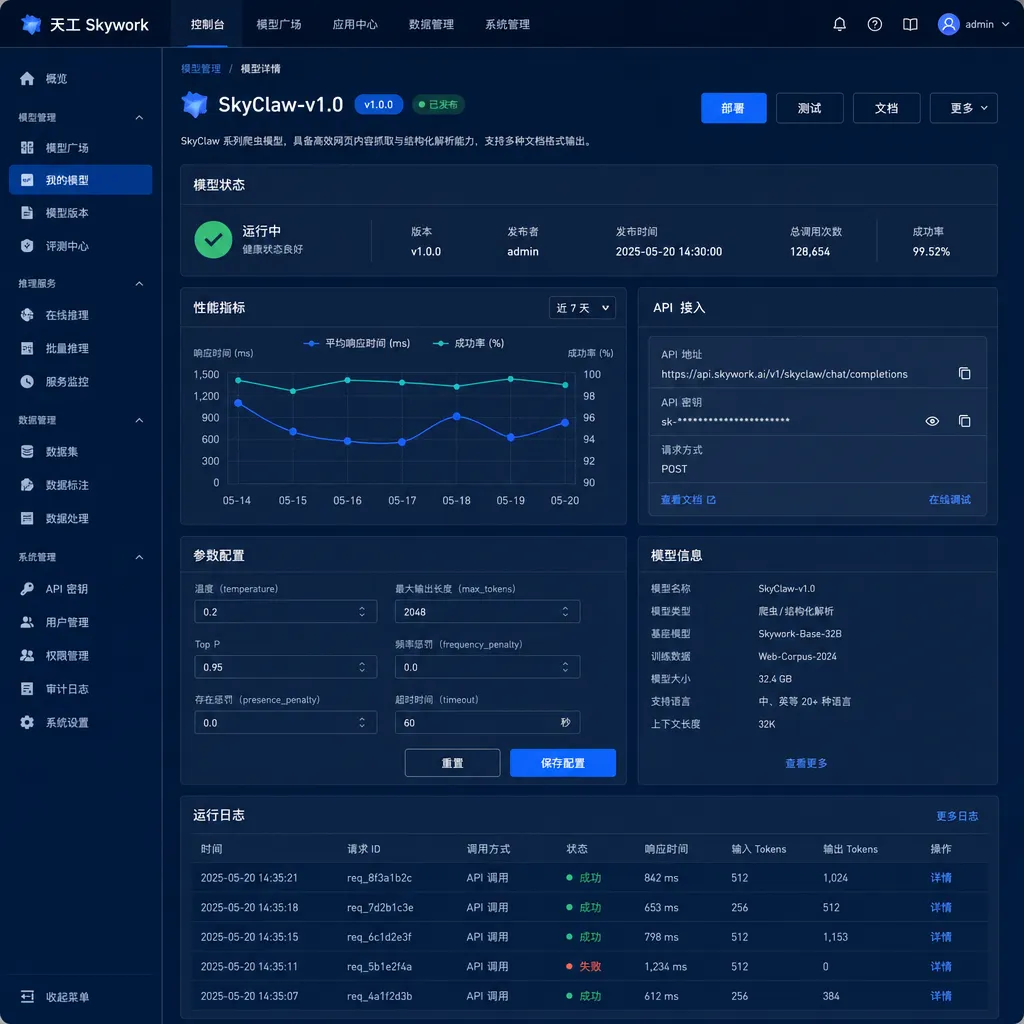
On May 26, Tiangong AI, a subsidiary of Kunlun Wanwei, officially launched the high-performance Agent model SkyClaw-v1.0, together with the lightweight version SkyClaw-v1.0-lite. The model supports a million-token context and was quietly integrated into the Tiangong Skywork platform on May 22. Today marks its official public debut.
The release timing is quite interesting. The Agent track has been buzzing for nearly a year — from OpenClaw to Hermes to Nanobot — with intense competition at the framework layer, while the model layer has faced an awkward truth: everyone’s been using general-purpose models like Claude Opus 4.6 or DeepSeek V4 Pro wrapped in a tool shell, not models actually trained for Agent scenarios. SkyClaw’s answer this time is — from day one of training, immerse the model in an Agent environment.
Two Models: One to Top Out the Ceiling, One to Guard the Cost Floor
This release is not just one model, but a combo.
SkyClaw-v1.0 is the flagship version, aimed at complex enterprise tasks: multi-step planning, complex toolchain calls, long-context multi-turn interactions. The official positioning is “scenarios requiring the highest reliability and execution accuracy,” which translates to — if you want to build delivery-grade Agent applications, use this.
SkyClaw-v1.0-lite is the lightweight version, but the official messaging repeats one point: Agent core capabilities are not compromised. In other words, essential Agent abilities like tool invocation and multi-step execution are retained; what’s cut is more about the depth of reasoning tied to parameter scale. The Lite version is geared toward developers’ daily use, early-stage product validation, and iterative trial-and-error scenarios.
This “main + lite” dual model combo has become almost an industry standard since last year — Anthropic has Opus/Sonnet/Haiku, OpenAI has GPT/mini, DeepSeek has Pro/Flash. The logic is simple: In many Agent tasks, numerous steps are just simple tool calls or state checks; using a sledgehammer to crack a nut drives costs way up in production. If Lite handles 80% of the steps and the main model is reserved for critical points, overall costs drop substantially.
Benchmark Position: On the Threshold of the First Tier
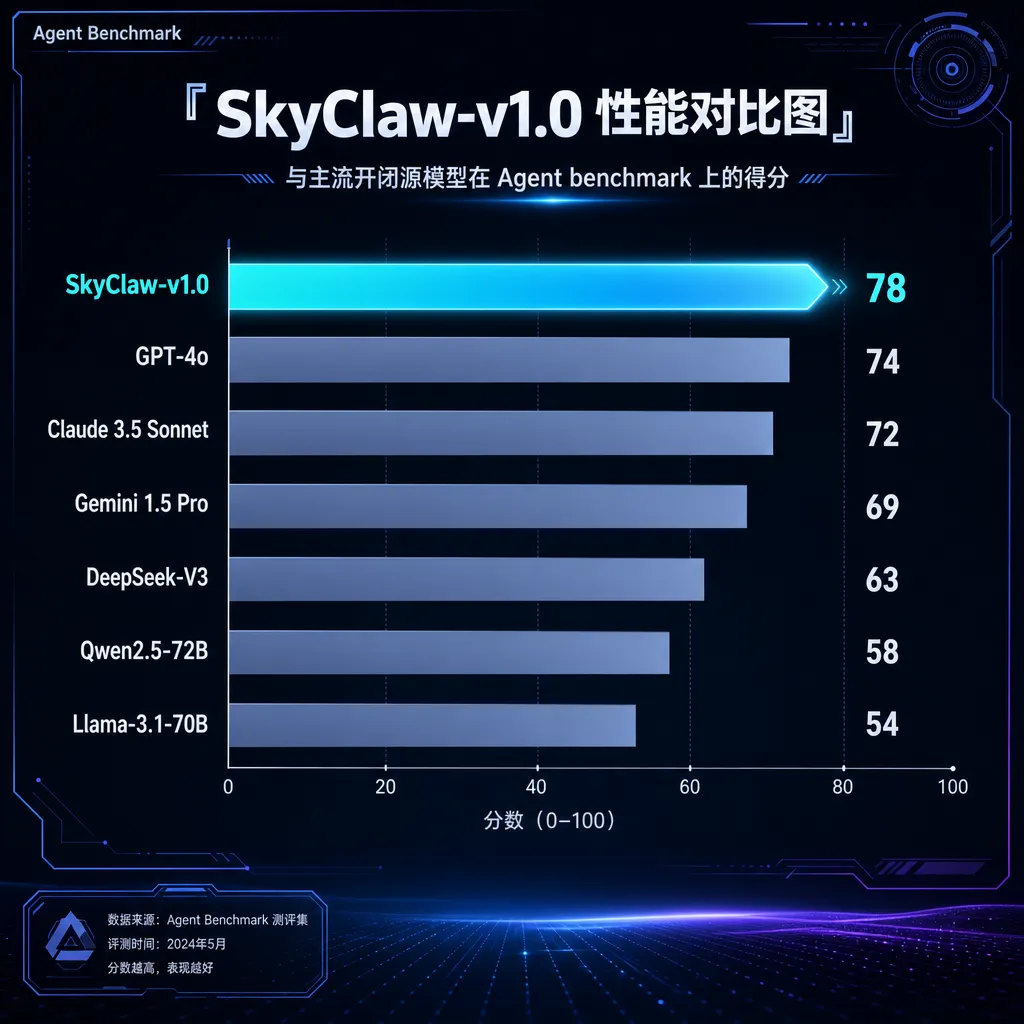
Let’s look at the official benchmark comparisons:
- Surpasses: Minimax 2.7, DeepSeek V4 Flash, Qwen 3.6 35B A3B, Qwen 3.6 27B
- Approaches: DeepSeek V4 Pro, Claude Opus 4.6, Qwen 3.6 Plus
Put together, the model’s position is clear — it’s at the top ceiling among mid-scale open-source models, and when looking up at closed-source/ultra-large models, the gap is small but not yet closed. On OpenClaw-related tasks (currently the most recognized comprehensive Agent benchmark in the industry), it can go head-to-head with Opus 4.6 — a strong standing for a domestic Agent-specialized model.
It’s worth noting that benchmark scores are just for reference. In real-world production scenarios, Agent models often differ in “error recovery” and “multi-turn iteration stability,” details that benchmarks can’t measure. The official docs clearly state that SkyClaw should be used within an Agent framework rather than as an independent chat model, because its strengths lie in “continuous execution, error recovery, and multi-turn iteration — not the superficial completeness of a single answer.” That’s a refreshingly honest statement.
Training Method: “Special Training” Starting at Mid-Training Phase
Technically, SkyClaw’s approach is worth discussing.
The conventional route is to train a general base model first, then use SFT and RLHF to teach it tool invocation. This “general + later remedial training” works fine for simple Agent tasks, but when complexity increases — e.g., needing dozens of tool calls, cross-file editing, automatic retries after errors — it falters. The reason is clear: the model is fundamentally trained with the goal of “predicting the next token,” and multi-step planning and tool-call stability are forced add-ons.
SkyClaw’s method is to move Agent-task training forward into the mid-training phase. Specifically:
- Mid-training phase — inject large volumes of complex Agent task trajectories so the model gets used to “calling tools” from the ground up
- SFT phase — reinforce with high-quality synthetic Agent task data
- RL phase — perform end-to-end reinforcement learning with targeted optimization for OpenClaw tasks
Equally crucial is broad compatibility. During training, SkyClaw covered mainstream Agent frameworks such as OpenClaw, Hermes, Nanobot, Claude Code, and Codex — essentially pre-adapting to large-scale frameworks. This detail is friendly to developers — many specialized Agent models excel only in their own framework, faltering elsewhere; SkyClaw ensures alignment in mainstream environments.
The million-token context is also a highlight. Agent workflows differ from regular chat — traces of tool calls plus file contents, error logs, and planning states can easily stack up to hundreds of thousands of tokens. SkyClaw pushes this to the million level, standing alongside the frontier players.
Pricing: Lowering the Threshold for Agent Capability
Pricing is the most striking part of this release:
| Model | Input Price | Output Price | |-------|-------------|--------------| | SkyClaw-v1.0 | 0.5 CNY / million tokens | 4 CNY / million tokens | | SkyClaw-v1.0-lite | 0.3 CNY / million tokens | 2 CNY / million tokens |
This is over 50% cheaper than models of the same level like Minimax 2.7 and Qwen 3.6, and even cheaper than discounted DeepSeek V4 Pro. Agent applications dread excessive token consumption — a moderately complex Agent task running a few hundred-thousand-token context can quickly turn into a massive bill. SkyClaw’s pricing essentially allows small and medium teams to freely verify Agent product cost structures.
Adding the official 2–4 week free trial, teams still in the selection phase face almost zero opportunity cost.
Real Use Cases: From Desktop Pets to Financial Terminals
Rather than just parameters, let’s look at real outputs.
Financial Terminal: Global index scroll at the top, channel navigation on the left, news feed in the middle with source and linked stocks, portfolio on the right with mini K-line charts, plus pop-up breaking news alerts. Such multi-module interactive UIs would take traditional front-end teams days to assemble; SkyClaw writes all the code in one go, and developers can hook it to live data to run.
Digital Desktop Pet: From requirements to code to packaging plan — all handled itself. A gradient SVG cat, Pomodoro timer supporting 25/45/60 minutes, work-mode switching, health reminder module — all present. Notably, the model proactively suggests using Electron to package into a desktop app, even popping up an IM connection panel supporting seven chat tools: Feishu, Slack, Discord, Telegram, etc.
AI Weekly Report System: This is more hardcore — a complete product prototype using FastAPI backend, pulling data from RSS, GitHub, HuggingFace, and webpages, cleaning and classifying for trend analysis, generating the report automatically, and storing in SQLite. Finally, it prompts the user: “Would you like to set this as a scheduled task to run automatically every Monday morning?”
The takeaway is more important than single-point capability: SkyClaw is no longer the kind of model that needs step-by-step instructions fed to it. It proactively recommends the next step in the workflow and suggests saving generated output as reusable Skills. This “initiative” is the biggest experiential dividing line between Agent models and Chat models.
Usage: Two Integration Paths
Developers have two access routes to SkyClaw.
First is the Tiangong Skywork platform (tiangong.cn). SkyClaw-v1.0 was integrated on May 22, accessible directly in the browser without an Agent environment. This path suits quick validation, demos, and capability boundary testing.
Second is API integration, currently free. Official endpoint is apifree.ai, OpenAI-compatible, supporting streaming output, tool invocation, and multi-turn conversations. For developers already using OpenAI SDKs, it should theoretically run by just swapping the baseURL and model name.
It’s worth noting that OpenAI Hub is rapidly integrating domestic Agent models. Developers using a single API key for GPT, Claude, Gemini, DeepSeek, etc., may later switch to SkyClaw in the same aggregation layer, avoiding separate key applications and multiple quota management. This aggregation method is useful for teams doing model selection comparisons and A/B testing — especially in cost-sensitive Agent scenarios.
Some Observations
What’s most impressive about SkyClaw’s release is not isolated capabilities, but its chosen path.
In the past, top Agent capability meant accepting the triad of “large parameters + high cost + slow inference.” SkyClaw took a different route — instead of piling on parameters, it reworked the training flow into specialized Agent-focused drills, pushing capability up on smaller parameter counts. If this works, Agent capability could trickle down much faster than expected.
Looking at the bigger picture, Kunlun Wanwei clearly aims for more than releasing a model. From March’s first six official Skills posted on GitHub and Clawhub (PPT, docs, spreadsheets, design, search, music), to SkyClaw’s proactive suggestion for workflow saving, to the Tiangong Skywork platform supporting third-party models like Claude and GPT — it’s building a complete Agent work ecosystem. No matter how strong a single model is, without a platform to carry it, Skills to accumulate, workflows to connect, its capabilities are one-off.
Of course, some things need to be monitored: stability after the free trial ends, real performance differences across frameworks, reliability data for enterprise-level long tasks — these can only be seen after running in production. There’s often a big gap between impressive benchmark numbers and real-world task usability.
At the very least, this time, a domestic Agent model delivered a decent answer on all three dimensions — “usable, affordable, easy to integrate.” This is already a notable step forward in the Agent track.
References
- Kunlun Wanwei Tiangong AI Releases SkyClaw-v1.0: Million-Token Context Agent Model for Real Workflows - IT Home: Official IT Home report on the SkyClaw-v1.0 launch, including technical details and access info
- Kunlun Wanwei Officially Launches High-Performance Agent Model SkyClaw-v1.0 - linux.do: Developer community discussion thread with API documentation links and live feedback


