
Meituan Errand integrates AI Agent, compressing six steps into one through natural language ordering

Meituan today released the Errand Skill, opening ordering capabilities to the AI assistant ecosystem. With just one sentence from the user, the AI automatically completes scenario recognition, address matching, price estimation, and order submission, compressing the traditional multi-step form process into a single round of conversation.
Meituan Errand Service Integrates AI Agent, Compressing Six Ordering Steps into One with Natural Language
Today (May 26), Meituan released the “Errand Skill,” making its errand ordering capability available to the AI assistant ecosystem in an encapsulated Skill format. This means that whether users are using OpenClaw, Cursor, WeChat, or Feishu’s AI assistant, they can simply say “Help me pick up my package from the station and deliver it to my home,” and the system will automatically complete scenario recognition, address matching, price estimation, and order submission — compressing the original six-step process of opening the app, selecting the address, filling in item details, choosing the delivery type, confirming the price, and submitting the order into a single sentence.
This is not merely replacing manual form-filling with voice input; it’s completely deconstructing the structured form operations into natural language interactions. Meituan’s goal is to enable AI Agents to truly get things done, not just talk.
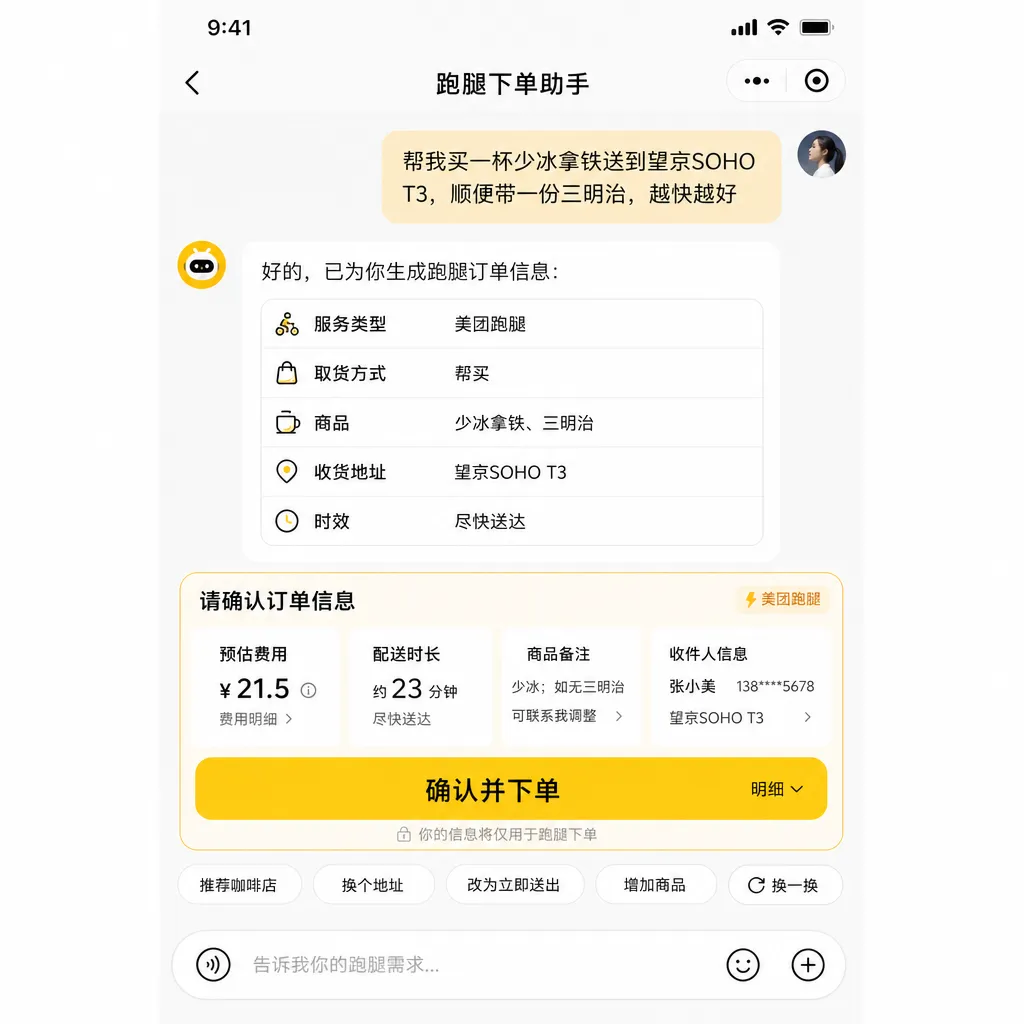
From Six Steps to One — What Happens Behind the Scenes with AI
The traditional errand ordering process is a classic multi-step form operation: open the app → choose pickup address → choose delivery address → fill in item details → select delivery type → confirm price → submit order. Each step requires the user to click or type in a structured interface, and if there’s a bottleneck at any step, the process must start over.
The Meituan Errand Skill restructures this entirely. Users just need to clearly state their needs in everyday language, for example: “Help me buy 1 jin of fresh river snails from the market.” The AI then works in the background to:
- Scenario recognition: Determine this is a “buy” scenario, rather than “deliver” or “pickup.”
- Address parsing: Match “market” and default receiving address from the user’s address book; if unmatched, call POI search.
- Item understanding: Identify “1 jin of fresh river snails” as belonging to the fresh food category and automatically fill in item details.
- Price estimation: Calculate delivery fee based on distance, item weight, and time period.
- Order preview: Generate a complete order card containing pickup address, delivery address, item, delivery fee, and estimated arrival time.
- Await confirmation: Submit the order only after the user says “Confirm,” avoiding silent ordering.
The entire process only requires the user to say two sentences: the first describes the requirement, the second confirms the order. All structured actions in between are completed collaboratively by the AI and the Skill.
Zero Development Integration, Compatible with All Claw Clients
The Meituan Errand Skill supports zero-development integration and is open-sourced on GitHub. It is compatible with OpenClaw local edition, cloud deployments like Volcano Engine, and third-party clients like Qclaw. There are two installation methods:
- Send the GitHub link to the AI assistant and say “Help me install this Skill” — it will install automatically.
- Download the zip package, send it to the AI assistant, and say “Help me install this Skill.”
On first use, the process will jump to the Meituan app for authorization, eliminating repeated steps thereafter. The design is restrained: Meituan does not require payments within the AI assistant, leaving that step in its own app. Large-value orders require additional confirmation to prevent order errors due to LLM misinterpretation or accidental triggering.
This restraint reflects Meituan’s understanding of the AI Agent ecosystem: they’re not moving the Meituan app into the AI assistant, but opening errand ordering capabilities to the AI assistant ecosystem. Wherever the users are, the service will be there.
Address Book, POI Search, Order Tracking — Details Shape the Experience
There are several noteworthy technical details in the Meituan Errand Skill implementation:
Smart Address Matching
After logging in, it automatically pulls the Meituan address book and prefers fuzzy matching. If a user says “Pick up my package downstairs at work,” the AI will first look for the “work” label in the address book — if matched, it’s used directly; if not, POI search is called. This avoids repeated address input and is especially friendly for frequent users.
Automatic Item Recognition
If a user says “Help me buy a Luckin coffee,” the AI automatically identifies it as a beverage and populates the item information. Users don’t have to manually select “Food & Drinks → Drinks → Coffee” in dropdown menus. This capability relies on LLM semantic understanding, but Meituan implemented category mapping at the Skill layer to ensure correct correspondence with the Meituan Errand item classification system.
Real-Time Order Status Query
After ordering, the user can directly ask the AI assistant “Has the rider arrived?” and the Skill will call the Meituan Errand order status API to return real-time delivery progress. Users don’t need to switch to the Meituan app — the whole process closes the loop inside the AI assistant.
These details may seem minor, but each addresses friction points in real user scenarios. Meituan’s experience with food delivery, ride-hailing, and grocery services means they understand exactly where users get stuck and what constitutes smooth interaction.
The AI Agent Ecosystem Entry Pass: Skill Standardization
The release of the Meituan Errand Skill coincides with the rapid rise of the AI Agent ecosystem. Over the past year, platforms like OpenClaw, Cursor, WeChat, and Feishu have been building AI assistant capabilities, with user request entry points no longer confined to a single app but scattered across multiple AI assistants.
For service providers, this presents both opportunities and challenges. The opportunity lies in more points of user contact; the challenge is how to make service capabilities callable across different AI assistants. Meituan’s answer is Skill standardization: encapsulate errand ordering ability as a standard Skill that any AI assistant compatible with the Claw protocol can integrate.
This approach is similar to SDK encapsulation from the mobile internet era, but goes further. SDKs encapsulate capabilities for developers, while Skills encapsulate them for AIs. Developers must write code to call an SDK; an AI only needs to understand the Skill definition to call it. This means service providers don’t need to develop separate integrations for each assistant, and assistants don’t need to write adaptation code for each service.
Meituan isn’t the first to create a Skill, but the completeness of the Meituan Errand Skill is high — from scenario recognition, address matching, and price estimation to order submission and status queries, the entire chain is connected. This is not a demo; it’s a production-grade service that truly runs.
Frequent Users and Nonstandard Requests — Two Undervalued Scenarios
Meituan’s announcement highlighted two scenarios: frequent users and nonstandard requests.
For frequent users, the Errand Skill’s value lies in efficiency. Merchants, purchasing agents, and personal assistants often place dozens or even hundreds of orders daily; the traditional method requires inputting address, item, and notes manually for each one. With the Skill, the entire process from ordering to payment can be completed just by speaking the request, significantly reducing operation time during peak ordering periods.
For nonstandard requests, the Skill lowers the threshold. Many users are unsure what errand services can or cannot do — seeing a form, they give up. AI can proactively guide feasible solutions; for example, if a user says “Help me collect medicine from the hospital,” AI will prompt “You need to provide a photo of the prescription; the rider will help you collect and deliver the medicine.” Such guided interaction is more effective than static help documents.
Though at opposite extremes — heavy users and light users — both scenarios tackle the same problem: reducing friction in service usage. Heavy users’ friction comes from repetitive operations; light users’ friction comes from cognitive thresholds. AI can solve both.
From “Teaching AI to Talk” to “Teaching AI to Do Things”
Meituan concluded its announcement with: “For the past three years, we’ve been teaching AI to talk. Now, we’re teaching AI to do things.”
This is accurate. In recent years, the focus has been on conversational AI — understanding human language, answering questions, and chatting. But conversation is a means, not an end. Users want AI to complete tasks, not just chat.
The Meituan Errand Skill is a sample of “teaching AI to do things.” It’s not a simple voice assistant converting text to speech and back, but an AI that truly understands user intent, calls real service capabilities, and completes real business processes.
Meituan isn’t alone in this direction — OpenAI’s GPTs, Anthropic’s Claude Tools, and Google’s Gemini Extensions are all pursuing similar goals. Meituan’s advantage lies in real service scenarios, massive order data, and a mature fulfillment system — the infrastructure for building Skills.
Risks and Boundaries
Meituan’s Skill disclaimer states clearly: “This Skill operates within the independent AI assistant environment chosen by the user and is powered by the user-selected large model. Meituan only provides errand-related APIs and Skill definitions, and does not bear responsibility for the AI assistant’s operating environment or the security and compliance of large models.”
This reveals two points:
- Responsibility boundary: Meituan is only responsible for the Skill’s functions and APIs, not for the AI assistant’s behavior. If the LLM misunderstands user intent and places a wrong order, it’s not Meituan’s fault.
- Safety controls: Meituan implemented multiple protections at the Skill layer — order preview, user confirmation, secondary confirmation for large orders, payment in the app — to reduce risks from LLM misunderstandings.
This pragmatic approach acknowledges the AI Agent ecosystem’s early stage and the LLM’s current unreliability in fully autonomous decision-making. Meituan retains manual confirmation at key points rather than chasing full automation — correctly showing restraint.
Another key point is data security. User addresses, orders, and payment info circulate only within Meituan’s system and are not exposed to AI assistants. AI assistants can only call services via the Skill-defined APIs without seeing underlying data — protecting both user privacy and Meituan’s data assets.
This is Just the Beginning
The Meituan Errand Skill is Meituan’s first step into the AI Agent ecosystem, but not the last. Food delivery, ride-hailing, hospitality, grocery — each of Meituan’s business lines could be opened to the AI assistant ecosystem in Skill form.
Imagine telling an AI assistant: “Order a work lunch for tomorrow noon, call a car to the airport in the evening, and book a hotel near the airport.” The AI automatically calls Meituan Food Delivery Skill, Meituan Ride-Hailing Skill, and Meituan Hospitality Skill to complete three orders. You only need to say one sentence and confirm three times.
This is not science fiction — it will likely happen within the next year or two. The core of the AI Agent ecosystem is not the intelligence of the LLM, but how many real service capabilities AI can call. Meituan has services, scenarios, data, and fulfillment capacity — the hard currency of the AI Agent ecosystem.
The Errand Skill is just the start. Meituan is betting that AI Agents will become the next traffic entry point, and users will grow accustomed to completing all tasks via natural language. It’s a big bet, but one Meituan is qualified to make.
References
-
Meituan launches “Errand Skill” to connect with major AI assistants for “one-sentence ordering” - IT Home
Meituan’s official detailed introduction and usage guide for the Errand Skill -
Meituan Errand Skill: One sentence, rider comes to help - Juejin
Technical details and installation guide released by Meituan’s technical team -
Meituan Errand Skill - GitHub
Open-source code repository for the Meituan Errand Skill


