
Xiaomi MiMo-V2.5-Pro Tops the Global Open-Source Rankings
Xiaomi released its Q1 2026 financial report. The base large model MiMo-V2.5-Pro ranked first globally among open-source models in both the Artificial Analysis Intelligence Index and the Agent Index. At the same time, its weekly token usage on the OpenRouter platform reached 4.82 trillion tokens, ending Minimax’s streak at the top of the charts.
Xiaomi MiMo-V2.5-Pro Tops Global Open Source Rankings
In Xiaomi’s Q1 2026 financial report released today (May 26), there’s a noteworthy signal hidden inside: its flagship base model, MiMo-V2.5-Pro, has taken the #1 spot among global open-source models in both the Intelligence Index and Agent Index on Artificial Analysis.
This isn’t Xiaomi’s first big investment in AI — according to the report, Q1 R&D spending was 9 billion RMB, up 33.4% year-on-year; this year’s AI investment will be at least 16 billion RMB, and over 60 billion RMB in the next three years. But what’s different this time is that the money has translated directly into rankings.
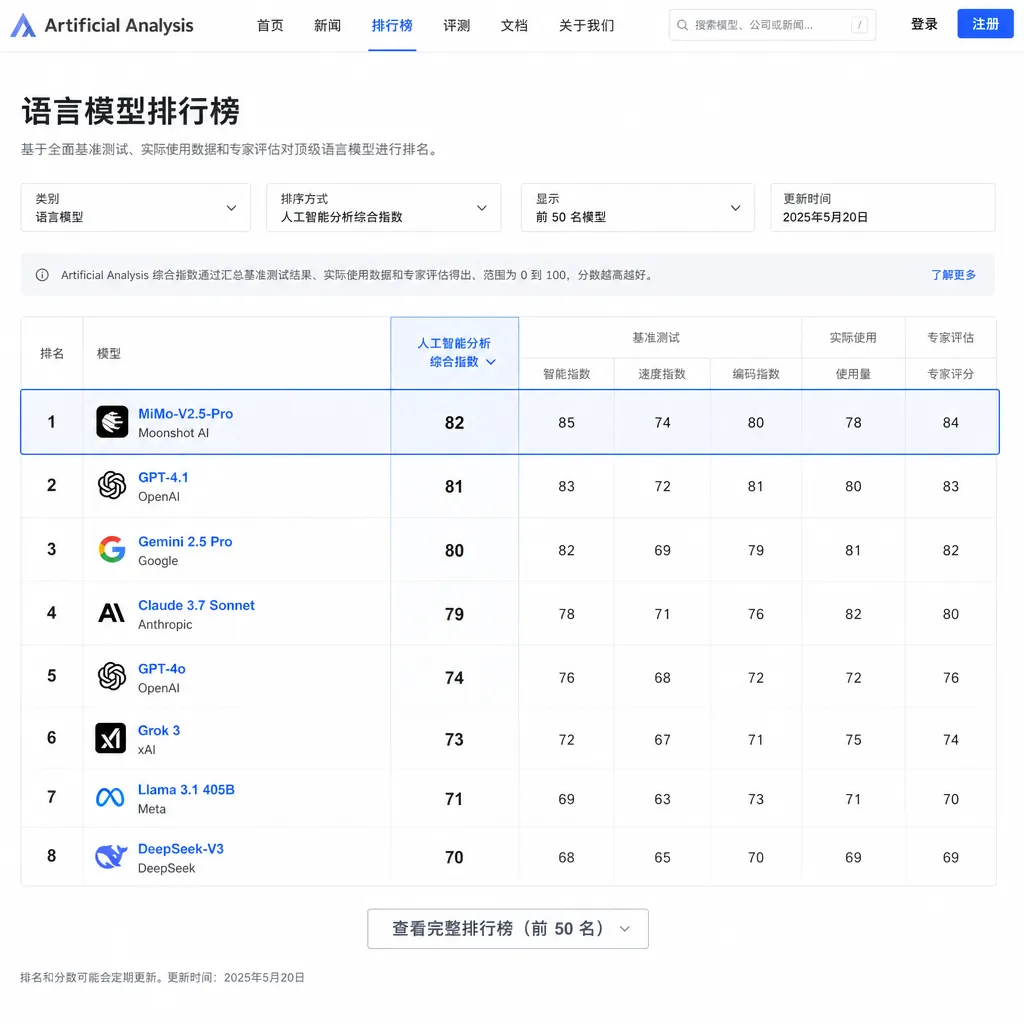
Double #1, but the key is Agent capability
Artificial Analysis is an industry-recognized, rigorous third-party evaluation platform. Its Intelligence Index combines skills like reasoning, coding, and mathematics, while the Agent Index specifically measures models’ autonomous decision-making and tool-usage capabilities in complex tasks. MiMo-V2.5-Pro topping both lists proves it’s not just gaming scores in one area.
To understand how hard this is, compare it to top closed-source models like Claude Opus 4.6 and GPT-5.4, which have long been benchmarks in Agent abilities. For an open-source model to catch up, it’s not just about parameters and training data — it’s also a test of architecture design and alignment strategies. Xiaomi sitting “at the same table” with them demonstrates that domestic open-source models are no longer just bystanders in the Agent race.
Further proof comes from OpenRouter platform data: MiMo-V2-Pro (note: this is V2-Pro, not the latest V2.5-Pro) topped the weekly chart with over 30% market share in a single week, hitting 4.82 trillion tokens in calls, ending Minimax’s streak at #1. And these calls weren’t inflated — developers voted with their feet, choosing a model that actually gets the job done.
MiMo-V2.5 Series: Four models, two tracks
Xiaomi’s MiMo-V2.5 series includes four models:
- MiMo-V2.5-Pro: Flagship model, focused on general agent capabilities, complex software engineering, and long-range tasks; benchmarked against Claude Opus 4.6 and GPT-5.4
- MiMo-V2.5: Native multimodal model, supports vision and audio comprehension, surpasses MiMo-V2-Pro in agent performance, supports 1 million token context
- MiMo-V2.5-TTS Series: Speech synthesis models
- MiMo-V2.5-ASR: Speech recognition model
MiMo-V2.5-Pro and MiMo-V2.5 are both globally open-sourced. Xiaomi didn’t do what many vendors do — release a stripped-down version — but instead open-sourced the full-strength Pro version. This either shows real confidence or an intent to quickly capture developer ecosystems through open-source. Judging from call volumes, the latter is already working.
Technical detail: Saving tokens means saving money
Compared with Moonshot’s Kimi K2.6, MiMo-V2.5-Pro saves 42% tokens; compared with Meta’s Muse Spark, MiMo-V2.5 saves 50% tokens. This looks like just a technical metric, but for developers it’s hard cash.
Example: Using MiMo-V2.5-Pro for a 1-million-token long-document analysis task saves 420,000 tokens over Kimi K2.6. With current API pricing (input tokens around 0.01–0.03 RMB per thousand tokens), that’s several to a dozen RMB per single task. For high-frequency enterprise use, monthly savings could exceed the model’s subscription cost.
Behind this are advances in model compression and inference optimization. Xiaomi hasn’t disclosed technical details, but results suggest possible work in:
- More efficient tokenizer: Improved tokenization to express the same meaning with fewer tokens
- Dynamic context pruning: Intelligent removal of redundant context while maintaining task quality
- Inference-time optimization: Reduced actual compute via KV cache reuse, speculative decoding, etc.
Pricing changes: Dropping complex billing, straight price cut
Xiaomi adjusted MiMo Token Plan pricing:
- Removed the “1 token = 4 credits” conversion; billed directly per token
- No price multiplier between 256k and 1M context windows
- Monthly subscription: Existing users with auto-renew get 30% off next month; new users get 23% off next month
- Annual subscription: One-off 12% discount, up to 948.96 RMB off
It seems like simplification, but it’s actually a price drop. Previously, billing complexity — variable rates by context length, separate billing for input/output tokens, conversion into credits — drew complaints. Token-based pricing now lets developers better plan costs.
Comparison (for 1M tokens input):
- GPT-5.4: ~30–50 RMB (context-length dependent)
- Claude Opus 4.6: ~45–60 RMB
- Kimi K2.6: ~20–35 RMB
- MiMo-V2.5-Pro: ~15–25 RMB (open-source free, API calls paid)
Xiaomi clearly aims to capture market share through price advantage. In open-source, that’s common — but matching closed-source top performance while costing half isn’t just a price war.
Luo Fuli and the 36-day iteration cycle
Notably, MiMo’s lead Luo Fuli, called the “genius girl” in the industry, is a former core member of DeepSeek. It’s been only 36 days from the MiMo-V2 series release to V2.5.
That iteration pace is aggressive for large models. Normally, major version cycles are at least 2–3 months due to retraining, alignment, evaluation, bug fixes. Delivering in 36 days suggests either massive team/compute investment or modular architecture allowing quick component swaps and upgrades.
Luo Fuli previously said, “When future models are stable enough, we’ll open-source them.” With MiMo-V2.5-Pro now open-sourced, Xiaomi evidently sees it as stable for widespread use. That’s good news for developers — no worries about abandonment mid-use.
MiMo-V2.5’s multimodal capability: More than “look and describe”
MiMo-V2.5 (non-Pro) focuses on native multimodal capability — supports vision and audio. “Native” matters: not just bolted image encoder + language model, but trained from the start to reason across modalities.
Specifically, MiMo-V2.5 can:
- Visual comprehension: Beyond identifying objects; understands spatial relationships, causality, timelines (e.g., infers processes from ordered screenshots)
- Audio comprehension: Identifies speech content, speaker emotion, background audio; infers scenes (e.g., hears keyboard/mouse clicks → deduces coding)
- Cross-modal reasoning: Given a product design image and a user feedback recording, integrates both to give improvement suggestions
This shines in Agent scenarios — e.g., debugging frontend: the agent sees code and browser screenshots, understands rendering vs. expected outcome, then recommends changes. Much more efficient than text-only models.
Chinese models’ call volume surpasses US for five weeks running
OpenRouter data shows Chinese models’ total call volume has exceeded US models for five consecutive weeks. This trend began Q1 2026 and is now stable.
Reasons:
- Cost-benefit: Chinese models are generally 30–50% cheaper; similar performance = cheaper choice
- Localization: Stronger in Chinese comprehension and domestic scenarios (e-commerce, short video, social media)
- API stability: Domestic APIs have clearly better speed/stability within mainland China
- Compliance: Easier to meet local data storage requirements with domestic models
Xiaomi’s MiMo series is a key player — MiMo-V2-Pro topping OpenRouter shows it’s not just low-price dumping, but genuinely useful and well-used.
Hermes Agent: Top contributor model
The financial report also notes Xiaomi’s MiMo model drove Hermes Agent to top global call-volume charts, becoming the #1 contributing model. Hermes Agent is an open-source AI agent framework supporting multiple models for quick agent app building.
MiMo as Hermes Agent’s top contributor shows:
- Strong agent capability: Developers/users choose MiMo for best task performance
- Ecosystem integration: Xiaomi isn’t just making models — it’s actively integrating with major open-source agent frameworks
For Xiaomi, this creates a positive loop: good model → developer adoption → more feedback data → faster iteration → even better model. DeepSeek rose through this loop; Xiaomi is doing likewise.
Open-source models’ commercialization challenge
Open-sourcing MiMo-V2.5-Pro seems generous, but monetizing open-source models is tricky. Meta’s Llama is open to push its AI infra/tools; Mistral open-sources but earns mainly from enterprise customization/private deployment.
Xiaomi’s commercialization paths might include:
- API services: Open-source free, API call charged — simplest/most common
- Hardware bundling: Preload MiMo on Xiaomi phones/IoT devices for edge AI — boosts hardware competitiveness
- Enterprise services: Private deployments, fine-tuning, custom builds — higher margins than APIs
- Ecosystem revenue share: Apps built on MiMo with revenue cut — like Apple’s App Store
Given the “over 60 billion RMB AI investment in three years” disclosure, Xiaomi isn’t expecting near-term AI profits — it’s racing for market share and tech leadership, echoing its smartphone strategy of “hardware at cost, earn from services/ecosystem.”
What it means for developers
If you’re a developer, MiMo-V2.5-Pro topping charts impacts you:
- A reliable open-source option: Few strong open-source models — Llama 3.3, Qwen 2.5, DeepSeek-V3 — now MiMo-V2.5-Pro joins
- Lower agent app costs: For agent projects, MiMo-V2.5-Pro’s cost-performance is attractive, especially for long-context/complex reasoning
- Easier multimodal access: Native multimodal beats DIY multimodal via stitching models
- Stable domestic API: For mainland Chinese users, domestic APIs are faster/more stable
Potential issues:
- Open-source license: Xiaomi hasn’t disclosed MiMo-V2.5-Pro licensing specifics — confirm before commercial use
- Model stability: 36-day iteration = rapid evolution — API/behavior may change
- Community ecosystem: Still thinner than Llama/Qwen — fewer readily available solutions
New phase for domestic large models
MiMo-V2.5-Pro topping global open-source rankings marks domestic models moving from “catch-up” to “running alongside” and even “leading.”
Progress over 2 years:
- Early 2024: Domestic models chasing GPT-4
- Mid-2024: DeepSeek-V2 shows parity with GPT-4 in some aspects
- Late 2024: Qwen 2.5, DeepSeek-V3 put domestic models in open-source first tier
- 2025: Claude Opus 4.6, GPT-5 raise closed-model ceilings
- Q1 2026: Xiaomi MiMo-V2.5-Pro proves domestic Agent ability matches top closed models
The pace is stunning. Two years ago: “When will Chinese models catch GPT-3.5?” Now: “When will open-source surpass closed-source entirely?”
Still, closed-source advantages remain:
- Comprehensive capabilities: GPT-5, Claude Opus 4.6 balanced with no major weaknesses
- Stability: Mature API services with SLA guarantees
- Safety: Stronger content safety, alignment, jailbreaking prevention
- Ecosystem: Richer developer ecosystems/toolchains from OpenAI, Anthropic
Open-source beating closed-source in all respects will take time, but in niches like agent, long context, multimodal, open-source already shows strength.
Xiaomi’s AI ambitions
Financials show Xiaomi’s serious AI commitment: 16 billion RMB this year, 60B+ over three years — among China’s top-tier tech firms (Alibaba, Tencent, ByteDance possibly invest more but disclose less).
Xiaomi’s AI advantages:
- Hardware ecosystem: Phones, IoT, cars — direct AI integration potential
- User scale: Over 600M global users — valuable training data
- Rich scenarios: From smart homes to smart driving — broad AI application coverage
- Engineering capability: Strong software engineering — all AI execution needs covered
Weaknesses:
- Compute power: Smaller than Alibaba/Tencent/ByteDance — relies on cloud providers
- AI talent: Even with top hires like Luo Fuli, smaller/depth than BAT
- Data quality: Mostly hardware-derived — less internet content (text/images/video) than content platforms
Xiaomi’s strategy: play to strengths — open-source to win developers, landing AI in hardware, price to capture share. Success will depend on execution.
Final thoughts
MiMo-V2.5-Pro topping global open-source charts is a milestone for domestic models, not the finish line. Large-model competition is just starting, with dizzying tech iteration.
For developers, it’s a great time — more strong, cheap, accessible models — but also stressful: tech changes so fast today’s skills may be obsolete tomorrow.
Xiaomi’s achievement deserves recognition, but the real question is whether it can keep iterating and leading. In large-model races, no one can rest on past glory. A 36-day release cycle is both strength and pressure.
References
- Xiaomi Group: Q1 revenue 99.14B RMB - 36Kr — Official Xiaomi Q1 2026 financials
- Xiaomi dual models officially open-source! MiMo-V2.5-Pro worked through “macOS” without interruption - Zhihu — MiMo-V2.5 technical details and performance comparison


