
Kuaishou Keye 2.0 introduces DSA to multimodality for the first time, with 30B parameters matching a 200B open-source model.
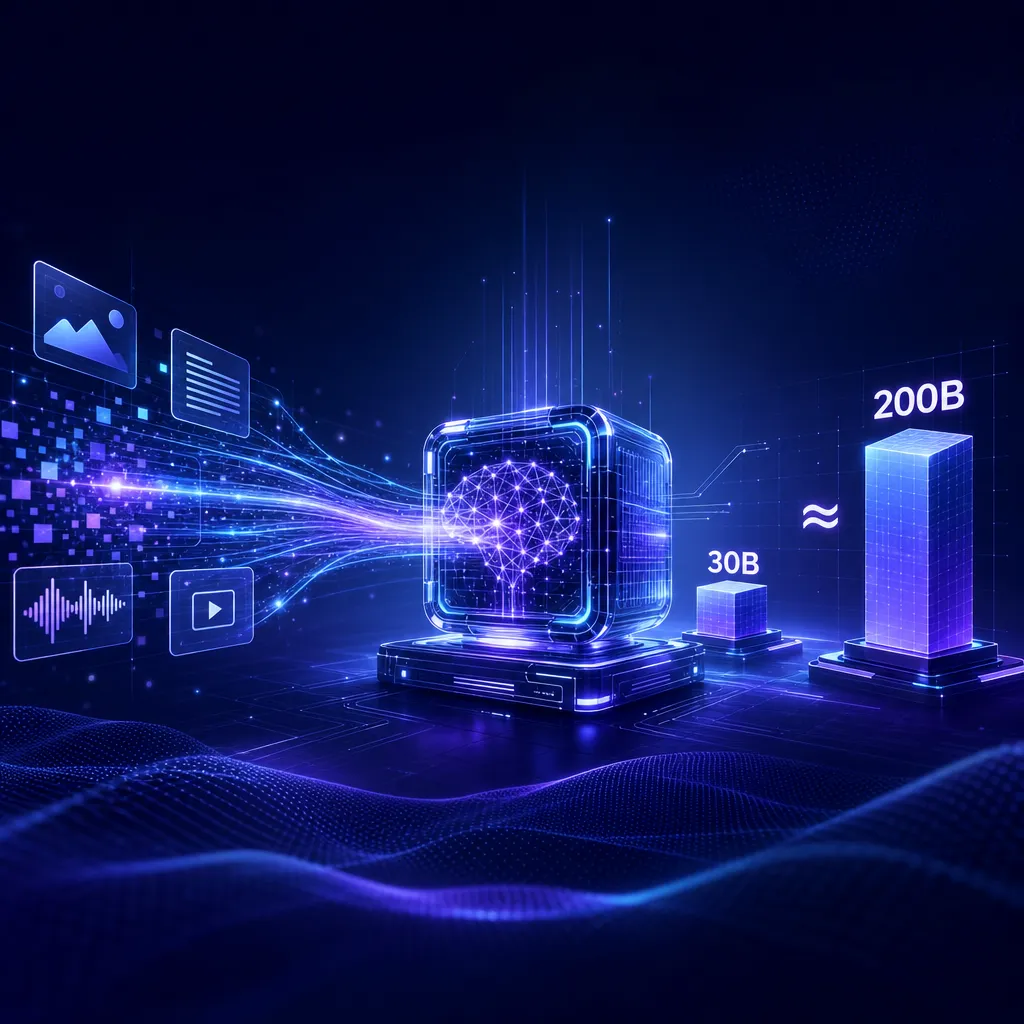
Kuaishou releases Keye-VL-2.0-30B-A3B, applying the DeepSeek sparse attention mechanism in multimodal scenarios for the first time, supporting a 256K ultra-long context. Its long video comprehension capability rivals the closed-source Gemini model, while reducing inference cost by 50%.
Kuaishou Keye 2.0 Introduces DSA to Multimodal for the First Time, 30B Parameters Match 200B Open-Source Models
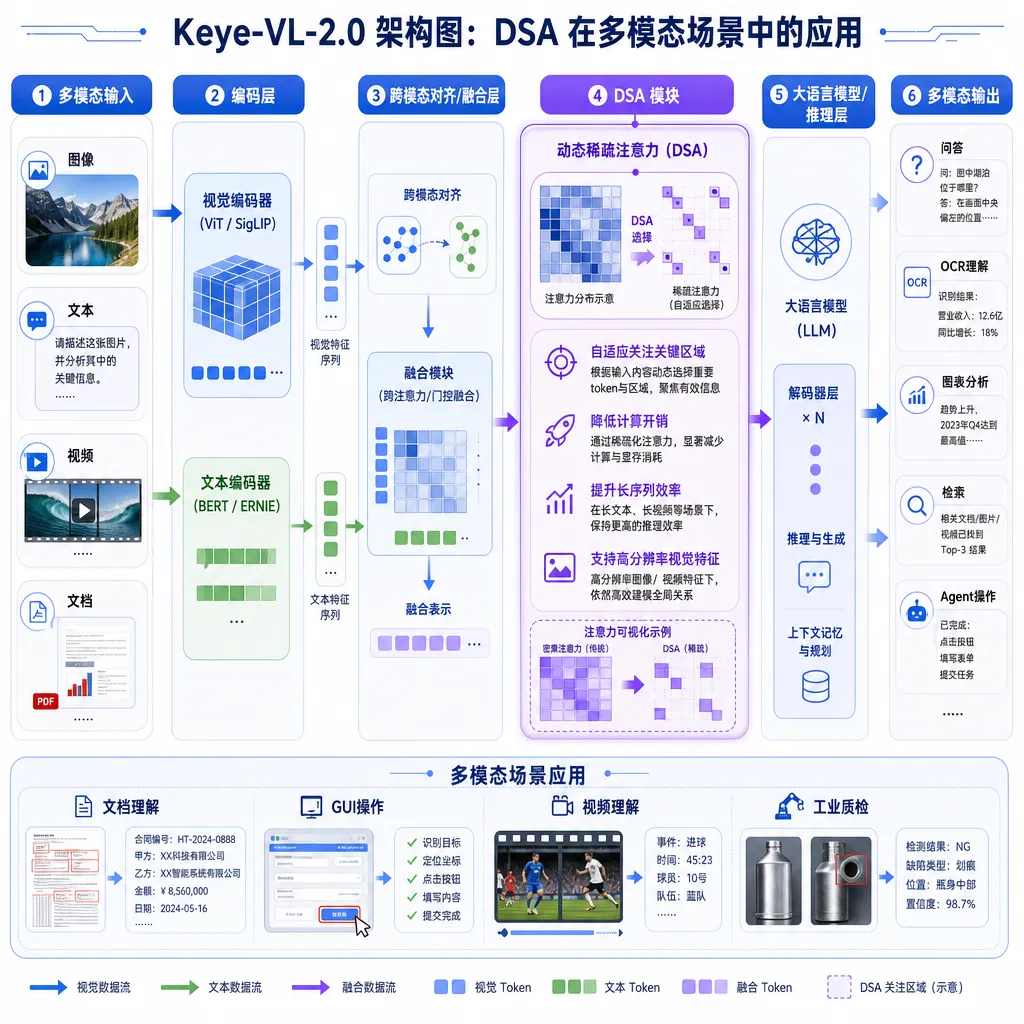
Kuaishou has just released its new version of the multimodal large model Keye-VL-2.0-30B-A3B, with the key highlight being the introduction of DeepSeek’s sparse attention mechanism (DSA) into multimodal understanding — an industry first.
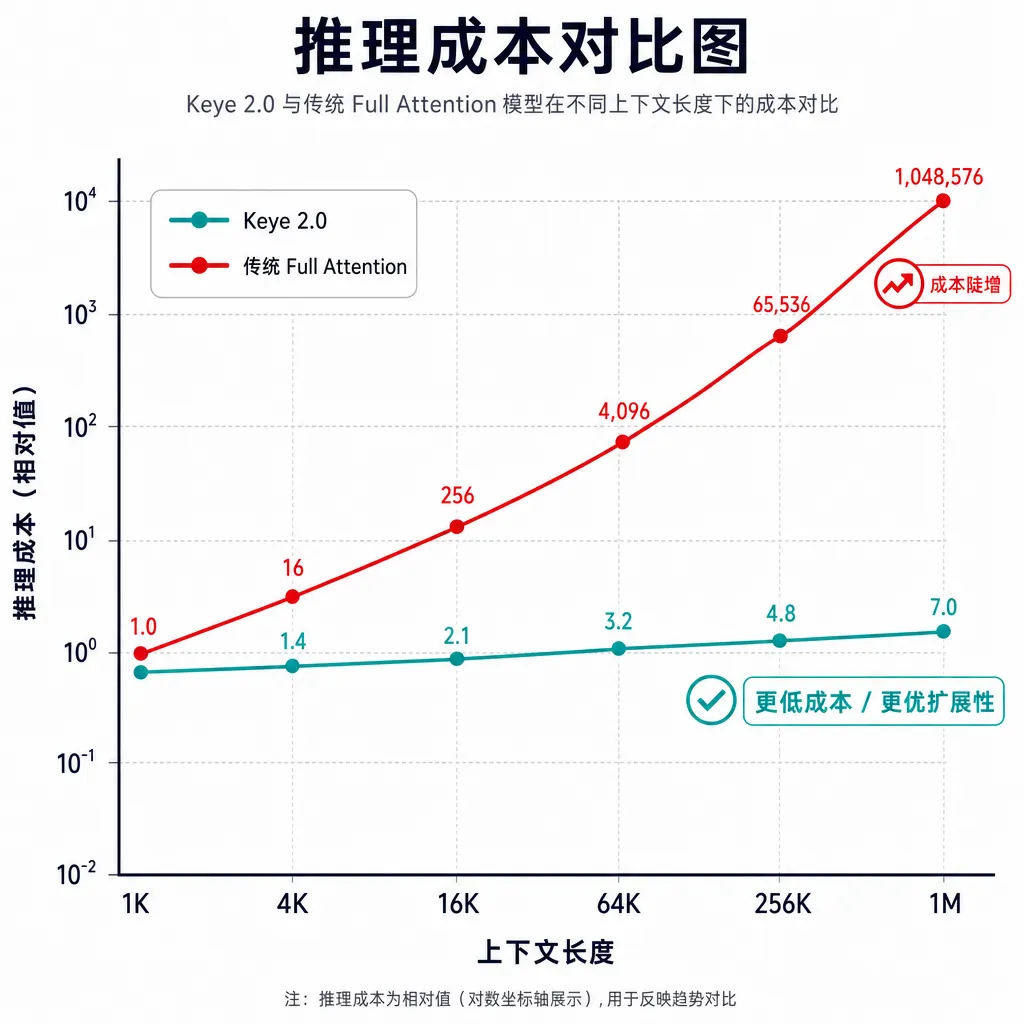
This move is not just for show. DSA addresses the compute bottleneck in long video comprehension: with traditional Full Attention, processing hour-long videos causes exponential growth in computation. Keye 2.0 slashes Prefill costs by 50% via sparse attention, and the cost curve in the Decode stage becomes extremely flat. As a result, the 30B parameter model not only outperforms same-level open-source bases in multiple temporal understanding tasks, but even surpasses super large 200B+ parameter models across tiers.
DSA Is Not New, But This Is the First Use in Multimodal
DSA itself is not new — DeepSeek-V3 showcased sparse attention’s power in pure text scenarios: by letting each token attend only to a relevant subset, rather than all tokens globally, computational complexity is greatly reduced. But multimodal scenarios are more complex — video frames, image patches, and text tokens are mixed together, with temporal, spatial, and semantic information intertwined. Deciding how to allocate sparse attention, which features to retain, and which to discard, are new challenges.
The Kuaishou team combined "spatiotemporal unified encoding" and "long-term feature aggregation." Specifically, they used a Slow-Fast encoding strategy for video: calculating cosine similarity at the patch level for consecutive frames. Frames with similarity above 95% are marked as "fast frames" (high frame count, low resolution), and others as "slow frames" (low frame count, high resolution). Slow frames preserve high-resolution details, and fast frames receive only 30% of the token budget of slow frames. This ensures key frames are information-dense while controlling total token count.
Then, DSA is introduced in the attention layer, allowing the model to precisely locate truly important visual features and temporal relationships in ultra-long sequences, without being drowned in redundancy.
Long Video Understanding: From "Seeing" to "Comprehending"
There are plenty of long video understanding models in the industry, but most are stuck with two issues: first, "long context decay" — the more frames are input, the more diluted the attention, and accuracy drops; second, they can only perform surface-level perception, lacking deep reasoning.
Keye 2.0 completely reversed the decay trend on VideoMME V2. When input was expanded from 64 frames to 512 frames, the average accuracy rose from 35.34% to 42.44%, and the nonlinear score (representing complex logical depth) climbed from 18.54 to 24.19. This means the model not only "sees" more frames but truly "comprehends" them.
On LongVideoBench, Keye 2.0 scored 74.10 — far exceeding same-level open-source models and approaching top closed-source giants. The Kuaishou team tested an 8-minute documentary "Changbai Mountain Cloud Palace Snow Sculpture Reconstruction," asking the model for scene segmentation and narrative summarization. The model precisely split it into eight core scenes, identified the key turning point "unprecedented winter rain causing snow structure collapse," extracted the engraving "Revitalize the Northeast" from the imagery, linked it to character backgrounds, and summarized the deeper theme: "Snow and ice projects embody the passionate desire of Northeasterners to revive their hometown."
This is not simple OCR + subtitle stitching — it is genuine cross-modal reasoning.
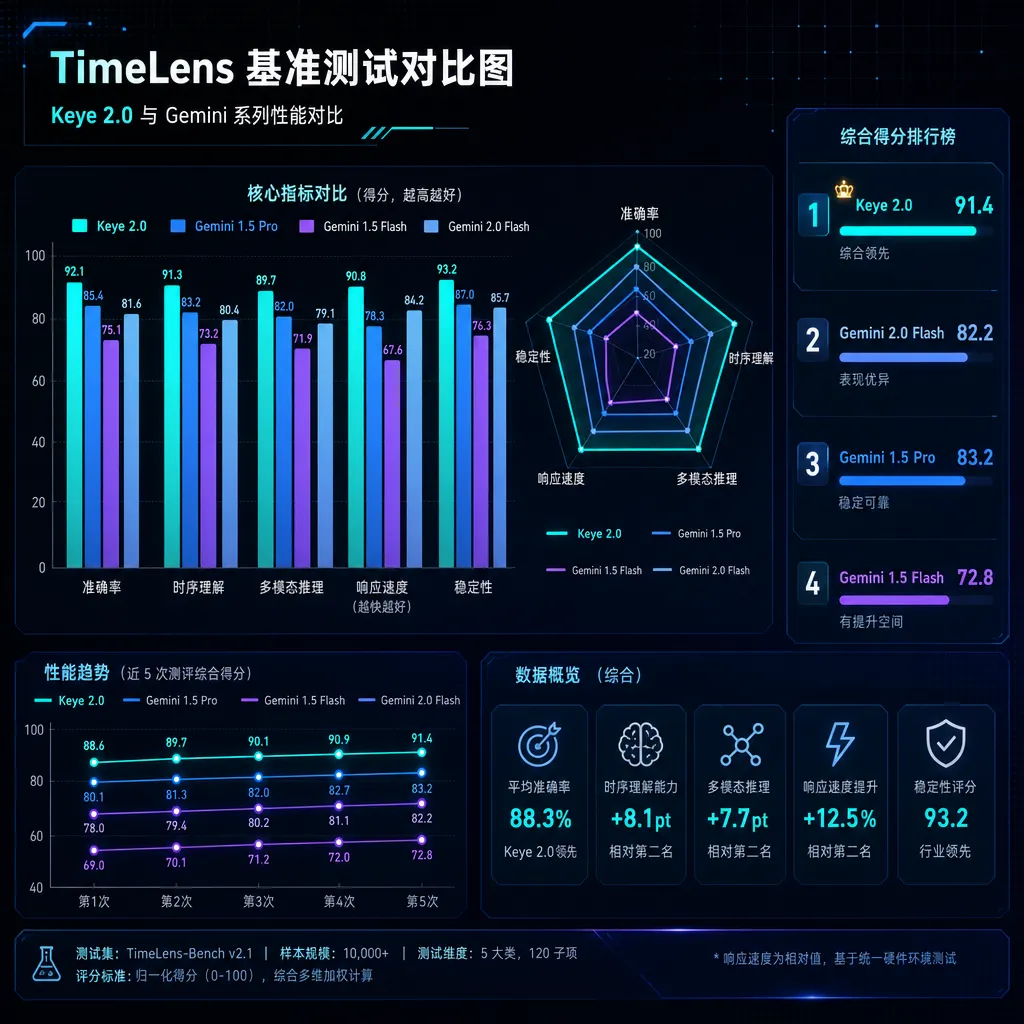
TimeLens Benchmark: Going Head to Head with Gemini Closed-Source Models
TimeLens is one of the most challenging video temporal understanding benchmarks, requiring not only action recognition but also precise temporal boundaries. Keye 2.0’s performance on three sub-tasks:
- Charades-TimeLens (daily action temporal parsing): mIoU 58.27, comparable to Gemini 3 Flash (61.19) and Gemini 3.1 Pro (55.71) in real-world tests
- ActivityNet-TimeLens (video action localization): mIoU 58.54, surpassing official Gemini-2.5-Pro (58.1) and real-world Gemini 3 Flash (56.95) & Gemini 3.1 Pro (55.08)
- QVHighlights-TimeLens (highlight moment extraction): mIoU 69.92, on par with top closed-source models, far outperforming Gemini 3 Flash (49.45) and Gemini 3.1 Pro (46.09) in real-world tests
The Kuaishou team tested with a video of the pottery cup-making process: from clay digging, firing, slip casting, and trimming, to glaze mixing and tea conditioning — over a dozen steps. The model not only recognized all processes but precisely aligned each action to the video timeline at millisecond precision. This fine-grained temporal awareness is rare in 30B parameter-level open-source models.
Agent Capabilities: From "Observer" to "Actor"
Keye 2.0 is the first in the Keye family to embed Agent collaboration capabilities. This means the model is no longer a passive responder but can actively plan tasks, call tools, and perform operations.
In Code Agent capabilities, the model scored 77.10 on LivecodeBench v6 and 39.20 on OJBench — ahead of same-level models and even surpassing some 200B parameter open-source bases. In the SWE-bench Verified task, closer to real business cases, the model achieved a baseline score of 62.00, capable of locating and fixing code issues.
In Tool Agent capabilities, the model scored 82.58 on TAU2-Bench, 65.72 on BFCL-V4, and 33.12 on VITA-Bench. The team tested a complex command: query stores with specific tags, calculate delivery distances by coordinates, filter goods, create hotel and delivery orders. The model autonomously planned and sequentially called APIs like get_delivery_store_info, longitude_latitude_to_distance, and create_hotel_order over a dozen times without crashes or errors.
This multi-step task breakdown and tool orchestration is crucial for real business scenarios. Internally, Kuaishou already uses Keye 2.0 for smart editing, content moderation, search recommendations, and more. Agent capabilities shift workflows from "human + AI assistance" to "AI-led + human oversight."
Technical Details: MOPD Solves Multi-Task Forgetting
The biggest pitfall in multi-task learning is "catastrophic forgetting" — after learning new tasks, performance on old tasks declines significantly. The Kuaishou team used MOPD (Multi-Expert Policy Distillation/Merging) to address this.
The core idea: first train multiple "homogeneous models" (same architecture, different data ratios or random seeds) and "heterogeneous models" (expert weights separately strengthened for weak areas like OCR or math). Then, use bucket advantage scaling to finely model structure organization, teacher expression, perception representation, and reasoning computation at the token level, and finally integrate these weights.
The benefit: when learning new capabilities, the model doesn’t sacrifice general base abilities. The final Keye 2.0 release shows comprehensive performance spikes in Video, Agent, Math & Reasoning, STEM, and Instruction Following, with no obvious weaknesses.
The team also applied MOPD for repeated crash prevention — in long sequence generation, models tend to loop or crash, and traditional methods only give vague negative feedback. MOPD uses multi-granularity detection and precise localization to turn negative feedback into traceable optimization signals, greatly improving robustness in long sequence generation.
Post-Training: Context-RL Suppresses Hallucinations
In the post-training stage, the team designed a multimodal reinforcement learning system centered on a Context-RL reward mechanism.
Traditional RLHF often runs into issues in multimodal: the model might "fabricate" content absent from the video, or exhibit logic gaps in multi-step reasoning. Context-RL forces the model to strictly anchor to the input, forbidding divergence. The reward function simultaneously considers rule-based rewards (checking JSON, Markdown, etc. structures via regex and AST parsing), generative rewards (logic consistency evaluation via external large models), and model rewards (fine-grained preference scores from the Keye-Reward model).
To ensure data quality, the team crafted a stringent filtering process: auto-generating step-by-step answers, grading them with a second model, manually refining and re-reviewing mid-tier samples, and directly storing high-score samples. This "high SNR data + high-precision rewards" combo breaks cheating and collapse issues in RL training.
The result: Keye 2.0’s tendency toward hallucinations in visual perception and multimodal reasoning was greatly suppressed, with qualitative leaps in decision stability during long-range reasoning.
Compute Efficiency: Inference Cost Reduced by 50%
With DSA architecture and system-level engineering optimizations, Keye 2.0 cuts long sequence Prefill cost by 50%. More importantly, as the input video context lengthens, traditional Full Attention’s Decode compute explodes exponentially, while Keye 2.0’s DSA-based Decode cost curve stays extremely flat.
The team also implemented several system-level optimizations:
- ExtraIO architecture: deploy IO separately and scale on demand, eliminating IO bottlenecks from video decoding and frame extraction
- ViT-LM heterogeneous parallel + two-level load balancing: solving compute/memory balance issues in long video and variable sequence lengths
- ViT activation zero-memory optimization (Recompute/Offload): further reducing memory usage
These optimizations allow the 30B Keye 2.0 to far exceed 200B+ open-source models in inference efficiency, providing highly competitive low-cost solutions for large-scale ultra-long video deployment.
Business Deployment: Not Just Benchmark Score Farming
Kuaishou has already applied Keye 2.0 internally across three dimensions:
1. Content Understanding & Recommendation
Keye 2.0’s fine-grained long video perception and text-image parsing abilities are integrated into generative recommendations, content ecosystem governance, and commercial targeted delivery. The model captures the "between-the-lines" nuances and temporal logic like a human, greatly improving recommendation precision, and achieving significant commercial gains in precise ad tagging extraction.
2. Automated Production Pipeline
The combination of "precise multimodal understanding + Agent automated orchestration" creates an end-to-end fully automated loop: from smart retrieval in massive video libraries, key highlight slicing, to automated editing & packaging based on logical progression, and generating marketing copy aligned with viral trends. Keye 2.0 lowers the barrier for producing high-quality content.
3. Safety Governance
Kuaishou’s safety algorithm team uses Keye 2.0 for content moderation — the model can not only detect prohibited imagery but also understand contextual meaning to judge if there is subtle violation expression. This depth of understanding improves both precision and recall in moderation.
New Benchmark for Open-Source Models
Keye 2.0’s success proves one thing: in multimodal understanding, parameter size is not the only variable — architectural innovation and engineering optimization matter equally. Matching a 200B open-source model with 30B parameters, and even approaching top closed-source models like Gemini, was achieved through a combination of DSA sparse attention, Slow-Fast encoding, MOPD multi-task integration, and Context-RL hallucination suppression.
The Kuaishou team said Keye 2.0’s success will be migrated to larger-scale models, aiming for true Native Multimodal and end-to-end deep integration. Judging from its current performance, this trajectory is promising.
Keye-VL-2.0-30B-A3B is now open-source, supporting 256K ultra-long context. Developers can directly apply it for long video understanding, multimodal reasoning, and Agent collaboration. For hour-long video processing with low cost and high efficiency needs, this model is a solid choice.
References
- Kuaishou’s self-developed multimodal large language model successfully introduces DSA - Linux.do - Community discussion post with model key feature overview
- Ten Minutes to Understand DeepSeek-V3.2 Sparse Attention DSA - Zhihu column - DSA technical principle analysis
- Keye-VL-2.0-30B-A3B - Hugging Face - Model weights and technical documentation
- Keye GitHub Repository - Open-source code and usage guide


