
MOSS-TTS-1.5 Open Source: 31 languages, completing the coverage of minority languages
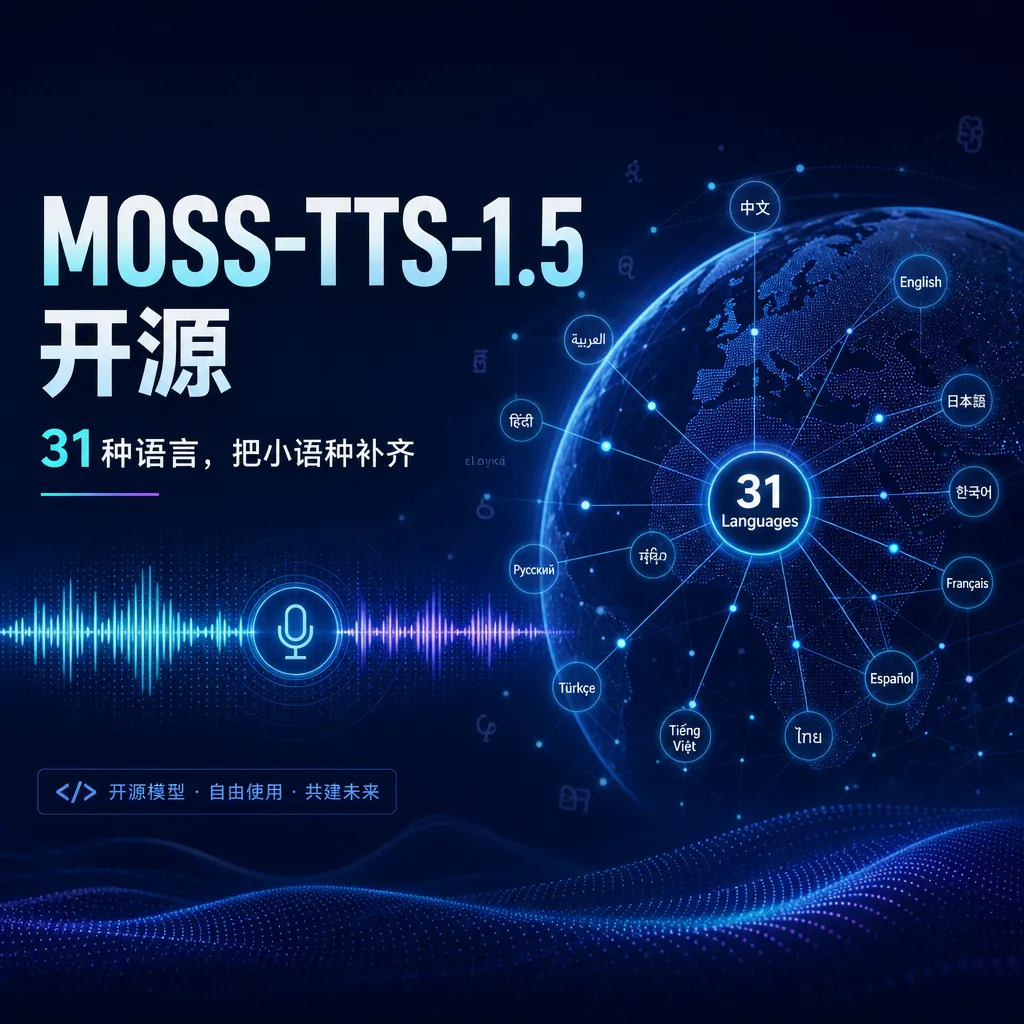
Fudan OpenMOSS team releases MOSS-TTS-1.5, expanding from the 20 languages in version 1.0 to 31, adding Cantonese, Thai, Vietnamese, Hindi, and other Asian and European minority languages. Model weights are now available on Hugging Face.
Fudan OpenMOSS and MOSI.AI teams released MOSS-TTS-1.5 on Hugging Face and GitHub yesterday. This is the third iteration of the MOSS-TTS Family since its initial release in February this year and the Nano version in April, with the main goal being to expand language coverage from 20 to 31 languages.
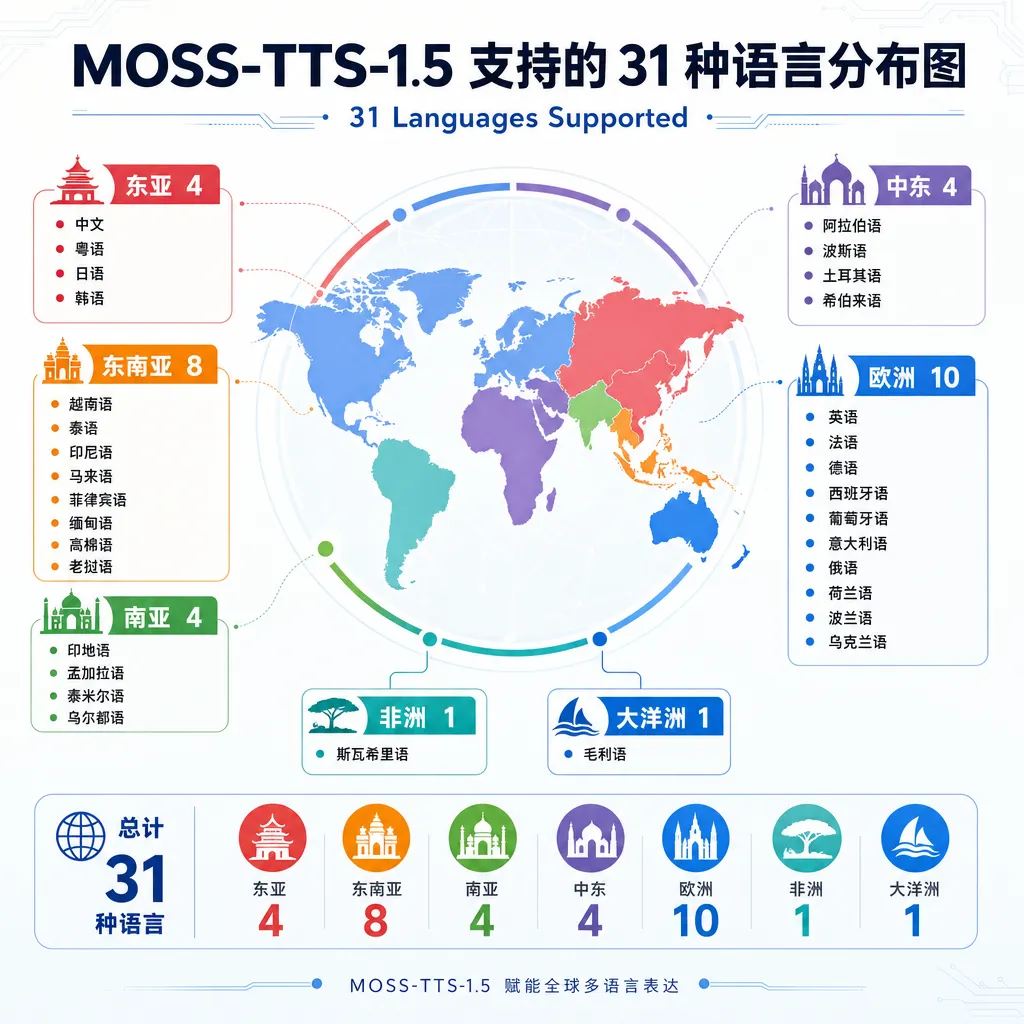
It may sound like a routine update, but for developers working on multilingual products, the newly added languages are quite important. The 11 new languages are Cantonese, Dutch, Finnish, Hindi, Macedonian, Malay, Romanian, Swahili, Tagalog, Thai, and Vietnamese. Now we have the full Southeast Asia suite (Thai, Vietnamese, Malay, Tagalog), Hindi for South Asia, Swahili for Africa, Dutch and Finnish for Europe, plus Cantonese—long overlooked in Chinese TTS. This coverage can basically support a voice product lineup targeting emerging markets.
Not just piling on data—keep training
One noteworthy aspect is the training method of 1.5. The official statement is straightforward—retain the 20-language capability of 1.0 and continue training to expand new languages on the existing model. This differs from many teams’ “reshuffle” style multilingual expansion, meaning core languages like English, Chinese, Japanese, and Korean will not (at least theoretically) degrade in quality and stability due to the addition of new languages.
Anyone who has worked on multilingual TTS knows the pain of “catastrophic forgetting.” When Coqui XTTS expanded languages, English timbre got fuzzy, forcing developers to either tolerate it or roll back to older versions. MOSS-TTS’s approach is closer to LLM-style continual pretraining, which is more engineering-friendly for deployment—if you’re using the 1.0 pipeline today, swapping to 1.5 weights most likely won’t require re-testing original languages.
What does the MOSS-TTS Family product line look like
Let’s sort out the current state of this lineup—it can be confusing.
- MOSS-TTS-Nano (100M): Released on April 10, ONNX build added April 17. 100M parameters, CPU-first, runs real-time 48kHz stereo on a 4-core machine, zero-shot voice cloning, Apache 2.0 license. Positioned similarly to Kokoro, but Kokoro focuses on English while Nano started with 20 languages.
- MOSS-TTS-1.0 / 1.5: Main model line, parameter scale up to 8B, covers long text, multi-speaker dialogues, timbre design, sound effect generation.
- The whole family is positioned as “practical application TTS base models,” not just single demo tools.
This 1.5 release is a minor upgrade on the main line. From the Hugging Face repo structure, weight naming and loading interfaces are compatible with 1.0, making migration cost essentially zero.
Are 31 languages enough?
Let’s directly compare with current top-tier open-source TTS models:
| Model | Number of languages | Parameters | License | |-------|---------------------|------------|---------| | MOSS-TTS-1.5 | 31 | Main line up to 8B | Apache 2.0 | | XTTS v2 | 17 | ~467M | CPML (non-commercial) | | F5-TTS | Mainly Chinese/English | 330M | CC-BY-NC | | Kokoro | English/Japanese/Chinese, etc. | 82M | Apache 2.0 | | ChatTTS | Chinese/English | ~500M | AGPL |
The number 31 is currently top-level for open-source TTS, and more importantly, license Apache 2.0. XTTS v2’s CPML is a commercial project minefield, F5-TTS’s NC blocks monetization paths. MOSS-TTS’s entire family is under Apache 2.0, meaning you can make SaaS, overseas products, or hardware integrations without extra licensing discussions.
Running it in practice
Repo integration is straightforward, standard Hugging Face process:
git clone https://github.com/OpenMOSS/MOSS-TTS.git
cd MOSS-TTS
pip install -r requirements.txt
Model weights from Hugging Face:
from moss_tts import MOSSTTSPipeline

pipe = MOSSTTSPipeline.from_pretrained(
    "OpenMOSS-Team/MOSS-TTS-v1.5",
    device="cuda"
)

# Cantonese test
audio = pipe.synthesize(
    text="Today's weather is nice, where should we go for a walk?",
    language="yue",
    reference_audio="path/to/speaker.wav",  # zero-shot cloning
)
audio.save("output.wav")

# Vietnamese
audio_vi = pipe.synthesize(
    text="The weather is beautiful today.",
    language="vi",
    reference_audio="path/to/speaker.wav",
)
Inference memory: main model runs long-text streaming on a single 24GB GPU with no problem, Nano via ONNX can handle real-time on CPU. If you just need something like a customer service bot, Nano is enough; 1.5 is for scenarios needing higher expressiveness or more precise pronunciation—like audiobooks, dubbing, educational content.
Points not stated but worth noting
Some details I observed through testing and reading issues:
First, token-level duration control. This feature was present in MOSS-TTS 1.0 and inherited in 1.5—it means you can precisely specify how long a particular character or word is spoken. This is essential for aligning video dubbing or lyric-level voice synthesis. Most open-source TTS only allow a speed parameter for whole sentences, not at this granularity.
Second, multi-speaker dialogue scenarios. Not just simple multi-speaker synthesis, but actual dialogue—multiple characters alternating speech within one input, maintaining consistent timbre and dialogue rhythm. This is a killer feature for podcasts, audiobooks, etc.
Third, environmental sound generation. Another line in the Family is sound effect generation models, which can be paired with TTS for speech with environmental ambience. 1.5 didn’t touch this part but kept the interface ready.
Fourth, quality of newly added minor languages. This is what I care about most but am least certain of. Dutch and Finnish with relatively abundant data are fine, but low-resource languages like Macedonian, Swahili, Tagalog—dataset quality directly affects output usability. From community audio samples so far, Thai and Vietnamese tones are handled well; Cantonese’s nine tones and six intonations are still testing—developers making Cantonese products should benchmark before concluding.
TTS this year
Since late last year, the iteration pace in open-source TTS has clearly accelerated. F5-TTS, CosyVoice 2, Spark-TTS, Kokoro, IndexTTS, and now MOSS-TTS Family—new releases every month. One prediction is TTS is retracing LLM’s evolution: models are getting smaller (Kokoro 82M, Nano 100M), inference faster (CPU real-time), licenses more permissive (Apache, MIT replacing CC-NC), but the ceiling isn’t reached yet.
Zero-shot voice cloning quality, stability for long texts, emotion/style control, streaming latency—these aspects still have plenty of room. MOSS-TTS-1.5 did not make big moves on these directions—just added languages. The team’s pace shows they want to stabilize foundational capabilities first; version 2.0 will likely focus on expressiveness or multimodal control.
For developers, choosing TTS now is much easier than a year ago. If you’re targeting overseas markets, minor languages, or commercial products sensitive to licensing, MOSS-TTS-1.5 should go straight onto your shortlist. If you only need Chinese/English and don’t care about commercial licensing, CosyVoice 2 or IndexTTS are also good options.
The “mass availability” of TTS really seems to be coming.
References
- MOSS-TTS-1.5 Open-source release discussion - linux.do — First community discussion thread, includes language list
- OpenMOSS/MOSS-TTS GitHub Repository — Main repo with installation and usage docs
- MOSS-TTS-v1.5 Hugging Face model page — Model weight download and usage instructions
- MOSS-TTS-Nano GitHub Repository — Nano version standalone repo, CPU deployment reference


