
DeepSeek V4 Launches This Month: Trillion-Parameter Open Source Model, Priced at Only One-Fifth of GPT-4o
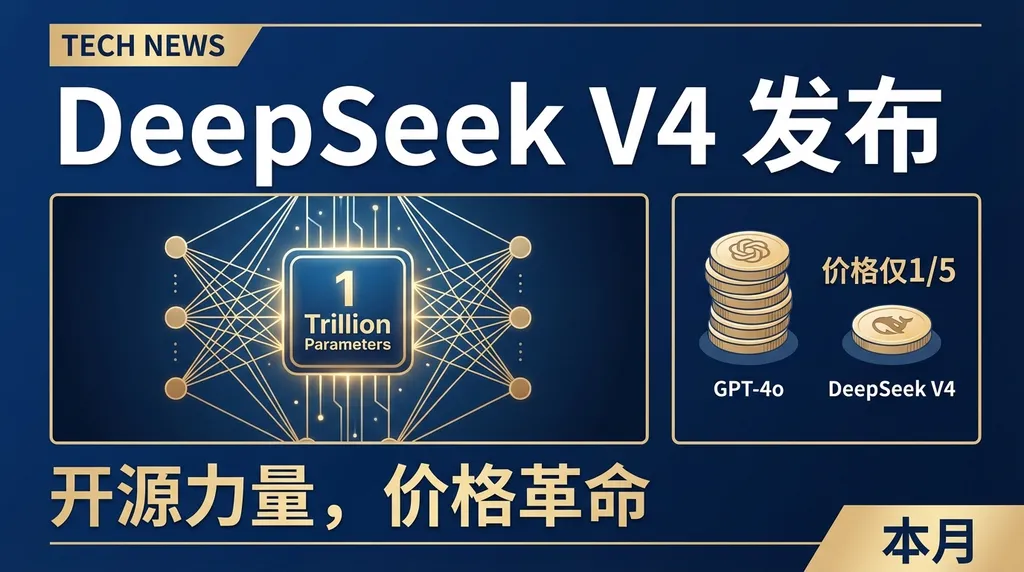
DeepSeek V4 confirmed for April 2026 release — trillion parameters, million-token context, native multimodality, Apache 2.0 open source, API input pricing at only $0.5 per million tokens, programming benchmark scores surpass GPT-5 and Claude Opus.
DeepSeek V4 is set — this month.
After multiple delays around the Spring Festival, Liang Wenfeng’s team has finally sent a clear signal: official release in April 2026. Trillion parameters, million-token context window, native multimodality, Apache 2.0 open source. This is not a minor iteration in one dimension—it’s a generational leap, laying all the cards on the table.
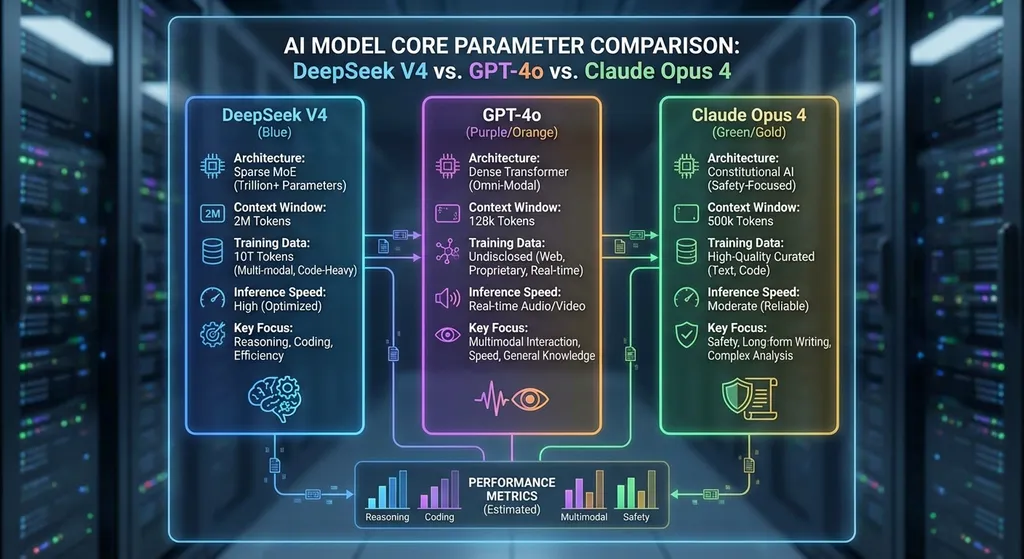
The price is even more exciting: API input costs only $0.5 per million tokens. GPT‑4o costs $2.5, Claude Opus 4 costs $15. In other words, with the same budget, you can run 30 times more with V4 than with Opus.
This article breaks down the core technical breakthroughs of V4, what they mean for developers, and why this “delay” might actually be a positive sign.
First, about that delay
The large-parameter version of V4, originally slated for release around the Spring Festival, has been postponed to April. A smaller version was already released early this January to the open-source community for adaptation, but the big one never showed up.
According to people close to the project, the main reason for the delay was that Liang Wenfeng’s team spent the past half year fixing key technical shortcomings—especially in long-term memory (LTM) and multimodal integration. It wasn’t that they “couldn’t get it done,” but that they “didn’t want to launch a half-finished product.”
From V1 to V4, DeepSeek took just two years, with fewer than 200 people—an aggressive pace even by global standards. Hitting the brakes at the last moment suggests that V4 isn’t just meant to be “a little better than V3,” but to raise the ceiling for open-source models in one decisive leap.
Trillion parameters + million-token context: more than big numbers
First, parameters. V4 reaches the trillion-parameter scale, but that doesn’t mean all trillion are used during inference. Starting from V2, DeepSeek adopted a Mixture of Experts (MoE) architecture, and V4 likely continues this design—only a subset of parameters are activated per inference. That’s the underlying reason they can drop API prices to $0.5.
Next, the context window. What’s a million tokens? Roughly 7.5 million English words—enough to fit the entire Three-Body Problem trilogy plus hundreds of thousands of lines of code at once.
For developers, this means:
- You can feed entire large codebases for analysis, refactoring, and vulnerability detection—no more manual chunking.
- Long-document processing (contracts, research reports, technical docs) no longer needs hacky segment-stitching.
- In agent scenarios, full dialog history and tool calls can be preserved without constant summarization.
Compared with V3, this expanded context isn’t just “a bigger number.” Traditional transformers scale attention with O(n²) complexity; computing attention over 1M tokens would be infeasible. V4 introduces architectural changes here—its core technical breakthrough.
Long-Term Memory (LTM): possibly the most underrated V4 capability
A model’s memory has long been a headache. Even a huge context window is still “working memory”—it’s gone when the chat ends. Talk with GPT about a project for three months, start a new session, and it remembers nothing.
V4 introduces a self-developed Engram (memory imprint) conditional memory system that decouples knowledge storage and dynamic reasoning at the architecture level.
In plain terms: V4 has an independent long-term memory module that can permanently store conversation history and knowledge base information, with retrieval complexity near O(1). This isn’t a retrieval-augmented generation (RAG) add-on, but a natively supported feature.
That’s huge for agent developers. One of today’s most painful issues in agent architectures is state management—you need an external memory system to save and reinsert key data between conversations. If V4 can solve that at the model level, agent development complexity drops dramatically.
Of course, “near O(1)” will need real-world verification. Details of the Engram mechanism aren’t public—whether it sparsifies attention or uses an external memory network remains to be seen. But if it works as internal tests suggest, this could be V4’s most valuable long-term contribution.
Programming ability: top benchmark scores—but the real story is engineering power
First, the scores:
| Benchmark | DeepSeek V4 | GPT‑5 | Claude Opus 4 | |------------|-------------|-------|---------------| | HumanEval | 87.6%+ | — | — | | SWE‑Bench Verified | 83.7% | <83.7% | <83.7% | | Design2Code | 92% | — | — |
HumanEval 87.6%, SWE‑Bench Verified 83.7%—reportedly surpassing GPT‑5 and Opus—and Design2Code at 92% accuracy.
But benchmarks are just one dimension. More exciting is V4’s advance in engineering‑level programming:
- Supports 338 programming languages
- Understands hundreds of thousands of cross‑file code lines (with million‑token context)
- Performs automatic project refactoring, vulnerability detection, and test generation
That means V4 isn’t just a “Copilot for writing functions” but an engineering partner that understands full‑project context and performs system‑level tasks—especially valuable for developers handling large monorepos.
The SWE‑Bench Verified 83.7% is particularly noteworthy. It measures the ability to fix real GitHub issues—diagnosing bugs, modifying code, passing tests—an order of magnitude harder than HumanEval and far more representative of real-world workflows.
Native multimodality: not just “adding a vision module”
V4’s multimodal capability is natively unified, not bolted on. Text, image, and video are fused at the low-level semantic layer, end-to-end.
Key features include:
- High-precision understanding of complex charts, math formulas, and scanned docs via DeepSeek‑OCR
- Industrial quality‑inspection image recognition
- Direct support for image generation, video understanding, and multimodal Q&A
- High‑precision SVG generation
The difference between native and plug‑in multimodality? Think of the plug‑in approach as giving a text‑only person a translator who describes images in words—lots of information loss. A native model can both read and see directly.
For developers, that means you don’t need a separate vision model in your pipeline—the same API call handles it all.
Domestic compute adaptation: Huawei Ascend’s growing role
A small but important detail: V4 has been optimized first for domestic chips such as Huawei Ascend, achieving 85% compute utilization, at reportedly one‑third the deployment cost of NVIDIA‑based setups.
Built on tens of thousands of CPU+DCU clusters, DeepSeek has validated stable trillion‑parameter operation. Given ongoing supply‑chain uncertainty, a trillion‑parameter model capable of running efficiently on local hardware is itself a strategic asset.
DeepSeek’s self‑developed mHC architecture claims to cut inference costs by 90%. If true, then V4’s $0.5 pricing isn’t just “loss leading”—it’s grounded in real cost advantage.
A new stage in the price war
Let’s look again at the numbers:
| Model | Input price (per million tokens) | |--------|---------------------------------| | DeepSeek V4 | $0.5 | | GPT‑4o | $2.5 | | Claude Opus 4 | $15 | | Qwen 3.6‑Plus | — |
V4 is one‑fifth the cost of GPT‑4o, one‑thirtieth of Opus—and it’s open source.
Under Apache 2.0, anyone can freely use, fine‑tune, deploy, and sell services—no fees to DeepSeek. Hugging Face’s co‑founder called it a “major milestone.”
The impact on the API market will be immediate. When a trillion‑parameter, top‑scoring model open‑sources and charges $0.5 per million tokens, everyone’s pricing model must be recalculated. Token usage is outpacing compute growth; even cloud‑business economics will need a rethink.
Worth noting: Alibaba’s Qwen 3.6‑Plus recently topped OpenRouter with 1.4 trillion daily token calls. Chinese models are quickly growing their presence in global developer communities—and V4 will only accelerate that.
What it means for developers
If you’re building AI applications, several things to watch once V4 launches:
- Agent architectures may need rework. If LTM performs as advertised, your external state‑management code could shrink dramatically.
- Simpler long‑document pipelines. Million‑token context + low cost means many chunk‑and‑retrieve setups can be replaced by direct full‑input processing.
- Lower multimodal development cost. Native fusion means no separate vision‑model maintenance.
- New private‑deployment options. Apache 2.0 licensing + domestic hardware support benefit compliance‑sensitive enterprises.
Through OpenAI‑compatible aggregators like OpenAI Hub, developers can switch to DeepSeek V4 using the same code, without changing interfaces. Example calls:
from openai import OpenAI

client = OpenAI(
    api_key="your-openai-hub-key",
    base_url="https://api.openai-hub.net/v1"
)

# Text reasoning — analyze large codebases using million-token context
response = client.chat.completions.create(
    model="deepseek-v4",
    messages=[
        {
            "role": "system",
            "content": "You are a senior software engineer skilled in code review and refactoring."
        },
        {
            "role": "user",
            "content": "Please analyze the following codebase for architectural issues and propose refactoring suggestions:\n\n"
                       + open("entire_codebase.txt").read()  # Entire codebase input at once
        }
    ],
    max_tokens=8192
)

print(response.choices[0].message.content)
# Multimodal reasoning — native image understanding, no external vision model
response = client.chat.completions.create(
    model="deepseek-v4",
    messages=[
        {
            "role": "user",
            "content": [
                {"type": "text", "text": "What design issues do you see in this architecture diagram? Identify potential single points of failure."},
                {
                    "type": "image_url",
                    "image_url": {"url": "https://example.com/architecture-diagram.png"}
                }
            ]
        }
    ],
    max_tokens=4096
)

print(response.choices[0].message.content)
Model name subject to final release, but the interface format will remain unchanged—that’s the benefit of OpenAI‑compatible standards: switch models by changing one string.
Stay clear‑headed
Amid the excitement, a few cautions:
- Benchmark vs. real experience. HumanEval and SWE‑Bench scores look great, but real development workloads are much more complex. Performance on vague requirements, cross‑domain reasoning, and long‑chain logic will need mass‑user verification.
- Practicality of the million‑token context. A big window doesn’t automatically mean strong “needle‑in‑a‑haystack” search. Many models degrade later in the context. Whether the Engram mechanism truly fixes this will be critical.
- Open‑source ≠ easy to use. Trillion‑parameter deployment needs serious hardware. Despite domestic‑chip support and cost optimization, API access may remain the more practical route for most teams. Fortunately, multiple parameter scales exist—January’s smaller builds (as light as 1.5 GB RAM) already scored huge math‑test jumps (AIME 20.8%→89.2%), covering everything from edge to workstation.
- Ecosystem maturity. Even with great model capability, if fine‑tuning frameworks, inference engines, or deployment tools lag, switching costs stay high. DeepSeek released small models early for community adaption, showing awareness—but ecosystem building takes time.
In closing
From V1 to V4 in just two years, under 200 people—DeepSeek’s pace is exceptional worldwide.
If V4 delivers as internal tests suggest, it won’t just be “another open-source model.” It could fundamentally change how developers calculate trade‑offs: when a top‑performing, cheapest, fully open model is right there, “why not try it?” becomes a hard question to answer.
The exact April release date remains undisclosed—but one thing’s certain: this month’s AI world won’t stay quiet.
References
- Trillion parameters and open source? DeepSeek V4 is coming—this time it’s truly different — Zhihu Column, core specs and pricing analysis
- DeepSeek V4 expected online in April! LTM, programming, and multimodality fully upgraded — Sina Tech, technical‑breakthrough insights
- DeepSeek V4 to launch in April (ZAKER reprint) — Details on LTM, programming, and multimodal tech
- DeepSeek‑V4 — Baidu Baike — Comparison of generational enhancement over V3
- DeepSeek V4 reportedly delayed to April, but here’s the good news — NetEase, delay reasons and domestic compute adaptation
- Huanwen Finance Weibo — Core breakthroughs and domestic‑chip optimization info


