
Xiaomi MiMo-V2.5 API price reduced by 99%, all existing user quotas reset
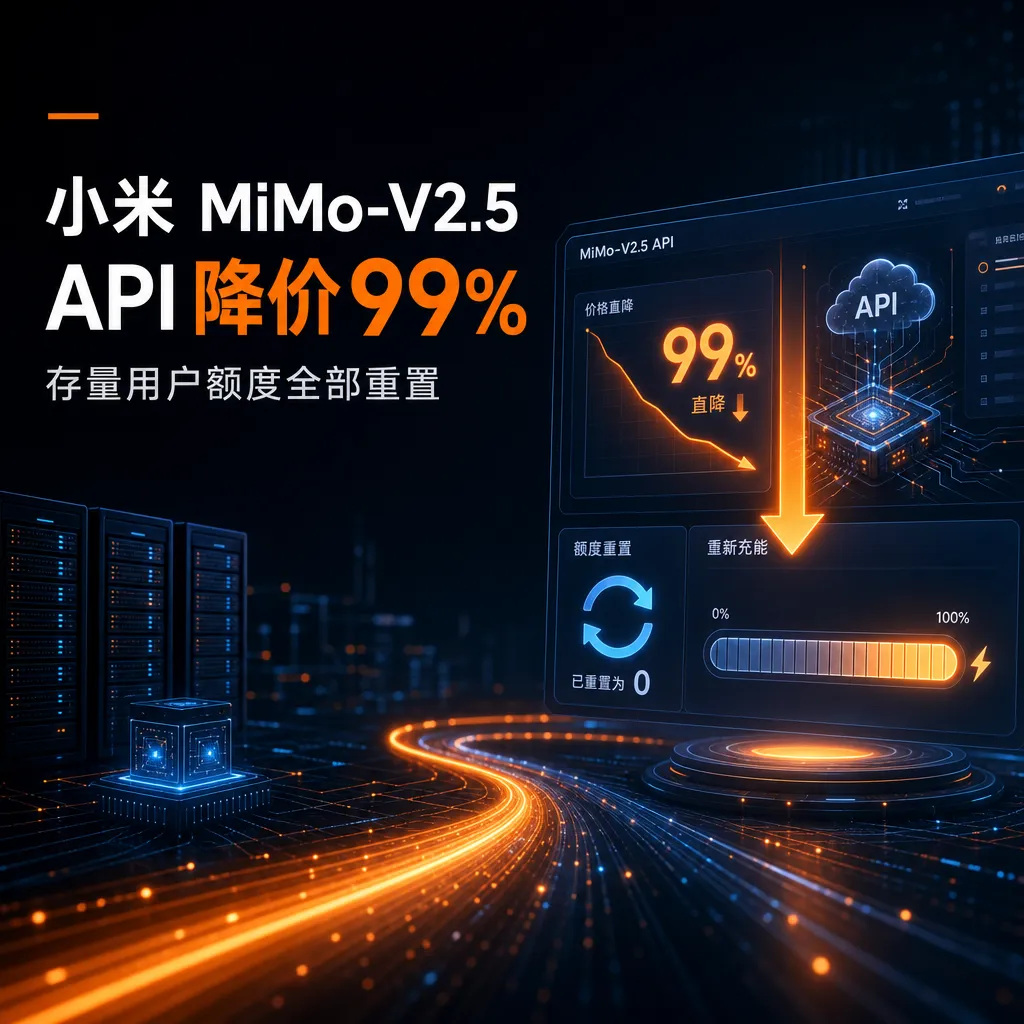
Xiaomi MiMo-V2.5 series API saw a major price adjustment today, with a maximum reduction of 99%. At the same time, all Token Plan users within the validity period have had their quotas reset, with usage capacity increased by 5–8 times.
Xiaomi MiMo-V2.5 API Price Cut 99%, All Existing User Quotas Reset
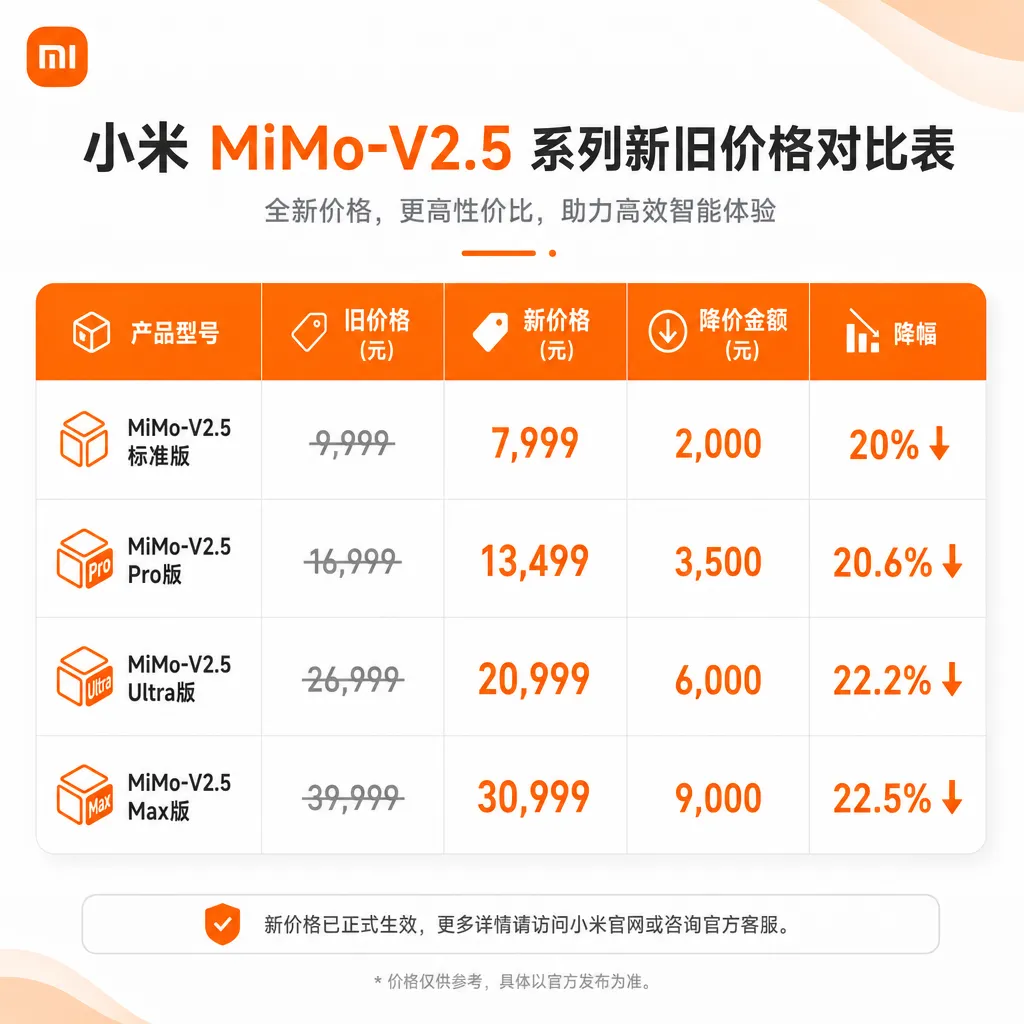
Today, Xiaomi made an aggressive price adjustment to the MiMo-V2.5 series model API. The MiMo-V2.5-Pro input price dropped from ¥300/million tokens to ¥3, a 99% reduction; the MiMo-V2.5 input price dropped from ¥100/million tokens to ¥1, also a 99% reduction. More importantly, Xiaomi simultaneously reset the quotas of all Token Plan users still within their validity period—regardless of how much of the current plan has been used, credits are reset to zero and recalculated, with the validity period unchanged.
Both the scale and pace of this price cut are unusual. The MiMo-V2.5 series was only released this April, positioned by Xiaomi against Claude Opus 4.6 and GPT-5.4 as “born for long, complex Agent tasks” flagship models. The initial pricing strategy was relatively conservative, with the Token Plan charging 1 Token = 4 Credits, also differentiating between 256k and 1M context windows. Many developers complained that the prices were too high at the time, and the cheaper packages did not provide enough tokens.
Now Xiaomi has cut prices to rock bottom and simplified the billing logic: canceling the 4x credit billing, no longer differentiating between context window lengths. MiMo-V2.5 is billed at 1:1 (1 Token = 1 Credit), MiMo-V2.5-Pro at 1:2. Even without considering the price cut, the billing change alone quadruples the actual available quota for users. Combined with the 99% price drop, the number of tokens that can be called for the same money is several dozen times greater than before.
Quota Reset: Direct Benefit to Existing Users
What’s more noteworthy is the quota reset policy. Xiaomi applied it not just to new purchases but to all Token Plans still within their validity period—including packages obtained via the “100 Trillion Token Creator Incentive Plan” and special benefits for the Apache Software Foundation—resetting all credit usage records.
For example: if you bought an annual package in April and have already used 80% of your quota by now, under the new rules, that 80% usage is erased, your package is back to full quota, and due to billing optimization, that “full quota” corresponds to 5–8 times more tokens than when you first bought it. The validity period remains the same and is not shortened due to the reset.
This kind of move is rare among API providers. Typically, price cuts only apply to new purchases; existing users either wait for their packages to expire and renew at the new price, or just accept bad luck. Xiaomi chose to let existing users benefit directly, which from a business perspective is sacrificing short-term revenue to gain user stickiness and goodwill.
The community reacted immediately. On the Linux.do forum, users posted saying “I simply can’t use it all,” and others joked “Xiaomi is handing out freebies.” Judging from the timeline, the news began spreading widely this afternoon, with the official announcement likely made around midday.
Additional Nighttime 20% Discount
On top of the price cut and quota reset, Xiaomi introduced a nighttime discount period: daily from 00:00 – 08:00, the credit consumption rate for all models is further reduced by 20%. This means if you call MiMo-V2.5-Pro during the early hours, the actual consumption is 1 Token = 1.6 Credits, instead of the daytime 2 Credits.
This is clearly designed to guide users toward off-peak usage, reducing inference load during peak hours. For batch processing, data labeling, and offline analysis tasks without high real-time requirements, nighttime offers excellent cost-effectiveness.
Xiaomi also launched continuous monthly and annual subscription modes. Existing users who enable auto-renew get 30% off the next month; new users get 23% off. Annual subscriptions offer 12% off for a one-time payment, saving up to ¥948.96. Combined, if you’re a heavy user choosing annual + nighttime usage, costs can be driven very low.
Actual Capabilities of the MiMo-V2.5 Series
Price aside, the model’s capabilities are key. When MiMo-V2.5 was released in April, Xiaomi positioned it as “comparable to the world’s top Agent models.” Public evaluation data shows MiMo-V2.5-Pro performs well in Agent benchmarks such as Claw-Eval, though still behind Claude Opus 4.6 and GPT-5.4.
One point Xiaomi emphasizes is token efficiency. Official data indicates that at the same Claw-Eval score, MiMo-V2.5-Pro saves 42% tokens compared to Kimi K2.6, and MiMo-V2.5 saves 50% compared to Muse Spark. This advantage is more apparent in long-context, multi-turn dialogue scenarios, especially for cost-sensitive applications.
MiMo-V2.5-Pro supports long tasks with nearly a thousand tool calls, valuable in complex software engineering, data analysis, and automation workflows. Xiaomi’s examples include implementing a full SysY compiler in Rust (completed in 4.3 hours, whereas Peking University undergraduates typically need weeks), developing a video editor web application (8,192 lines of code in 11.5 hours), and designing simulated circuit EDA (tasks that experienced engineers need days for completed in 1 hour).
These examples warrant some skepticism. AI-generated code passing tests is one thing; being production-ready is another. But they do suggest MiMo-V2.5-Pro has some ability to handle long-chain reasoning, tool use, and multi-task collaboration—not just a “PPT model.”
MiMo-V2.5 is full-modal, supporting image, audio, and video inputs. In multimodal evaluations such as VideoMME, CharXiv, MMMU-Pro, its performance is close to or even surpasses Claude Opus 4.6, Gemini 3 Pro, and GPT-5.4. The “close to or surpasses” description is vague, but given MiMo-V2.5’s pricing, if its multimodal capabilities are indeed strong, the value ratio could be competitive.
Half the Open-source Promise Fulfilled
When Xiaomi released the MiMo-V2.5 series in April, it promised global open-sourcing. In early May, MiMo-V2.5-Pro and MiMo-V2.5 were indeed open-sourced, alongside launching the “MiMo Orbit 100 Trillion Token Creator Incentive Plan” distributing 100 trillion free tokens in 30 days.
The open-source versions were adapted to chips from AWS, Alibaba T-head, AMD, Baidu Kunlun, Biren Tech, Moore Threads, TianShu AI, and others, and support the two mainstream inference frameworks SGLang and vLLM. Community feedback suggests deployment and inference experience is acceptable, but the ecosystem still lags behind mature open-source models like Llama and Qwen.
Open-sourcing is a double-edged sword for Xiaomi. On one hand, it rapidly expands the developer ecosystem, attracting more people to build secondary development and applications based on MiMo; on the other, the existence of the open-source version diverts API call volume, especially from cost-sensitive teams with self-hosting capabilities. This massive price cut is partly competing with Xiaomi’s own open-source version—if the API price is low enough, many teams won’t bother with self-deployment.
The Logic Behind This Price Cut
Why did Xiaomi cut prices at this moment? Several possible reasons:
Inference cost reduction. The MiMo-V2.5 series has been out for two months, with ongoing inference optimization, model distillation, and hardware adaptation. If the inference cost has dropped to a new level, cutting prices becomes feasible. Xiaomi has its own chip business, which may give it an advantage in controlling compute costs compared to pure API providers.
User growth bottleneck. MiMo-V2.5 launched with high pricing, and after developers tried it, renewal rates may have been poor. Price cuts are the most direct stimulus, especially combined with quota resets, to quickly activate existing users and attract new ones.
Competitive pressure. Domestic players such as DeepSeek, Kimi, Zhipu, and Moonshot AI are all engaged in price wars, while OpenAI and Anthropic constantly optimize pricing strategies. If Xiaomi doesn’t follow, MiMo risks being marginalized.
Hardware ecosystem preparation. Xiaomi’s ultimate goal isn’t selling APIs, but embedding AI capabilities into phones, cars, and IoT devices to build an “all-scenario AI” across people, cars, and homes. API price cuts rapidly accumulate users and data to feed model iteration, ultimately serving the hardware ecosystem.
From this perspective, Xiaomi’s price cut is not mere price war, but preparation for bigger strategic plans. Once MiMo-V2.5’s API call volume rises and the developer ecosystem grows, AI applications will land more smoothly on Xiaomi devices.
Impact on Developers
For developers already using MiMo API, this adjustment is pure benefit. Costs drop dramatically, available quotas rise significantly, and scenarios previously avoided due to budget constraints can now be run freely.
For developers still on the fence, MiMo-V2.5’s current cost-performance is worth serious consideration. If your application scenario requires Agent capability, long context, and multimodal support, and is cost-sensitive, MiMo-V2.5 could be a good choice—provided you accept a relatively young model ecosystem and possible issues with stability and compatibility.
Xiaomi also teased a “surprise gift” for historical paid users whose Token Plans have expired, to be announced within the next week. Judging from the scale of this adjustment, the “surprise” is likely substantial.
The Endgame of the Price War
This MiMo-V2.5 price cut reinforces a trend: the large model API price war is far from over. From GPT-3.5 to GPT-4, from Claude 2 to Claude 3, from Llama 2 to Llama 3, each generation’s inference cost has fallen rapidly, and prices continue to drop.
This is good for developers but challenging for model providers. In the endgame of the price war, either top players will build moats through scale and technical advantages, squeezing out smaller players, or everyone will be driven to zero profit and shift to vertical scenarios, enterprise services, and hardware integration for new growth.
Xiaomi is choosing the latter. MiMo API is not Xiaomi’s core business but infrastructure serving its hardware ecosystem. As long as the API helps Xiaomi establish itself in the AI era, short-term revenue losses are acceptable.
From this angle, Xiaomi’s price cut is not just a product strategy adjustment, but a bet on future AI ecosystem layout. Whether this bet pays off will depend on MiMo’s iteration speed, ecosystem development, and Xiaomi’s ability to land AI on hardware.
References
- Xiaomi MiMo Crazy Price Cut, Scary Strong - Linux.do - Community discussion on the MiMo-V2.5 price cut
- Xiaomi MiMo price cut leaves quotas impossible to exhaust - Linux.do - User feedback on surplus quota after price cut
- Xiaomi MiMo large model massive price cut, quotas multiplied several times and reset - Linux.do - Explanation of quota reset policy
- Xiaomi Hardcore Token Plan (Nuke) - Linux.do - Token Plan optimization details
- MiMo Token Plan usage reset - Linux.do - User test results of quota changes


