
Starlette exposes severe BadHost vulnerability, millions of AI Agents at risk of attack

The Python Web framework Starlette, with a weekly download volume of 325 million, has been reported to have a severe vulnerability called BadHost, which can lead to remote code execution. Since the framework is widely used for building AI Agent backend services, millions of Agent systems face the risk of being hijacked. Attackers can achieve full control through malicious Host header injection.
Starlette Exposes Critical "BadHost" Vulnerability, Millions of AI Agents Face Attack Risk
A Python web framework with a weekly download volume of 325 million has run into serious trouble.
Security researchers recently discovered a severe vulnerability in Starlette—dubbed "BadHost"—that allows attackers to achieve remote code execution by crafting malicious HTTP Host headers. Even worse, Starlette is one of the most popular backend frameworks in today’s AI Agent development ecosystem—FastAPI is built upon it—meaning that millions of AI Agent systems running in production are exposed to this attack surface.

Essence of the Vulnerability: An Overlooked Detail in the HTTP Protocol
The core of the BadHost vulnerability lies in flawed logic in Starlette’s handling of the HTTP Host header. Normally, web frameworks verify whether the Host header in the request matches the server’s configured domain list, but under certain configurations Starlette skips this verification step and directly uses the Host header value for critical actions like building redirect URLs or generating absolute paths.
An attacker can send a request with a malicious Host header, for example:
GET /api/agent/execute HTTP/1.1
Host: evil.attacker.com
Content-Type: application/json
If the application uses the Host header to generate callback URLs or redirect links, the attacker can lead victims to a malicious server, enabling phishing, session hijacking, or code injection. Even more dangerous, many AI Agent systems dynamically generate API callback addresses when executing tasks; if these addresses are built on unverified Host headers, they become entry points for attacks.
This is not a new attack method—Host header injection was proposed back in 2012—but in the new AI Agent context, its impact is amplified. Traditional web applications have relatively fixed attack surfaces, whereas AI Agent systems often need complex interactions with external APIs, toolchains, and data sources. Every step might be hijacked due to Host header poisoning.
Why AI Agents Are Especially Vulnerable
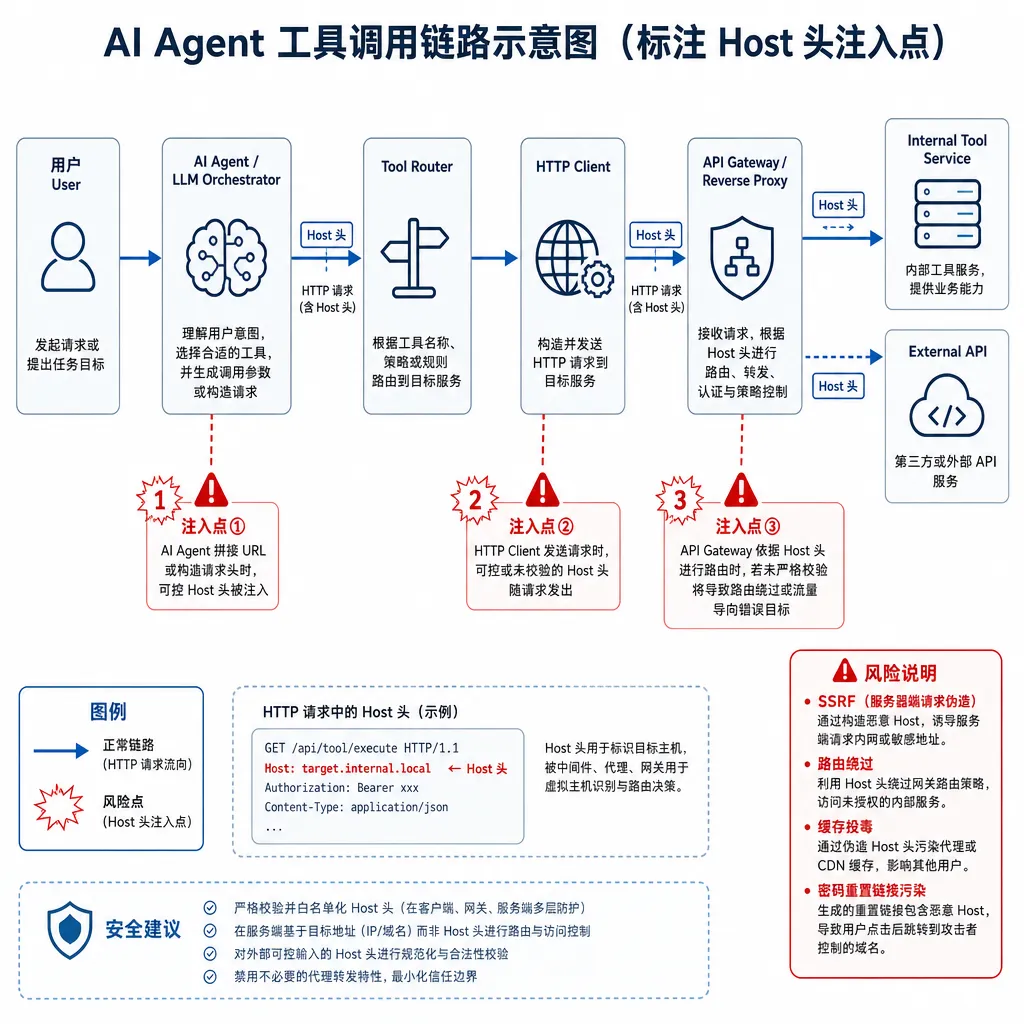
To understand the impact of this vulnerability on AI Agents, we first need to examine the typical architecture of an Agent system.
Most production-grade AI Agents adopt a “large model + tool calls” pattern: the user issues instructions, the Agent uses a large model to understand the intent, then calls various tools (file I/O, database queries, API requests, etc.) to complete the task. These tools are usually exposed as HTTP APIs, and Starlette/FastAPI are the mainstream choices for building such API services.
The problem is, AI Agent tool call chains are often very long. A typical scenario is:
- The user sends a task to the Agent via a web interface
- The Agent calls an internal API to analyze the task
- The API returns a response containing a callback URL
- The Agent performs tool operations, then sends results to the callback URL
- The callback URL triggers the next process
If step 3 generates the callback URL using an unverified Host header, an attacker can redirect the callback to their own server. More insidiously, since Agent systems usually run in intranet environments, developers often consider the Host header trustworthy and fail to implement strict verification.
The Claude Code vulnerability disclosed last year (CVE-2025-55284) was a similar side-channel attack example. Attackers manipulated the Agent’s file reading tool to send sensitive data to external servers. The BadHost vulnerability offers a more direct attack path: no need to lure the Agent into specific actions—just sending a malicious request is enough to hijack the entire callback chain.
Scope of Impact: Not Just FastAPI
Starlette’s weekly download volume reaches 325 million, which alone signals the severity of the problem. But what’s truly worrying is how deeply it has penetrated the AI ecosystem.
FastAPI is the most directly affected. As the most popular API framework in the Python ecosystem, FastAPI is almost the default choice for AI Agent backend development. Official sample code from mainstream Agent frameworks like LangChain, LlamaIndex, and AutoGPT is built on FastAPI. This means large numbers of developers unknowingly bring the vulnerability into production environments.
Enterprise-grade Agent platforms are also vulnerable. Many companies use Starlette to build internal Agent orchestration systems for scenarios like automated operations, data analysis, and customer service. These systems often handle sensitive data; if attackers exploit the BadHost vulnerability, the consequences could be catastrophic.
Open-source Agent projects are likewise at risk. Searching “starlette agent” on GitHub yields thousands of projects, including popular repositories with tens of thousands of stars. Maintainers may not yet grasp the seriousness of the problem, and users are even less prepared.
Across industries, sectors like finance, healthcare, and government—where security requirements are extremely high—are deploying AI Agents on a large scale. If such systems use vulnerable Starlette versions, attackers can exploit BadHost to steal customer data, alter transaction records, or even control critical business processes.
Attack Scenarios: From Information Leakage to Full Control
Specifically, what can attackers do with the BadHost vulnerability?
Scenario 1: Session Hijacking
Many AI Agent systems use URL-based session management. By injecting a malicious Host header, attackers can cause the system to generate session URLs pointing to their own server. When users click these URLs, session tokens leak to the attacker, granting them full user privileges.
Scenario 2: Data Exfiltration
If the Agent system needs to send data to external services during task execution (e.g., calling third-party APIs), attackers can use Host header injection to redirect data to their own server. This is fatal for Agents handling sensitive information—imagine a medical AI Agent analyzing patient records, but sending data to an attacker’s server.
Scenario 3: Code Execution
Most dangerous of all, some Agent systems dynamically load configurations or execute code based on the Host header. Attackers can craft Host headers pointing to malicious configuration files, causing the system to load and execute the attacker’s code. This attack is especially easy to carry out on Agent platforms using dynamic plugin mechanisms.
Scenario 4: Supply Chain Poisoning
If attackers control the backend service of a widely used Agent tool or plugin, they can inject malicious logic into all Agent systems using that tool via the BadHost vulnerability. The impact range of such supply chain attacks can be exponential.
The Defense Dilemma: Fixing Isn’t Just a Version Change
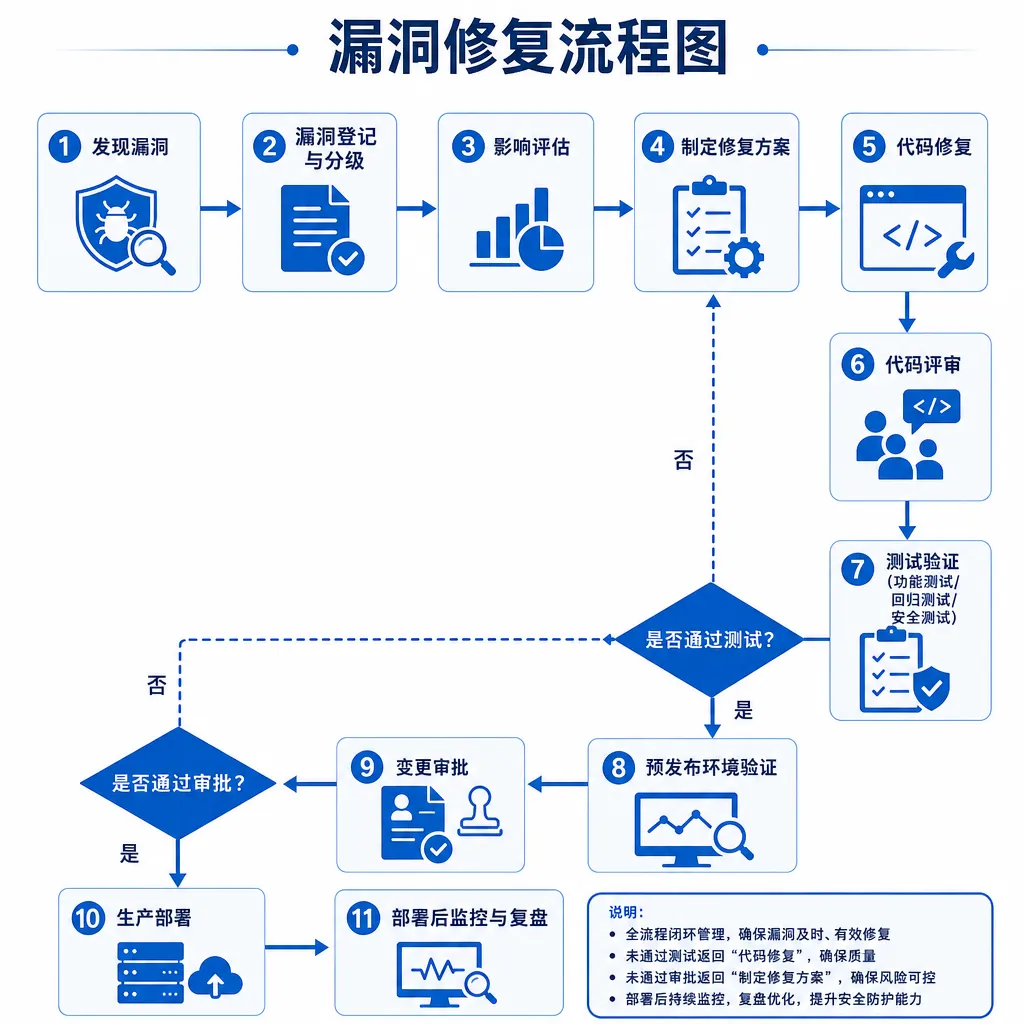
The Starlette team has released a patch, but the problem is far from over.
Firstly, there’s the complexity of dependency chains. Many projects don’t depend on Starlette directly but bring it in indirectly through FastAPI, Uvicorn, etc. Developers may have no idea they are using Starlette, let alone upgrading it promptly.
Secondly, compatibility risks. The patch changes Host header verification logic, which may break code relying on previous behavior. For large Agent systems, upgrading framework versions requires thorough testing, which may take weeks or even months.
More troublesome are configuration issues. Even with a secure version, if developers don’t correctly configure the allowed Host list, the system can still be attacked. Starlette’s default configuration is relatively lax and must be hardened manually.
On a larger scale, the BadHost vulnerability exposes structural flaws in the AI Agent security system. Current Agent development paradigms focus too much on functionality and severely neglect security. Developers are accustomed to rapid iteration and deployment, with security audits often treated as secondary. This “ship first, fix later” culture is amplified in the AI boom.
Industry Reflection: AI Agent Security Must Not Be a Post-Facto Patch
This is not the first security incident for AI Agents, nor will it be the last.
The Doubao Agent incident last December serves as a warning. ByteDance’s Doubao Agent was found to have multiple serious vulnerabilities within 24 hours, including prompt injection, privilege bypass, and data leakage. Post-mortem analysis revealed that these vulnerabilities mainly stemmed from security design flaws in the basic architecture rather than bugs in specific features.
The BadHost vulnerability reaffirms this point: AI Agent security issues are fundamentally software engineering problems. No matter how powerful the large model is, it cannot compensate for vulnerabilities in the underlying framework. When we package AI capabilities into API services, all traditional web security issues reappear, and with Agents’ autonomy and complexity, the harm is often greater.
From a technical perspective, current AI Agent security protection focuses on three main directions:
- Input validation: to prevent prompt injection, malicious commands, etc.
- Permission control: to limit resources and actions the Agent can access/execute
- Output filtering: to avoid leaking sensitive information
But these measures assume the underlying infrastructure is secure. The BadHost vulnerability shatters this assumption. If the HTTP framework itself is vulnerable, no amount of upper-layer defenses will help.
A deeper issue is that AI Agents’ attack surfaces are much more complex than traditional applications. A typical Agent system may include:
- Web frontend (user interaction interface)
- API gateway (request routing and authentication)
- Agent engine (task orchestration and execution)
- Tool set (file ops, database access, external API calls, etc.)
- Large model service (inference and generation)
- Vector database (knowledge retrieval)
- Message queue (asynchronous task processing)
Any layer can have vulnerabilities, and these can form attack chains. The BadHost vulnerability affects the API gateway layer, but attackers can leverage it to penetrate the Agent engine, then control the tool set, ultimately gaining full control of the entire system.
What Developers Should Do
If you are developing or operating an AI Agent system, here are actions to take immediately:
1. Check dependency versions
Run the following command to check the Starlette version:
pip show starlette
If the version is lower than 0.37.2 (assuming this is the patched version), upgrade immediately:
pip install --upgrade starlette
Also check the FastAPI version to ensure it includes the security patch.
2. Configure Host whitelist
Explicitly configure allowed Hosts in Starlette/FastAPI applications:
from starlette.applications import Starlette
from starlette.middleware.trustedhost import TrustedHostMiddleware

app = Starlette()
app.add_middleware(
    TrustedHostMiddleware,
    allowed_hosts=["yourdomain.com", "*.yourdomain.com"]
)
Do not use wildcard ["*"], which is equivalent to no protection.
3. Audit callback URL generation logic
Check all code that generates URLs based on the Host header and ensure it uses hardcoded domain names or trusted values from configuration files, not the request’s Host header directly.
4. Enable request logging
Log Host headers of all HTTP requests for later audit and attack tracing:
from starlette.middleware.base import BaseHTTPMiddleware

class HostLoggingMiddleware(BaseHTTPMiddleware):
    async def dispatch(self, request, call_next):
        logger.info(f"Host: {request.headers.get('host')}")
        response = await call_next(request)
        return response
5. Implement defense-in-depth
Do not rely on a single protective measure. Deploy WAF rules at the network layer to filter abnormal Host headers, perform strict validation at the application layer, and set up alert rules at the monitoring layer.
6. Conduct regular security audits
Integrate dependency security scans into CI/CD processes; use tools like safety and pip-audit to automatically detect known vulnerabilities:
pip install safety
safety check
For critical Agent systems, conduct penetration testing quarterly.
The Bigger Picture: AI Security Needs Systematic Solutions
The BadHost vulnerability is just the tip of the iceberg. As AI Agents are applied deeply across industries, security threats are exhibiting new characteristics.
Qi An Xin’s “Mid-Year 2025 Network Security Vulnerability Threat Landscape Study” report stated that in the first half of this year, 23,351 new vulnerabilities were added worldwide, with high and critical vulnerabilities accounting for 43.5%. Notably, 30.2% of high-risk vulnerabilities were exploited on the day of disclosure, and 83.7% within 21 days. This drastic shortening of the “attack-defense time gap” poses huge challenges for fast-iterating systems like AI Agents.
The report also predicts that in the second half of the year, AI-driven vulnerability discovery will become a major threat. Attackers use large models to analyze open-source code, increasing vulnerability discovery efficiency by 3–5x. This means open-source frameworks like Starlette will face more intensive security scrutiny—from both researchers and attackers.
From a defense perspective, relying solely on manual audits and patching is no longer enough. A panoramic defense system combining “technical defense + management optimization” is needed:
- AI-driven vulnerability scanning: use ML models to automatically identify security risks in code
- Automated response pipelines: automate the entire process from vulnerability discovery to patch deployment
- Red-blue team exercises: regularly simulate real attack scenarios to test defense effectiveness
- Supply chain security management: continuously monitor and assess risks for all dependencies
For the emerging AI Agent field, dedicated security standards and best practices must be established. Currently, the industry lacks a unified Agent security framework, with each team exploring its own approach—resulting in redundant effort and security blind spots.
Some positive signs are appearing. OWASP has initiated a security guideline project for AI Agents, and major cloud providers are launching Agent security solutions. But these efforts are still in early stages, and it will be a long road before a mature security ecosystem takes shape.
Final Words
The exposure of the BadHost vulnerability is a wake-up call for the entire AI Agent industry.
We are at a critical juncture: AI Agents are moving from labs to production environments, from toy projects to critical business systems. In this process, security can no longer be an afterthought—it must be a core design consideration.
For developers, this means changing the “rapid iteration first” mindset and reserving adequate space for security alongside functionality innovation. For enterprises, this means allocating a reasonable security budget in AI investments instead of patching after the fact. For the whole industry, this means building more complete security standards, toolchains, and talent cultivation systems.
The potential of AI Agents is undeniable, but only with a solid security foundation can this potential be truly realized. The BadHost vulnerability reminds us: on the road to AGI, security is not optional—it’s a required question.
References
- Millions of AI agents imperiled by critical vulnerability in open source package - Ars Technica – Original vulnerability report, detailing the technical specifics and scope of impact of BadHost
- “Mid-Year 2025 Vulnerability Landscape Report” – Qi An Xin – Provides authoritative data and trend analysis on global vulnerability threat landscapes in the first half of 2025


