
Opencode Go Launches Qwen3.7-Max: First Time a Closed-Source Model Enters Low-Cost Subscription
The Opencode Go plan now supports Alibaba Cloud's Qwen3.7-Max closed-source model, with a quota slightly higher than GLM-5.1, making it the first non-open-source coding model to be included in this low-cost subscription service.
Opencode Go Launches Qwen3.7-Max: First Closed-Source Model in Low-Cost Subscription
Opencode has just added support for Alibaba Cloud's Qwen3.7-Max model to its Go plan. This marks the first inclusion of a closed-source model since the launch of the Go plan, breaking the previous all open-source model lineup.
The news comes from Opencode’s official Feishu (Lark) group, and the official website has already updated its model list. From the quota configuration, Qwen3.7-Max has slightly more calls than GLM-5.1, but Opencode has yet to disclose the exact pricing strategy or technical details.
Why this update matters
Opencode Go is a low-cost subscription service at $10/month ($5 for the first month), positioned as a “coding model for everyone.” Previously, the Go plan only supported open-source or semi-open-source models such as GLM-5/5.1, Kimi K2.5/K2.6, MiniMax M2.5/M2.7, DeepSeek V4 Pro/Flash, and MiMo-V2.5 series.
Qwen3.7-Max is the flagship closed-source model of Alibaba Cloud’s Qwen series. Its weights are not publicly available for download, and it can only be accessed via API. Such closed-source models usually have higher costs and stricter commercial restrictions, and rarely appear in low-cost subscription services. The fact that Opencode managed to include it in the Go plan suggests they either secured special cooperation terms or found new ways to control costs.
For developers, this means that within a $10/month budget, you can now enjoy both the flexibility of open-source models and the performance ceiling of closed-source models. For teams needing to switch models for different scenarios, this combination greatly boosts practical value.
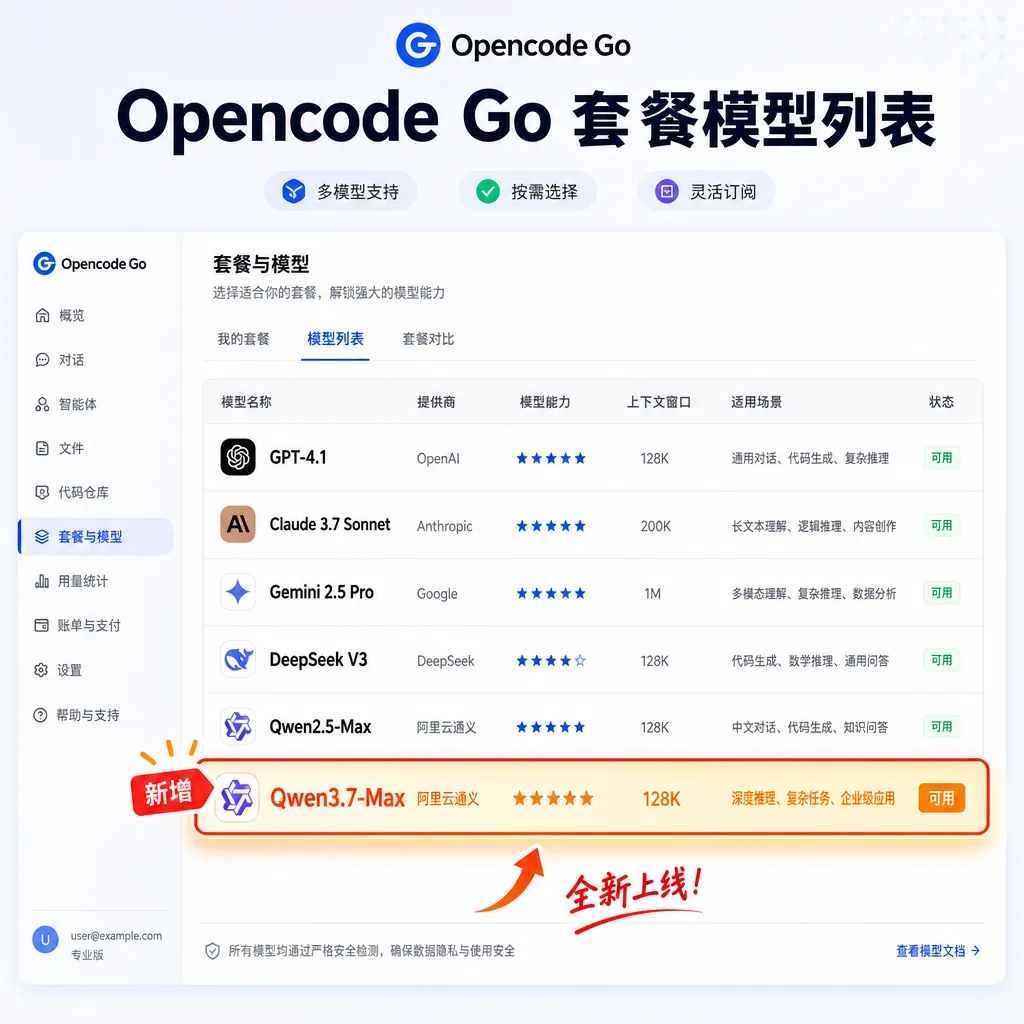
Real-world performance of Qwen3.7-Max
According to Alibaba Cloud, Qwen3.7-Max is positioned as “the most powerful coding model in the Qwen series,” excelling in code generation, multilingual support, and long-context understanding. Based on Alibaba Cloud’s public benchmark data, it performs close to GPT-4 on coding test sets like HumanEval and MBPP, though it still lags in complex reasoning tasks.
Community feedback highlights the following traits of Qwen3.7-Max:
- Fast code completion: Generation latency is 20-30% lower than Claude Sonnet, making it suitable for real-time completion scenarios
- High-quality Chinese code comments: Significantly better understanding of Chinese variable names and comments compared to international models
- Stable API: Alibaba Cloud’s infrastructure ensures high availability with minimal rate limiting or timeouts
- Cost-sensitive: Official API pricing is about 40% cheaper than GPT-4, but 3–5× more expensive than open-source models
However, it has notable shortcomings. In deep reasoning algorithm tasks and system design problems, it falls short of Claude Opus or GPT-4o. And as a closed-source model, it cannot be fine-tuned for specific domains, limiting flexibility.
For Opencode Go users, Qwen3.7-Max is better suited as a primary model for “rapid prototyping” and “daily code completion,” rather than a replacement for Claude or GPT-4 in complex tasks.
The Go plan’s quota system
According to Opencode’s documentation, the Go plan uses a “Big Pickle” points system, with different models consuming different amounts of points. Current known configuration is:
| Model | Small Tasks | Medium Tasks | Large Tasks | |----------------|-------------|--------------|-------------| | GLM-5.1 | 880 | 2,150 | 4,300 | | Kimi K2.6 | 1,290 | 3,230 | 6,450 | | DeepSeek V4 Pro| 10,200 | 25,500 | 51,000 | | MiniMax M2.7 | 3,450 | 8,630 | 17,250 | | Qwen3.6 Plus | 3,400 | 8,500 | 17,000 |
From community discussions, Qwen3.7-Max’s quota is “slightly above GLM-5.1,” estimated between 1,000–1,200 small tasks. This makes sense—closed-source models cost more, so they naturally have smaller quotas, but not so small as to be unusable.
In practice, “small tasks” usually refer to single-file code completion or simple bug fixes; “medium tasks” are multi-file refactors or API designs; “large tasks” are full feature module development. If you mainly use AI for code completion and quick prototypes, Qwen3.7-Max’s quota should last a month. But if you heavily rely on AI for architecture design and complex refactoring, you may run out in a week.
What this means for the Go plan
The Go plan’s original core appeal was “low cost + open-source models,” targeting budget-conscious developers unwilling to pay for Claude Max or Cursor Pro. With Qwen3.7-Max onboard, the plan is shifting toward a “multi-model combination” focus.
Notable implications:
1. Changing cost structure
Closed-source model APIs often cost 3–10× more than open-source ones. To offer Qwen3.7-Max at $10/month, Opencode likely either got a bulk discount from Alibaba Cloud or is limiting quotas to control costs. Judging from the current quotas, the latter is more likely.
This opens the door to possible “tiered quotas” in the future—open-source models with generous usage, closed-source ones with tighter limits. For users, this isn’t necessarily bad—at least it offers choice.
2. Shifting competitive landscape
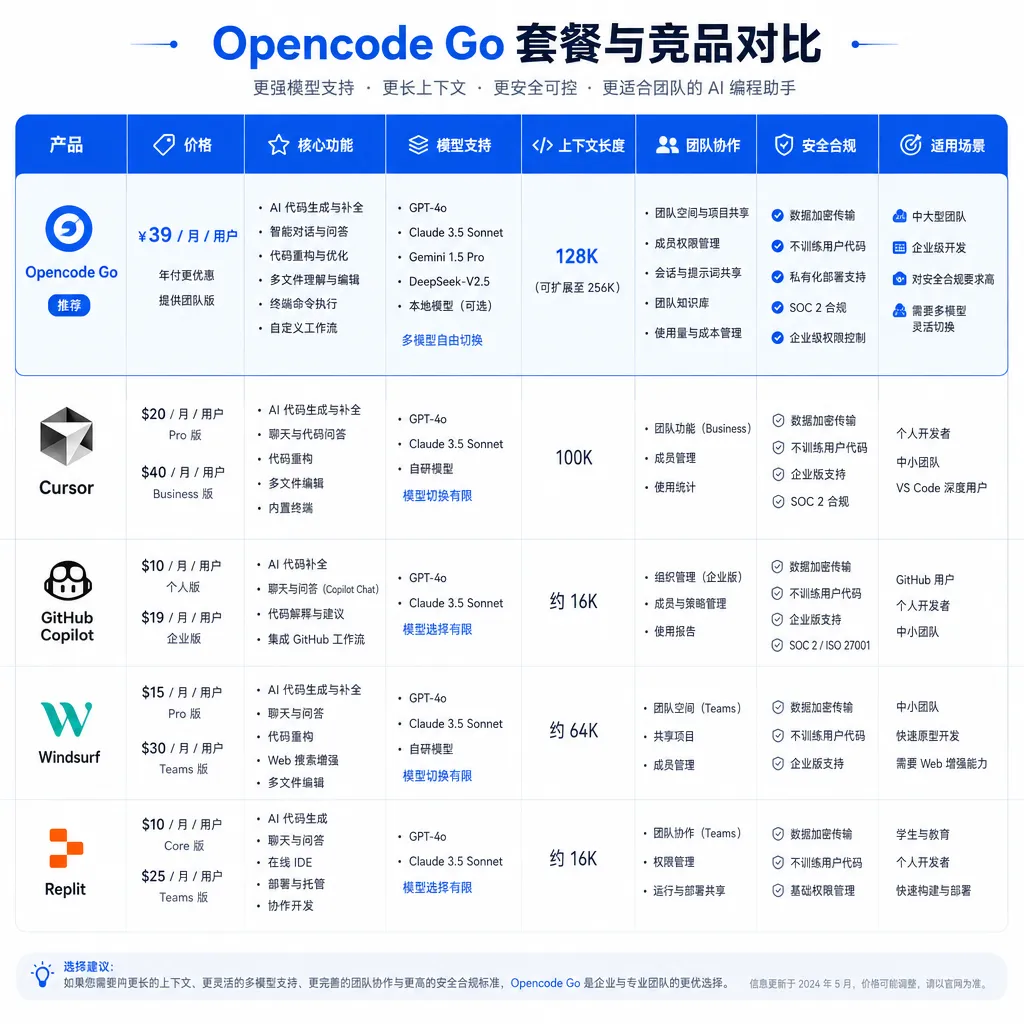
At the $10/month price point, Opencode Go’s main competitors are Alibaba Cloud’s Coding Plan ($5.8/month) and various generic API aggregation services. Alibaba Cloud’s advantage is lower cost and more models, but use is tied to its ecosystem. Generic APIs are flexible, but require you to manage keys and quotas.
With Qwen3.7-Max, Opencode has effectively brought Alibaba Cloud’s core model onto its own platform while keeping cross-platform flexibility. This adds value for existing Opencode users, though it may be less enticing than directly using Alibaba Cloud or generic APIs for others.
3. Increasing model choice complexity
The Go plan now supports 12 models, each with different quotas, performance, and ideal use cases. For beginners, this complexity can be daunting—you need to know which model suits which task to maximize value.
Opencode should improve guidance, such as offering a “task type → recommended model” table, or adding auto-switching based on task type in IDE plugins. Otherwise, most users will stick to the default model, wasting other quotas.
Developer reactions
Discussions on the Linux.do forum show polarized reactions.
Support mainly centers on “finally a closed-source model” and “Qwen3.7-Max’s Chinese capabilities are indeed strong.” Some developers said they previously used the Go plan for its low cost, but open-source models underperformed on complex tasks—Qwen3.7-Max fills that gap.
Criticism focuses on “too few quotas” and “unclear how they got the deal.” One calculation suggests that if the quota is only ~1,000 calls, with each task averaging 3 minutes, that’s just about 50 hours of use a month—insufficient for heavy users.
Some also point out that since Qwen3.7-Max is closed-source, Alibaba Cloud wouldn’t normally give a third party low-cost API access. Opencode may have special ties or use technical optimizations (like batch requests or cache reuse) to lower costs—but has not disclosed details, prompting curiosity.
Impact on other platforms
The addition of a closed-source model to Opencode Go could pressure other low-cost subscriptions.
Cursor Pro ($20/month) supports only GPT-4 and Claude, without Chinese models. If Opencode offers similar closed-source performance for half the price, Cursor may need to drop prices or expand its lineup.
Alibaba Cloud Coding Plan ($5.8/month) is cheaper but limited to Alibaba IDEs and tools—less flexible than Opencode. To stay competitive, Alibaba might open more use cases or cut prices further.
Generic API aggregation services (like OpenAI Hub, API Yi, etc.) focus on pay-as-you-go with no monthly subscription. Opencode Go proves that “low-price subscription + multi-model combo” has market appeal, which could push these platforms to add similar plans for budget developers.
Long-term, AI coding tool competition will center on “cost vs. performance” and “flexibility vs. ease of use.” Opencode Go’s bet is low price and multi-model choice, but whether it can stay profitable and maintain quality remains to be seen.
Should you subscribe to the Go plan?
It’s worth trying if you:
- Are on a budget: Don’t want to pay $20/month for Claude Max or Cursor Pro
- Have multi-scenario needs: Use AI across different IDEs, CLI tools, and custom scripts
- Primarily work on Chinese projects: Qwen3.7-Max and GLM-5.1 are much better at Chinese than international models
- Light to moderate usage: Use AI for coding 1–2 hours a day, not heavily dependent
It’s less suitable if you:
- Are a heavy AI user: Code 4+ hours a day with AI—the quota may not last
- Only use one IDE: If you just use AI in VS Code or JetBrains IDEs, the official plugin might be easier
- Need top performance: For maximum code quality, Claude Opus or GPT-4o are still better
- Need fine-tuning: Closed-source models can’t be customized for specific domains
Also consider “lock-in risk.” Opencode Go is easy to cancel if it doesn’t fit you. But if your workflow deeply depends on a model in the plan and Opencode changes its pricing or drops the model, switching could be costly.
From this perspective, the Go plan is better as a “supplement to your main tool” rather than your sole AI coding tool. You could keep a generic API pay-as-you-go account as backup, or also subscribe to Cursor Pro for heavy-duty tasks.
Final thoughts
Opencode Go adding Qwen3.7-Max is a meaningful experiment in low-cost AI coding subscriptions. It proves the “$10/month + multi-model combo” model is feasible and offers a reference point for other platforms.
But the market is far from mature. Models are iterating fast, costs are falling, and user needs are evolving. Whether Opencode can stay competitive depends on securing attractive model partnerships, optimizing costs, and delivering a good user experience.
For developers, now is a good time—competition is fierce and platforms are trying to entice you with low prices and new features. Test out multiple platforms and find the mix that best fits your workflow—that’s the most practical approach.
References
- Opencode Go Plan Now Supports Qwen3.7-Max - Linux.do - First community report of Qwen3.7-Max joining the Go plan
- Is the OpenCode Go plan worth buying? Real-world comparison - Reddit - Discussion on Go plan model selection and usage experience


